Eyewitness testimony
 Call Kai
 Learn
Learn Practice Test
 Spaced Repetition
 Match
Match Flashcards
 Knowt Play
1/17

There's no tags or description
Looks like no tags are added yet.
Name | Mastery | Learn | Test | Matching | Spaced | Call with Kai |
|---|
No analytics yet
Send a link to your students to track their progress
18 Terms
What is a leading question?
It is a question which, because of a certain way it is phrased suggests a certain answer
What is a study that investigates leading questions?
Loftus and Palmer
Showed 45 students 7 clips of road traffic accidents - lab environment
Pt.1
Asked them the speed of the car- but phrased the question differently to each group - ‘How fast was the cars going when they… 1. Contacted / 2. Hit / 3. Bumped / 4. Collided / 5. Smashed’
‘Contacted’ - 32mph / ‘Smashed’ - 41mph
(IV: the wording of the question) (DV: the estimates of speed given by participants)
Pt.2
Asked them if there were any broken glass - there wasn’t any
‘Did you see any broken glass when the cars… 1. Smashed / 2. Hit’
‘Smashed’ - Yes 32% / ‘Hit’ - Yes 14%
What was Loftus’ later study? Describe it and its findings
Another lab experiment showing clips
Control group - ‘Did you see a broken headlight?’
Experimental group - ‘Did you see the broke headlight?’
Twice as many in the experimental group said tat they have seen broken headlights
Why do leading questions affect EWT?
Response-bias explanation
Suggests that the wording of the question has no real effect on the participants’ answer, BUT influences how they decide to answer it
E.g. when a participant gets a leading question with the word ‘smashed’’, it encourages them to give a higher estimate of the car’s speed
Substitution explanation
Suggests the wording of the leading question actually changes participants’ memory
E.g. participants who originally heard ‘smashed’ later were more likely to report seeing broken glass then those who heard ‘hit’
What is post-event discussion?
PED occurs when there is more than one witness to an event
They may discuss what they have seen with co-witnesses
This may influence the accuracy of each witness’ recall of the event
What do post-event discussion impact EWT?
Source monitoring theory
Memories of the event are genuinely distorted - witness can recall information, but cannot recall where it came from
Source confusion: unsure wether it was from their own memory or did they heard it from someone else
Conformity theory
Memories of the eyewitness are not genuinely distorted - recall changed only because they go along with the accounts of co-witnesses
Could be for social approval (NSI), or they believe that other witnesses are right and they are wrong (ISI)
What is a research that investigated PED?
Gabbert et al. (2003) - participants in pairs
Each participant watched a video of the same crime, but in different POVs
Both participants discussed before individually completing a recall test
71% mistakenly recalled aspects of thee event that they didn’t see in the video, but picked up in discussion
Control group - no discussion - 0% mistakenly recalls
= Evidence of memory conformity
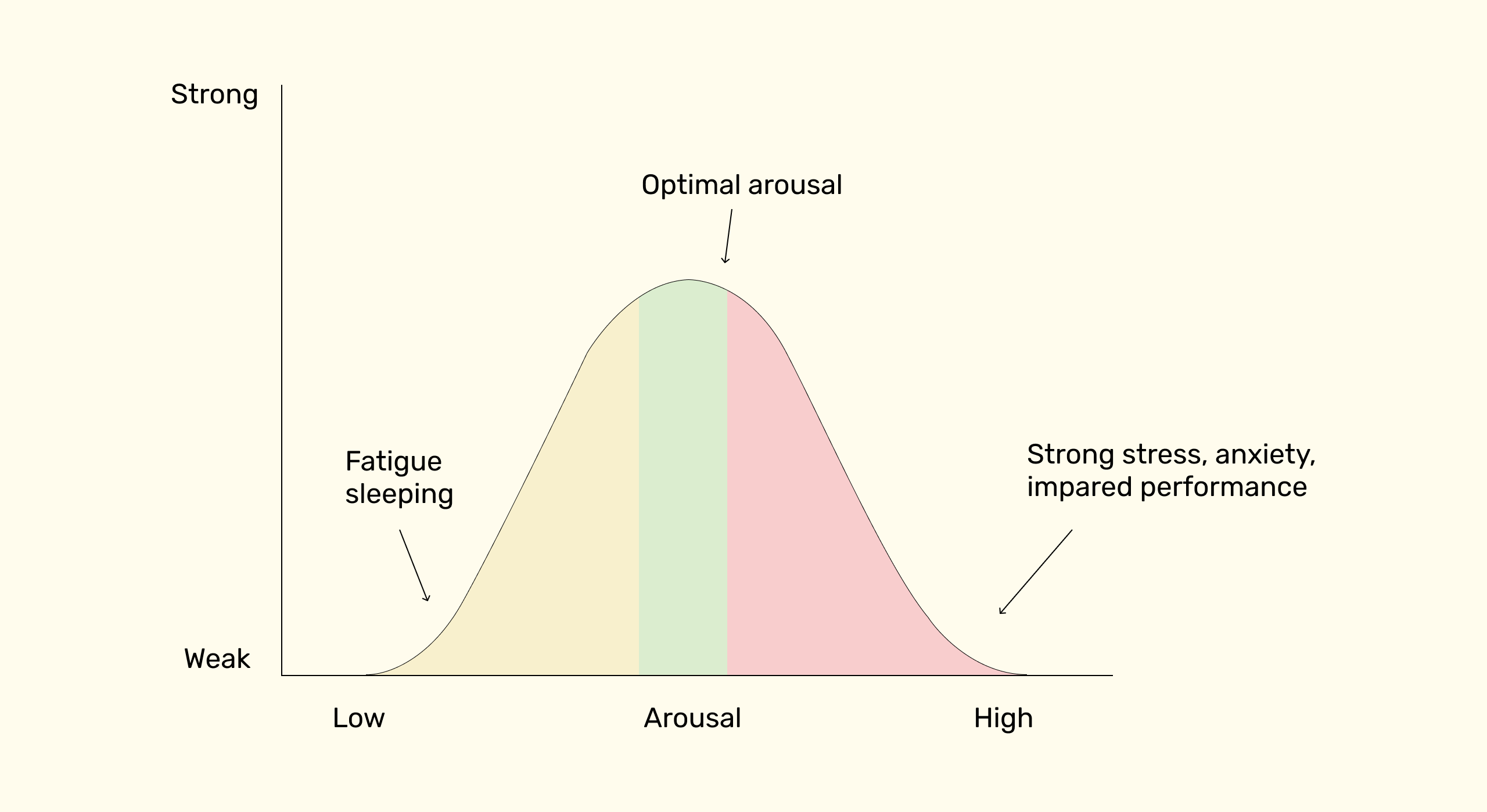
What is the Yerkes-Dodson law?
It explains the effect of anxiety in EWT
We function best when we are at a moderate level of arousal
Moderate level of arousal = optimum level
What are the 4 studies investigating anxiety and EWT?
Johnson and Scott (1976)
Yuille and Cutshall (1986)
Parker et al. (2006)
Valentine and Mesout (2009)
What was the Johnson and Scott (1976) study?
Made participants believe that it was a lab study - then hears argument in the next room
2 conditions:
Low anxiety: man carrying greasy pen
High anxiety: man carrying bloody knife
They then had to pick out the man from a set of 50 photos
Low anxiety: 49% identified him
High anxiety: 33% identified him
= Supports the tunnel theory and weapon focus effect
= Anxiety has a negative effect on recall
What is the tunnel theory?
People have enhanced memory for central events
What was the Yuille and Cutshall (1986) study?
Real life shooting in a gun shop
21 witnesses and 13 took part in the study
Used 7 point scale of stress
Compared to the number of details remembered after 4-5 months
Little change in the amount of accuracy in 5 months - very accurate
Highest level of stress = more accurate
Less accurate about the colour of items etc.
= Anxiety has a positive effect on recall
What was the Parker et al. (2006) study?
Interviewing people who had been affected by the destruction brought by a hurricane in the US in 1992
Defined anxiety in terms of the amount of damage the participants suffered to their homes
There is a link between the level of recall and the amount of anxiety experienced
= Anxiety can have a positive or negative effect on recall
What was the Valentine and Mesout (2009) study?
Real life setting of the Horror Labyrinth at the London Dungeon
Participants given a questionnaire at the end - self reported anxiety
They also wore wireless heart monitors
Asked to describe a person they encountered in the dungeon
2 conditions:
High anxiety: recalled the fewest correct details - 17% correctly identified the actor in a line up
Low anxiety - 75% correctly identifications
= Having higher anxiety makes recall worse
What is cognitive interview?
Geiselman et al. (1984)
Context reinforcement: recall the scene, the weather, what you were thinking and feeling
Report everything: report every detail you can, even if they seem irrelevant
Recall from a changed perspective: describe the event as if it would have been seen from a different viewpoint
Recall in reverse order: describe the event in reverse order
What are the aims of CI?
Improve the effectiveness of interviewers when questioning witnesses
Gain greater quantities of and more accurate information
Apply the results of psychological research which showed that memory is not like a video camera but an active process
Help avoid miscarriages of justice
What are the other elements are enhanced CI?
Fisher et al. (1987) - introduced other elements
No distractions
Active listening
Open questions
No interruption
Use the language of the EW as this is how they have information stored
Explain how CI works
Context reinforcement: recalling how you felt and the context enhances recall (cues) - RF
Report everything: witness might not realise that some detail are important and details could act as cues to help them recall significant information - RF
Recall from a changed perspective: encourages many retrieval paths and prevents access to schemas
Recall in reverse order: when events are recalled in forward order - witness reconstructs based on their schemas, but in reverse order - schemas cannot be assessed, so more accurate