Equilibrium Presentation Questions
 Call Kai
 Learn
Learn Practice Test
 Spaced Repetition
 Match
Match Flashcards
 Knowt Play
1/16

Earn XP
Description and Tags
Possible equilibrium unit test analysis/application questions.
Name | Mastery | Learn | Test | Matching | Spaced | Call with Kai |
|---|
No analytics yet
Send a link to your students to track their progress
17 Terms
State three properties of chemical equilibrium and explain how they can be applied to the bicarbonate buffer system in blood plasma.
Forward and reverse reaction rates are equal. Application: The formation and consumption of carbonic acid and other species occur at equal rates.
Constant concentration of products and reactants in equilibrium. Application: The concentrations of CO2, H2O, and H2CO3 are maintained as a result of forward and reverse reaction rates being equal.
Equilibrium is dynamic. Application: In the bicarbonate buffer system, all species continuously react with each other, even though no macroscopic change is observed.
Explain how the bicarbonate buffer system responds to acidic conditions using equilibrium concepts.
When the blood becomes more acidic, the concentration of H⁺ ions increases.
According to Le Chatelier’s Principle, the equilibrium shifts to the left to reduce this increase.
This causes H⁺ ions to combine with bicarbonate to form carbonic acid, which can then be converted into carbon dioxide and water.
As a result, the concentration of H⁺ decreases, helping restore the pH to normal.
At high altitudes, people can start to feel dizzy. Using equilibrium principles, explain why.
High altitudes, atmospheric pressure is lower, the concentration of oxygen is lower
The decrease in oxygen concentration causes the equilibrium to shift left due to Le Chatelier’s principle
Oxyhemoglobin is decomposed into more hemoglobin and oxygen
Less oxygen binds to hemoglobin when you breathe in, reducing the amount of oxygen delivered to your brain, heart, tissues, etc.
which causes symptoms of dizziness since you do not have as much oxygen to produce atp
These are the equilibrium reactions of oxyhemoglobin and carboxyhemoglobin.
Hb(aq) + 4O2(aq) ⇋ Hb(O2)4(aq)
Hb(aq) + CO(aq) ⇋ HbCO(aq)
Why is the presence of CO in the body dangerous? Reference equilibrium.
CO binds with 200 to 250 times greater affinity to Hb, thus the carboxyhemoglobin reaction is essentially removing Hb from the oxyhemoglobin reaction
Removing reactants from the oxyhemoglobin reaction, so system shifts left to using Hb(O2)4 (oxygen in blood) to replace that hemoglobin
Since Hb(O2)4 is being used to balance the equilibrium, it's not being used to deliver oxygen to run your body.
How does adding hydrogen impact the equilibrium, and the ammonia yield, of a haber-bosch system at equilibrium?
According to Le Chatalier’s principle, a system at equilibrium under stress will change so as to relieve that stress. Thus, adding product (hydrogen) will shift the equilibrium to the right so that the added product is used up. This results in an increase in the production of ammonia, since once the system re-established equilibrium, more nitrogen reacts with hydrogen to synthesize ammonia.
Point 1: Explain what will happen to the equilibrium
Point 2: Explain what will happen to the yield of ammonia
Point 3: Explain why ammonia yield will increase
The following is the chemical equation of the reaction used in the Haber-Bosch process:
N2(g)+ 3H2(g) <-> 2NH3(g) + energy
Explain why a high pressure, and a moderate temperature is used for this reaction.
A high pressure is used to shift the equilibrium to the product side, since due to le Chatelier's principle, the equilibrium will shift to the side with the least amount of mols to lower the pressure. Moderate temperature is used as a compromise between low and high temperatures. A high temperature would increase the rate, while a low temperature would increase the yield of ammonia (since the forward reaction is exothermic). Thus, a moderate temperature is used as a compromise to get the benefits of both.
Point 1: Explain the usage of high pressure
Point 2: State why a moderate temperature was decided
Point 3: Explain why high and low temperatures are beneficial (To support point 2)
The reaction 2 KCl + H₂SO₄ ⇌ K₂SO₄ + 2HCl is carried out in an open vessel. Predict what would happen to the yield of K₂SO₄ if the same reaction were run in a sealed container instead, and explain using Le Chatelier's principle
In an open vessel, HCl gas escapes into the atmosphere, continuously removing a product, so by Le Chatelier's principle the system shifts right, producing more K₂SO₄.
In a sealed container, HCl builds up and increases product concentration, causing the system to shift left by Le Chatelier's principle, meaning less K₂SO₄ is produced.
Therefore a sealed container significantly reduces yield, which is why industry uses open or vented reactors to allow continuous HCl removal.
A chemist proposes removing CaSO₄ from the reactor continuously rather than letting it accumulate. Using equilibrium principles, explain how this would affect the yield of H₃PO₄ and justify your answer.
Continuously removing CaSO₄ decreases the concentration of a product in the equilibrium system.
By Le Chatelier's principle, the system shifts right to oppose this change and restore equilibrium.
More Ca₃(PO₄)₂ and H₂SO₄ are consumed and more H₃PO₄ is produced, resulting in a greater overall yield of phosphoric acid.
A pickling solution becomes less acidic over time due to dilution. Using equilibrium concepts, explain how this change would affect the ionization of acetic acid and the effectiveness of food preservation?
all aqueous species will become more spread out, their concentration will lower. The concentration of acetic acid will decrease
The reaction will shift right to produce more hydronium ion to counteract the decrease of acetic acid
However even though some H3O+ ions were produced, it can’t fully restore the original concentration of H3O+ increasing the pH and reducing the effectiveness of food preservation
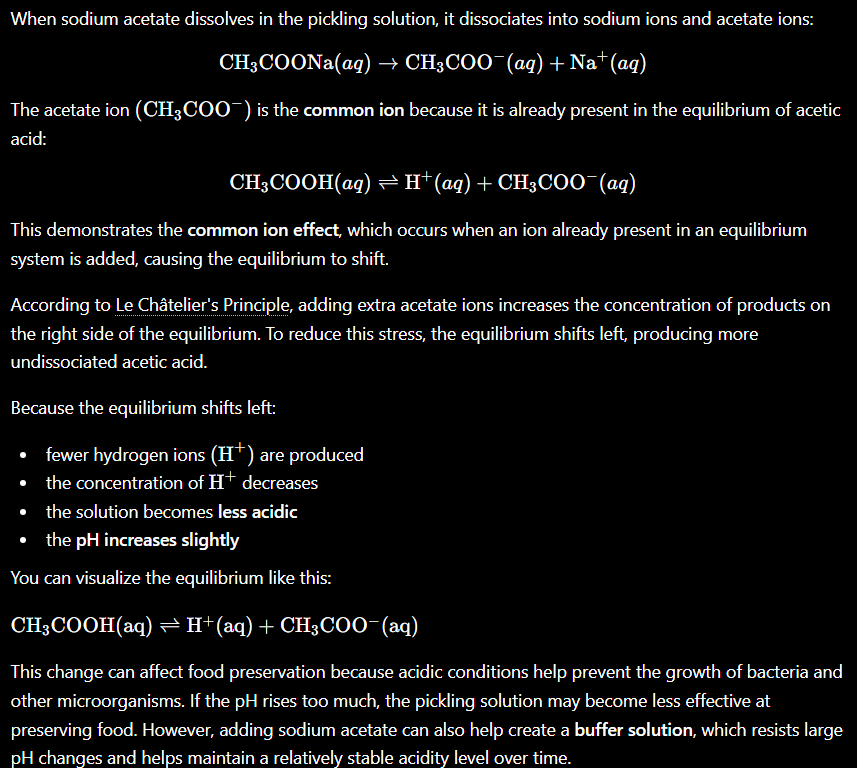
Ver 1: Explain how adding sodium acetate to a pickling solution demonstrates the common ion effect? Using equilibrium concepts, explain the possible changes in pH and its effect on food preservation?
Ver 2: Explain how adding sodium acetate to a pickling solution demonstrates the common ion effect? Using equilibrium concepts, explain the possible changes in pH and its effect on food preservation?
Dissociation of sodium acetate: CH3COONa(aq)→CH3COO−(aq)+Na+(aq)
Sodium acetate will fully dissociate where Na+ will become a spectator ion and acetate, the common ion. The concentration of acetate will increase
The reaction will shift left to produce more acetic acid and reduce the concentration of acetate ions
As a result, the concentration of H30+ will also decrease. This slightly increases pH. the solution becomes less acidic and less effective in preservation
If the equilibrium reaction in the ocean is
CO2(aq) + H2Ol ←—> HCO3-(aq) + H+(aq)
Which direction will the equilibrium shift if NaOH is added to the ocean? Also explain how this will effect the concentration of Co2 and the pH of the water?
Equilibrium will shift towards the HCO3-(aq)+ H+(aq) to eleviate the stress of lower amounts of H+ ions. CO2 concentration decreases and pH increases (slightly)
The Contact Process uses a temperature of ~450°C even though lower temperatures would favour a higher equilibrium yield of SO₃. Using Le Chatelier's Principle and your knowledge of reaction kinetics, explain why 450°C is chosen as the industrial operating temperature. What trade-off is being made?
[1] Le Chatelier — exothermic rxn, lower T shifts right → more SO₃
[1] Kinetics — very low T makes reaction too slow / catalyst inactive below ~400°C Maxwell boltz distribution curve
[1] Trade-off — 450°C balances equilibrium yield AND adequate reaction rate using V₂O₅ catalyst
The Contact Process relies on vanadium pentoxide (V₂O₅) as a catalyst in Step 2. A student claims that adding a catalyst is the best way to increase the yield of SO₃ because it speeds up the reaction. Explain why the student's understanding of catalysts is incorrect in the context of dynamic equilibrium, and describe what effect, if any, a catalyst has on the equilibrium position and the value of Keq.
[1] Catalyst speeds up forward AND reverse equally → equilibrium position unchanged, yield of SO₃ unchanged
[1] Keq unchanged — only temperature affects Keq, not catalysts
[1] Real benefit: V₂O₅ increases reaction rate while at temperature of 450°C — without it, rate too slow to be viable
Explain why high temperature is required for the production of quicklime using Le Chatelier’s principle.
The forward reaction is endothermic (ΔH = + 178kJ/mol), meaning it absorbs heat. According to Le Chatelier’s Principle, increasing the temperature shifts the position of equilibrium to the right to counteract the added heat. This shift favors the formation of more products CaO and CO2, thus increasing the yield of lime.
In industrial kilns, CO2 is constantly removed from the furnace. Why is it vital that CO2 pressure remains 1 atm throughout the calcination process?
The removal of CO2 shifts the reaction in the forward direction to resist stress according to Le Chatelier’s principle. If the pressure of CO2 is less than 1 atm, the Keq value of the equation is less than 1 and moves in the backward direction.
Explain why high pressure increases methanol yield.
The industrial synthesis of methanol from syngas (CO + 2H_2 → CH_3OH$) is a reversible reaction governed by Le Chatelier’s Principle. According to this principle, if a system at equilibrium is subjected to a change in pressure, the system will shift its equilibrium position to counteract that change. In this specific reaction, there are three moles of gaseous reactants (one mole of carbon monoxide and two moles of hydrogen) but only one mole of gaseous product (methanol).
When the pressure is increased, the system is "crowded," and it attempts to reduce the pressure by shifting toward the side with the fewer number of gas molecules. Because the product side has significantly fewer molecules, the equilibrium shifts to the right, favoring the forward reaction. This results in a higher percentage of reactants being converted into methanol, thereby increasing the overall yield. Without high pressure (typically between 50 and 100 atmospheres), the reactants would collide less frequently, and the equilibrium would stay shifted toward the left, making the process economically unviable.
Why is a catalyst used in industrial methanol production?
A catalyst is essential in methanol production because it resolves the conflict between reaction rate and equilibrium yield. Since the formation of methanol is an exothermic process (it releases heat), Le Chatelier’s Principle tells us that high temperatures would actually shift the equilibrium backward, favoring the reactants and lowering the yield. However, at low temperatures, the reactant molecules move too slowly to overcome the activation energy ($E_a$) required for a successful collision.
The catalyst (commonly a mixture of copper, zinc oxide, and alumina) provides an alternative chemical pathway with a much lower activation energy. This allows the $CO$ and $H_2$ molecules to react efficiently even at moderate temperatures. By using a catalyst, the reaction reaches equilibrium much faster without requiring the extreme heat that would otherwise destroy the product yield. In essence, the catalyst allows the industry to run the "slow" exothermic reaction at a speed that is profitable while maintaining a temperature range that keeps the methanol stable.