Unit 7 History Study Guide
 Call Kai
 Learn
Learn Practice Test
 Spaced Repetition
 Match
Match Flashcards
 Knowt Play
1/16

There's no tags or description
Looks like no tags are added yet.
Name | Mastery | Learn | Test | Matching | Spaced | Call with Kai |
|---|
No analytics yet
Send a link to your students to track their progress
17 Terms
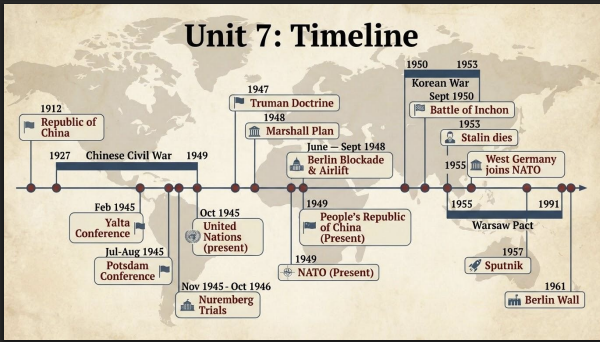
Timeline
Republic of China (1912)
Chinese Civil War (1927 - 1949)
Yalta Conference (February 1945)
Potsdam Conference (July - August 1945)
United Nations (October 1945 - present)
Nuremberg Trials (Nov.1945 - Oct. 1946)
Truman Doctrine (1947)
Marshall Plan 1948
Berlin Blockade & Airlift (June - Sept. 1948)
People’s Republic of China (1949 - Present)
NATO (1949 - Present)
Korean War (1950 - 1953)
Battle of Inchon (Sept. 1950)
Stalin dies (1953)
West Germany joins NATO (1955)
Warsaw Pact (1955 - 1991)
Sputnik (1957)
Berlin Wall (1961)
Timeline (Picture)
Mao Zedong
Mao Zedong was a communist leader
He wrote “Little Red Book” and led the Communists to victory after 20 years
China
1893 - 1976
He is important because with his book, his sayings turned into a book that everyone was required to read at the time
Nikita Kruschev
Leader of Soviet Union
Worked to “de-Stalinize” the Soviet Union and “Peaceful coexistence” with the West, constructed the Berlin Wall, & part of the Cuban Missile Crisis
Kalinovka, Russia
1894 - 1971
He shifted Soviet Policy to a great focus on economics and was part of U-2 Incident 1960
Kim il Sung
Soviet army Captain; known as ‘heroic guerrilla commander.’He was also named Premier of the Democratic People’s Republic of Korea
Rejected Satellite status and embraced Korean nationalism & reforms (KPA) (gender equality, land redistribution, and political education)
North Korea
1912 - 1994
His ultimate goal was to unite Korea
The Marshall Plan
Harry Truman
This plan provided food, machines, and various necessities for countries that were struggling and resisting communism
Primarily in West Germany, the UK, France, etc.
Signed into law on April 3, 1948, and operated on December 1951
To influence new and rebuilding countries to NOT support communism
Chinese Civil War
(Nationalist Party) KMT & (Communist Party of China) CCP
Political split between the KMT & CCP after the collapse of the Qing Dynasty
KMT fled to Taiwan after the violent purge of Communists
1927 - 1949
It establishes People’s Republic of China after the Communists win
The Korean War
Soviets & United States
North Korean troops invade South Korea, causing China, the U.S., and the Soviet Union to enter the war
North and South Korea, divided by the 38th Parallel
1950 - 1953
With this war, Korea is still divided into North (Communist) & South (Democratic) Korea, and the DMZ remains the most heavily armed stretch of land on earth
Space Race
Beginning in WWII, it was a competition between the U.S. & Soviet Union over who was more technologically advanced, which led to massive advancements in rocketry & human spaceflight.
Space Race Outcomes
The outcomes of this were a focus on math & science in schools, founding the STEM education, and schools introduced “tracking” and IQ testing, also with the development of the SAT. It also led to comprehensive high schools and schooling cohesion, believing that students with different aptitudes and interests are better together (a greater sense of democracy)
The United Nations
Formed on October 24, 1945, after 29 nations ratified the Charter. Its four main purposes were to protect human rights, deliver humanitarian aid, support sustainable development, and climate action. It has 5 permanent members & 10 non-permanent members that serve two-year terms.
NATO
Formed in 1949 to protect peace and security in Europe and North America. It was created during the Cold War to prevent the spread of communism and to unite countries on both sides of the Atlantic. NATO members agree that if one country is attacked, all will defend it. Its main role is to safeguard the freedom and security of its member nations.
The Warsaw Pact
A Soviet-led alliance of communist countries in Eastern Europe, formed in 1955 in response to West Germany joining NATO. Its purpose was to strengthen Soviet control over the Eastern Bloc and provide collective defense among member nations. It was based on cooperation and mutual assistance, and it dissolved in 1991 after the collapse of the Soviet Union.
Cultural Revolution (China)
In China was a campaign led by Mao Zedong to strengthen communism. Students were organized into Red Guards, who targeted people seen as anti-communist. Mao’s ideas were spread through the “Little Red Book,” which everyone was expected to study. During this time, teachers and intellectuals were persecuted, cultural artifacts were destroyed, and millions of people died.
Great Leap Forward
A campaign led by Mao Zedong in China to rapidly industrialize and collectivize agriculture. People were forced into communes and told to increase food and steel production. However, poor planning and unrealistic goals led to a massive famine, causing the deaths of tens of millions of people.