Quiz 2: Phylogenetics and Bryophytes : PLANT FINAL
 Call Kai
 Learn
Learn Practice Test
 Spaced Repetition
 Match
Match Flashcards
 Knowt Play
1/26

There's no tags or description
Looks like no tags are added yet.
Name | Mastery | Learn | Test | Matching | Spaced | Call with Kai |
|---|
No analytics yet
Send a link to your students to track their progress
27 Terms
Field of science dealing with description, identification, nomenclature, and classification (DINC)
Taxonomy
Field inclusive of taxonomy establishing evolutionary relationships (phylogeny)
Systematics
Assignment/listing of features or attributes to a taxon
Description
Associating an unknown taxon with a known one
Identification
Select the epithet in Adenostoma fasciculatum Hooke & Arn
a) Adenostoma b) fasciculatum c) Hooke & Arn
fasciculatum
Based on what we know from evolutionary history
Evolutionary history or pattern of descent
Classifications from reflect the pattern of evolution
Phylogenetics
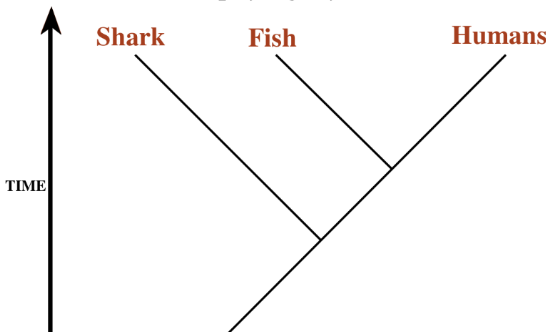
In this phylogeny fish and shark are more closely related than any other combinations.
False
Select all the evidence that explains the spines in euphorbs and cacti is due to convergent evolution:
a) Euphors and cacti are distantly related belonging to two different unrelated families
b) Euphorbs are bryophytes and cacti are monocots
c)Euphorbs and cacti share a most common recent ancestor
d) “spines” of cacti & euphorbs differ in position and development: leaf spines vs. stipular spines
a, d (Euphors and cacti are distantly related belonging to two different unrelated families and “spines” of cacti & euphorbs differ in position and development: leaf spines vs. stipular spines)
Select shared features in green plants also know as Virdiplantae (group including green algae and land plants)
a) chlorophyll b
b) Cuticle
c) Cellulose walls
d) true starch storage compound
e) thaylakoids stacked in Grana
Chlorophyll b; Cellulose walls; true starch storage compound; thaylakoids stacked in Grana
Shared features of land plants also known as Embryophyta.
a) Cuticle
b) Alternation of generations
c) Archegonium
d) Antheridium
e) Flowers
f) Seeds
Cuticle; Alternation of generations; Archegonium; Antheridium
Fusion of similar gametes
Isogamy
Fusion of large immobile egg with motile sperm
Oogamy
Spore
Haploid (n)
Gametophyte
Haploid (n)
Sporophyte
Diploid (2n)
Archegoniophore
Haploid (n)
Gemmae
Haploid (n)
Capsule
Diploid (2n)
Liverworts have stomata
True or False
False
in bryophytes, haploid spores germinate and form a protonema
True or False
True
Archegonium and antheridium are part of the gametophyte (haploid), through mitosis, they form eggs and sperm, respectively
True or False
True
The embryo which results from fusion of the sperm and the egg, is the early stages of the sporophyte
True or False
True
Sperm in bryophytes lack flagella
True or False
False
Explain whether Bryophytes (mosses, liverworts and hornworts) are a monophyletic group and explain the reason.
Bryophytes excludes vascular plants, which makes it a paraphyletic group.
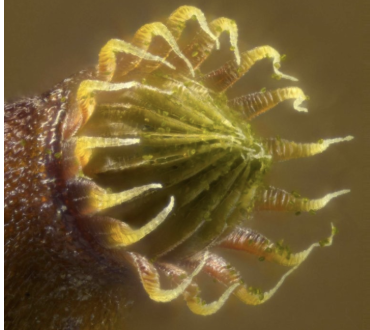
Image shows
a) stipe
b) Peristome teeth and spores
c) operculum
d) gametophyte
Peristome teeth and spores
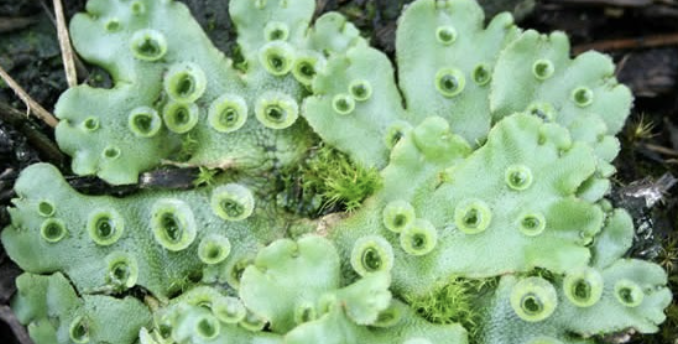
Image shows
a)Liverwort with gemma cups
b) Hornwort with gemma cup
c) Hornwort with antheridiophores
d) Liverwort with antheridiophores
Liverwort gemma cups
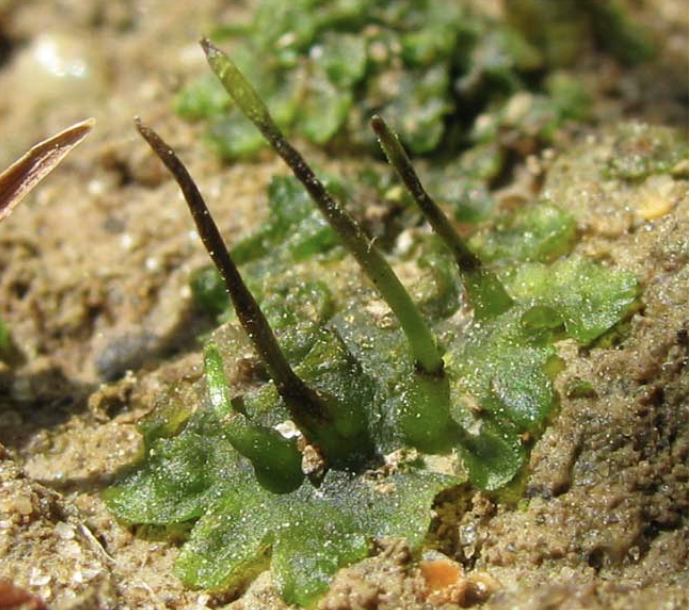
Image shows
a) Tracheophytes
b) Mosses
c) Hornworts (Anthocerotae)
d) Liverworts - Hepaticae
Hornwort