medgen concept assessments
 Call Kai
 Learn
Learn Practice Test
 Spaced Repetition
 Match
Match Flashcards
 Knowt Play
1/248

There's no tags or description
Looks like no tags are added yet.
Name | Mastery | Learn | Test | Matching | Spaced | Call with Kai |
|---|
No analytics yet
Send a link to your students to track their progress
249 Terms
A 4-year-old girl is referred to the genetics clinic to be evaluated because she may have fragile X syndrome. During the appointment, the patient's mother provides information on the family history. Which of the following statements about her daughter's family history is MOST suggestive of fragile X syndrome?
a) "Her father completed the 9th grade and then dropped out."
b) "Her maternal grandmother went through menopause early."
c) "Her maternal uncle has a son with autism."
d) "Her paternal grandfather and his brother have tremors."
b) "Her maternal grandmother went through menopause early."
What is an example of a major anomaly? Select all that apply.
a) 5th finger clinodactyly
b) Ventricular septal defect
c) Bulbous nasal tip
d) Cleft palate
b) Ventricular septal defect
d) Cleft palate
A 50-year-old man has 120 CGG repeats in the FMR1 gene. He is at risk to develop symptoms that could be mistaken for:
a) Parkinson disease
b) Alzheimer disease
c) Huntington disease
d) Frontotemporal dementia
a) Parkinson disease
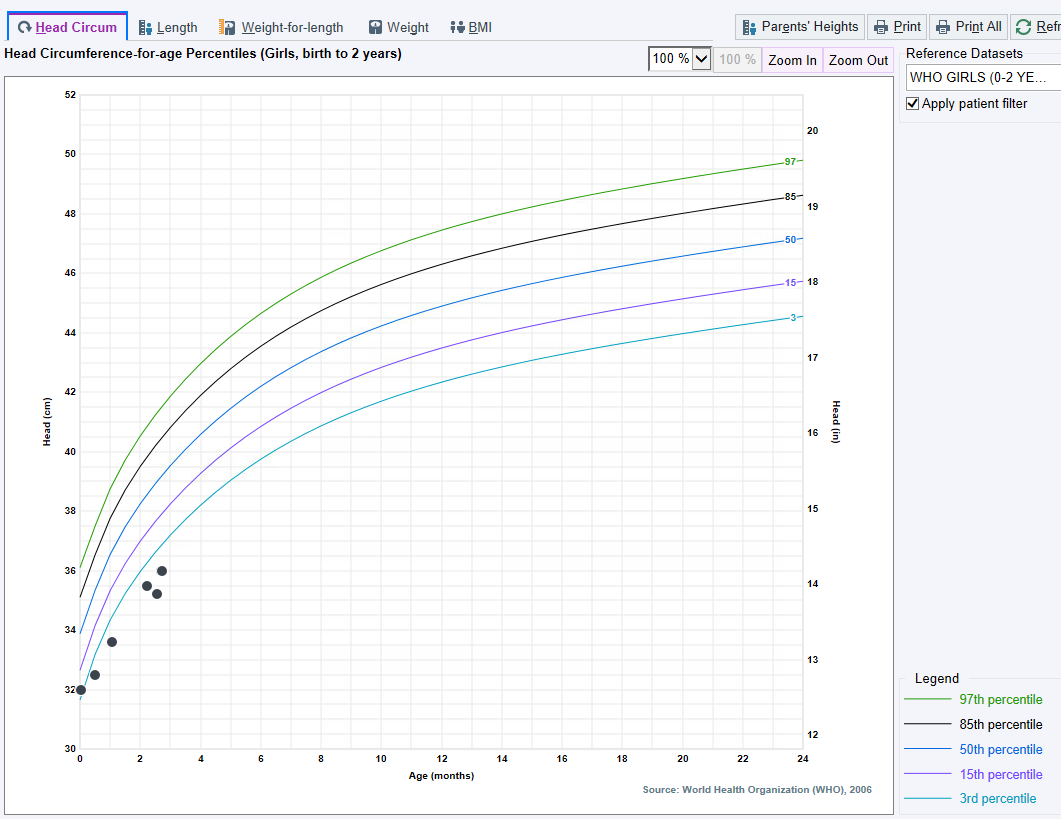
What is the following growth chart showing?
a) Normocehalic head
b) Small body habitu
c) Short stature
d) Microcephalic head
d) Microcephalic head
What is the FIRST test you would recommend for a woman with multiple miscarriages?
a) FMR1 analysis
b) Exome sequencing
c) Chromosomal microarray
d) Karyotype
d) Karyotype
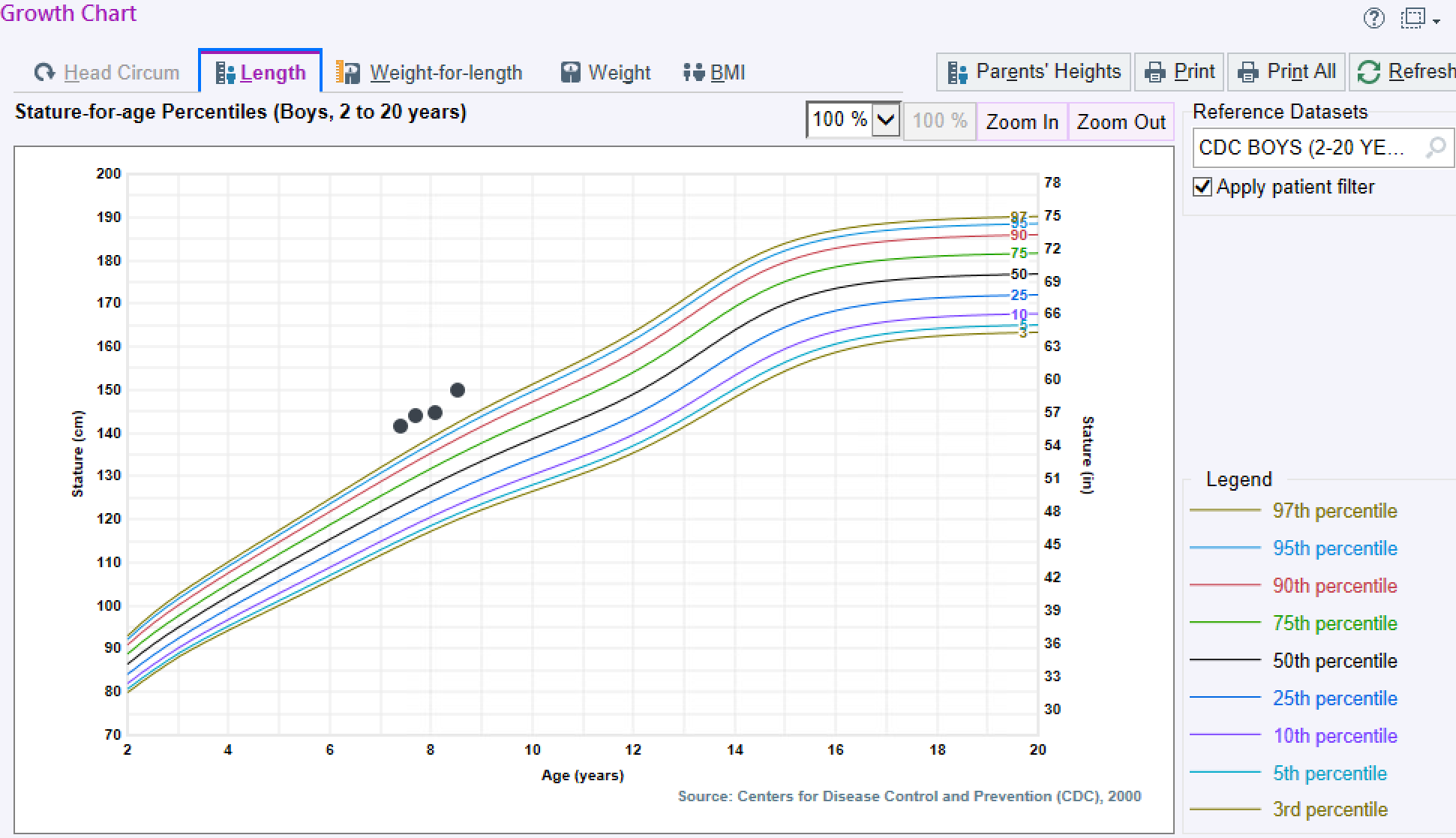
T/F: The following growth chart shows weight >97%ile.The following growth chart shows weight >97%ile.
False
What %ile on a head circumference growth chart is considered macrocephalic?
a) 50-97%ile
b) <3%ile
c) >97%ile
d) 3-50%ile
c) >97%ile
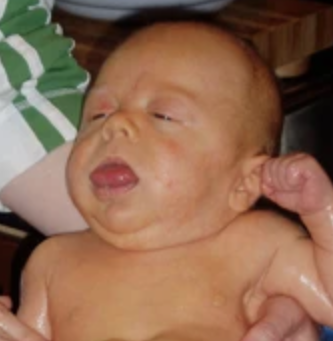
What term would you use to describe this patient's tongue?
a) Macrodontia
b) Malocclusion
c) Macroglossia
d) Microglossia
c) Macroglossia
What is ptosis?
Drooping eyelid
What is hypotelorism?
Decreased distance between eyes
What is hypertelorism?
Increased distance between eyes
What is strabismus?
Misalignment of the eyes
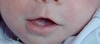
What term best describes this patient's lips?
a) Thick lower lip
b) Thin upper lip
c) Downturned corners of the mouth
d) Thick upper lip
b) Thin upper lip
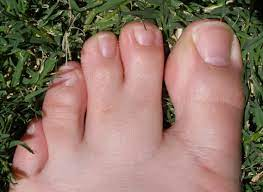
What is the following picture an example of?
a) Minor anomaly
b) Normal variant
c) Major anomaly
b) Normal variant
What type of anomaly is single palmar crease?
Minor anomaly
What type of anomaly is stork bite?
Normal variant
What type of anomaly is spina bifida?
Major anomaly
A 3-year-old male patient is being seen for developmental delay and autism spectrum disorder. What is the first-tier testing that would be recommended?
a) Intellectual disability panel
b) Mitochondrial genome analysis
c) Chromosome microarray
d) Exome sequencing
c) Chromosome microarray
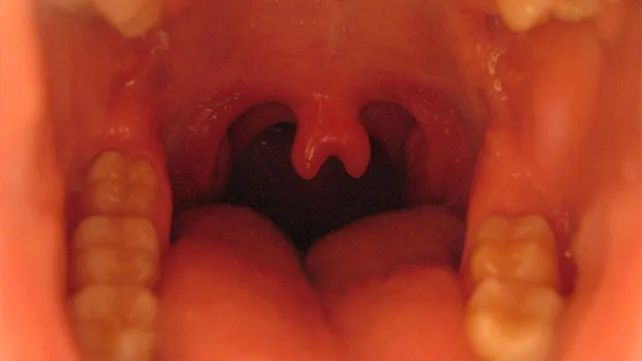
What is the following picture an example of?
a) Bifid uvula
b) Normal uvula
c) Absent uvula
d) Cleft hard palate
a) Bifid uvula
Define normal variant
Features that occur in more than 4% of the population
Define major anomaly
An anomaly that affects a medically important structure
Define minor anomaly
Anomalies that occur in less than 4% of the population and are of no serious consequence
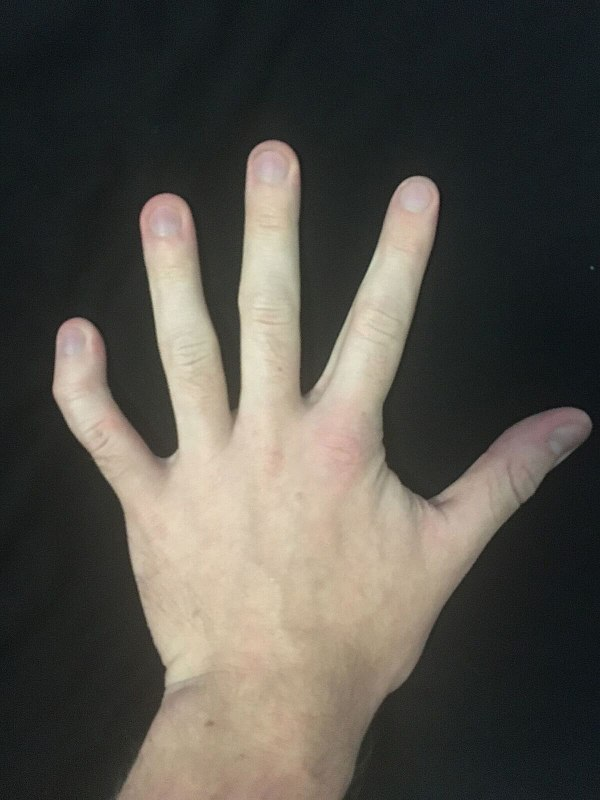
What term best describes the hand anomaly?
a) Postaxial polydactyly
b) 1st finget clinodactyly
c) Preaxial polyfactyly
d) 5th finger clinodactyly
d) 5th finger clinodactyly
What is clinodactyly?
Digit curves to one side
What is polydactyly?
One or more extra digits
What is ectrodactyly?
Split hand/foot malformation
What is syndactyly?
Fused digits
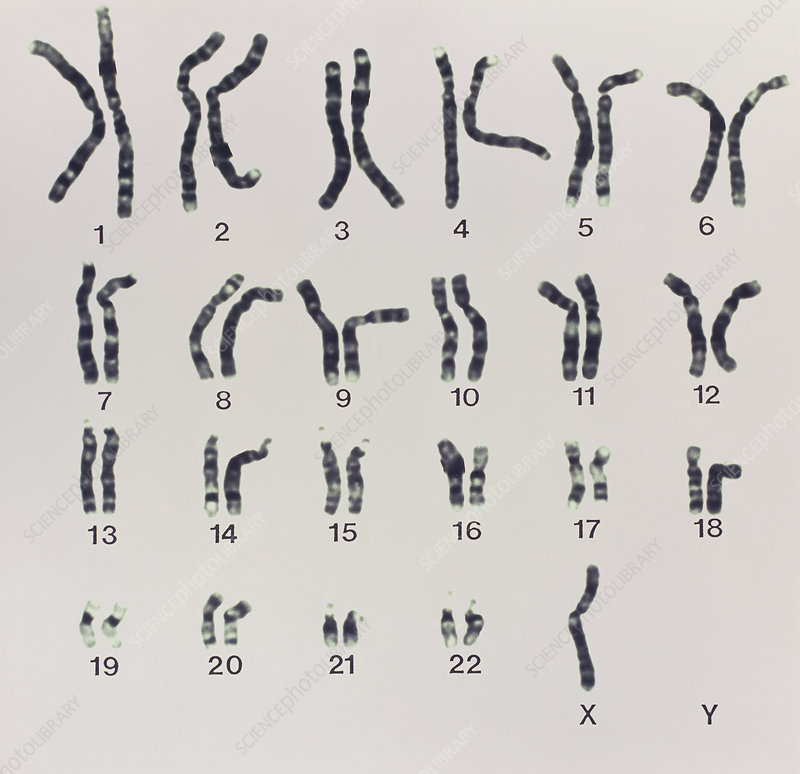
What does the following karyotype show?
a) Patau syndrome
b) Pallister-Killian syndrome
c) Turner syndrome
d) Down syndrome
c) Turner syndrome
What is the microdeletion implicated in DiGeorge syndrome?
a) 22p12.3
b) 22p11.2
c) 22q12.3
d) 22q11.2
d) 22q11.2
Which of the following are the most common cytogenetic abnormalities observed in spontaneously aborted embryos? Select all that apply.
a) Trisomy 21
b) Trisomy 18
c) Trisomy 16
d) Monosomy X
e) Trisomy 13
c) Trisomy 16
d) Monosomy X
Which of the following chromosomal aneuploidy syndromes is associated with polydactyly?
a) Monosomy X
b) Trisomy 21
c) Trisomy 18
d) Trisomy 13
d) Trisomy 13
Which of the following conditions does not display autosomal dominant inheritance?
a) Neurofibromatosis type 1
b) Myotonic dystrophy
c) Achondroplasia
d) Xeroderma pigmentosum
d) Xeroderma pigmentosum
T/F: A consanguineous union involving 2 first cousins is associated with a 10% increased risk of congenital anomalies/recessive conditions above that of the general population.
False
T/F: A marker chromosome identified on karyotype should always be investigated further.
True
You just found out that your baby sister was diagnosed with cystic fibrosis. You're 18 years old and studying genetics and figured out that there is a ______ chance that you’re a carrier of CF.
2/3
Which of the following conditions are or can be inherited in an X-linked manner? Select all that apply.
a) NF1
b) Fragile X syndrome
c) Rett syndrome
d) Hemophilia A
b) Fragile X syndrome
c) Rett syndrome
d) Hemophilia A
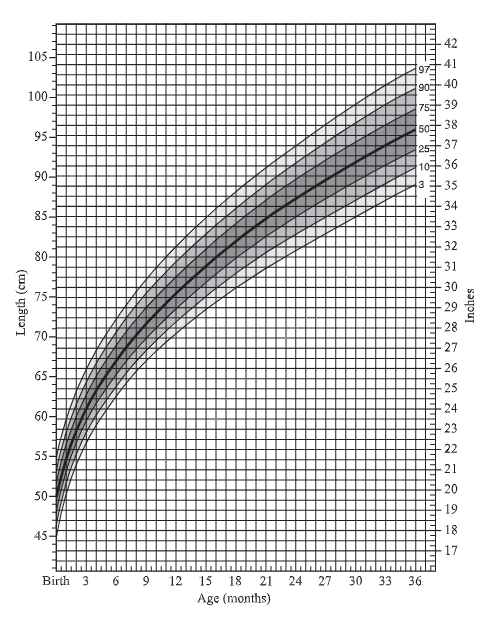
What %ile is a 24-month-old who measures 85cm in length?
a) 75%ile
b) 10%ile
c) 80%ile
d) 25%ile
d) 25%ile
The majority of genetic conditions will manifest during what age range?
a) Prenatal period
b) Post-reproductive period
c) Pediatric period
d) Reproductive period
c) Pediatric period
What is the inheritance of retinitis pigmentosa? Select all that apply.
a) Autosomal dominant
b) X-linked
c) Autosomal reccessive
a) Autosomal dominant
b) X-linked
c) Autosomal reccessive
This disorder that is commonly screened for via genetic carrier screening can also play a role in male infertility as it can cause congenital absence of the vas deferens.
a) Spinal muscular atrophy
b) Cystic fibrosis
c) Galactosemia
d) Pompe disease
b) Cystic fibrosis
Which of the following conditions are caused by repeat expansions? Select all that apply.
a) Myotonic dystrophy, type 2
b) Fragile X syndrome
c) 22q11.2 deletion syndrome
d) MEN2B
a) Myotonic dystrophy, type 2
b) Fragile X syndrome
T/F: A pericentric inversion on chromosome 9 is most likely a variant of no clinical significance.
True
T/F: Down syndrome is the most common chromosome abnormality in liveborn infants. Nearly 95% of cases that are diagnosed prenatally will survive to term.
False
Which of the following is not true regarding HFE-hereditary hemochromatosis?
a) Females may appear to be more severely affected.
b) Is most frequent among individuals of northern European descent
c) A common treatment is blood letting/phlebotomy
d) It is inherited in an autosomal recessive fashion
a) Females may appear to be more severely affected.
Approximately ___% of cases of autism will be caused by an underlying chromosome abnormality that can be detected on microarray.
a) 1%
b) 2-3%
c) 10-20%
d) 5-7%
c) 10-20%
The population incidence of balanced translocations is approximately _______.
a) 1/500
b) 1/250
c) 1/100
d) 1/1000
a) 1/500
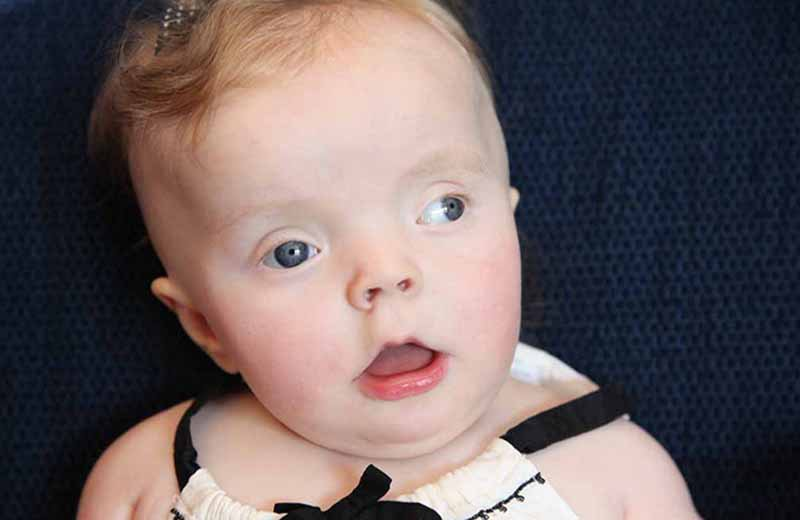
This is a newborn infant with a mosaic form of Pallister-Killian syndrome. What are two dysmorphic features that you recognize?
Thin upper lip
Strabismis
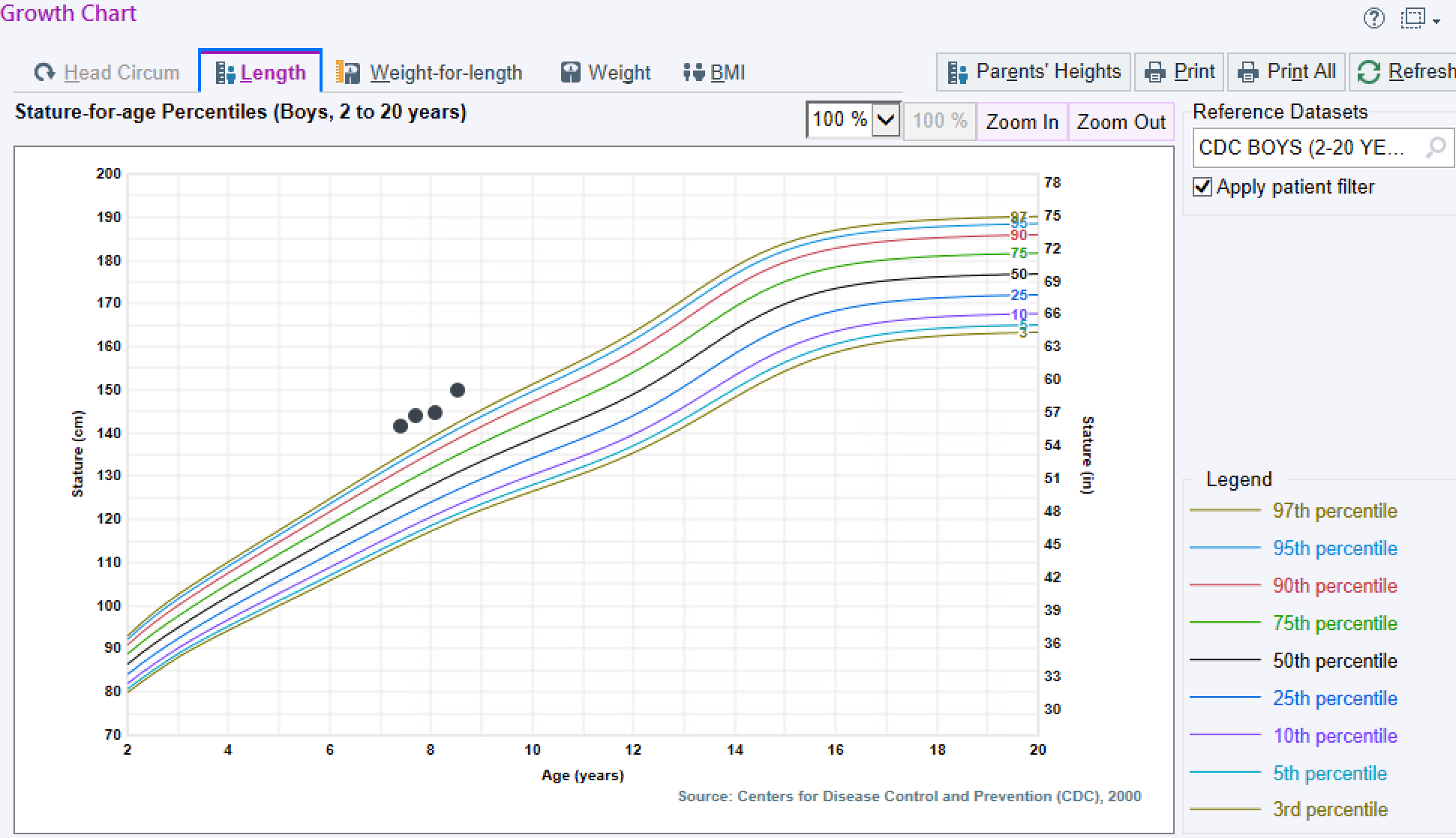
T/F: The following growth chart shows weight >97%ile.
False
What %ile on a head circumference growth chart is considered macrocephalic?
a) 50-77%ile
b) <3%ile
c) >97%ile
d) 3-50%ile
c) >97%ile
What is the inheritance of retinitis pigmentosa? Select all that apply.
a) Autosomal dominant
b) X-linked
c) Autosomal recessive
a) Autosomal dominant
b) X-linked
c) Autosomal recessive
This disorder that is commonly screened for via genetic carrier screening can also play a role in male infertility as it can cause congenital absence of the vas deferens.
a) Spinal muscular atrophy
b) Cystic fibrosis
c) Galactosemia
d) Pompe disease
b) Cystic fibrosis
Which of the following conditions are caused by repeat expansions? Select all that apply.
a) Myotonic dystrophy, type 2
b) Fragile X syndrome
c) 22q11.2 deletion syndrome
d) MEN2B
a) Myotonic dystrophy, type 2
b) Fragile X syndrome
T/F: A pericentric inversion on chromosome 9 is most likely a variant of no clinical significance.
True
T/F: Down syndrome is the most common chromosome abnormality in liveborn infants. Nearly 95% of cases that are diagnosed prenatally will survive to term.
False
Which of the following is not true regarding HFE-hereditary hemochromatosis?
a) Females may appear to be more severely affected.
b) Is most frequent among individuals of northern European descent
c) A common treatment is blood letting/phlebotomy
d) It is inherited in an autosomal recessive fashion
a) Females may appear to be more severely affected.
Approximately _________% of cases of autism will be caused by an underlying chromosome abnormality that can be detected on microarray.
a) 1%
b) 2-3%
c) 10-20%
d) 5-7%
c) 10-20%
The population incidence of balanced translocations is approximately __________.
a) 1/500
b) 1/250
c) 1/100
d) 1/1000
a) 1/500
All of the following are polyglutamine disorders except:
a) Spinocerebellar ataxia
b) Myotonic dystrophy
c) Huntington disease
d) DRPLA
b) Myotonic dystrophy
Which of the following is a hallmark feature of short tandem repeat disorders?
a) Genetic heterogeneity
b) Incomplete penetrance
c) Elevated CK levels
d) Anticipation
d) Anticipation
A patient with progressive muscle weakness, trouble puckering their lips and closing their eyes when they sleep is most likely affected with:
a) Emery dreifuss muscular dystrophy
b) Limb girdle muscular dystrophy
c) Myotonic dystrophy
d) Facioscapulohumeral muscular dystrophy
d) Facioscapulohumeral muscular dystrophy
All of the following conditions can have onset early in life. Which one would have the most severe presentation?
a) Spinal muscular atrophy
b) Fragile X syndrome
c) Friedrich's ataxia
d) Duchenne muscular dystrophy
a) Spinal muscular atrophy
Which of the following conditions are X-linked? Select all that apply.
a) Becker muscular dystrophy
b) Spinal muscular dystrophy
c) DRPLA
d) Rett syndrome
e) Langer-gideon syndrome
f) Fragile X syndrome
a) Becker muscular dystrophy
d) Rett syndrome
f) Fragile X syndrome
A 3-year-old boy is referred to the genetics clinic for evaluation of his autistic-like behaviors and cognitive impairment. The test with the highest diagnostic yield is:
a) Chromosomal microarray
b) FMR1 analysis
c) Mitochondrial sequencing
d) Urine organic acids
a) Chromosomal microarray
All of the following disorders exhibit genetic heterogeneity with the exception of:
a) Limb girdle muscular dystrophy
b) Emery dreifuss muscular dystrophy
c) Charcot marie tooth disease
d) Machado joseph disease
d) Machado joseph disease
You are seeing an adult patient in clinic with a history of muscle weakness and hearing loss. Upon physical examination, the geneticist notes that the patient cannot pucker lips or purse lips together. What testing would you recommend sending first?
a) Neuromuscular panel
b) Exome sequencing
c) Karyotype
d) Fragile X testing
a) Neuromuscular panel
Select the conditions that would exhibit elevated serum creatine kinase levels:
a) Duchenne muscular dystophy
b) Spinobulbar muscular atrophy/Kennedy disease
c) Huntington disease
d) Limb girdle muscular dystrophy
e) Spinocerebellar ataxia
a) Duchenne muscular dystophy
b) Spinobulbar muscular atrophy/Kennedy disease
d) Limb girdle muscular dystrophy
Which of the following is the most common inherited ataxia?
a) Spinocerebellar ataxia type 1
b) Friedreich ataxia
c) Spinobulbar muscular atrophy
d) Fragile X syndrome
b) Friedreich ataxia
T/F: The first symptom in Huntington disease is usually chorea.
False
T/F: The majority of short tandem repeat disorders are hereditary in nature (vs. de novo).
True
T/F: In Fragile X, AGG repeats stabilize the expanded region during transmission for women with intermediate/gray zone alleles.
True
T/F: Spinal muscular atrophy is often screened for on carrier screening panels.
True
T/F: In patients with Charcot-Marie-Tooth type 1A, the initial presentation is typically pain, numbness, and tremors in the hands and upper limbs.
False
T/F: The de novo mutation rate in DMD is about 75%.
False
T/F: The main health concern for female carriers of DMD is cardiomyopathy.
True
T/F: The cause of death in Friedrich's ataxia is typically heart failure.
True
What is the gene for Myotonic dystrophy type 1?
DMPK
What is the gene for Huntington disease?
HTT
What is the gene for Friedrich’s ataxia?
FXN
What is the gene for Charcot-marie-tooth type 1A?
PMP22
What is the gene for Fragile X syndrome?
FMR1
What is the number of CGG repeats of FMR1 for normal alleles?
5-44 repeats
What is the number of CGG repeats of FMR1 for normal alleles?
What is the number of CGG repeats of FMR1 for intermediate alleles?
45-54 repeats
What is the number of CGG repeats of FMR1 for premutation alleles?
55-200 repeats
What is the number of CGG repeats of FMR1 for full mutation alleles?
200+ repeats
Define pes planus
Flat foot
Define pes cavus
High arched foot
Define chorea
Spasmic, involuntary movements of limbs or facial muscles
Define nystagmus
Involuntary movements of the eyes
Define dysarthria
Difficulty speaking
Define dyspnea
Difficulty breathing
Define dysphagia
Difficulty swallowing
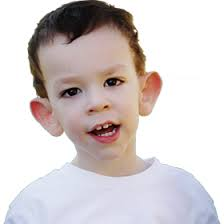
Describe two dysmorphic features of the following patient with Fragile X syndrome.
Prominent ears
Long, narrow face
The microdeletion in DiGeorge/Velocardiofacial syndrome is __________.
22q11.2
Describe 3 clinical features of Duchenne muscular dystrophy that would be noted during a genetics work-up (can be physical exam findings, labwork, etc.)
Mobility, CK levels, scoliosis
Describe 3 clinical features of spinocerebellar ataxias that would be noted during a genetics work-up (can be physical exam findings, labwork, etc.)
Hypotonia, cardiovascular issues, seizures
Describe 2 genetic counseling challenges that may arise during a consult for pre-symptomatic carrier testing for Huntington disease.
1) Reveals if parents/other family members are affected by the disease; some may not be ready to come to terms with this possibility.
2) No standard treatment for this condition, this can alter life planning for most.
What is the most common microdeletion syndrome?
a) Williams syndrome
b) 1p36 deletion syndrome
c) 22q11.2 deletion syndrome
d) Smith-magenis syndrome
c) 22q11.2 deletion syndrome
What is the defining characteristic for Williams syndrome?
“Cocktail party personality”
What is the defining characteristic for Smith-magenis syndrome?
Inverted circadian rhythm of melatonin
What is the defining characteristic for Cri du chat syndrome?
High pitched crying