Membrane Structure and Transport
 Call Kai
 Learn
Learn Practice Test
 Spaced Repetition
 Match
Match Flashcards
 Knowt Play
1/12

There's no tags or description
Looks like no tags are added yet.
Name | Mastery | Learn | Test | Matching | Spaced | Call with Kai |
|---|
No analytics yet
Send a link to your students to track their progress
13 Terms
List and describe the general functions of the membrane.
Component | Function |
|---|---|
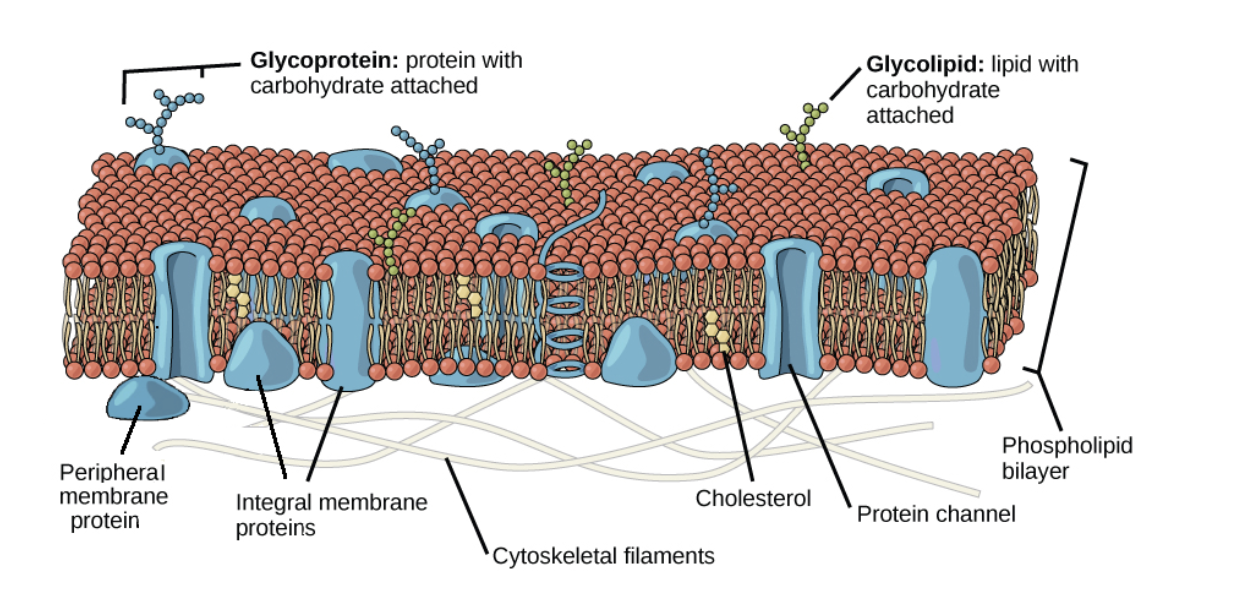
Phospholipid bilayer | Main structure — two layers of phospholipids. Hydrophilic heads face outward, hydrophobic tails face inward |
Embedded proteins | Transport, communication, enzymes, receptors |
Cholesterol | Stabilizes membrane fluidity — keeps it from being too rigid or too fluid |
Carbohydrate chains | Cell identification and communication — like a cell's ID tag |
Key functions of the membrane:
Controls what enters and exits (selective permeability)
Communication with other cells
Structural support
Differentiate between the different types of membrane proteins.
Type | Function |
|---|---|
Transport proteins | Move substances across the membrane |
Receptor proteins | Receive signals from outside the cell (like hormones) |
Enzymatic proteins | Carry out chemical reactions at the membrane |
Cell recognition proteins | Act as ID tags so cells recognize each other |
Cell junction proteins | Connect adjacent cells together |
Two categories based on location:
Integral proteins — embedded directly into the membrane, often spanning the whole bilayer
Peripheral proteins — attached to the surface of the membrane, not embedded
Describe the factors that control membrane fluidity.
1. Temperature
Higher temperature = molecules move faster = membrane more fluid
Lower temperature = molecules slow down = membrane more rigid/solid
2. Cholesterol
Acts as a buffer against temperature extremes
At high temperatures — cholesterol restrains phospholipid movement = prevents membrane from becoming too fluid
At low temperatures — cholesterol prevents phospholipids from packing too tightly = prevents membrane from becoming too rigid
Overall cholesterol stabilizes fluidity
3. Fatty acid composition
Unsaturated fatty acids (kinked) = more fluid membrane
Saturated fatty acids (straight) = less fluid, more rigid membrane
Define selective permeability and identify the types of materials that pass the membrane freely or do not pass freely.
Selective permeability means the membrane only allows certain substances to pass through freely.
Passes freely | Does NOT pass freely |
|---|---|
Small nonpolar molecules (O₂, CO₂) | Large molecules (glucose, proteins) |
Small uncharged molecules (water) | Charged ions (Na⁺, K⁺, Cl⁻) |
Hydrophobic molecules | Hydrophilic molecules |
Why? The membrane's core is hydrophobic (the fatty acid tails). So anything hydrophobic passes easily. Anything hydrophilic or charged needs a protein to help it cross.
Differentiate between active and passive transport in terms of the concentration gradient, energy/ATP required, and need for a specialized protein like a pump, pore, or channel.
Passive Transport | Active Transport | |
|---|---|---|
Energy (ATP) | No | Yes |
Direction | High to low concentration | Low to high concentration |
Proteins needed | Sometimes | Yes always |
Examples | Diffusion, osmosis | Sodium/potassium pump |
Differentiate between simple and facilitated diffusion.
Both are passive (no ATP needed), both go high to low concentration. The difference is whether a protein is needed:
Simple Diffusion | Facilitated Diffusion | |
|---|---|---|
Protein needed | No | Yes |
What crosses | Small nonpolar molecules | Large or charged molecules |
Examples | O₂, CO₂, water | Glucose, ions |
Simple diffusion — molecule passes directly through the phospholipid bilayer on its own
Facilitated diffusion — molecule needs a channel or carrier protein to help it cross but still no ATP required
Define osmosis.
Simple definition:
Osmosis — the diffusion of water across a selectively permeable membrane from an area of high water concentration to low water concentration
Water moves to where there is more solute (dissolved stuff)
No energy required — it's passive
Differentiate between solutions that are hypertonic, hypotonic, and isotonic.
Solution | Solute concentration compared to cell | Water moves | Result |
|---|---|---|---|
Hypertonic | More solute outside than inside | Water leaves cell | Cell shrinks |
Hypotonic | Less solute outside than inside | Water enters cell | Cell swells |
Isotonic | Equal solute inside and outside | No net movement | Cell stays same |
Explain or diagram what happens when you put a red blood cell (animal) or a plant cell in a solution that is hypertonic. Repeat for these cells in a hypotonic solution and isotonic solution.
Solution | Red Blood Cell (Animal) | Plant Cell |
|---|---|---|
Hypertonic | Crenation — cell shrinks and shrivels | Plasmolysis — membrane pulls away from cell wall |
Hypotonic | Lysis — cell swells and bursts | Turgid — cell swells but cell wall prevents bursting |
Isotonic | Normal | Normal |
Differentiate between active transport proteins – uniporter, symporter, and antiporter.
Type | How it works | Example |
|---|---|---|
Uniporter | Moves ONE substance in ONE direction | Glucose transporter |
Symporter | Moves TWO substances in the same direction | Sodium-glucose transporter |
Antiporter | Moves TWO substances in opposite directions | Sodium/potassium pump |
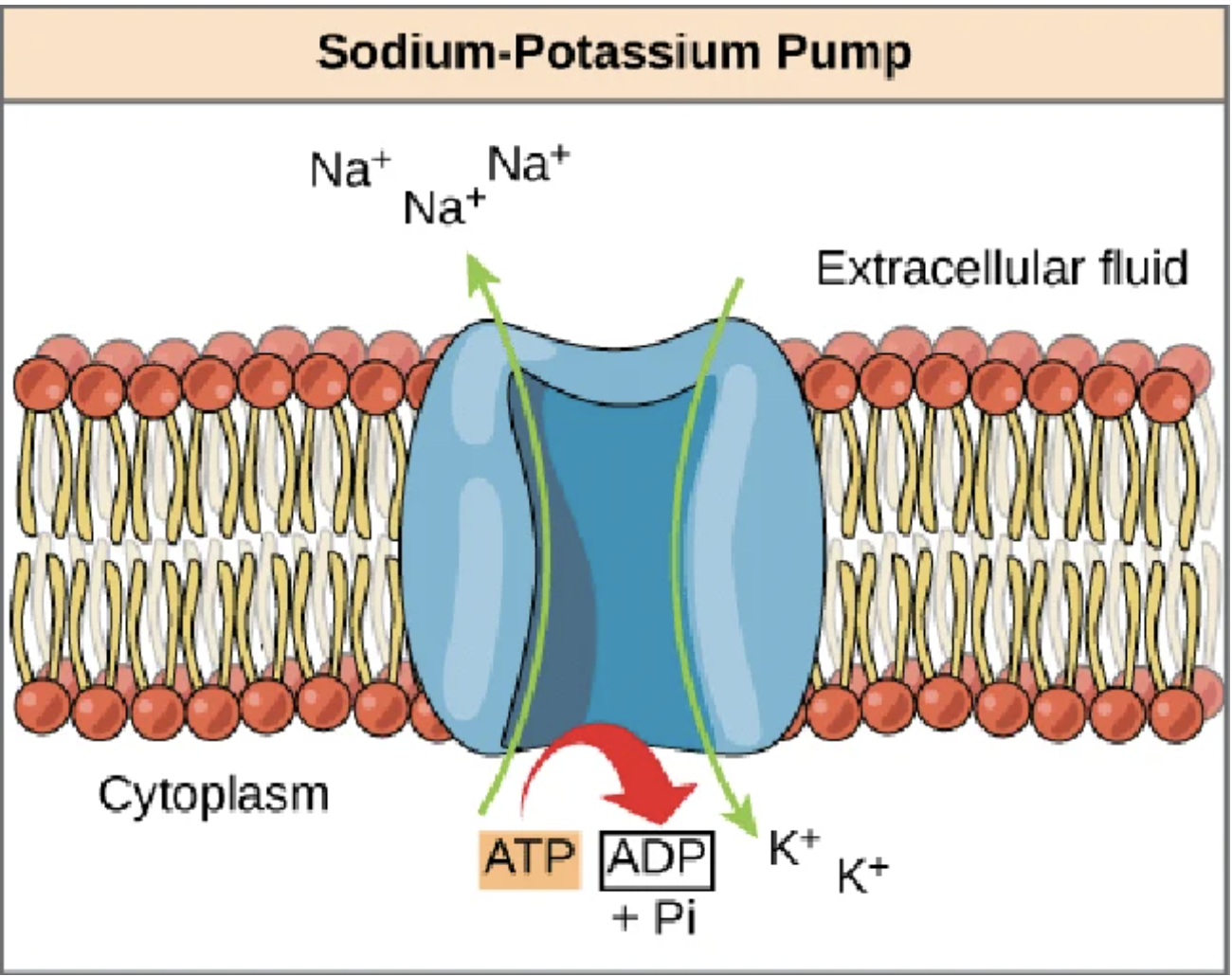
Diagram the sodium/potassium pump.
3 sodium ions (Na⁺) bind inside the cell to the pump
ATP is used to change the pump's shape → 3 Na⁺ pushed outside
2 potassium ions (K⁺) bind outside → pump returns to original shape → 2 K⁺ pulled inside
Sodium (Na⁺) | Potassium (K⁺) | |
|---|---|---|
Direction | Pumped OUT | Pumped IN |
Amount | 3 | 2 |
Differentiate between endocytosis and exocytosis.
Endocytosis | Exocytosis | |
|---|---|---|
Direction | INTO the cell | OUT of the cell |
How | Membrane folds inward, forms vesicle | Vesicle fuses with membrane, releases contents |
Example | Cell engulfing bacteria | Releasing insulin, neurotransmitters |
Differentiate between three types of endocytosis – pinocytosis, phagocytosis, and receptor-mediated endocytosis.
Type | What it takes in | How |
|---|---|---|
Pinocytosis | Fluid and small dissolved molecules | Cell membrane gulps in tiny droplets of extracellular fluid |
Phagocytosis | Large solid particles (bacteria, debris) | Cell wraps around and engulfs the particle — forms a large vesicle called a phagosome |
Receptor-mediated endocytosis | Specific molecules only | Molecules bind to specific receptors on membrane → membrane folds in → very selective |