PHYS2011 - Optics
 Call Kai
 Learn
Learn Practice Test
 Spaced Repetition
 Match
Match Flashcards
 Knowt Play
1/20

Earn XP
Description and Tags
These flashcards cover key concepts found in the PHYS2011 Optics lecture notes, focusing on alternating current, the nature of light, wave propagation, and interference patterns.
Name | Mastery | Learn | Test | Matching | Spaced | Call with Kai |
|---|
No analytics yet
Send a link to your students to track their progress
21 Terms
What does an AC current represent in the context of physics?
It is represented by a sinusoidal wave.
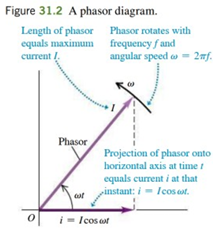
What is a phasor in optics?
A phasor is a geometric identity used to describe physical quantities that vary sinusoidally with time.
What does a phasor diagram look like?
The instantaneous value of a quantity that varies sinusoidally with tie is represented by the projection on to a horizontal axis of a vector o Length = amplitude of the quantity Vector rotates counterclockwise with constant angular speed (ω)
What are differences between Wave model and particle
Propagation - Wave, Emission and absorption - particle
What are lasers?
atoms induced to emit light in coherence, all similar frequency and focused.
What is a wavefront?
The leading edge of a wave. The locus of all adjacent points of equal phase in a travelling wave.
How is reflection defined?
When light strikes a surface, it is reflected and/or refracted.
Define the critical angle in optics.
The angle of incidence for which the angle of refraction is 90 degrees.
What is dispersion in optics?
The dependence of wave speed and index of refraction on wavelength.
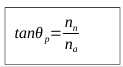
What is the significance of Brewster’s Law?
It relates the polarising angle to the indices of refraction of two media.
What are polarising filters used for?
It permits only waves with certain polarisation direction to pass.
What is a Dichroism
a selective absorption in which one of the polarised components is absorbed far more strongly than the other
How do circular and elliptical polarisation differ?
It results from superposition of two EM waves with a phase difference of 90 degrees.
What is Huygen’s Principle?
Every point of a wave front may be considered the source of secondary wavelets that spread out in all directions with a speed equal to the speed of propagation of the wave. Sum of all wavelets create a wave front.
What is the difference between converging and diverging lens’s?
C- produces an inverted real image on the opposite side of the lens compared to the object. D- produce an upright virtual image on the same side of the lens as the object
What is the principle behind interference in coherent light sources?
Coherence maintains a fixed phase relationship leading to stable interference fringes.
Explain constructive interference.
Constructive interference occurs when waves from two or more sources arrive at a point in phase.
Define intensity in two-source interference.
Max intensity is four times as great as intensity from each individual source.
How does the angle of incidence affect reflection?
The angle of reflection is equal to the angle of incidence.
What is total internal reflection?
Total internal reflection occurs when the angle of incidence exceeds the critical angle.
What factors influence the visibility of interference fringes?
Visibility of fringes depends on the coherence and number of wavelengths involved.