BI101: Final Exam
 Call Kai
 Learn
Learn Practice Test
 Spaced Repetition
 Match
Match Flashcards
 Knowt Play
1/30

There's no tags or description
Looks like no tags are added yet.
Name | Mastery | Learn | Test | Matching | Spaced | Call with Kai | Chat |
|---|
No analytics yet
Send a link to your students to track their progress
31 Terms
![<p><span><strong>[Use the following information when answering all questions on this page]:</strong> The pedigree below is for the earlobe trait (free or attached). Free earlobes are the dominant phenotype, while attached earlobes are the recessive phenotype.</span></p><p></p><p><span>In the space below, provide the genotype for the indicated person (person 1, 8, and 9) by using the letters E and e</span></p>](https://assets.knowt.com/user-attachments/54b886fe-806d-47d8-ae8d-e4acd9f31345.png)
[Use the following information when answering all questions on this page]: The pedigree below is for the earlobe trait (free or attached). Free earlobes are the dominant phenotype, while attached earlobes are the recessive phenotype.
In the space below, provide the genotype for the indicated person (person 1, 8, and 9) by using the letters E and e
Person 1: Ee
Person 2: Ee
Person 3: ee
![<p><strong>[Refer to the Pedigree at the top of the page when answering this question]</strong><span>: There is one person in the pedigree above, where the listed parents are not both their biological parents. Which person is this? Answer the question by indicating the correct person's number below. </span></p>](https://assets.knowt.com/user-attachments/5be4d6ac-ab90-45e4-95f2-5961ae92cb1a.png)
[Refer to the Pedigree at the top of the page when answering this question]: There is one person in the pedigree above, where the listed parents are not both their biological parents. Which person is this? Answer the question by indicating the correct person's number below.
13
![<p><strong>[Refer to the pedigree at the top of the page when answering this question]:</strong><span> Person 1 and 2 have one child whose genotype cannot be confidently determined with the information provided. Which child is uncertain (list their #), and what could their genotypes be? </span></p>](https://assets.knowt.com/user-attachments/0e06a5e9-96cb-4f8f-ac3c-2a33812b9be7.png)
[Refer to the pedigree at the top of the page when answering this question]: Person 1 and 2 have one child whose genotype cannot be confidently determined with the information provided. Which child is uncertain (list their #), and what could their genotypes be?
Uncertain Person: 5
Possible Genotypes: Ee or EE
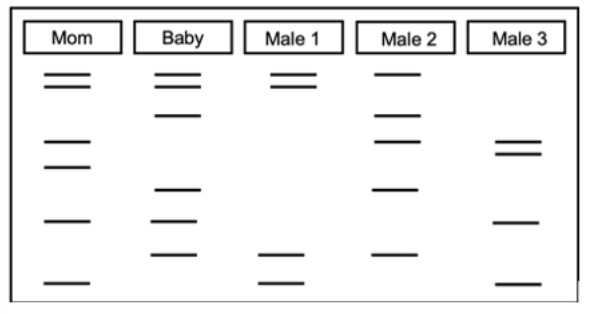
Which of the following males in the gel electrophoresis below (if any) is the father of the pictured child? How can you tell?
Male 2; his banding pattern matches the baby's banding pattern in every location where the baby and mother do not match
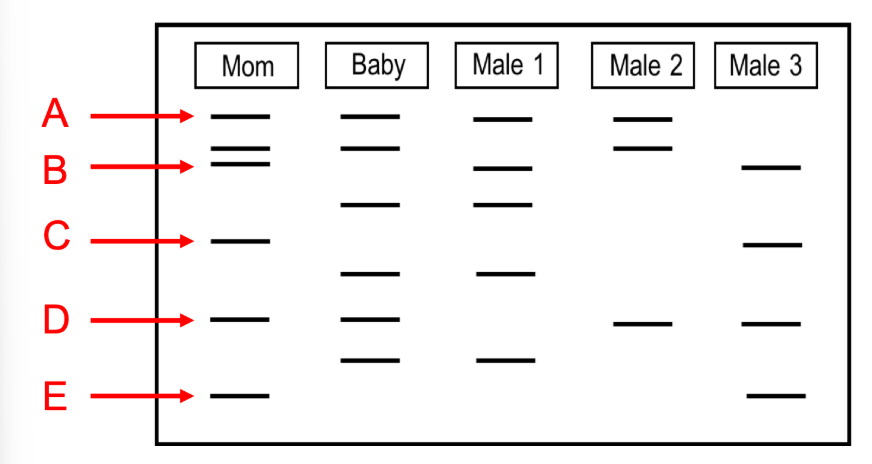
Which of the following labeled bands in the mother's DNA has the fewest number of base pairs (i.e. fewest number of nitrogenous bases) and is therefore the shortest DNA fragment?
E
Phospholipid bilayers generally restrict the movement of DNA across the membrane. With that being said, describe the two actions we took to allow the DNA to get into the bacteria, and explain why these actions helped the DNA cross the membrane barrier.
Action 1: Heat shocked
Why action 1 helped: This made the phospholipid bilayer more fluid, providing "holes" for the DNA to travel through.
Action 2: Added CaCl2
Why action 2 helped: The calcium ions from the calcium chloride bound to the negatively charged DNA, neutralizing it and thus making it easier to cross the membrane. Remember, things that are neutral can cross the membrane with more ease than things that are charged.
T/F: During the experiment, there was a jar containing just the isolated plasmids (i.e. plasmids in solution, not inside of bacteria) engineered to have the GFR protein (glowing gene). If you were to shine a UV light on these plasmids, they would glow.
False
In order for an allele to increase in frequency due to natural selection, it has to lead to an increase in biological fitness. What is biological fitness? What would indicate an organism has a high biological fitness? In our natural selection simulation, how did we ensure biological fitness was correlated with foraging success?
What is biological fitness (i.e. what would indicate an organism has a high biological fitness)?
Biological fitness is the ability to reproduce. Producing a higher number of offspring would be considered having a high biological fitness
In our natural selection simulation, how did we ensure biological fitness was correlated with foraging success?
By how many seeds were collected (how many offspring you produced)
Did the addition of arabinose affect the e.coli's ability to grow? If so, how and why?
Did the addition of arabinose affect the e.coli's ability to glow? If so, how and why?
Did the addition of arabinose affect the e.coli's ability to grow? If so, how and why?
No. The presence or absence of arabinose had no effect on the growth of the e.coli.
Did the addition of arabinose affect the e.coli's ability to glow? If so, how and why?
Yes. The arabinose caused the regulatory protein to be removed from the promoter, allowing RNA polymerase to attach and transcribe the pGlo gene.
People often say that taking antibiotics cause bacteria to develop antibiotic resistance. Is this statement correct? Explain why or why not.
No, this statement is not correct. Resistance is initially introduced via a random mutation that is not contingent on whether someone is actually taking an antibiotic.
Vaccines are considered the most effective way to prevent viral outbreaks. Answer the following questions, given your understanding of vaccines.
-What are vaccines? (i.e. what is actually administered in a vaccine?)
-How do vaccines help prevent viral infections?
-What are vaccines? (i.e. what is actually administered in a vaccine?)
Vaccines are either some part of a virus (generally its genetic material), a dead or weakened virus, or a toxin produced by the virus.
-How to vaccines help prevent viral infections?
They trick your body into thinking you are sick (i.e. experiencing the primary infection). In response, your body produces B & T cells, some of which remain as memory cells. The memory cells allow your body to have a faster response time for secondary infections, leading to few or no symptoms.
The word herd immunity has been talked about a lot in connection to the Covid-19 response. Specifically, we are striving to implement herd immunity. Answer the following questions in regard to your understanding of herd immunity. Please list your answers in the order of the questions below:
-Describe two ways herd immunity could be reached
-Describe how herd immunity protects susceptible parties (i.e. people not immune to the virus)
-Describe two ways herd immunity could be reached
1. A large proportion of people get sick and then recover
2. A large proportion of people get vaccinated
-Describe how herd immunity protects susceptible parties (i.e. people not immune to the virus)
It reduces the likelihood of an unvaccinated person coming into contact with someone who is sick and contagious. Since vaccinated people are unlikely to transmit the virus, having only vaccinated people in your immediate social circle greatly decreases the chance you will become sick, even if you yourself cannot be vaccinated.
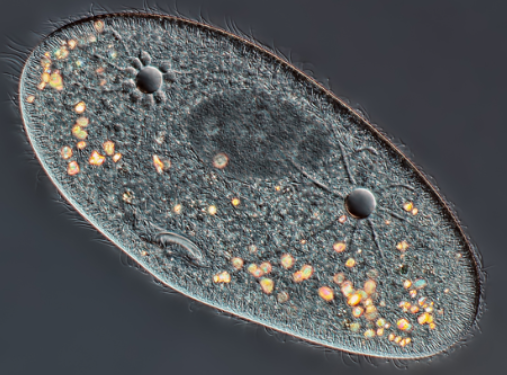
What is the name of the locomotive appendage used by this protist?
Cilia
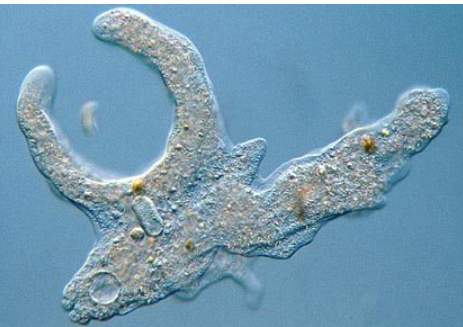
What is the name of the locomotive appendage used by the protist pictured below?
Pseudopod
Why is it important to finish your entire antibiotic prescription, even if you start to feel better?
Bacteria that randomly acquired resistant alleles will most likely be what is present right up until the end of the prescription, meaning the frequency of resistance would be higher in the remaining population
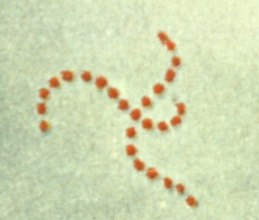
Based on shape, what is the most likely name for the bacteria pictured below?
Streptococcus
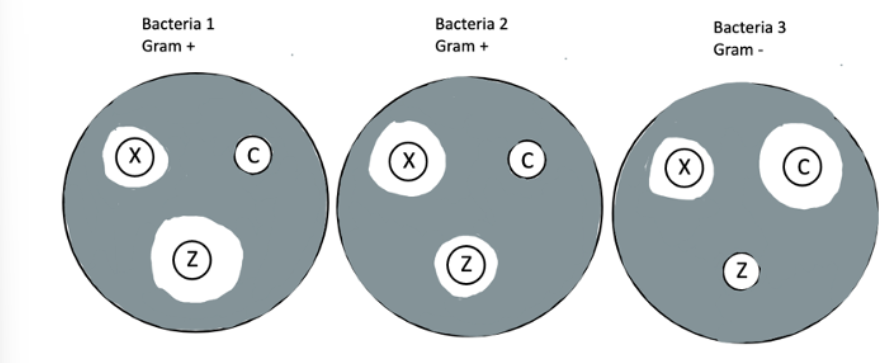
After reading the following scenario, and examining the accompanying image, match the correct antibiotic on the right, with the correct statement on the left. Some options may be used more than once, or not at all.
Suppose a hospital wanted to know the effectiveness of three antibiotics (Z, X, & C) on three different species of bacteria (Bacteria 1, Bacteria 2, and Bacteria 3). To determine the effectiveness, the hospital prepared the following three Kirby Bauer plates. In the diagram, white circles represent antibiotic discs (Z, X, or C respectively), while gray shading is used to indicate areas where bacteria has grown.
— If a patient has an infection caused by bacteria 3, this would be the least effective medication to prescribe
— Narrow Spectrum antibiotic
— Broad spectrum antibiotic
— For bacteria 1, the antibiotic that has the largest zone of inhibition
1. | Antibiotic C |
2. | Antibiotic X |
3. | Antibiotic Z |
4. | Both Antibiotic C and Antibiotic Z |
5. | Both Antibiotic C and Antibiotic X |
3
4
2
3
Once antibiotic resistance is present in a population, which mechanism is the driving force for increasing the frequency of the resistant allele in the population?
Natural selection

Spirochete

Vibrio

Spirillum

Bacillus

Coccus
Know what a Kirby Bauer test is used for, how it is prepared, and how to interpret the results
Method used to determine how sensitive or resistant a specific bacterium is to various antibiotics. The diameter of the zone indicates whether it’s susceptible or resistant
Explain what antibiotic resistance is, how it is introduced into a population, how it gets propagated in populations, and why this can happen relatively quickly in bacteria
Antibiotic resistance occurs when bacteria adapts in ways that reduce the effectiveness of antibiotics.
Explain how a gel electrophoresis separates DNA as well as applications for this technology
we apply an electric current, which makes one side of the gel negative and the other positive, causing the negatively charged DNA to migrate towards the positive electrode
Be able to describe the general steps needed to genetically modify an organism
Isolate the gene, modify the gene, insert the gene into the target organisms
E. Coli and other bacterium are ideal subjects to genetically modify. What characteristics of bacteria make them ideal subjects?
Bacteria grow rapidly, so you can see the results somewhat quicker than if it were something multicellular. And because it’s a single cell, it makes it easier to get a copy of the instructions into that one cell
What is the purpose of adding ampicillin to one of the plates?
To make sure that only the bacteria that took up the gene can grow, and the other ones do not.
What is the role of the Arabinose in this experiment?
To turn the gene on, allowing for the gene to be expressed
CaCI2 is present in one of the solutions given to you. What is the purpose of this substance in this experiment?
The CaCl2 is going to break apart into calcium ions and into chloride ions. The calcium is going to cover up the negatives from the DNA to neutralize the molecule, this will make it easier for it to move through that pore.