Psych 001 Final Content
 Call Kai
 Learn
Learn Practice Test
 Spaced Repetition
 Match
Match Flashcards
 Knowt Play
1/183

There's no tags or description
Looks like no tags are added yet.
Name | Mastery | Learn | Test | Matching | Spaced | Call with Kai |
|---|
No analytics yet
Send a link to your students to track their progress
184 Terms
Intelligence
ability to learn from experience, solve problems, and use knowledge to adapt to new situations
general intelligence (g)
an intelligence factor that, according to Spearman and others, underlies specific mental abilities and is therefore measured by every task on an intelligence test
Thurstone Test of Mental Alertness
Four Job-Related Tasks assessed: Adjusting to new situations, learning new skills quickly, understanding complex or subtle relationships, thinking flexibly.
Thurstone primary mental abilities
7 clusters of primary mental abilities: word fluency, verbal comprehension, spatial ability, perceptual speed, numerical ability, inductive reasoning, and memory
Those who excelled in one of the 7 clusters generally scored well on the others
fluid intelligence (Gf)
our ability to reason speedily and abstractly; tends to decrease with age, esp during late adulthood
Ex: solving novel logic problems
crystallized intelligence (Gc)
our accumulate knowledge and verbal skills; tends to increase with age
Ex: vocab and analogies tests
Cattell-Horn-Carroll (CHC) theory
theory that our intelligence is based on general intelligence (g) as well as specific abilities, bridged by fluid intelligence (Gf) and crystallized intelligence (Gc).
Savant Syndrome
condition in which a person otherwise limited in mental ability has an exceptional specific skill, such as in computation or drawing
Sternberg's Three Intelligences
Analytical (academic problem solving) intelligence -> Well refined problems having a single right answer
Creative intelligence
Practical intelligence -> Every day test
Emotional Intelligence
ability to perceive, understand, manage and use emotions
Perceiving Emotions
recognizing them in faces, music and stories and identifying our own emotions
Understanding Emotions
predicting them and how they change and blend
Managing Emotions
knowing how to express them in varied situations
Using emotions
to facilitate adaptive or creative thinking
Intelligence Test
method for assessing an individual's mental aptitudes and comparing them with those of others, using numerical scores
Achievement Test
a test designed to assess what a person has learned
Ex: final exam
Aptitude Test
test designed to predict a person's future performance
Ex: entrance exam to predict ability to do in college; SAT
Mental Age
measure of intelligence test performance devised by Binet; the level of performance typically associated with children of a certain chronological age. Thus, a child who does as well as an average 8yo is said to have a mental age of 8
Stanford-Binet IQ Test
widely used US revision of Binet's original intelligence test
IQ
defined originally as the ratio of mental age (ma) to chronological age (ca) multiplied by 100. On contemporary intelligence tests, the average performance for a given age is assigned a score of 100
IQ = ma/ca * 100
Works well for kids but not adults
Wechsler Adult Intelligence Scale (WAIS)
this and its companion versions for children are the most widely used intelligence test; they contain verbal and performance (nonverbal) subtests
15 subtests:
Similarities
Vocab
Block design
Letter number sequence
Standardization
defining uniform testing procedures and meaningful scores by comparison with the performance of a pretested group
Flynn effect
Flynn observed that the average person's intelligence test score rose 3 points per decade
Low extreme: intellectual developmental disorder
Test score <70
High extreme:
IQ >135
Reliability
extent to which a test yields consistent results, as assessed by the consistency of scores on 2 halves of the test, on alternative forms of the test, or on retesting
Ex: researchers test people many times
Ex: measuring peoples height
Validity
extent to which a test measures/predicts what it is supposed to
Predictive Validity
success with which a test predicts the behavior it is designed to predict; it is assessed by computing the correlation between test scores and the criterion behavior
Ex: intelligence test
Cohort
group of people sharing a common characteristic, such as being from a given time period
Heritability
proportion of variation among individuals in a group that we can attribute to genes
Never applies to an individual, only to why people in a group diff from one another
H = genes/(genes + environment)
NOTE: as environment variation increases, heritability decreases
Finger number: H is low
Remember: "due to genetics" DOES NOT EQUAL genetically determined
Growth Mindset
focus on learning and growing rather than viewing abilities as fixed
Stereotype
self-confirming concern that one will be evaluated based on a negative stereotype
Can an invalid test be reliable?
Yes: can measure wrong thing repeatedly
Can an unreliable test be valid?
No: measure something
68-95-99.7 rule for normal distribution
68% will fall within 1SD
95% will fall within 2SD
99.7% will fall within 3SD
So if get 200 (3s.d.s below the mean), only 0.15% (0.3/2) are worse!
HALF ARE ABOVE HALF ARE BELOW
Expectancy effects: Rosenthal & Jacobson (1966)
Pygmalion effect
psychological phenomenon where high expectations from others lead to improved performance, acting as a self-fulfilling prophecy
Dweck's Fixed and Growth Mindsets
Fixed: just show ur performance, Give up if you don't know
Growth: you can always get better at it (want to master it), Keep trying if you don't know
- Performance vs mastery
Stereotype Threat
self-confirming concern that one will be evaluated based on a negative stereotype
Psychodynamic Theories
theories that view personality with a focus on the unconscious mind and the importance of childhood experiences
Conscious mind vs unconscious mind
Associated motives and conflicts
Psychoanalysis
Freud's theory of personality that attributes thoughts and actions of unconscious motives and conflicts; the techniques used in treating psychological disorders by seeking to expose and interpret unconscious tension
Unconscious
according to Freud, a reservoir of mostly unacceptable thoughts, wishes, feelings and memories. According to contemporary psychologist, info processing of which we are unaware
Ex: unexplained deafness -> caused by not wanting to hear something that aroused intense anxiety
Free Association
in psychoanalysis, a method of exploring the unconscious in which the person relaxes and says whatever comes to mind, no matter how trivial or embarrassing
Id
reservoir of unconscious psychic energy that strives to satisfy basic and aggressive drives. Operates on the pleasure principle, demanding immediate gratification
Ex: a newborn infant crying out for satisfaction
Ex: people who focus on the present more than the future — those who misuse alc, or other drugs
Ego
partly conscious, "executive" part of personality that mediates among the demands of id, the superego and reality. Operates on the reality principle, satisfying the id's desires in ways that will realistically bring pleasure rather than pain
Contains our partly conscious perceptions, thoughts, judgments and memories
Superego
partly conscious part of personality that represents internalized ideals and provides standards for judgment and for future aspirations
The ideal!
Focuses on how we ought to behave
Strives for perfection, judging actions and producing positive feelings of pride or negative feelings of guilt
- opposite of id
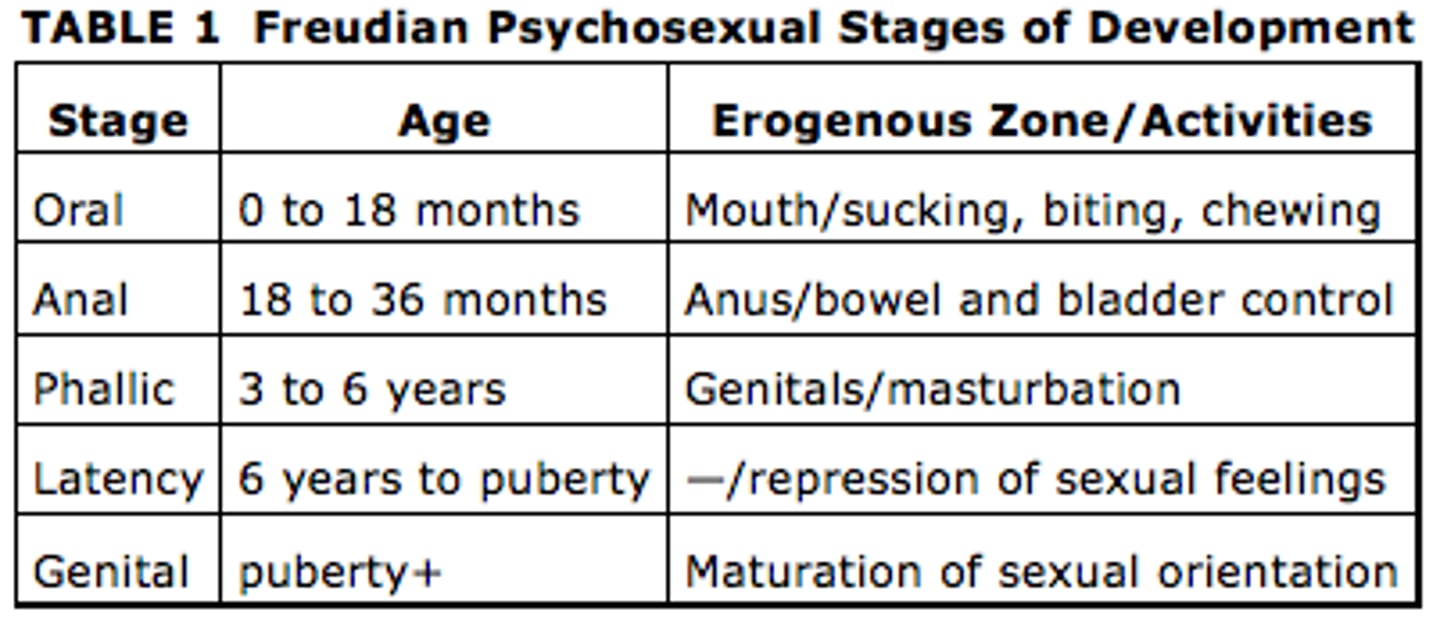
Psychosexual Stages
childhood stages of development during which the id's pleasure-seeking energies focus on distinct erogenous zones
Oedipus complex
according to Freud, a boy's sexual desires toward his mother and feelings of jealousy and hatred for the rival father (during phallic stage)
Development of superego:
1. Love for mother
2. Jealous of father
3. Castration anxiety
4. Identify w/ father -> Adopts morals of father
Resolution: superego
Identification
process by which children incorporate their parents' values into their developing superegos.
Fixation
lingering focus of pleasure-seeking energies at an earlier psychosexual stage, in which conflicts were resolved
Ex: a person who had been either orally overindulged or deprived might fixate at the oral stage
This orally fixated adult could exhibit either passive dependence (like that of nursing infant) or an exaggerated denial of this dependence by acting tough or uttering biting sarcasm) or the person might continue to seek oral gratification by smoking or excessive eating
Defense Mechanism
ego's protective methods of reducing anxiety by unconsciously distorting reality (functioned indirectly and unconsciously)
Repression
basic defense mech that banishes from consciousness anxiety-arousing thoughts, feelings and memories (conscious)
Collective Unconscious
concept of a shared, inherited reservoir of memory traces from our species' history
Explains why spiritual concerns are deeply rooted and why people in different cultures share certain myths and images
False Consensus Effect
tendency to overestimate the extent to which others share our beliefs and behaviors
Ex: people who binge-drink or break speed limits tend to think many others do the same
Terror Management Theory
theory of death-related anxiety; explores people's emotional and behavioral responses to reminders of their impending death
Thematic Appercetion Test (TAT)
projective test in which people express their inner feelings and interests through the stories they make up about ambiguous scenes
Provides a valid and reliable map of people's implicit motives
Projective Test
personality test, such as the TAT or Rorschach, that provides ambiguous images designed to trigger projection of people's inner dynamics
Rorscharch inkblot test
projective test that seeks to identify people's inner feelings by analyzing how they interpret 10 inkblots
Humanistic Theories
theories that view personality with a focus on the potential for healthy personal growth
Hierarchy of Needs
Physiological needs:
Personal safety:
Love:
Self esteem:
Self-actualization:
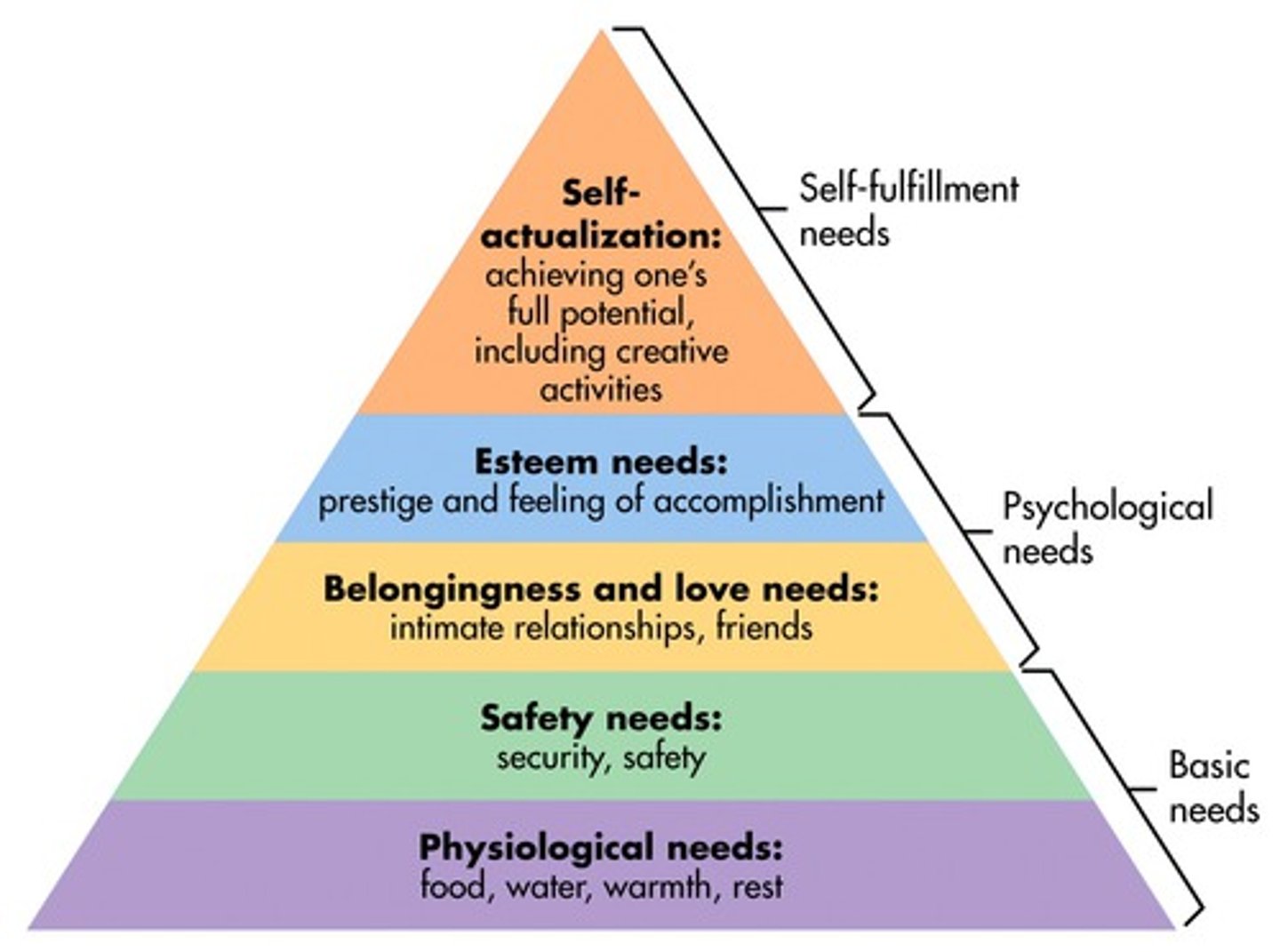
Self Actualization
one of the ultimate psychological needs that rises after basic physical and psychological needs are met and self-esteem is achieved; the motivation to fulfill one's potential
Self-transcendence: the striving for identity, meaning and purpose beyond the self
Carl Rogers' Person-Centered Perspective:
Acceptance: when people are accepting, they offer unconditional positive regard (a caring, accepting, nonjudgmental attitude, which Rogers believed would help people develop self-awareness and self-acceptance)
Genuineness: When people are genuine, they are open with their own feelings, drop their facades, and are transparent and self-disclosing
Empathy: when people are empathic, they share and mirror others' feelings and reflect their meaning
unconditional positive regard
according to Rogers, an attitude of total acceptance toward another person
Self-concept
all our thoughts and feelings about ourselves, in the answer to the question "Who am I?"
Traits
characteristic pattern of behavior or a disposition to feel and act in certain ways, as assessed by self-report inventories and peer reports
MBTI
Myers-Briggs Type Indicator: psychological test based in Jungian theory; four categories
1) Extroversion - Introversion
2) Sensing - Intuition
3) Thinking - Feeling
4) Judging - Perceiving
Eysenck Personality Questionnaire
uses extroversion,introversion,unstable,stable to organize personality
Factor Analysis
identifies clusters of test items that tap basic components of a trait
Extraversion-introversion & emotional stability-instability
Personality Inventory
questionnaire (often with T/F or agree-disagree items) on which people respond to items designed to gauge a wide range of feelings and behaviors; used to assess selected personality traits
Self-report
method of recording participants' descriptions of their personality traits, often using surveys, questionnaires, or tests
MMPI
most widely researched and clinically used of all personality tests. Originally developed to identify emotional disorders, this test is now used for many other screening purposes
Empirically Derived Test
test created by selecting from a pool of items those that discriminate between groups
Big 5 factors of personality
researchers identified 5 factors that describe personality (Handy acronym = OCEAN):
- openness
"I use difficult words"
I do not have a good imagination" (reversed)
- conscientiousness
"I follow a schedule"
"I make a mess of things" (reversed)
- extraversion
"I am the life of the party"
- agreeableness
"I take time out for others"
"I insult people" (reversed)
- neuroticism
"I get stressed out easily"
"I am relaxed most of the time" (reversed)
Social cognitive perspective
view of behavior as influenced by the interaction between people's traits and their social context
Reciprocal Determinism
interacting influence of behavior, internal cognition, and environment
Self
contemporary psych, assumed to be the center of personality, the organizer of our thoughts, feeling and actions
Spotlight Effect
overestimating others' noticing and evolution our appearance, performance, and blunders
Defensive Self Esteem
fragile; focuses on sustaining itself, which makes failure and criticism feel threatening
May respond to such perceived threats with anger or aggression
Secure Self-Esteem
less fragile bc it is less contingent on external evaluations
To feel accepted for who we are, and not for our looks, wealth, or acclaim, relieves pressure to succeed and enables us to focus beyond ourselves
Accept their own flaws also more compassionately accept others' flaws
Self-Efficacy
our sense of competence and effectiveness on a task
Self-Serving Bias
readiness to perceive ourselves favorably
Narcissism
excessive self-love and self-focus
Tend to be materialistic, desire fame, have inflated expectations, hook up more often without commitment, and gamble and cheat more
Opposite: humility -> attitude that no matter your accomplishments, you are not entitled to special treatment
Freudian Techniques
Dream analysis
Manifest vs latent content
Free association
Slips of tongue/forgetting
Displacement
(defense mechanism) safer target
Angry at boss but instead shower anger toward spouse
Reaction Formation
psychoanalytic defense mechanism by which the ego unconsciously switches unacceptable impulses into their opposites. Thus, people may express feelings that are the opposite of their anxiety-arousing unconscious feelings.
Projection
psychoanalytic defense mechanism by which people disguise their own threatening impulses by attributing them to others
Rationalization
defense mechanism that offers self-justifying explanations in place of the real, more threatening, unconscious reasons for one's actions
Electra Complex (girls)
1. penis envy
2. desire for father
3. jealous of mother
4. identify with mother
resolution: superego
Criticisms of Freud
limited data set
personal bias
penis envy vs womb envy
vague and untestable
nonfalsiable
"sometimes a cigar is just a cigar"
Hot/Cold Empathy Gap
A bias in which people underestimate the influence of their current internal state on their attitudes, preferences, and behaviors
cold state at night, say you will get up at 8am to go for a run
Wake up in hot state and you feel crappy and unmotivated
a bit like id vs ego
Construct Validity
degree to which a test or tool accurately measures the theoretical, non-observable concept
Verbal
Mathematical
Spatial
Barnum Effect
phenomenon where people believe high-accuracy, generic personality descriptions apply specifically to them
Ex: swarthmore sometimes intense
HEXACO
honesty-humility, emotionality, extraversion, agreeableness, conscientiousness, openness to experience (modified big 5)
Trait theory of personality
Personality consists of a set of traits which are characteristics that vary between people and are STABLE over the course of the lifetime. Key: NO ENVIRONMENTAL INFLUENCES. Very little personal control over personality, and personality is hereditable.
Challenges:
Mischel: poor cross situational consistency
People underestimate situation influence
FAE (fundamental attribution error)
Resolution: interaction
BUT people pick situations
& people change situations
- BUT surprising consistency --> Mischel: delay of gratification in childhood predicts SAT
Health Psychology
a subfield of psychology that provides psychology's contribution to behavioral medicine
- how do psychological states influence physical health
Hans Selye
(1907-1982) Psychologist who researched a recurring response to stress that he called the general adaptation syndrome
worked with rats
Enlarged adrenals glands
Shrunken lymph nodes
Bleeding ulcers
Coins term: STRESS
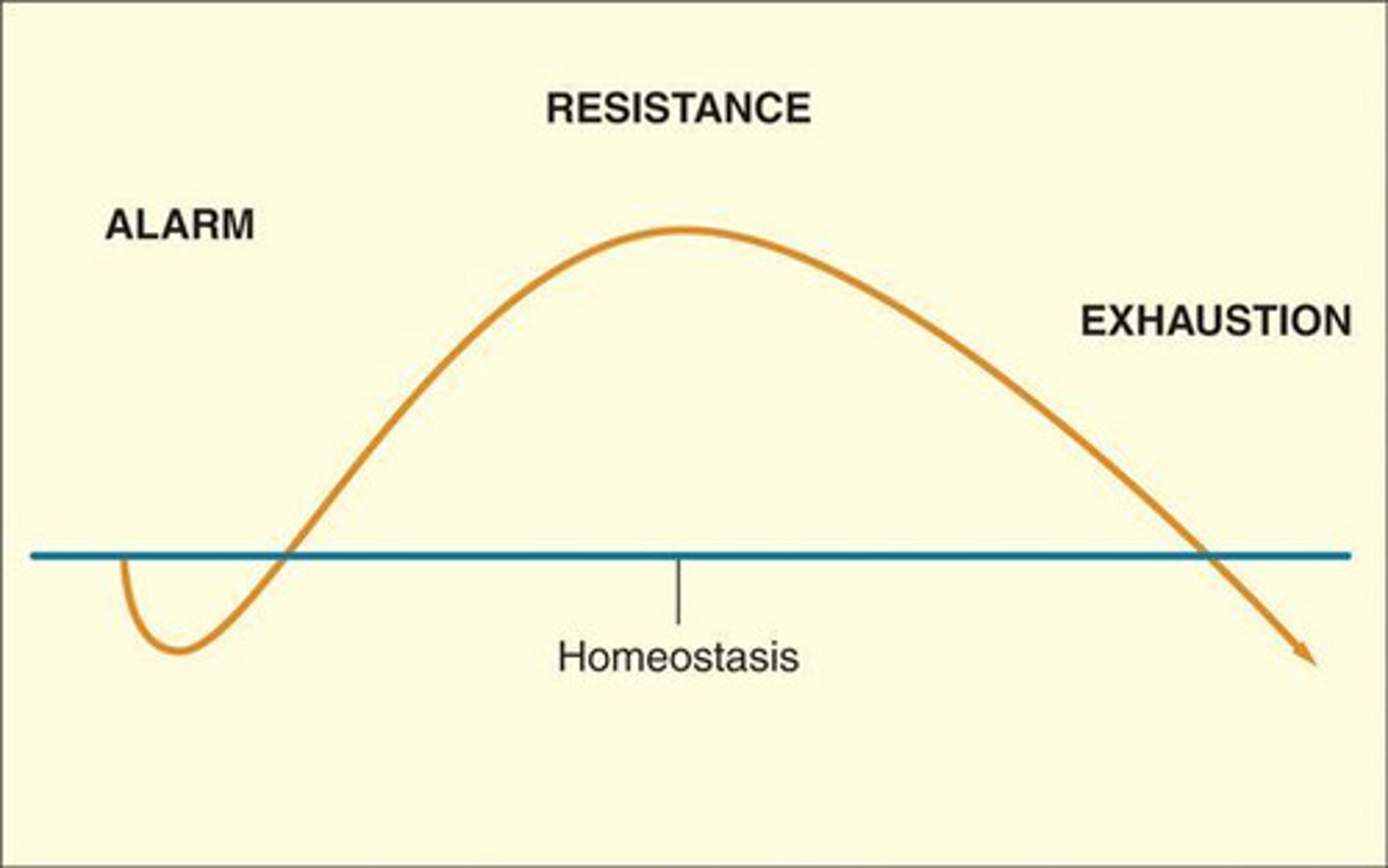
General Adaptation Syndrome
Seyle's concept that the body responds to stress with alarm, resistance and exhaustion
Phase 1 : alarm --> sympathetic NS is activated
Heart rate zooms
Blood is diverted to your skeletal muscles
You are ready to fight back
Phase 2: resistance --> temp, BP and respiration remain high
Adrenal glands pump epinephrine and norepinephrine into bloodstream
Fully engaged, summoning all resources to meet the challenge
As time passes, with no relief from stress, your body's reserves begin to dwindle
Phase 3: exhaustion --> you become more vulnerable to illness or, in extreme cases, collapse and even death
HPA axis
axis regulating stress response
Cortisol release — suppression of immune system -> illness
Causal Direction
whether X causes Y or Y causes X is not always obvious and may have to be examined carefully
explanatory/attributional style (martin seligman)
3 dimensions:
Internal vs external
Stable vs unstable
Global vs specific
Ex: fail test:
"Im stupid
Hard test
Predicts, cold, accidents, worse
James Pennebaker
writing about traumatic events can influence a variety of academic, social, and cognitive variables. --> no feedback needed
- benefits among professionals and prisoners
- not inhibiting
- multiple instances become one event
- organizes thoughts "narrative articulation"
- getting sense of organization of traumatic events helps with recovery
Emotion
response of the whole organism, involving:
1) physiological arousal
Ex: heart pounding
2) expressive behaviors
Ex: quickened pace
3) conscious experience resulting from one's interpretation
Ex: is this kidnapping?
Ex: panic, fear, joy
James Lange Theory
theory that our experience of emotion occurs when we become aware of physiological responses to an emotion-arousing stimulus
Ex: we are angry bc we strike
Ex: i noticed my racing herat and then, shaking with fright, felt the whoosh of emotion
Feeling of fear followed by body's response