Biology Unit 1 & 2 - Cell, Cell Division, Tissues and Body Cavities
 Call Kai
 Learn
 Practice Test
 Spaced Repetition
 Match
 Flashcards
 Knowt Play
1/217

218 Terms
What is Anatomy?
Structure of an organism and the relationship of its parts.
What is the Greek root of Anatomy?
“Cutting apart”
What is Physiology?
Study of the functions of the body (How it works)
What is Pathology?
The study of disease
What are the levels of organization?
Atoms, cells, tissues, organs, systems, organism
What is homeostasis?
How the body regulates internal systems so they function correctly and constantly.
Does survival depend on the maintenance/restoration of homeostasis?
Yes
What is the ability to maintain balance of body functions related to?
Age
The organization of the body begins at what level?
Chemical
The relatively constant state maintained by the body is known as:
Homeostasis
Most homeostatic control loops in the body involve:
Negative feedback
What do feedback loops involve?
Sensor, control center and effector
What is an example of negative feedback?
Temperature regulation
Describe how constant body temperature can be maintained?
The body temperature is the controlled condition. The sensors (cold receptors on the skin) detect a drop in temperature and alert the brain (control center) which sends signals to the muscles, causing shivering which raises body temperature and restores balance (effectors)
Describe how birth is positive feedback?
As the baby is pushed from the womb (variable), stretch receptors (sensor) in the birth canal signal the brain (control center) to release oxytocin, which travels to the bloodstream, triggering stronger contractions (effector) that continually amplify stretching and oxytocin release until delivery.
Instead of opposing a change in the internal environment, which type of feedback loop temporarily amplifies the change that is occurring?
Positive feedback loop
Uterine contractions are an example of:
Positive feedback loop
Temperature regulation in the body is an example of:
Negative feedback loop
What does it mean to fold a protein?
A protein gets “folded” into an individual three-dimensional shape that determines its function.
What do cells do?
Perform all living functions
What substance is found only in cells?
Cytoplasm

What is 1?
Plasma Membrane
What are organelles?
Little organs within the cell

What is 2?
Cytoplasm

What is 3?
Centrioles

What is 4?
Mitochondria

What is 5?
Lysosome
What are the two kinds of Endoplasmic Reticulum?
Rough and smooth

What is 6?
Golgi Apparatus
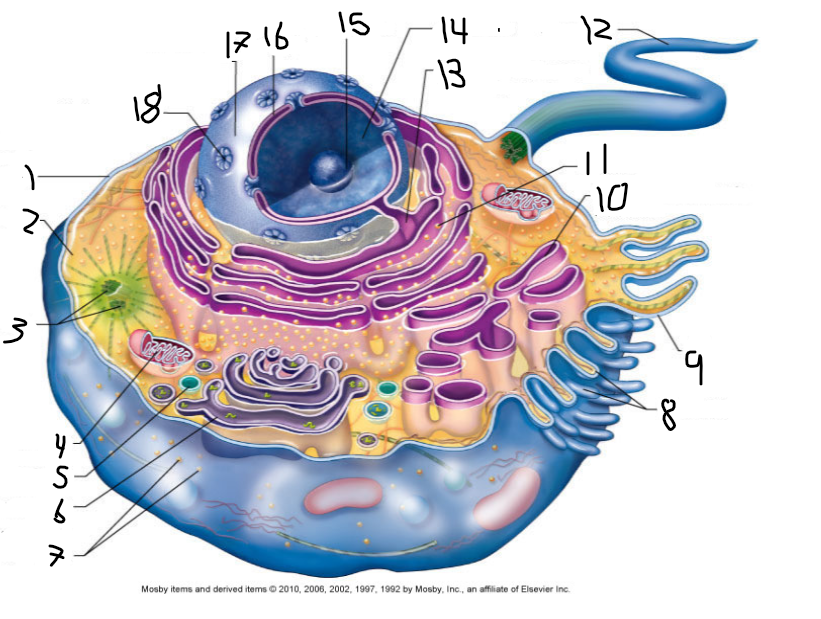
What is 7?
Free Ribosomes

What is 8?
Microvilli

What is 9?
Cillia
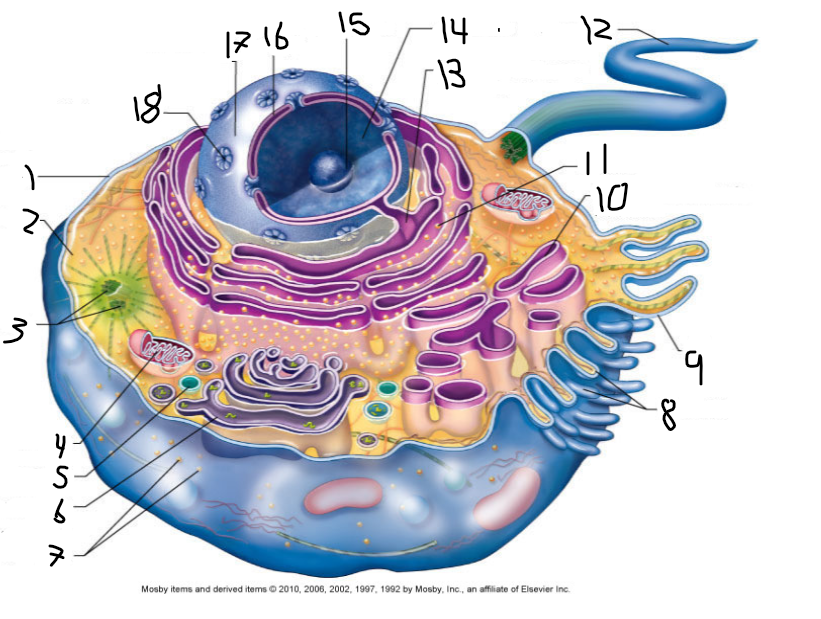
What is 10?
Smooth Endoplasmic Reticulum
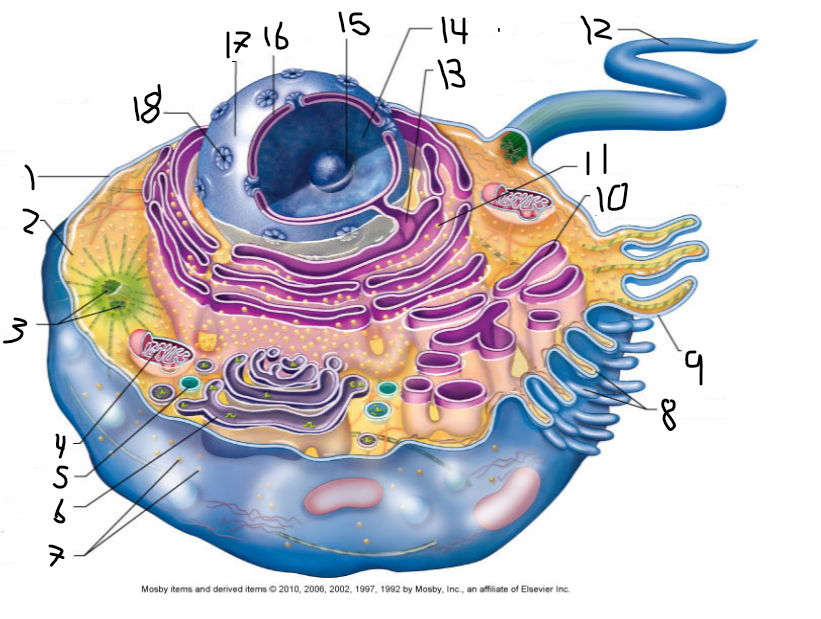
What is 11?
Ribosome
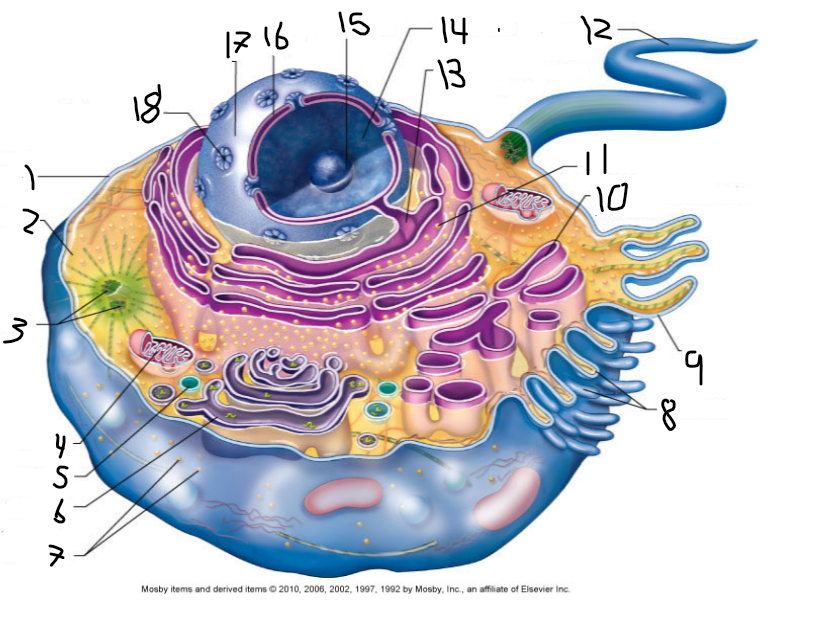
What is 12?
Flagella

What is 13?
Rough Endoplasmic Reticulum

What is 14?
Chromatin

What is 15?
Nucleolus

What is 16?
Nuclear Envelope

What is 17?
Nucleus
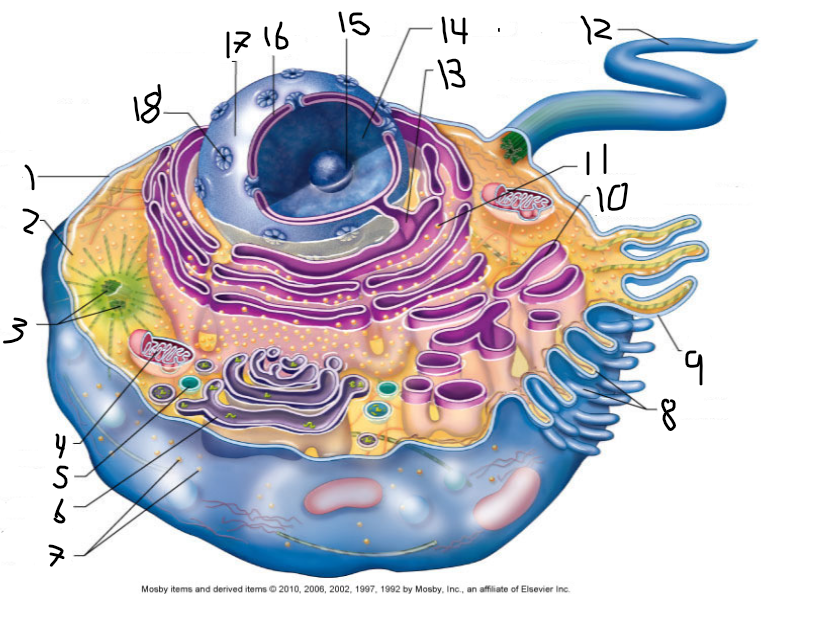
What is 18?
Nuclear Pores
What encloses the cell?
Plasma Membrane
What is the function of the plasma membrane?
Chooses what gets to enter or leave the cell.
Does the plasma membrane expand?
Yes
Is the Plasma Membrane a uniform “fabric”?
No
What does the cytoplasm contain?
Organelles
What cells have a plasma membrane?
Eukaryotic cells
What does the cytoplasm do?
Fills the space between plasma membrane and nucleus.
Which organelles may attach to the rough ER or exist freely in cytoplasm?
Ribosomes
What do ribosomes do?
Makes enzymes and proteins.
The Endoplasmic reticulum is a __________ of connecting sacs and canals?
Network
What is the function of the Endoplasmic Reticulum?
Modifies proteins by, for example, folding them or adding sugars, and synthesizing lipids.
What does the Rough Endoplasmic reticulum do?
Collects and folds proteins made by ribosomes for the Golgi Apparatus.
What does the Smooth Endoplasmic reticulum do?
It makes lipids.
What is the Golgi Apparatus?
Group of flattened sacks near the nucleus.
What is the function of the Golgi Apparatus?
Collects and packages chemicals into vesicles that are transported into the plasma membrane from the Endoplasmic Reticulum.
What is the function of the mitochondria?
Produces and stores energy for the cells.
The nucleus contains nuclear _______.
Pores
What surrounds the nucleus?
Nuclear Envelope
Each cell has __ chromosomes in the nucleus.
46
The Nucleolus is a ____ region of ____ material.
Dense, nuclear
The nucleus controls the cell because it contains ____.
DNA
What is DNA?
Genetic code which gives instructions for making proteins that determine cell function and structure.
The only example of Flagella in humans is:
Sperm cell “tails”
What are Flagella?
Single protrusions extending from cell surfaces.
What are Microvilli?
Fingerlike extensions of the plasma membrane
What are the functions of the Microvilli?
Increase absorptive surface area of the cell
What are the Cilia?
Hairline extensions found on exposed surfaces of some cells.
What can Cilia do?
Move together.
Where is the Centrosome found?
Near the nucleus.
What is the function of the Centrosome?
Organizes microtubules.
_____ are found within the Centrosome.
Centrioles
Centrioles are _____ organelles that lie at ____ angles to each other near the nucleus.
Paired, right
Centrioles function is in ___ reproduction.
Cell
What do Lysosomes contain?
Digestive enzymes
Lysosomes have a ___ function that is to ___________.
Protective, eat microbes
What is a Lysosome?
Membrane-walled organelle
What is another name for the Cytoplasm?
“Living matter”
What is another name for Plasma Membrane?
Surrounds cells
What is another name for Cholesterol?
Component of plasma membrane
What is another name for Nucleus?
Controls reproduction of the cell
What is another name for Centrioles?
Paired organelles
What is another name for Ribosomes?
“Protein factories”
What is another name for the Endoplasmic Reticulum
“Smooth and Rough”
What is another name for Mitochondria?
“Power plants”
What is another name for Lysosomes?
“Digestive bags”
What is another name for Golgi Apparatus?
“Chemical processing and packaging center”
What is passive transport?
When substances move across the cell membrane without needing to expend energy.
What is a common example of passive transport?
Diffusion
What is diffusion?
Matter will move across the cell membrane from an area of higher concentration to lower concentration.
What is moving from an area of higher concentration to lower concentration called?
Moving down the concentration gradient.
What are two examples of diffusion?
Osmosis, Dialysis
Osmosis is the diffusion of ___ across a semi-permeable membrane.
Water
Dialysis is the diffusion of _____ across a semi-permeable membrane.
Dissolved substances
What is another word for dissolved substances?
Solutes
What does facilitated diffusion use?
Transport proteins
What is facilitated diffusion?
It uses transport proteins to move macromolecules like glucose across the cell membrane without using energy.
What is filtration?
Water and dissolved substances move through one side of the membrane because of hydrostatic pressure.
What is hydrostatic pressure?
The force of fluid pushing against something.
What is responsible for urine formation?
Filtration