test 3
0.0(0)
Studied by 2 people Call Kai
 Learn
Learn Practice Test
 Spaced Repetition
 Match
Match Flashcards
 Knowt Play
Card Sorting
1/218

Earn XP
Description and Tags
Last updated 3:49 PM on 12/2/22
Name | Mastery | Learn | Test | Matching | Spaced | Call with Kai |
|---|
No analytics yet
Send a link to your students to track their progress
219 Terms
1
New cards
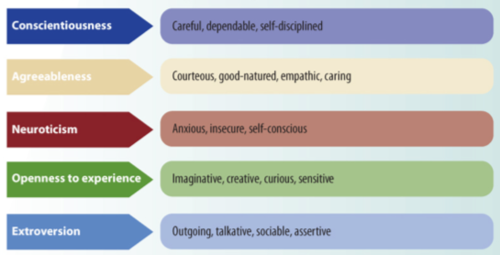
Big Five Personality Dimensions
1. extroversion
2. agreeableness
3. conscientiousness
4. emotional stability
5. openness to experience
2. agreeableness
3. conscientiousness
4. emotional stability
5. openness to experience
2
New cards
core self-evaluation
Represents a broad personality trait comprising four positive individual traits:
(1) self-efficacy, (I can/can't do task)
(2) self-esteem, (I like/dislike myself)
(3) locus of control (I am/am not the captain of my fate)
(4) emotional stability (I'm fairly secure/insecure when working under pressure)
(1) self-efficacy, (I can/can't do task)
(2) self-esteem, (I like/dislike myself)
(3) locus of control (I am/am not the captain of my fate)
(4) emotional stability (I'm fairly secure/insecure when working under pressure)
3
New cards
self-efficacy
belief in one's personal ability to do a task
4
New cards
Generalized self-efficacy
represents individuals' perceptions of their ability to perform across a variety of different situations
-career readiness competency desired by employers
-career readiness competency desired by employers
5
New cards
What can managers do? (self efficacy)
•Assign jobs accordingly.
•Develop employees' self-efficacy and generalized self-efficacy by giving constructive pointers and positive feedback.
•Monitor employees to avoid learned helplessness by offering guided experiences, mentoring, and role modeling.
•Develop employees' self-efficacy and generalized self-efficacy by giving constructive pointers and positive feedback.
•Monitor employees to avoid learned helplessness by offering guided experiences, mentoring, and role modeling.
6
New cards
locus of control
indicates how much people believe they control their fate through their own efforts
7
New cards
self esteem
the extent to which people like or dislike themselves,
8
New cards
inernal locus of control
you beleive you control your desitiny
9
New cards
external locus of control
you believe external forces control you
10
New cards
high self esteem
more apt to handle failure better, emphasize the positive and to take more risks.
11
New cards
low self-esteem
○tend to focus more on one's weaknesses, may be more dependent on others.
12
New cards
what managers can do (locus of control)
○Employees with internal locus of control should be placed in jobs requiring high initiative, lower compliance.
○Employees with external locus of control better in structured jobs requiring greater compliance.
○Internals may prefer and respond more productively to incentives such as merit pay or sales commissions.
○Employees with external locus of control better in structured jobs requiring greater compliance.
○Internals may prefer and respond more productively to incentives such as merit pay or sales commissions.
13
New cards
what managers do? (self esteem)
○Reinforce employees' positive attributes and skills.
○Provide positive feedback whenever possible.
○Break larger projects into smaller tasks and projects.
○Express confidence in employees' abilities to complete their tasks.
○Provide coaching when employees are struggling to complete task.
○Provide positive feedback whenever possible.
○Break larger projects into smaller tasks and projects.
○Express confidence in employees' abilities to complete their tasks.
○Provide coaching when employees are struggling to complete task.
14
New cards
Perception
process of interpreting and understanding one's environment
15
New cards
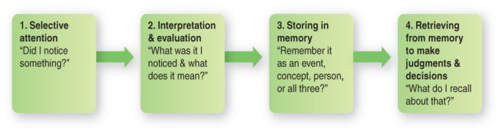
perception process
1. selection attention
2. interpretation & evalution
3. storing in memory
4. retrieving from memory to make judgements & decsions
2. interpretation & evalution
3. storing in memory
4. retrieving from memory to make judgements & decsions
16
New cards
Stereotyping
Those sorts of people are pretty much the same."
17
New cards
IMPLICIT BIAS
"I really don't think I'm biased, but I just have a feeling about some people."
18
New cards
THE HALO EFFECT
"One trait tells me all I need to know."
19
New cards
THE RECENCY EFFECT
"The most recent impressions are the ones that count."
20
New cards
CAUSAL ATTRIBUTIONS
Inferring causes for observed behavior
21
New cards
5 distortions in perception
1- stereotyping
2- implicit bias
3- the halo effect
4- the recency effect
5- causal attribution
2- implicit bias
3- the halo effect
4- the recency effect
5- causal attribution
22
New cards
fundamental attribution bias
○People attribute another person's behavior to his or her personal characteristics rather than to situational factors.
23
New cards
Self-serving bias
○People tend to take more personal responsibility for success than for failure.
24
New cards
Self-Fulfilling Prophecy (Pygmalion Effect)
○by raising managers' expectations for individuals, higher levels of achievement productivity can be achieved.
○when managers expect employees to perform badly, they will. when you expect them to perform well, they will.
○when managers expect employees to perform badly, they will. when you expect them to perform well, they will.
25
New cards
What can managers do?
Self-Fulfilling Prophecy (Pygmalion Effect)
Self-Fulfilling Prophecy (Pygmalion Effect)
○Create positive performance expectations.
○Recognize everyone has potential to increase performance.
○Introduce new employees if they have outstanding potential.
○Encourage employees to visualize successful execution of tasks.
○Help employees master key skills.
○Recognize everyone has potential to increase performance.
○Introduce new employees if they have outstanding potential.
○Encourage employees to visualize successful execution of tasks.
○Help employees master key skills.
26
New cards
Organizational behavior (OB)
●Dedicated to better understanding and managing people at work.
●Tries to help managers explain and predict work behavior, so they can better lead and motivate their employees to perform productively.
●Tries to help managers explain and predict work behavior, so they can better lead and motivate their employees to perform productively.
27
New cards
VALUES:
consistent beliefs and feelings about all things
●Lifelong behavior patterns are dictated by values that are fairly well set by the time people are in their early teens.
●After that, however, one's values can be reshaped by significant life-altering events.
●From a manager's point of view, it's helpful to know that values represent the ideals that underlie how we behave at work.
●Lifelong behavior patterns are dictated by values that are fairly well set by the time people are in their early teens.
●After that, however, one's values can be reshaped by significant life-altering events.
●From a manager's point of view, it's helpful to know that values represent the ideals that underlie how we behave at work.
28
New cards
ATTITUDES
consistent beliefs and feelings about specific things
29
New cards
●The three components of attitudes:
○Affective
○Cognitive
○Behavioral
○Cognitive
○Behavioral
30
New cards
●When attitudes and reality collide:
○Consistency and Cognitive Dissonance
31
New cards
BEHAVIOR
values and attitudes affect people's actions and judgments
●Values (global) attitudes (specific) generally in harmony, not always.
●A manager may put positive value on helpful behavior (global) yet have negative attitude toward helping unethical co-worker (specific).
●Together, however, values and attitudes influence people's workplace behavior—their actions and judgments.
●Values (global) attitudes (specific) generally in harmony, not always.
●A manager may put positive value on helpful behavior (global) yet have negative attitude toward helping unethical co-worker (specific).
●Together, however, values and attitudes influence people's workplace behavior—their actions and judgments.
32
New cards
EMPLOYEE ENGAGEMENT
An individual's involvement, satisfaction, and enthusiasm for work
●a person performing a work activity is full immersed in the activity, feeling full of energy and enthusiasm for the work."
●Employees more likely to become engaged when culture promotes employee development, recognition, trust.
●a person performing a work activity is full immersed in the activity, feeling full of energy and enthusiasm for the work."
●Employees more likely to become engaged when culture promotes employee development, recognition, trust.
33
New cards
what managers can do for employee engagement
●Managers can increase employee engagement with personal resource building, job resource building, leadership training, and health promotion interventions.
34
New cards
JOB SATISFACTION
●feel positively or negatively about various aspects of your work.
●how you feel about components, such as work, pay, promotions, coworkers, and supervision.
●how you feel about components, such as work, pay, promotions, coworkers, and supervision.
35
New cards
JOB SATISFACTION
Key correlates:
Key correlates:
○Stronger motivation, job involvement, and life satisfaction.
○Less absenteeism, tardiness, turnover, and stress.
○Less absenteeism, tardiness, turnover, and stress.
36
New cards
organizational commitment
reflects extent an employee identifies with an org. and is committed to its goals
●positive relationship between organizational commitment and job satisfaction, performance, turnover, and organizational citizenship behavior.
●positive relationship between organizational commitment and job satisfaction, performance, turnover, and organizational citizenship behavior.
37
New cards
Stress
●The tension people feel when they are facing or enduring extraordinary demands, constraints, or opportunities and are uncertain about their ability to handle them effectively.
38
New cards
●Sources of stress:
○Personality
○The job itself (task demands)
○Role-related
○Work-family conflict
○Work relationships
○Organizational culture
○The job itself (task demands)
○Role-related
○Work-family conflict
○Work relationships
○Organizational culture
39
New cards
Physically stress
●"the nonspecific response of the body to any demand made upon it."
40
New cards
Stressors
●hassles, or simple irritants, such as misplacing or losing things, having concerns about one's physical appearance, and having too many things to do.
41
New cards
Buffers
that managers can make to reduce the stressors that lead to burnout:
●Build resilience.
● employee assistance programs.
●Recommend holistic wellness approach.
●Create supportive environment.
●Make jobs interesting.
●career counseling available.
●Build resilience.
● employee assistance programs.
●Recommend holistic wellness approach.
●Create supportive environment.
●Make jobs interesting.
●career counseling available.
42
New cards
personal factors
a factor of motivation
personality, ability, core self-evaluations, emotions, attitudes, needs, values, work attitudes
personality, ability, core self-evaluations, emotions, attitudes, needs, values, work attitudes
43
New cards
contextual factors
a factor of motivation
organizational culture, cross-cultural values, physical environment, rewards and reinforcement, group norms, communication technology, leader behavior, organizational design, organizational climate,
job design,
HR practices
organizational culture, cross-cultural values, physical environment, rewards and reinforcement, group norms, communication technology, leader behavior, organizational design, organizational climate,
job design,
HR practices
44
New cards
why motivation is important
Join your organization
Stay with your organization
Show up for work at your organization
Be engaged while at your organization
Do extra for your organization
Stay with your organization
Show up for work at your organization
Be engaged while at your organization
Do extra for your organization
45
New cards
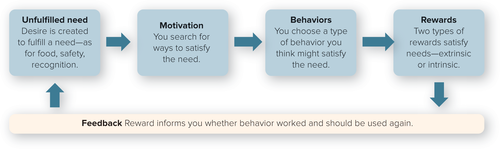
simple model of motivation
unfulfilled need, motivation, behaviors, rewards, feedback
46
New cards
unfulfilled needs
desire is created to fulfill a need - as for food, safety, recognition
47
New cards
Motivation
you search for ways to satisfy need
48
New cards
behaviors
you choose a type of behavior you think might satisfy the need
49
New cards
rewards
two types of rewards satisfy needs- extrinsic or intrinsic
50
New cards
Feedback
reward informs you whether behavior worked and should be used again
51
New cards
4 major perspectives on motivation
1. content
2. process
3. job design
4. reinforcement
2. process
3. job design
4. reinforcement
52
New cards
Content Theories
emphasize needs as motivators
53
New cards
Process Theories
theories focus on thoughts and perceptions that motivate behavior
54
New cards
job design theories
focus on designing jobs that lead to employee satisfaction and performance
55
New cards
Reinforcement Theory
based on the notion that motivation is a function of behavioral consequences and unmet needs
56
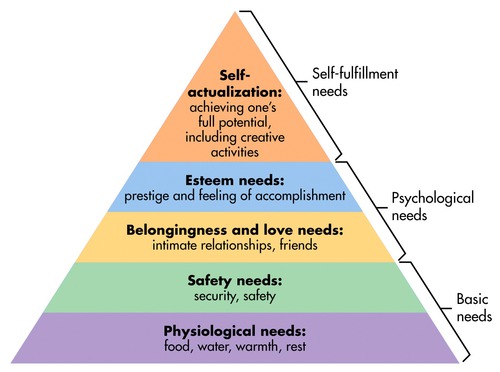
New cards
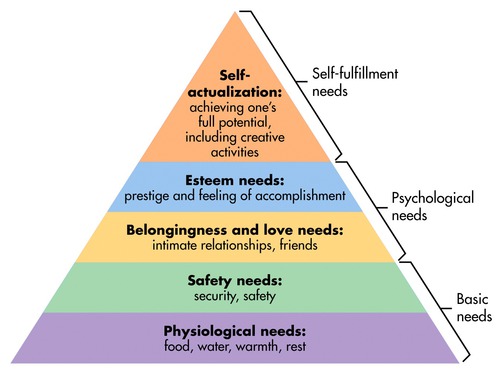
Maslow's Hierarchy of Needs
physiological, safety, love/belonging esteem,
self-actualization
self-actualization
57
New cards
content perspectives on motivation
theories that emphasize the needs that motivate people
58
New cards
content perspectives on motivation types
1.Maslow's hierarchy of needs theory.
2.McClelland's acquired needs theory.
3.Deci and Ryan's self-determination theory.
4.Herzberg's two-factor theory.
2.McClelland's acquired needs theory.
3.Deci and Ryan's self-determination theory.
4.Herzberg's two-factor theory.
59
New cards
physiological needs
need for food, clothing, shelter, comfort, self preservation
ex: employers cover these with wages
ex: employers cover these with wages
60
New cards
safety need
need for physical safety, emotional security, avoidance of violence
ex: health insurance
ex: health insurance
61
New cards
love
need for friendship, affection
ex: office parties company softball teams, management retreats
ex: office parties company softball teams, management retreats
62
New cards
esteem need
need for self-respect, status, reputation, recognition, self-confidence
ex: bonuses
ex: bonuses
63
New cards
self-actualization
need for self fulfillment increasing competence using abilities to fullest
ex: sabbatical
ex: sabbatical
64
New cards
MCCLELLAND'S ACQUIRED NEEDS THEORY
●Three needs a major motives determining people's behavior in workplace:
achievement
afflication
power
achievement
afflication
power
65
New cards
Achievement:
desire to achieve excellence in challenging tasks.
66
New cards
Affiliation:
1.desire for friendly and warm relationships.
67
New cards
Power:
desire to influence or control others.
68
New cards
DECI and RYAN'S SELF-DETERMINATION THEORY
○Assumes people are driven to try to grow and attain fulfillment, with their behavior and well-being influenced by three innate needs:
■Competence
■Autonomy
■Relatedness
○Focuses primarily on intrinsic motivation and rewards.
■Competence
■Autonomy
■Relatedness
○Focuses primarily on intrinsic motivation and rewards.
69
New cards
competence
●People need to feel qualified, knowledgeable, and capable of completing a goal or task and to learn different skills.
70
New cards
Autonomy
●People need to feel they have the freedom and the discretion to determine what they want to do and how they want to do it.
71
New cards
Relatedness
●People need to feel a sense of belonging, of attachment to others.
72
New cards
HERZBERG'S TWO-FACTOR THEORY
Two-factor theory
●Proposed that work satisfaction and dissatisfaction arise from two different factors
○work satisfaction - motivating factors
○work dissatisfaction - hygiene factors
●Proposed that work satisfaction and dissatisfaction arise from two different factors
○work satisfaction - motivating factors
○work dissatisfaction - hygiene factors
73
New cards
Hygiene factors:
●associated with job dissatisfaction which affect the job context in which people work.
74
New cards
Motivating factors:
●associated with job satisfaction, which affects the job content or the rewards of work performance.
75
New cards
Process perspectives
Concerned with the thought processes by which people decide how to act.
How employees choose behavior to meet their needs.
How employees choose behavior to meet their needs.
76
New cards
Process theories:
Equity or justice theory.
Expectancy theory.
Goal-setting theory.
Expectancy theory.
Goal-setting theory.
77
New cards
Equity theory
A model of motivation that explains how people strive for fairness and justice in social exchanges or give-and-take relationships.
78
New cards
Inputs
Equity theory Key elements "what effort am I putting into work"
79
New cards
output
Equity theory Key elements "what am I getting out of it"
80
New cards
Comparisons
Equity theory Key elements "how are my inputs/outputs compare"
81
New cards
ORGANIZATIONAL JUSTICE
Area in equity research concerned with the extent to which people perceive they are treated fairly at work
Distributive justice
Procedural justice
Interactional justice
Distributive justice
Procedural justice
Interactional justice
82
New cards
Distributive justice
reflects the perceived fairness of how resources and rewards are distributed or allocated.
83
New cards
Procedural justice
is defined as the perceived fairness of the process and procedures used to make allocation decisions.
84
New cards
Interactional justice
relates to the quality of the interpersonal treatment people receive when procedures are implemented.
85
New cards
FIVE PRACTICAL LESSONS FROM EQUITY AND JUSTICE THEORIES
1.Employee perceptions are what count.
2.Employees want a voice in decisions that affect them.
3.Employees should be given an appeals process.
4.Leader behavior matters.
5.A climate for justice makes a difference.
2.Employees want a voice in decisions that affect them.
3.Employees should be given an appeals process.
4.Leader behavior matters.
5.A climate for justice makes a difference.
86
New cards
expectancy theory
Suggests that people are motivated by two things:
How much they want something.
How likely they think they are to get it.
expectancy
instrumentality
valence
How much they want something.
How likely they think they are to get it.
expectancy
instrumentality
valence
87
New cards
Expectancy:
belief that a particular level of effort will lead to a particular level of performance.
88
New cards
Instrumentality
expectation that successful performance of the task will lead to the desired outcome.
89
New cards
Valence
the value a worker assigns to an outcome.
90
New cards
USING EXPECTANCY THEORY TO MOTIVATE EMPLOYEES
1.What rewards do your employees value?
2.What are the job objectives and the performance level you desire?
3.Are the rewards linked to performance?
4.Do employees believe you will deliver the right rewards for the right performance?
2.What are the job objectives and the performance level you desire?
3.Are the rewards linked to performance?
4.Do employees believe you will deliver the right rewards for the right performance?
91
New cards
Goal-setting theory
Suggests that employees can be motivated by goals that are specific and challenging but achievable.
92
New cards
Four motivational mechanisms:
1.Directs your attention.
2.Regulates the effort expended.
3.Increases your persistence.
4.Fosters use of strategic and action plans.
2.Regulates the effort expended.
3.Increases your persistence.
4.Fosters use of strategic and action plans.
93
New cards
learning goals
(goal orientation) focus on developing competence through new knowledge and skills
94
New cards
performance goals
(goal orientation) demonstrate and validate a competence we already have by seeking the approval of others.
95
New cards
JOB DESIGN PERSPECTIVES ON MOTIVATION
Division of an organization’s work among its employees.
The application of motivational theories to jobs to increase satisfaction and performance.
Two techniques:
Fitting people to jobs (scientific management).
Fitting jobs to people (enlargement or enrichment).
The application of motivational theories to jobs to increase satisfaction and performance.
Two techniques:
Fitting people to jobs (scientific management).
Fitting jobs to people (enlargement or enrichment).
96
New cards
Reinforcement theory
Suggests that behavior with positive consequences tends to be repeated, whereas behavior with negative consequences tends not to be repeated.
Pioneered by B.F. Skinner (operant conditioning) and Edward Thorndike (law of effect).
Pioneered by B.F. Skinner (operant conditioning) and Edward Thorndike (law of effect).
97
New cards
behavior modification.
Use of reinforcement theory to change human behavior
98
New cards
four types of reinforcement
Positive reinforcement
Negative reinforcement
Extinction
Punishment
Negative reinforcement
Extinction
Punishment
99
New cards
Punishment
Weakening behavior by presenting something negative or withdrawing something positive.
100
New cards
Extinction
Weakening behavior by ignoring it or making sure it is not reinforced