Kines 350: Exam 4
 Call Kai
 Learn
Learn Practice Test
 Spaced Repetition
 Match
Match Flashcards
 Knowt Play
1/73

There's no tags or description
Looks like no tags are added yet.
Name | Mastery | Learn | Test | Matching | Spaced | Call with Kai |
|---|
No analytics yet
Send a link to your students to track their progress
74 Terms
What are the principles of exercise training design?
training variables
specificity
overload
individuality
reversibility
variation
overtraining
what is specificity in training principles?
The training effect is specific to
muscle fibers recruited during exercise
energy system involved
force and velocity of contraction
type of contraction
(type of training dictates the adaptation)
what is overload in training principles?
system must be stressed beyond normal adaptation to occur
overload should be progressive (training loads should be continually adjusted)
overload achieved with FITT
what is FITT?
F - frequency of training
I - intensity of training
T - time (duration) of training
T - type of activity
what is the individuality principle of training?
adaptations and their rate vary between individuals
differences often have large genetic component
program must be specific to needs of individual
with right time/program, everyone responds
what is the reversibility principle of training?
training adaptations measurably reverse over time (endurance: 2 weeks, strength: 3 weeks)
few days without training could improve performance
at certain fitness level, a minimum amount of regular exercised required to maintain adaptations
what are the common goals of cardiorespiratory training?
start faster: decrease O2 deficit
higher race pace: increase steady state VO2
increase max rate of work: increase VO2 max
increase endurance time: increase lipolysis, spare glycogen
reduce comorbidities and risk of chronic disease
what are some of the most common adaptations after endurance training?
more rapid transitions
larger VO2 max and capacity to do work
changes in the determinants of VO2max
other adaptations: blood composition + pressure
lower submaximal heart rate and ventilation
how does endurance training adapt the O2 deficit?
O2 deficit is smaller after endurance training
less PCr depletion
less lactate accumulation
can “take out” races faster and maintain higher race pace
faster recovery from sprints
stronger finish
no change in steady state VO2 for unskilled activities
how does endurance training adapt VO2max
VO2max increases by 10-40%
greater endurance performance and capacity
submaximal VO2 at same work rate does not change significantly (same work requires same oxygen)
working at lower %VO2max
how can VO2max increase but submaximal VO2 not change significantly?
Training can significantly increase the amount of oxygen the heart can deliver (raising ) without necessarily making the muscles more economical in their use of oxygen at lower speeds.
what training can create adaptations in VO2max magnitude?
large muscle groups, dynamic activity
20-60 min
≥3 times/week
≥50% VO2max
6 weeks or more
what are the adaptations in the magnitude of VO2max?
average about 15-20%
wide variation between individuals
2-3% in those with high VO2max
requires >70% VO2max
up to 50% in those with low initial VO2max
requires 40-50% VO2max
how do genetics impact VO2max adaptations to training?
predisposition for exceptional VO2max
heritability plays an important role in determining exercise response
polymorphisms in 21 genes account for 47% of change in VO2max in white men
why does VO2max improve with training?
central adaptations:
enhanced delivery of blood/oxygen to muscles
larger blood volume + stroke volume + cardiac output
peripheral adaptations
increased oxygen extraction, widening a-vO2 difference
increased oxidative capacity + blood supply in muscle
what is the short-duration training effects in O2 extraction?
26% ↑ in VO2max
10% ↑ in SV
2% ↑ in O2(a-v)
↑ SV > ↑ O2(a-v)
what is the long-duration training effects in O2 extraction?
42% ↑ in VO2max
15% ↑ in SV
25% ↑ in O2(a-v)
↑ O2(a-v) > ↑ SV
what are the adaptations to cardiac output from endurance training?
no change in resting and submaximal CO
10-20% ↑ in CO during max exercise
greater advective movement of O2 to muscle
more blood flow to redistribute
how does endurance training adapt HR?
↓ HR at rest and fixed rates of submaximal work (↑ parasympathetic activity, ↓ intrinsic HR)
no change/slight ↓ in max HR
faster rate recovery post exercise
same HR at same %VO2max
how does endurance training adapt stroke volume?
greater SV at rest, submax, and max exercise
reflects cardiac hypertrophy
maintains CO with lower HR
what causes maximal SV to increase with training?
↑ Preload
↑ plasma volume, ↑ venous return, ↑ ventricular volume
↓ Afterload
↑ capillaries, ↑ maximal blood flow/no change in MAP, ↓ arterial constriction
↑ Contractility
changes occur rapidly
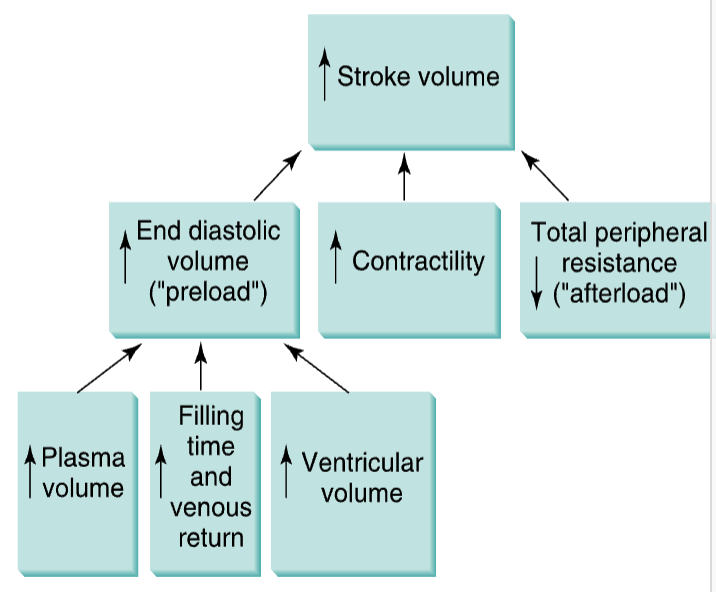
how are the ventricles adapted from endurance training?
↑ heart size
↑ chamber size, ↑ wall thickness, ↑ pericardial size
↑ wall thickness (strength training)
endurance training adaptations on O2 extraction
unchanged at rest and submax
↑ extraction during maximal exercise (takes very long time to occur)
better diffusion of O2 from muscle capillaries to mitochondria
increases O2 (a-v) difference
why does CvO2 decrease in trained athletes?
↑ muscle blood flow (less SNS vasoconstriction)
↑ capillary density (↑ recruitment + improved distribution)
↑ mitochondria number
how quickly are adaptations lost with detraining?
2-3 weeks
↓ SV
↓ Q
↓ VO2max
long term: ↓ O2(a-v)
what is the goal of cardiac rehab?
to minimize the impacts of detraining
adaptations to blood with endurance training?
↑ blood volume: ↑ plasma volume, ↑ RBC mass
↓ hematocrit
↓ blood pressure: ↓ SVR
endurance training on submaximal ventilatory response
no impact on long structure
oxygen maintained or improved
ventilation: lower at same submax work rate, higher at max exercise
how does endurance training adapt ventilation response?
changes in aerobic capacity of ventilatory muscles
less H+ production
less fatigable
changes in aerobic capacity of locomotor muscles
less H+ production
less afferent feedback from muscle to stimulate breathing
what are the general cardiorespiratory responses to training at absolute and relative intesnity?
absolute:
VO2 and Q are the same
HR and ventilation are less
(lower strain, same workload)
relative: VO2 and work is more
HR and ventilation are the same
workload is greater at same relative stress level
what are the implications/adaptations seen with an increased VO2max?
greater max CO: more O2 delivery to muscle
decreased resting HR: biomarker
greater SV: more O2 delivery
greater O2 extraction: better diffusion of O2 in muscles
what are the implications/adaptations seen with a smaller lower BP
less afterload
what are the implications/adaptations seen with an increased blood volume and hematocrit?
increased preload and oxygen carrying capacity
what are the implications/adaptations seen with lower ventilation?
more blood flow and oxygen available for movement
what are the five adaptations that improve oxygen extraction?
mitochondrial responses
capillary supply
myoglobin content
muscle fiber type
enzymatic activity
how does mitochondrial responses improve oxygen extraction?
sarcolemmal: larger, faster turnover (20%)
intermyofibrillar: more abundant, greater ATP synthesis (80%)
endurance training increases mitochondrial volume + turnover
decreased glucose utilization
increased fat metabolism
faster ADP uptake (spares PCr/tempers glycolysis)
mitochondrial response to training and detraining
quickly adapt (half response about 1 week)
detraining → 50% loss in 1 week, majority lost in 2 weeks
on week of detraining requires about 3-4 weeks retraining to regain
how does angiogenesis (capillaries) improve oxygen extraction?
10-30% increase in capillarization after 6-8 weeks of training
greater diffusion of oxygen
slower RBC transit time
increased O2(a-v)
how does endurance training adapt myoglobin?
↑ total amount of hemoglobin mass and myoglobin
Partial pressure and concentration change little
more O2 delivered to mitochondria
how does endurance training adapt muscle fiber type distribution?
exercise = fast to slow:
FG fiber prevalence decreases
FOG/IIa fiber prevalence and cross-sectional area increases (endurance)
SO/I fibers may increase
disuse = slow to fast
both fibers peak force + power reduced
large and variable decreases in type I cross sectional area, peak force, and velocity
smaller decrease in type II, area, and velocity
how do adaptations to enzymes increase oxygen extraction?
citrate synthesis (CS) catalyzes first reaction of krebs cycle (biomarker)
increased CS activity with all training intensities
independent of intensity and duration of IIa fibers
increase in CS in IIx fibers with higher intensity, longer duration trainin g
what are type IIx fibers
fast-twitch, anaerobic muscle fibers
maximal speed and force, but they fatigue rapidly
recruited last
specifically during high-intensity, explosive, or maximal-effort movements when type I and IIa fibers cannot meet the demand.
what are the overall muscle changes due to endurance training?
reduction in O2 deficit
increased O2 extraction
change in fiber type
increased capillary density
increased myoglobin content
increased mitochondrial content
increased oxidative enzyme activity
what are the four bioenergetic adaptations to endurance exercise?
better matching of glycolytic and oxidative systems
greater glycogen storage in muscle and liver
greater lipolysis reliance
improved acid base status
what are the endurance exercise adaptations to bioenergetic system matching?
lactate threshold occurs at a higher work rate
untrained: at 50% to 65% of VO2max
trained: at 70% yo 85% of VO2max
can maintain higher exercise intensity before fatiguing, faster race pace
endurance training adaptations to glycogen availability
increased muscle and liver glycogen stores
greater CHO availability
delays onset of fatigue
endurance training adaptations to lipid use
adipose tissue:
increased sensitivity of HSL to catecholamines (elevates lipolysis)
higher pH → less suppression of FA mobilization
muscle:
intramuscular lipid droplets smaller
increased amount of adipose triglyceride lipase (ATGL)
endurance training adaptations to muscle fuel utilization
increased utilization of fat, sparing plasma glucose + muscle glycogen
increased capillary density
slower BF in muscle, increased FFA transporters
increased uptake of FFA
increased FFA utilization
increased mitochondria number
increased beta oxidation enzymes: more acetyl-CoA formation
increased carnitine
endurance training adaptations to acid-base balance
increased mitochondrial content: less carb utilization → less pyruvate
increased NADH shuttles: better NAD+ recycling
change in LDH isoforms (H4 has less affinity for pyruvate → less lactate)
what is the exercise pressor reflex?
feedback from working muscles
group III and IV nerve fibers
responsive to tension, temperature, and chemical changes
feed to CV control center
what is central command of cardiorespiratory responses
feed forward from CNS
motor cortex, cerebellum, and basal ganglia
recruitment of muscle fibers
stimulates cardiorespiratory control centers
endurance adaptations to neural responses to exercise
mechanisms:
reduction in stimuli to muscle chemo receptors
fewer motor units recruited to accomplish the same absolute work
less sympathetic nervous system activation
less E/NE
cardiorespiratory: lower HR/Ventilation
metabolism: shift in fuel toward fat
endurance training on glucose homeostasis
insulin doesnt decrease as much (lower catecholamines)
less rise in glucagon (lower catecholamines)
less rise in glucagon/insulin ratio:
glycogen sparing
greater reliance on FFA
what is muscular strength?
maximal force a muscle/muscle group can generate
often measured with 1-repetition maximum (1-RM)
what is power?
rate of work → Force x distance/time
requires measurements of force and velocity
what is muscular endurance?
capacity to sustain repeated muscle contractions, or maintain a single contraction
e.g., number of repetitions at 80% 1-RM
what are the goals of resistance training?
strength/size:
increase strength/size/alter proportions
reduce risk of muscle tension/injury
power
increase speed, power, and agility
endurance
maintain high force for more repetitions
what are the general responses to resistance training?
improved motor unit recruitment
hypertrophy of muscles
fiber type shift from FG to FOG
metabolic adaptations
how quickly does strength increase in response to resistance training? why does it increase?
quickly, days to weeks of training
improved motor unit recruitment → ↑ force generation
little changes in muscle size
how does muscle hypertrophy occur in response to resistance training
months to years of training
increased cross sectional area
increase in size of muscle fibers
more cross bridges = more force
what role do neural responses have in early strength gaining?
responsible for early gains
8-20 weeks
increased ability to recruit motor units
altered motor neuron firing rates
enhanced motor unit synchronization
removal of neural inhibition
what is a “pump”
it is an edema
high muscle forces occlude blood flow
metabolites accumulate, drawing water into muscles via osmosis
not associated with strength, but water
Preworkout could promote pumps:
Stimulants increase focus/motivation
Amino acids increase resting muscle blood flow
is muscle enlargement attributed to increase in size or number?
size (hypertrophy)
englargement of type I and (mostly) II
increase in myofibrillar proteins
hyperplasia usually occurs in response to injury
increase in number of muscle fibers
what is myonuclear domain theory?
each nucleus affects protein synthesis in a limited volume of muscle fiber
when the volume is exceeded more nuclei are added
satellite cells donate nuclei → more nuceli = more domains = more protein synthesis
how are muscle fiber types adapted in response to resistance training?
all fiber types hypertrophy
type IIx and IIa fibers more than type I
modest fast → slow shift (IIx to IIa)
how is muscle fiber strength and size impacted by detraining?
slower change in size from detraining
small changes in fiber size
CNS changes help maintain strength despite reduced muscle/fiber mass
retraining
rapid regain of strength and muscle size “muscle memory”
why is there “muscle memory”
when a trained muscle is detrained:
additional nuclei remain
rehab proceeds more quickly
retraining occurs more quickly because nuclei domains are small, fewer satellite cells are needed
does exercise training increase oxidative capacity/capillary density
conflicting results
different frequencies and duration of resistance training
long term high-volume to improve oxidative capacity (HIIT)
what are the benefits of resistance training in older individuals
causes muscle hypertrophy and strength gains
delays sarcopenia
improves activities of daily living and balance
reduces risk of falls
what about exercise triggers training adaptation?
stress activates gene transcription, increases specific muscle proteins
form adaptation is specific to the type of training
what is the process of training induced muscle adaptation
muscle contraction activates primary and secondary messengers
results in expression if genes and synthesis of new proteins (peak mRNA lvls 4-8 hrs)
5 steps of protein synthesis
gene activation
transcription
mRNA processing
translation
post-transactional modification
what are the steps leading to exercise adaptations?
primary signals: stretch, Ca2+, low O2, etc
activation of cell signalling pathways
transcriptional activator enters the nuclei and binds to gene promoter
DNA transcribed to mRNA
mRNA leaves nucleus and binds with ribosomes
mRNA translated to amino acids
what are