Lecture 17: Surgery of the Carpus, Metacarpus, Phalanges, and Sesamoids
 Call Kai
 Learn
Learn Practice Test
 Spaced Repetition
 Match
Match Flashcards
 Knowt Play
1/31

There's no tags or description
Looks like no tags are added yet.
Name | Mastery | Learn | Test | Matching | Spaced | Call with Kai |
|---|
No analytics yet
Send a link to your students to track their progress
32 Terms
palmigrade stance
occurs when foot is positioned such that palmar surface of metacarpus contacts ground
valgus position
foot is an outward deviation
varus position
foot is an inward deviation
carpal fractures
rare in companion animals
often disabling because carpal joint serves a major weight-bearing function
what happens when carpal fractures are not treated?
joint incongruity and development of OA leads to severe lameness
what is the most frequently diagnosed fracture of carpal bones in companion animals?
radial carpal bone fractures
radial carpal bone fractures
may involve chronic lameness without history of trauma
3 common fracture patterns occur → speculated these results from incomplete ossification of radial carpal bone
what is the most common breeds to have chronic radial carpal bone fractures?
boxers and sporting breeds
accessory carpal bone fractures
occur in racing greyhounds and sled dogs
mostly occurs in right leg
considered avulsion injuries
medical or conservative management of carpal fractures
not indicated!
surgical treatment for radial carpal bone
small chip fragments that cannot be stabilized → removed
large fragments-anatomically reduced and rigidly stabilized with lag screws or a combination of lag screws and K-wires
dogs with chronic fractures → best treated with carpal arthrodesis
the carpus is composed of
proximal and distal row of carpal bones
radial carpal bone anatomy
articulates primarily with radius
serves as major weight-bearing area
what is the most common injury of the carpus?
hyperextension injury
conservative management for carpal hyperextension
rarely successful
arthrodesis → best treatment
pancarpal or partial carpal arthrodesis
pancarpal or partial carpal arthrodesis for carpal hyperextension
remove cartilage
autogenous cancellous bone graft
rigid fixation
postop care for carpal hyperextension
coaptation with splint for up to 6 weeks is indicated for most dogs
screws for reconstruction of radial carpal bone are not removed unless cause problems
prognosis for carpal fractures
fair to good for return to function
prognosis for carpal arthrodesis
fair for partial
good for pancarpal arthrodesis
carpal laxity syndrome
dogs 5-27 weeks; males 2:1
treat by appropriate diet, controlled exercise, recovery 1-4 weeks
sesamoid bones
small, round or oblong bones found adjacent to metacarpophalangeal joints
metacarpal bone fractures
common in dogs and cats
result from a direct blow or force to paw or from hyperextension injuries
sesamoid fractures
in racing greyhounds and rottweilers
occur after excessive tension on digital flexor tendons
sesamoid bones 2 and 7 of forelimb are most often affected
proximal sesamoid fragments are removed if
they are causing chronic lameness
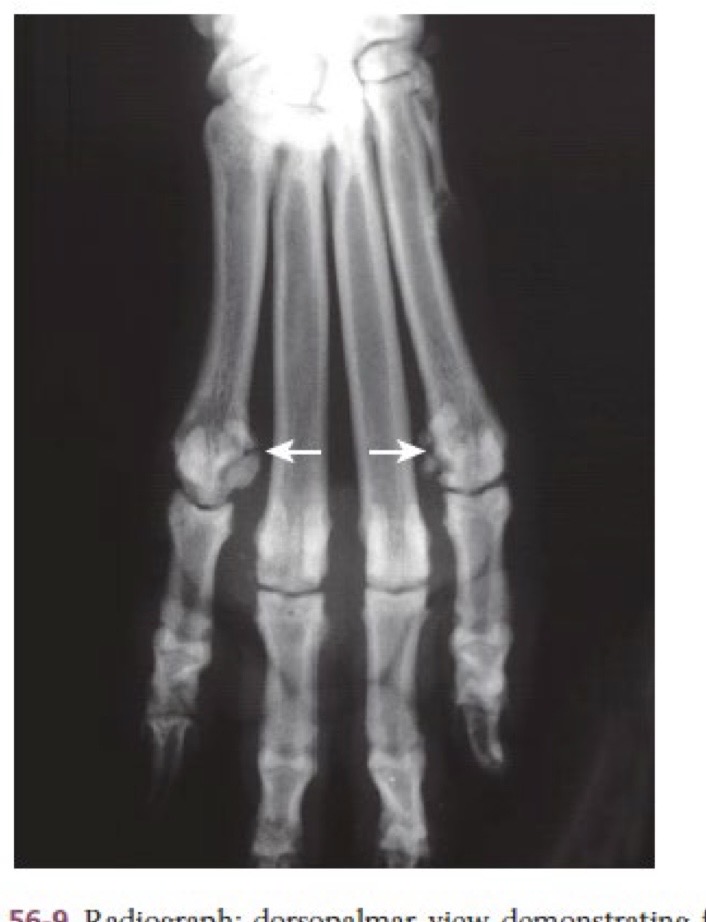
what is this?
sesamoid fracture of 2 and 7
dogs with sesamoid fractures have a history of
acute lameness that subsided but recurred with exercise
luxations of metacarpophalangeal joints or interphalangeal joints
typically occur in working dogs or racing greyhounds
chronic instability leads to DJD and less than optimal function
acute luxations in working or racing dogs are best treated with
open reduction and suturing of joint capsule and collateral ligaments
chronic luxations of 2nd or 5th toe can be treated with
amputation
diagnosis of phalange masses
radiographs → osteolysis and soft tissue swelling
fine needle aspirate for cytology
recommended treatment is digit amputation
digit amputation
make elliptical skin incision
preserve pad
remove the sesamoid bones
digit arthrodesis
expose joint
open joint capsule
remove articular cartilage
contour small plate to dorsal surface of bones
attach plate using lag screw
temporarily hold bones in position with K-wires and tension band