Exam 1 Zambia
 Call Kai
 Learn
Learn Practice Test
 Spaced Repetition
 Match
Match Flashcards
 Knowt Play
1/177

There's no tags or description
Looks like no tags are added yet.
Name | Mastery | Learn | Test | Matching | Spaced | Call with Kai |
|---|
No analytics yet
Send a link to your students to track their progress
178 Terms
LDC
Least Developed Countries
LIC
Lowest income countries
LMIC
lower-middle income countries
HIC
High income countries
OECD
Industrialized countries
Organization for Economic Cooperation and development “country club of Nations”
Catorgizing countries
In the course, the, use of low-income is even though called “Developing world.”
Currently favored term is Global South (be
Gross National Income
Gross National income is the value of income also called output or national output, produced by a countrys residents (both citizens and foreign residents) Within its geographical borders, plus net receipts of income (wages, salary, and property income) from abrad
Inshort, GNI is a measure of all moeny, goods, services and investments that come into or stay in the country
Zambia (Bank Income Groups) vs USA
Lower- Middle and High
Global income
Gross National Income per Capita:
Low income and lower middle income countries also are teh Least Developed Countries, and they have the lowest health
Developed defintion
What shall I eat? raither than Will I eat?
Preamble to the WHO Constitution of 1948
Health is a state of complete physical, mental, and social well-being and not merely the absence of disease or infirmity
(Messiah Revision) Health is a state of complete physical, mental, social, and spiritual well-being and not merely the absence of disease or infirmity
Global health
A field of acedemic study, research, and applied practice that seeks to improve population health world wide
Global two meanings
Worldwide
Comprehensive
Public Health is
Population focused efforts
Global health initiatives
aim to improve health at the population level
Population health
Encompasses health outcomes and determinants of health in groups and humans at the community, regional, national, and/or wworldwide level
Population
Can be a group of individuals, communities, nations, or other entities
Determinants of health
Individual behaviors
Population -based intervetnions enanle idividuals to adopt healthier behaviors
Improving outcomes of individuals improves the overall health status of their communities
Addressing political and environmental factors may be more complete
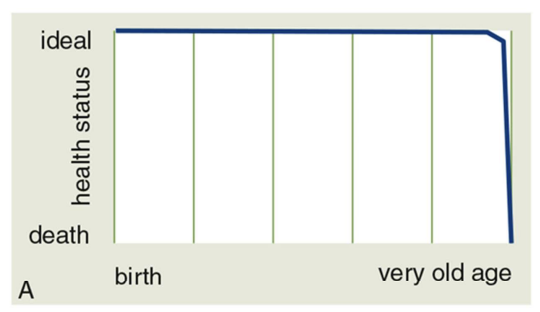
Complete lifespan focus
conception to healthy birth, through to gentle, agony-free death
Ideal health
Countries with High income
can afford high income interventions
Public health vs Medicine
Public Health: Population, Public service, Disease prevention and health promotion for communities, Broad spectrum that may target the environment, human behavior, lifestyle, and medical care
Medicine: Individual, personal service, Disease diagnosis, treatment, and care for individuals, Emphasis on medical care
Motto of John hopkins Bloomberg School of Public Health
Protexting Health, Saving Lives- Millions at a time
Medicine is the practice of
Preventing, diagnosing, and treating health problems in individuals and families
Intervention, treatment of existing problems
Public Health encompasses
The actions taken at the population level to promote health and prevent illnesses, injuries, and early deaths
Emphasizes on prevention
P.A.C.E.S
Populations- (focuses on Preventable deaths)
Action- (Prevent illness)
Cooperation- (Prevent)
Equity- (Prioritizing the needs of low income)
Security-
Risk Factor
an exposure that increases the likelihood of experiencing a particular health outcome
Major Risk Factor DOES NOT EQUAL major cause of death
Health Transition
A health transition is a shift in the health status of a population that usually occurs in conjuction with socioeconomic development
One hundered years ago (health transitions)
Most populations across the globe had similar health profiles: high birth rates high chold mortality rates, short life expectancies, and a considerable proportion of illnesses and deaths due to infections and undernutrition
During the 20th century (Health transitions)
high income nation transitioned to having longer life expectancies and lower rates of infection and chronic hunger
Gaps in Health equity have
Increased
Health → wealth
Globalization
Process of countries around the world becoming more integrated and interdependent across economic, political, cultural, and other domains
Can be both good and bad
Globalization contributes to…
favorable and unfacorable health transitions,
Increasing access to health technologies
encouraging urbanization
Changing social and cultural practives
Accelerating environmental changes
Exploitation ( can also happen)
Global Health security
Public health interventions protect populations from threats to health and safety
Implemented by governmental and military personnel in collaboration with other stakeholders
Countries participating in global health activities reap the benefits of self-protection in addition to the humanitarian gains and goodwill that these activities may generate
Example: Pandemic preparedness and response capabilities
Funding in health interventions
Funding available for health interventions is limited
Advocates for various health problems and solutions
must compete for attention and support, and only the proposals that garner buy-in from well resourced groups are able to move forward
Funding agencies
Each funding agency applies its own criteria for the types of activities that it will support
Priotitization based on
Burden of Disease for/ of particular condition
Statistics: Causal conditions and prevalence
Best Buys
Help many people make meaningful gains in health status
Low cost per person or at a low cost per adverse event averted by the intervention
In general, low-cost primary prevention activities are the most cost-effective interventions
Millennium Development Goals (MDGs)
established in 2000 to be achieved by 2015
Eight Goals with 15 targets
To fight AIDS, TB, and Malaria
MDGs
Eradicate extreme poverty and hunger
Achieve universal primary education
Promote gender equlity and empower women
Reduce child mortality
Inprove matemal health
Combat HIV/AIDS, malaria and othe r diseases
Ensure environmental sustainablitliy
Develop a global partnership for development
Focus on MDGs
Half of extreme poverty and hunger: 1.2 billion people still live on less than $1 a day. (1/2)
Reduce Under-Five Mortality by Two-thirds (2/3)
Reduce maternal mortality by three-quarters (3/4)
Reverse the spread of diseases, especially HIV/ AIDS and Malaria
Sustainable Development Goels (SDGs)
2015
Seventeen Goals (169 targets
meet goals by 2030
All realte to health; directly or indirectly
SDG Goals
Mixed goals for poverty reduction with other targets
SDGs treat health as both a necessary prerequisite for and an outcome of economic growth
Two of the 17 SDGs focus specifically on health (SDG 3) and nutrition (SDG 2)
using 2015 levels as benchmarks
SDG 3
Good health and Well-beig
SDG #2
Zero hunger
Eradicate
world-wide elimination
Cannot return
Smallpox
Eliminate
controlled well in a defined geographic area
Sufficiently to prevent epidemic
example Polio
1998 Pediatric Mortality Macha Mission hospital
Total Deaths= 192
30.13%
2005 Mach childrens ward deaths
Malaria 7%
Anteatal
Pre-natal
Perinatal services
Pregnacy- 1 year
Post Patum services
delivery - 6/8 weeks
Vital Statistics
Population level quantifications
Birthds
Deaths
Other relevatn and useful life events
Numbered affects by disease/ disorder
Vital registrationsystems
Births
Deaths
Casuse of death
Important Health indicators
Infant Mortality rate
Under Five Mortality rate
Infant Mortality Rate
Number of deaths of infants under age 1 per 1,000 live births in that year
Life expectancy at birth
Average number of years a newborn baby could expect to live if current mortality trends continue for the rest of teh newborn’s life
Maternal morality rate
Number of women who die as a reslut of pregancy and childbirth complication per 100,000 live births in a given year
Neonatal mortality rate
Number of death of infants under 28 days in a given year per 1,000 lives births in that year
Under 5 mortality rate (child mortality rate)
Probability that a newborn baby will die before reaching age 5, expressed as a number per 1,000 live births
Birth rate (annual cride live birth rate)
Number of births occurring in a defined population during a year/ number of people in that population at midyear of the same year
Times Hungry
You NEED an accurate census
Mortality
Easier tomeasure the diseases
98% of all children deaths
Verbal Autopsy
look and say what it is
Infant Mortality rate (annual infant mortality rate, IMR)
Number of deaths under one year of age in a defined population during a year / Number of live births occurring in that population during the same year
Times 1,000
It is widely accepted as a good indicator of the health at the POPULATION level
Live birth
is the complete expulsion or extraction from its mother of a product of conception, irrespective of the duration of pregnancy, which, after such separation, breathes or shows any other evidence of life such as beating of the heart, pulsation of the umbilical cord, or definite movement of voluntary muscles, whether or not theumbilical cord has been cut or the placenta isattached; each product of such a birth isconsidered live-born regardless of gestational age
Zambia IMR vs USA IMR
36.6 (2023)
4.9 (2023)
Under five mortality rate (U5MR)
Number of deaths under five years of age in a defined population during a year / Number of live births occurring in that population during the same year
1,000
Maternal mortality Ratio
Number of death from pregnacy (childbirth) in a defined population during a year / 100,000 live births in that population during the same year
Incidence
Used to indicate the burden of a disease over time (usually one year)
The number of new cases of a condition occurring in a defined population (in a year) / Number in that population at midyear of the same year
K
Prevalence (or Point Prevalences)
Indicates burden of disease as a onetime “snap-shot”
Number of cases of a specified condition existing in a defined population at a particular point in time / Number in that population at the same point in time
times K
Epidemiology
Concept of “age or population pyramids”
These help us understand population growth and what factors may influence population growth
Allow for early recognition of changes in life expectancy
Morbidity
Effect by disease
YLL
Years of life lost due to premature mortality
YLD
Years lived with disability
DALY
Disability-adjusted like year
Deaths before old age
Nonfatal cause of reduced health status
QALY
Quality-adjusted life year
Positive metric
Used to measure effectiveness of interventions
Personal level
genes
Gender
age
social
environment
educational level
Health practives and behaviors
health care service availability
Populations are healthiest when
The ability of their members to be healthy is not inhibited by income level, educational level, gender, employment, race, ethnicity, immigration status, or other socioeconomic and political factors.
The Goal of health equity is to:
Reduce the health disparities between low and high-income population
While improving health status in all population groups
Socioeconomic Status (SES) of Socioeconomic Position (SEP)
Individuals standing in a society
Based on individual and houshold income, education, gender, occupation, ethnicity and race, and other characteristics
Individuals
Much variability in health status
Populations and SES
Lower SES populations have significatnly lower heatlh status
Health equity principle
Everone should have an equal opportunity to be as healthy as possible
Social determinants of health
Personal factors and community conditions that enable or hinder access to health
Summarized by the acronym Progress
PROGRESS
Place of residence
Race and ethnicity
Occupation and employment status
Gender and sex
Religion
Education
Social capital
Other (Socioeconomic indicators)
Social Justice Principle
Moving toward greater equality in the distribution of income and wealth, opportunities for education and employment, access to health and security, and involvement in civic and political activities is valuable for human flourishing
Health inequality (real disparity)
Difference between groups; can be remedied
Health inequity
Whent the differnce remains due to unjust/ unfair circulstance
Globalism
Can exacerbate difference and provide opportunities
all benefit via cooperation
Guiding Thesis of Health Equity
When the health status of lower-income countries improves, those health equity gains yield benefits for overall world health
Socioeconomic Determinants
Economics
Education
Gender / sex
Employment
Culture (views related to health)
Discrimination
Movement / Immigration Status (Migrants, Refugees, Internally Displaced Persons
Governments
Income is the
amount of take home pay
wealth is the
accumulated worth of a household resources
Extreme poverty
less then $3
Decreased from 35% in 1990 to 10% in 2025
Relative poverty
occurs when people are living on less than the nationally defined poverty line in their own countries
Multidimensional Poverty Index (MPI)
United Nations Development Programme
Index captures various dimensions of poverty
MPI increases proportion of people classified as living in poverty in lower income countries