4.9 - Task sensitive preferences
 Call Kai
 Learn
Learn Practice Test
 Spaced Repetition
 Match
Match Flashcards
 Knowt Play
1/22

There's no tags or description
Looks like no tags are added yet.
Name | Mastery | Learn | Test | Matching | Spaced | Call with Kai |
|---|
No analytics yet
Send a link to your students to track their progress
23 Terms
Task sensitive preferences
The idea that standard economic preferences are misleading because we assume preferences exist independently
TSP is where you don’t have preferences at all until you have a decision in front of you
Therefore preferences are only formed in light of this decision
‘Constructed preferences’
inherently comparative preferences
deeper sense of comparison required for the formulation of preferences
Cant calculate attractiveness of a lottery unless you have one to compare it to
cant formulate lottery value or its utility
Salience theory and inherently comparative preferences
Agent chooses the option that has the best outcome in the event in which the outcomes of the options differ most
No option assessable without knowing the other option.
Transitivity & lotteries
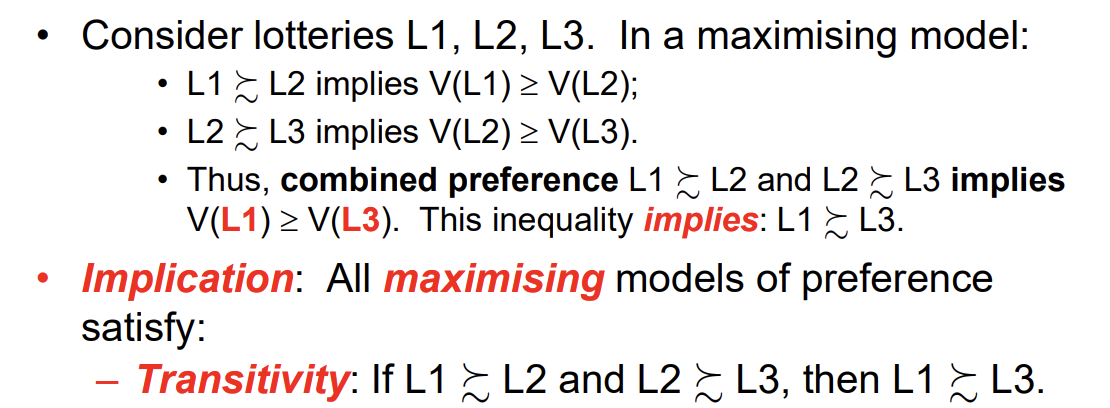
inherently-comparative preferences & Intransitivity: Loomes et al. (1991) - OV
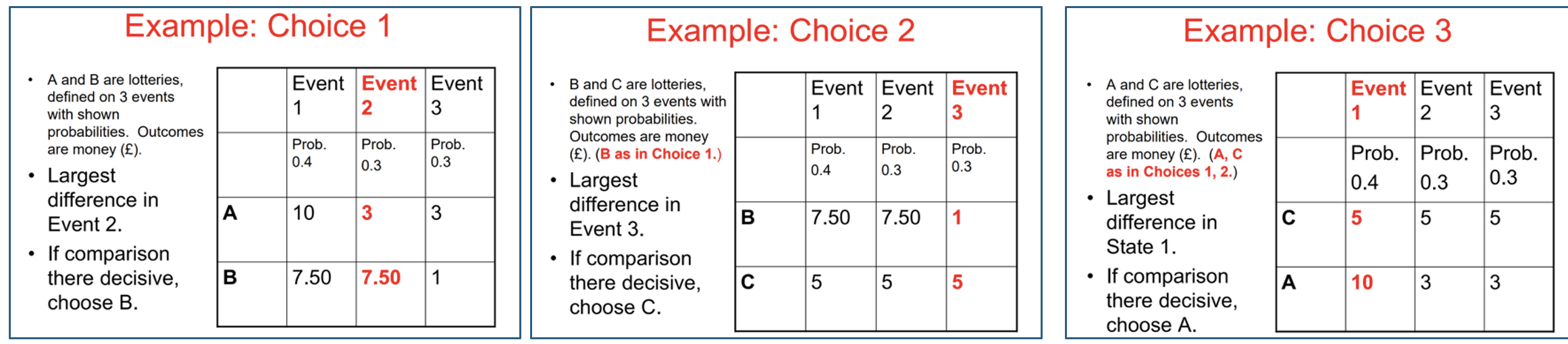
Agent is putting more weight on 1 event in each case but it’s a different one in each 3 choices - relative weights vary across choices even though probability doesnt
Preference cycle only goes in 1 direction if intransitive
Wasnt set up to test salience theory (regret theory & preference reversal - PC in only 1 direction)
inherently-comparative preferences & Intransitivity LSS (1991) - Results
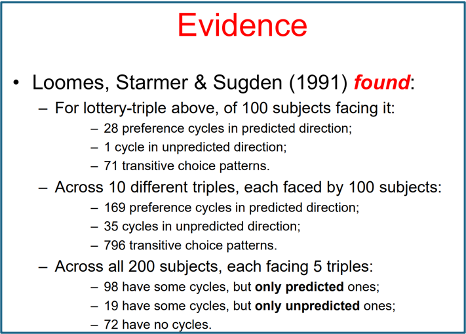
80% had transitive preferences
Of 20% intransitive, majority in predicted direction
of 200 subjects, most had at least 1 cycle of intransitivity
almost ½ of all subjects in predicted direction
inherently-comparative preferences & Intransitivity - LSS (1991) vs other studies
LSS just 1 study - other studies vary in how much intransitivity is found
depends on how decisions presented
LSS set up study to over emphasise events with large outcome differences
Preference reversal
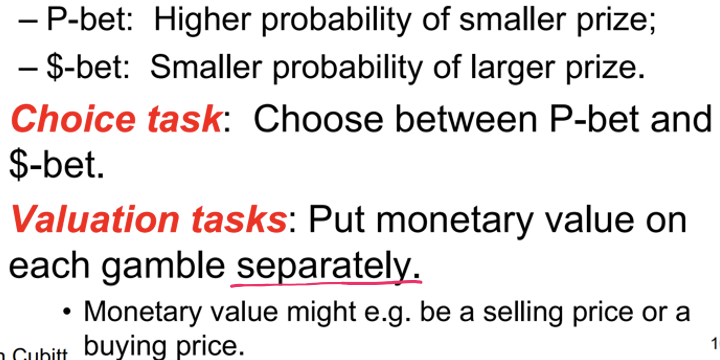
2 choices with similar expected value - Choice depends on risk aversion
Systematic tendency for subjects to choose P-bet in choice task but put higher value on $-bet in the valuation tasks (standard PR)
Observed preference differ when inferred from choice or valuation (buying OR selling L)
PR is highly robust / replicable
not incentive or inexperience cause
Cubitt et al. / CMS (2004) - OV
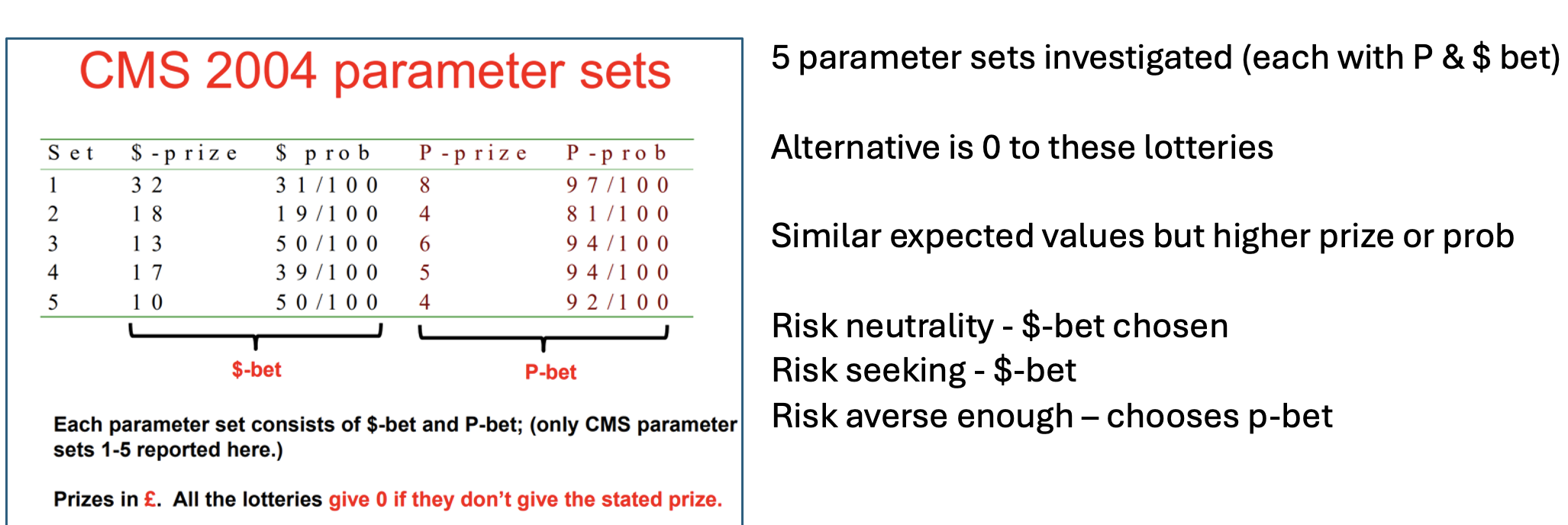
CMS (2004) - Results
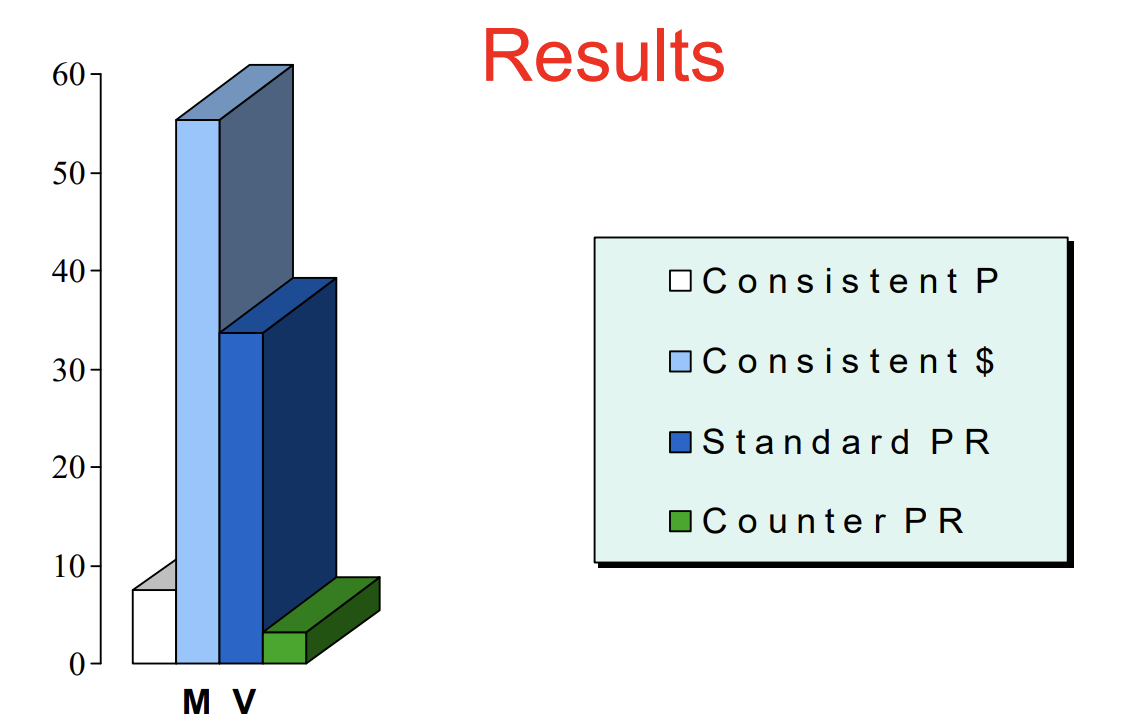
MV - Monetary value
Sum of left 2 (consistent) – just over 60%
~40% committed either reversal - Standard PR more frequent
Almost no preference reversal if $-bet chosen in choice task
Extensive evidence that PR is robust
PR scepticism
PR first seen in 1960-70s by Slovic & Lichtenstein
Both lab + field (casinos in Las Vegas)
Economists initially sceptical – lots of criticism
Grether & Plott criticised a lot and tried to repeat on their own
Found PR in own experiment – overwhelming majority shown when choosing p-bet
“Taken at face value, the data are simply inconsistent with preference theory ….. . The inconsistency …. suggests that no optimisation principles of any sort lie behind even the simplest of human choices.”
PR causes
Incentives
Procedure invariance
Intransitivity - PR without PI violation
Regret aversion (Salience T sorta reason)
Loss aversion (Sugden 2003)
Scale-Compatibility hypothesis (Tversky et al. 1988)
Procedure invariance
Preferences are unaffected by the procedures used to elicit them
Preferences are independent of the tasks they face
PR as Artefact of incentives
Within-subjects design usually used, so need to incentivise all tasks without distorting them
1 random round (RLIS) incentive or BDM mechanism
assumes independence axiom and subject will ignore the other tasks when making a choice
if PR found then D-Q problem says RLIS may have distorted choices (no clean explanation)
These incentive structures are valid experimental procedures if subjects rely on EUT → PR could just be regular Allais paradox interacting with incentive structure
use an OPS to get around this
PR as Violation of assumption of Procedure Invariance
Elicited preferences depend on how they are elicited
Valuation vs choices give different preference
PI vs intransitivity test
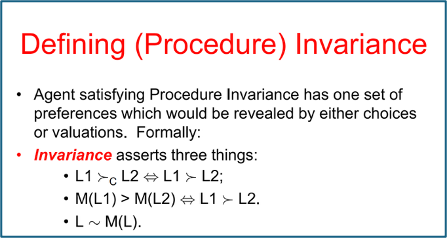
>c = strict preference revealed by a choice
Standard PR: P >c $ BUT M($) > M(P)
If subject displays PR & satisfies PI then subject must have PC
P > $ ~ M($) > M(P) ~ P
Therefore PR caused by intransitivity
Tversky et al. (1990) - OV
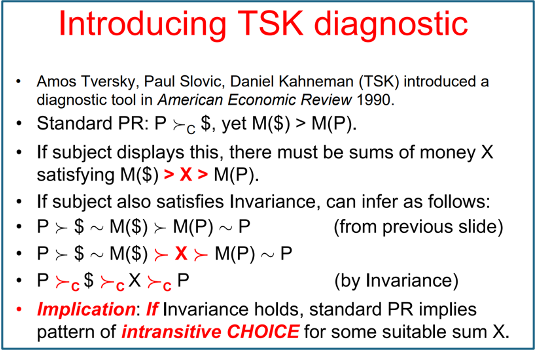
use X as sum of money between M($) & M(P)
Then give agent option of X & M(…) or P/$
If subject satisfies PI but also shows PR then must be intransitive preferences
Used OPS to avoid independence axiom but Cubitt et al. showed that still requires it at the meta level
TSK (1990) - RESULTS
TSK find only 10% explained by this – intransitivity not main cause
preference cycle in majority predicted direction
Sugden (2003) - OV and results
Theoretical paper
In choice task preferences elicited with reference that subject owns neither lottery
in valuation the subject ‘owns’ one of the L - gives their WTA to sell it
losing $-bet is a bigger ‘loss’ than P-bet
Loss aversion causing the higher valuation of $-bet
Scale-Compatibility hypothesis (Slovic et al. 1990)
The way in which an individual is required to respond to a task can affect the weights that he or she places on particular dimensions of alternatives being evaluated
valuation tasks require a money amount as output → individuals place particularly high (low) weight on the money (probability) dimension
leads to inflated $-bets
Chu & Chu (1990) - OV and Results
Exposed preference reversers to ‘money pumps’
had their stated preferences implemented across a series of trades
Experimenter used arbitrage of their choice and valuation which ultimately resulted in monetary losses if PR chosen
Led to PR being avoided quickly
Market experience of 1 PR gamble also carried forward to other PR gambles → PR avoided
PR and monetary payoffs - Slovic et al. (1990)
Prevalence of PR is substantially reduced by using nonmonetary payoffs
more PR also found with real payoffs compared to hypotheticals
PR and time preferences
PR still found when looking at dynamic problems
Tversky et al. (1990) studied choices between delayed payments
found people chose the shorter delay option but valued the longer delay one higher