BIOL142 - Chapter 40: Basic Principles of Animal Form and Function
 Call Kai
 Learn
Learn Practice Test
 Spaced Repetition
 Match
Match Flashcards
 Knowt Play
1/103

Earn XP
Description and Tags
Key objectives: Correlation between animal form (anatomy) and function (physiology), Identification of the four major types of animal tissues, Feedback control mechanisms maintain the internal environment, Homeostatic process for thermoregulation involve form, function, and behavior
Name | Mastery | Learn | Test | Matching | Spaced | Call with Kai |
|---|
No analytics yet
Send a link to your students to track their progress
104 Terms
What is the definition of “anatomy?”
The biological form of an organism
What is the definition of “physiology?”
The biological functions an organism performs
T or F: Form and function are closely related.
A complex body plan helps an animal living in a variable environment to maintain a relatively ________.
stable internal environment
What enables animals to have sufficient exchange with the environment?
Specialized, extensively branched, or folded structure (evolutionary adaptation)
In animals, what is the space between cells filled with and what is its function?
Interstitial fluid, which links the exchange surface to body cells
Why must cells stay small or have thin, folded shapes?
As cells grow, volume increases faster than surface area, and staying small ensures that the cell has enough surface to support its volume
In a cell, what is the rate of exchange proportional to?
Rate = Surface area
In a cell, what is the amount of material proportional to?
Amount = Volume
How does a multicellular Hydra ensure all its cells can exchange materials?
It has a hollow body —> both its inner and outer layers of cells are in direct contact with water
What is the hierarchical organization of body plans?
Cells —> Tissues —> Organs (systems)
What are the 8 main components of the digestive system?
Mouth, pharynx, esophagus, stomach, intestines, liver, pancreas, and @nus
Functions of the digestive system:
Food processing (ingestion, digestion, absorption, and elimination)
What are the 3 main components of the circulatory system?
Heart, blood vessels, and blood
Functions of the circulatory system:
Internal distribution of materials
What are the 3 main components of the respiratory system?
Lungs, trachea, and other breathing tubes
Functions of the respiratory system:
Gas exchange (uptake of oxygen, disposal of carbon dioxide)
What are the 5 main components of the immune and lymphatic system?
Bone marrow, lymph nodes, thymus, spleen, and lymph vessels
Main functions of the immune and lymphatic system:
Body defense against infections and virally induced cancers
What are the 4 main components of the excretory system?
Kidneys, ureters, urinary bladder, and urethra
Main functions of the excretory system:
Disposal of metabolic wastes, regulation of osmotic balance of blood
What are the 5 main components of the endocrine system?
Pituitary, thyroid, pancreas, adrenal, and other hormone-secreting glands
Main functions of the endocrine system:
Coordination of body activities (like digestion and metabolism)
What are the 2 main components of the reproductive system?
Ovaries/testes and associated organs
Main functions of the reproductive system:
Gamete production, promotion of fertilization, and support of developing embryo
What are the 4 main components of the nervous system?
Brain, spinal cord, nerves, and sensory organs
Main functions of the nervous system:
Coordination of body activities, detection of stimuli and formulating responses to them
What are the main components of the integumentary system?
Skin and its derivatives (hair, claws, sweat glands)
Main functions of the integumentary system:
Protection against mechanical injury, infection, dehydration, and thermoregulation
What are the main components of the skeletal system?
Skeleton (bones, tendons, ligaments, cartilage)
Main functions of the skeletal system:
Body support, protection of internal organs, and movement
What are the main components of the muscular system?
Skeletal muscles
Main functions of the muscular system:
Locomotion and other movement
What are the 4 main types of animal tissue?
Epithelial, connective, muscle, and nervous
Function of epithelial tissues:
Covers the outside of the body and lines the organs and cavities within the body; contains cells that are closely joined
What are the 3 shapes of epithelial cells?
Squamous: flat/thin
Cuboidal: cube-shaped
Columnar: tall columns
Function of squamous epithelial cell:
Rapid diffusion (makes things easy to pass through) & protection (outer layer of skin prevents water loss and infection)
Function of cuboidal epithelial cell:
Secretion of substances - salivary gland and pancreas (enzymes, mucus, hormones)
Function of columnar epithelial cell:
Secretion of substances and absorption of nutrients (microvilli increases surface area, intestine)
What is the function of the Simple epithelial layer, and where can it be found?
Has 1 single later and is for efficient exchange (intestine, lungs)
What is the function of the Stratified epithelial layer, and where can it be found?
Has multiple stable layers for protection (skin)
What is the function of the Pseudostratified epithelial layer, and where can it be found?
Has 1 layer that looks like many because of varying lengths and transports mucus/trapped particles (trachea)
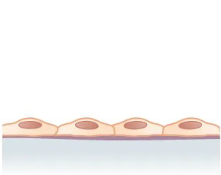
What the shape and layer of this epithelial tissue?
Simple squamous
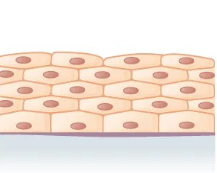
What the shape and layer of this epithelial tissue?
Stratified squamous
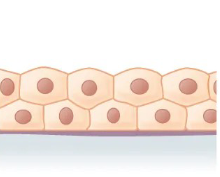
What the shape and layer of this epithelial tissue?
Stratified cuboidal
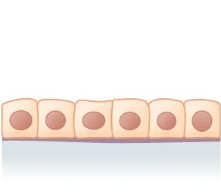
What the shape and layer of this epithelial tissue?
Simple cuboidal
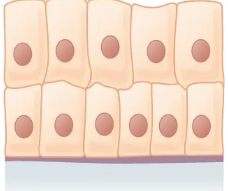
What the shape and layer of this epithelial tissue?
Stratified columnar
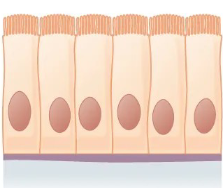
What is the shape and layer of this epithelial tissue?
Simple columnar
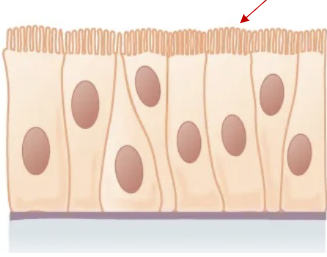
What is the shape and layer of this epithelial tissue?
Pseudostratified columnar
Function of connective tissue:
Binds and supports other tissues and contains sparsely packed cells scattered throughout an extracellular matrix
What does the extracellular matrix (ECM) consist of?
Fibers in a liquid, jelly-like, or solid foundation
What are the 5 types of connective tissues?
Loose connective tissue, dense connective tissue, cartilage, bone, and blood
Which connective tissue is built by fibroblasts?
Loose and dense connective tissues
Which tissue is built by chondroblasts?
Cartilage
Which tissue is built by osteoblasts?
Bone
What is the ECM of blood?
Plasma
3 types of connective tissue FIBERS:
Collagenous fiber, reticular fiber, and elastic fiber
Function of collagenous fibers:
Provides strength and flexibility
Function of reticular fibers:
Joins connective tissue to adjacent tissues
Function of elastic fibers:
Stretch and returns to their original length and shape
Features and functions of collagenous fiber bundles (loose connective tissue):
Loosely packed, more ground substances, many cells, soft and flexible (binds tissues, provides cushioning, supports immune defense, allows diffusion of nutrients), and areolar/adipose tissue
Features and functions of fibrous connective tissue:
Densely packed, less ground substances, fewer cells. strong and resistant to tension (provides high tensile strength, resists pulling forces), tendon (muscle to bone)/ligament (bone to bone)/dermis (blood vessel)
Features of central canal:
(located in bone), small channel at the center of an osteon, containing blood vessels and nerves; supports nutrient and oxygen, removes waste, communication pathway within bone
Features of osteon:
(located in bone), structural unit of compact bone, provides strength and organization, distributes mechanical stress among bone
Features of chondrocytes:
Living cells in cartilage, found in lacunae and produces and maintains cartilage matrix, including collagen fibers and proteoglycan
Features of plasma:
Liquid portion of blood (55% of blood volume), transports nutrients, hormones, and waste products
Features of white blood cells:
Larger and fewer than RBCs, immune defense and can leave bloodstream
Features of red blood cells:
packed with hemoglobin and no nucleus
What is muscle tissue responsible for?
For nearly all types of body movement
What do muscle tissues consist of?
Filaments of the protein actin and myosin, which together enables muscles to contract
What are the 3 types of muscles?
Skeletal, smooth, and cardiac
What is the skeletal muscle (or striated muscle) responsible for?
Voluntary movement
What is the smooth muscle responsible for?
Involuntary body activities
What is the cardiac muscle responsible for?
Contraction of the heart
What is a sarcomere?
The smallest functional unit of striated skeletal muscle, consisted of actin and myosin
What happens during contraction?
Actin slides over myosin and sarcomere shortens
What is the first thing that happens when a nerve signal reaches a muscle fiber?
Acetylcholine (Ach) is released, which causes the Sarcoplasmic Reticulum to release Calcium ($Ca^{2+}$).
What is the specific role of Calcium in the sliding filament theory?
It binds to Troponin, causing Tropomyosin to move away and expose the binding sites on Actin.
Describe the "Power Stroke."
The Myosin head pivots and pulls the Actin filament toward the M line, shortening the sarcomere. $ADP$ and $Pi$ are released.
What causes the Myosin head to detach from the Actin?
A new ATP molecule binds to the Myosin head. (Note: Without new ATP, the muscle stays contracted).
How is the Myosin head "reactivated" or re-cocked?
ATP is broken down (hydrolysis) into $ADP$ + $Pi$, providing the energy to reset the Myosin head to its high-potential position.
The contraction cycle will continue repeating as long as which two substances are available?
1. Calcium (to keep binding sites open) 2. ATP (to power the attachment, pull, and release).
What happens during Muscle Relaxation?
Nerve stimulation stops, Calcium is pumped back into the Sarcoplasmic Reticulum, and Tropomyosin moves back to cover/block the binding sites on Actin.
What do nervous tissues contain and what is tis fucntion?
Neurons or nerve cells, which transmit nerve impulses
What do organisms use to maintain a “steady state” or internal balance regardless of external environment?
Homeostasis
Features of negative feedback
Helps to return a variable to a normal range, and homeostasis in animals rely on this
Features of positive feedback:
Amplifies a stimulus and does not usually contribute to homeostasis in animals
Features of thermoregulation:
The process by which animals maintain and internal temperature within a normal range
Features of endothermic animals:
Generates heat by metabolism (birds/mammals)
Features of ectothermic animals:
Gain heat from external sources (most invertebrates, fishes, amphibians)
What 4 physical processes do organisms use to exchange heat?
Radiation, evaporation, convection, and conduction
What region of the brain controls thermoregulation in mammals, and what does it do?
The hypothalamus; triggers heat loss or heat generating mechanisms
What are the 5 adaptations that help animals thermoregulate?
Insulation, Circulatory adaptations, cooling by evaporative heat loss, behavioral responses, and adjusting metabolic heat production