[D.1] WOOD AND WOOD FINISHES (copy)
 Call Kai
 Learn
Learn Practice Test
 Spaced Repetition
 Match
Match Flashcards
 Knowt Play
1/85

There's no tags or description
Looks like no tags are added yet.
Name | Mastery | Learn | Test | Matching | Spaced | Call with Kai |
|---|
No analytics yet
Send a link to your students to track their progress
86 Terms
Timber
Uncut log; not yet usable for construction
Lumber
Timber sawn or split in the form of beams, boards, joists, planks. Material bought in the hardware store
Softwood
Any light, easily cut wood; cone bearing or coniferous; needle-leafed, usually evergreen trees
Hardwood
Any tough, heavy timber with a compact texture; any deciduous or broad-leafed tree (any tree that loses its leaves annually). Dominant feature is its presence of pores or vessels
Parts of a Tree Trunk
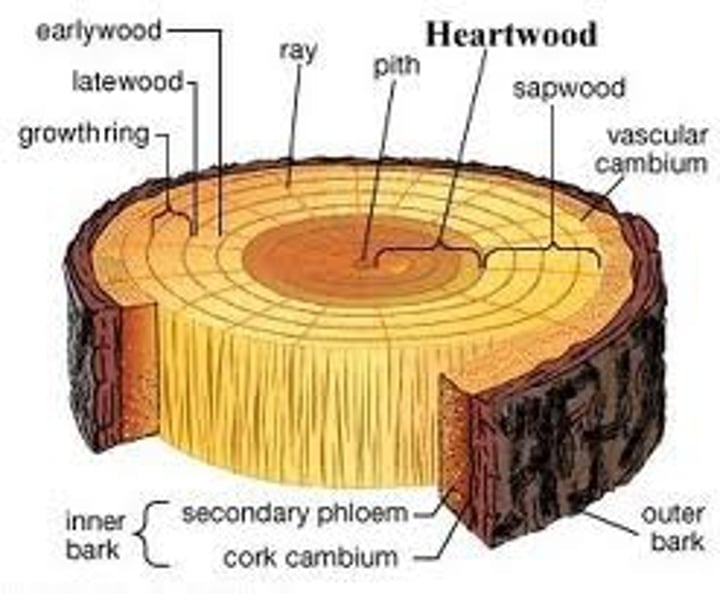
Pith
Part of a tree trunk; hardest part of a tree; center or core
Heartwood
Part of a tree trunk; older, darker part of the trunk surrounding the center of the log
Sapwood
Part of a tree trunk; younger, light-colored wood just beneath the bark of the tree
Earlywood
Part of a tree trunk; spring wood; lighter and lower density compared to latewood
Latewood
Part of a tree trunk; summer wood; darker and more dense
Medullary Rays
Part of a tree trunk; brings nutrients and water to the tree
Natural Drying
Commonly called air-drying or sun-drying. Lumber is strip-piled at the slope on a solid foundation to allow air to circulate around every piece while sloping allows water to run off quickly
Kiln Drying
Places the stacks of sawn timber in a kiln, to reduce the moisture content in wood, where the heat, air circulation, and humidity is closely controlled
S1S
Surfaced one side; used for framing
S2S
Surfaced two sides; used for framing
S4S
Surfaced four sides; often used for parts with exposed sides and carving details
Nominal Size
The size of lumber when it is cut from the log; before it is planed down to s1s, s2s, s4s
Actual Size
Dimensions of lumber after it has been dressed or surfaced
Board Foot
A unit of measurement for lumber that equals 1'' x 12'' x 12”; refers to the nominal size of a dressed lumber

Straight Grain
Fibers running in the same direction as the main axis of the tree
Inter-locked Grain
Grains are in successive layers and in opposite direction
Wavy or Curly Grain
Constantly changing in orientation so that a line drawn parallel to their direction appears as wavy lines
Plain/Tangential or Flat Grain
When wood is cut parallel to the grain direction and tangent to the growth rings
Quarter or Radial Grain
When board is cut parallel to the grain direction but through the radius of the growth rings
End Grain
When board is cut across the grain (perpendicular to the grain direction and the growth rings)
Plain Sawing
Method of sawing lumber; the most common method because it produces the highest quantity of usable lumber. Shows flat grain on their faces and quarter grain on the edges
Quarter Sawing
Method of sawing lumber; cuts the log quarters then slices each quarter into boards. Shows mostly quarter grain or their faces and flat grain on the edges
Live Saw
Method of sawing lumber; sometimes called sawing through and through. Shows mostly mixed grain; flat grain near the center of the face and quarter grain near the edges
Natural Wood Defects
Acquired defects in wood occasioned by seasonal checks, insect, and fungal attack
Artificial Wood Defects
Defects caused by incorrect sawing and seasoning
Knots
Natural wood defect; basal stumps of incipient or cast-off branches in the living tree
Pin Knots
Grade of knots; small knots 1/2” (12.5mm) or under, caused by the shedding of early branches. Usually allowable in prime timber
Spike or Splay Knots
Grade of knots; knots sliced through their length during sawing, and commonly known as “slash” knots
Encased Knots
Grade of knots; dead knots which are still sound and difficult to dislodge, often ringed with resin in softwood
Branched Knots
Grade of knots; two or three knots springing from a common center
Shakes
Natural wood defect; the medullary ray and springwood cells of ring-porous hardwoods are weaker than the remainder, and built-in tensions are created which tend to level out, either in the growing tree under certain adverse conditions or in the felled tog during seasoning. Thus extensive splitting may occur in the weakest links
Radial Shakes
Form of shakes; log splits from the pith or heart radially along the medullary rays, usually indicating that the tree has passed its prime
Frost Shakes
Form of shakes; project inwardly from a definite frost rib on the cambium and is the result of severe weather
Tangential Shakes
Form of shakes; the soft springwood splits away from the harder summerwood either during seasoning or through shearing stress
Cross Shakes
Form of shakes; caused by compression and not by splitting or shearing, while the actual rupture is across the grain and not with it as with all other shakes
Pitch Veins or Pitch Pockets
Natural wood defect; sometimes known as resin pockets, they can appear either as thin veins or shallow cavities filled with resin. Usually caused by damage to the cambium layer
Pitch Flecks
Natural wood defect; repeated damage to the cambium layer by small insects is often healed over with hark and may show small dots or patches of brown cork deeply buried in some woods, notably birch alder and sycamore
Rind Galls
Natural wood defect; patches of ingrown bark caused by exterior damage to the growing tree
Internal Sapwood
Natural wood defect; the wood usually separates and breaks away along the ring during conversion
Burls or Burrs
Natural wood defect; caused either by fungal or insect attack irritating the cambium layers or by small twigs which fail to develop owing to insufficient nourishment, forming a dense mass
Callus
Natural wood defect; tissue formed over a wound in a tree resulting in unnatural growth incorporated in the normal wood growth
Canker
Natural wood defect; caused by fungoid disease
Catface
Natural wood defect; a partially heated fire scar
Cupping or Rounding
Artificial wood defect; the plank hollows across the width, forming a rounding on the underface, often due to incorrect piling
Bowing
Artificial wood defect; the plank is curved like a bow throughout its length
Springing
Artificial wood defect; sometimes known as edge bend. The wood remains flat but bends edgewise on its own plane
Twisting
Artificial wood defect; the plank twists on its longitudinal axis with the result that the long edges are straight but the diagonals are curved. Known as “in winding”
Warping or Casting
Artificial wood defect; synonymous terms for distortion in one or more directions
End Splitting
Artificial wood defect; the butt end of the plank splits open, usually caused by too rapid drying, but some species will always split
Sun Checking
Artificial wood defect; the wood surface is covered with small splits along the grain caused by too rapid drying in hot sun
Flaking
Artificial wood defect; the surface of the wood lifts in innumerable small flakes or layers which spring under the cutting action, preventing a smooth surface
Diagonal Grain
Artificial wood defect; the grain runs obliquely to the longitudinal axis, usually due to incorrect sawing
Case Hardening
Artificial wood defect; if the wood dried too quickly then the surfaces dry out at a rate quicker than the rate of movement of moisture by capillary attraction from the plank
Honeycombing
Artificial wood defect; if the KD of the case-hardened timber is continued to dryness then the natural shrinkage movement of the moist interior as it dries will be locked in by the rigid outer skin, resulting in sever internal stress and subsequent disruption of the wood fiber, not visible from the outside
Collapse
Artificial wood defect; characterized by extensive shrinking and warping, particularly in springwood, giving a washboard effect
Wood Finishes
These are applied to wood for its protection and to enhance grain structure or alter its wood application
Transparent Finishes
Emphasize and enhance the charm of natural wood color and grain
Penetrating Finishes
Soaks into the wood pores to give a natural look and feel
Surface Coating
Seals wood pores for protection against water and other destructive elements
Clear Lacquer
Made from resin dissolved in ethyl alcohol; it forms a high gloss film on the surface when dried
resin + ethyl alcohol
Varnish
Gives relatively hard, tough and elastic finish
resin + oil
Shellac
Spirit varnish, made by dissolving purified lac flakes in denatured alcohol
lac flakes + denatured alcohol
Oil Stain Finish
Finish using boiled linseed oil and various other oils
Polyurethane Finish
Transparent plastic finish. Very tough, hard and flexible finish. Has superior resistance to chipping, abrasion and dirt retention; used in flooring
Wax or Films
Achieved by brushing, rubbing or spraying processed fatty acids from animals and vegetables, mineral sources combined with alcohol
Wood Stain Finish
Dyes or pigments suspended in water or oil. it alters coloring the wood or accentuates its natural color without covering the grain
Bleach Finish
Lightening the wood color achieved by applying one of the various acids and chlorine compound pertained to as bleaching agents
Chlorinated Laundry Bleach
Comparatively weak, excellent for removing chemicals, dyes, ink and water stains from wood surface if used full strength
Oxalic Acid
Best bleach to use not only on natural wood colors but also on many water and chemical stains
Two-solution Bleach
Fairly expensive and extremely strong. Brings out light tones on dark wood
Opaque
Gives a solid finish for protection and decoration
Paints and Enamels
A mixture of a solid pigment suspended in a liquid vehicle
Pigment
A finely ground, insoluble substance suspended in a liquid vehicle to impart color and opacity to a paint
White Pigment
Pigment; either white lead, oxide, lithophane or titanium
Colored Pigments
Pigment; derived from minerals or clay
Extenders
Pigment; whitting, talc, and silica
Vehicles
A nonvolatile fluid in which the solid body material is suspended
Drying Oils
Vehicles; linseed oil, tung oil, soybean oil, or fish oil
Thinners
A volatile liquid used to dilute paint or varnish to the desired or proper consistency for ease in application
Driers
Added to the paint to accelerate the oxidation and hardening of vehicle
Fanciful Finishes
Effects such as antique finish, crackle or crazed finish, wrinkle finish, and others