C. Developmental Theories
 Call Kai
 Learn
Learn Practice Test
 Spaced Repetition
 Match
Match Flashcards
 Knowt Play
1/75

There's no tags or description
Looks like no tags are added yet.
Name | Mastery | Learn | Test | Matching | Spaced | Call with Kai |
|---|
No analytics yet
Send a link to your students to track their progress
76 Terms
Behavioral Theories
Designed to explain the development of specific behaviors and suggest their relationship to other developing social skills.
Psychodynamic Theories
Focus on personality-trait development and psychological challenges at different ages.
Cognitive Theories
Focus on advancement of the development of thinking.
Humanist Theories
Describe the influence of human experiences such as love and attachment on behavior and personality development.
Sociocultural Theories
Describe how culture influences behavior.
Importance of Understanding Developmental Theories
Changes in physiology, psychology, and behavior that occur normally at different stages in the lifespan.
Factors Influencing Behavior
Behaviors influenced by culture, environment, past experiences, family, health status, and the reaction of the individual.
Freud's Theory of Psychosexual Development
Identified three interacting parts of a person's psychological functioning.
Id
Present at birth, unconscious, represents biological drives and demands instant gratification.
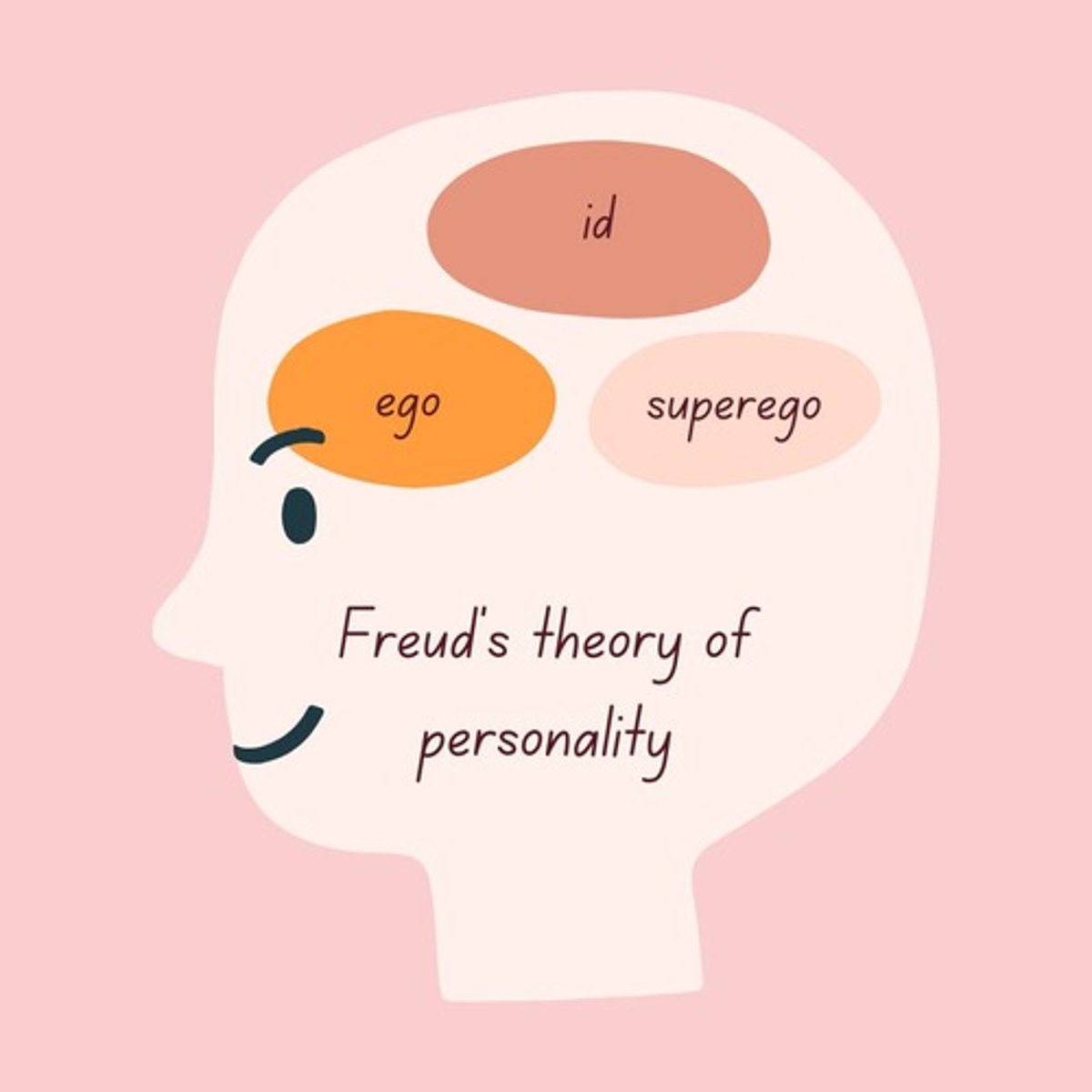
Ego
Conscious sense of self that seeks gratification by avoiding social disapproval.
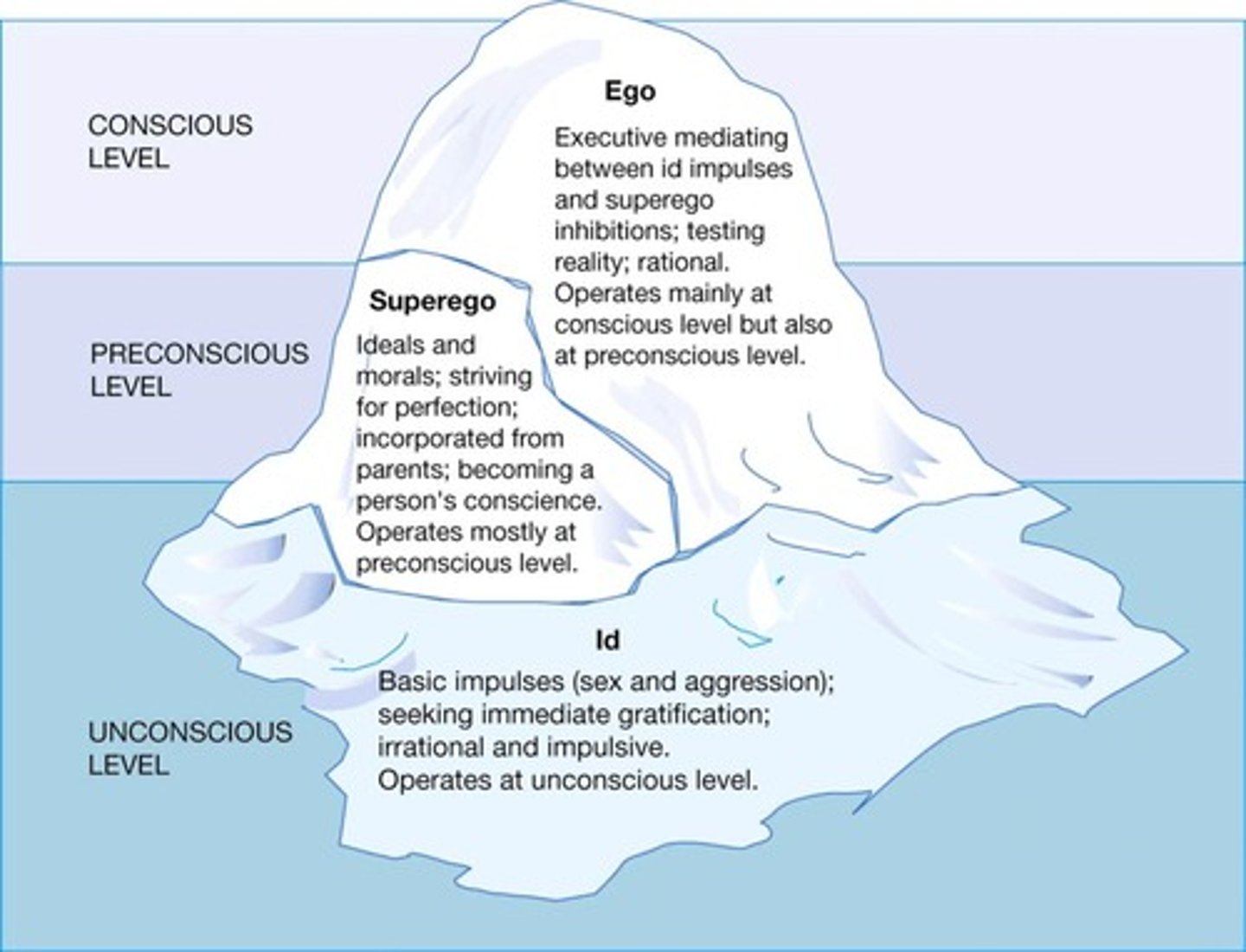
Superego
Internalizes the wishes and morals of a child's caregivers and behavior of ego.

Oedipus Complex
Arises during the phallic stage of development (age 3-6 years) where little boys compete with their fathers for their mother's attention.
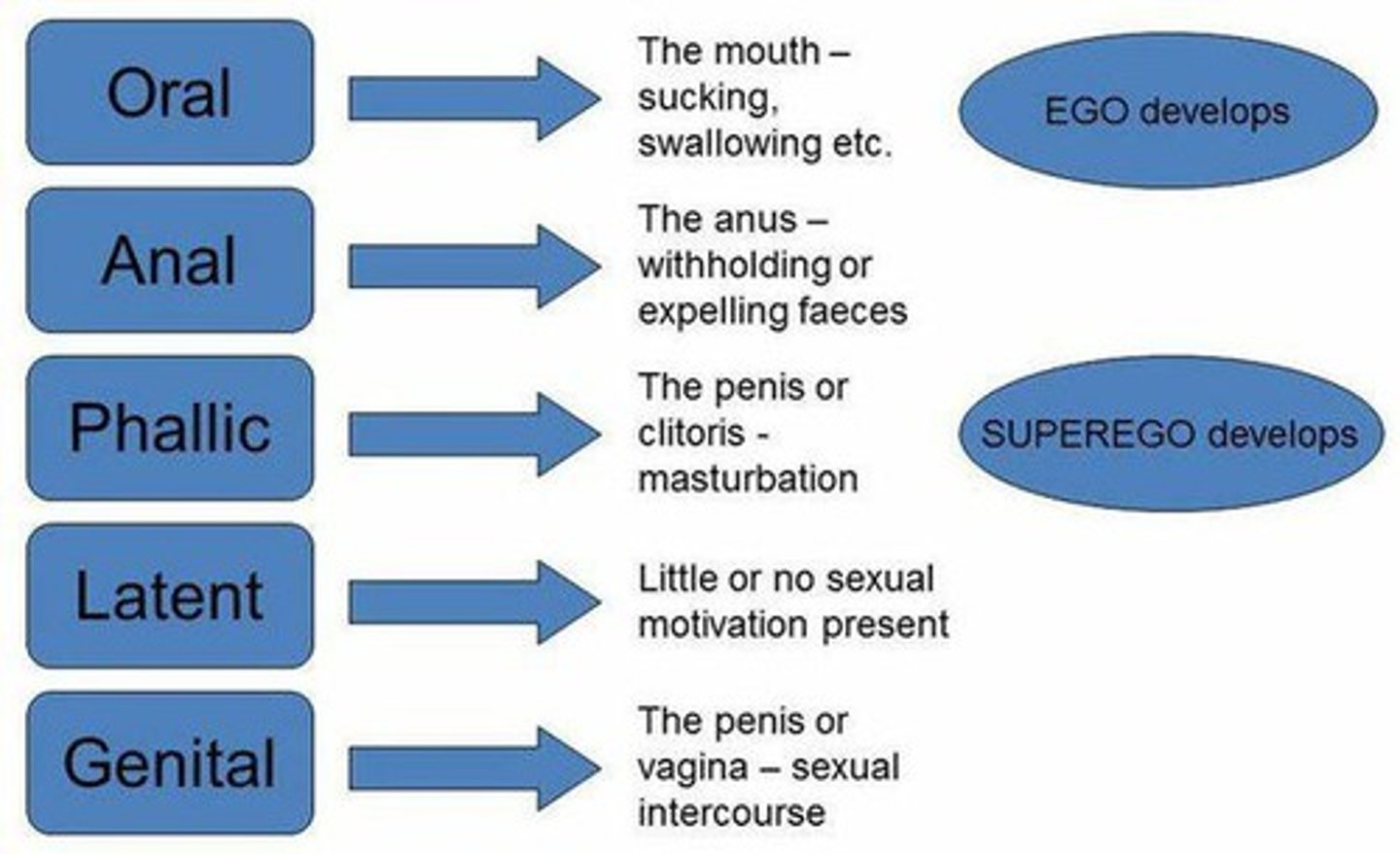
Electra Anxiety
Occurs when little girls compete with their mothers for the love and attention from their fathers.
Carl Jung's Personality Traits
Believed that development extended into adulthood at the age of 40 known as the 'noon of life'.
Introvert
A quiet person who focuses inwardly on self.
Extrovert
An outgoing person who focuses on others in the environment.
Self-Actualization
Recognizing one's own talent.
Psychosocial Theory (Erik Erikson)
Describes a part of personality development that are dependent on social environment and social interactions.
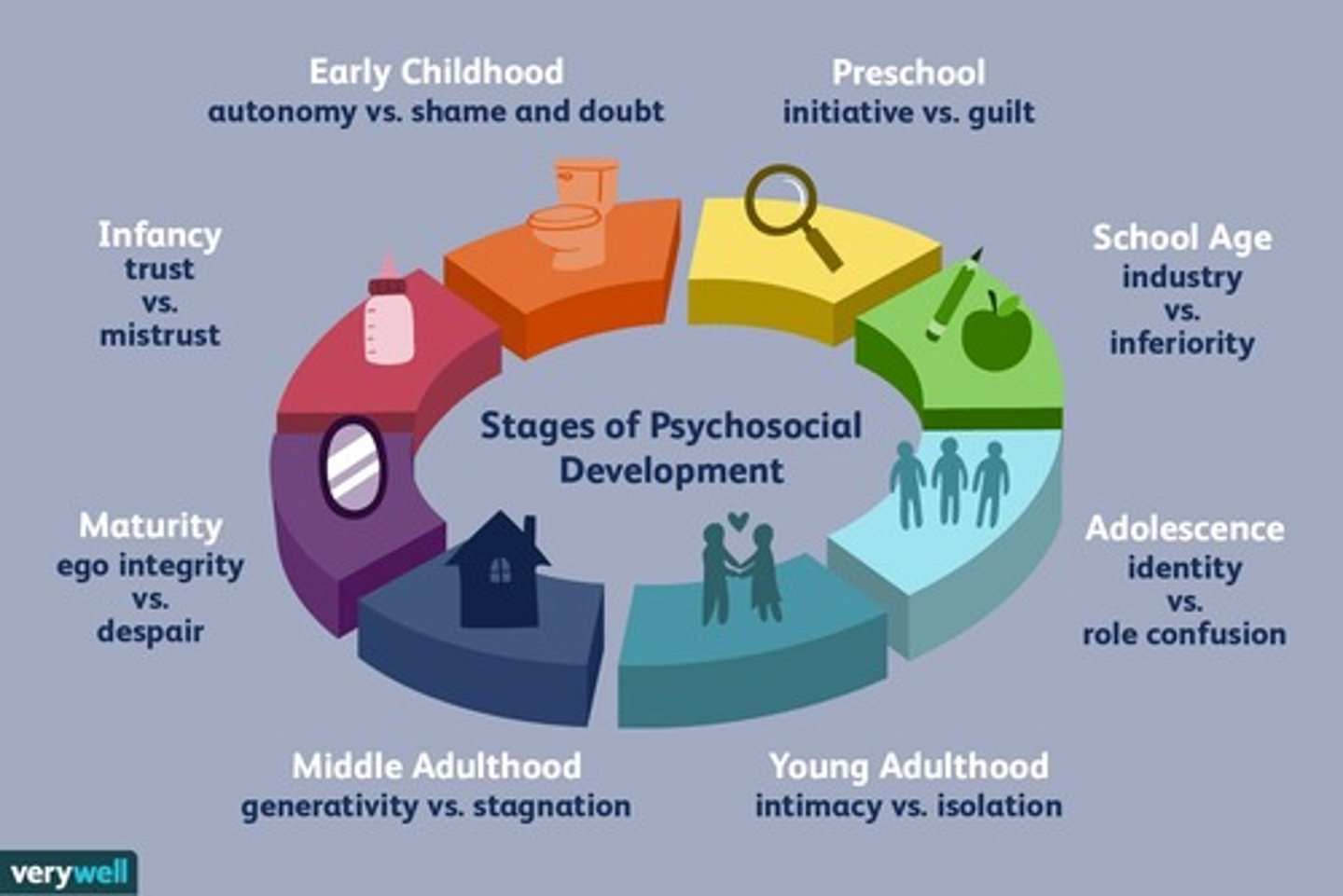
Identity Crisis
Period of inner conflict during which one examines one's values and makes decisions about one's life roles.
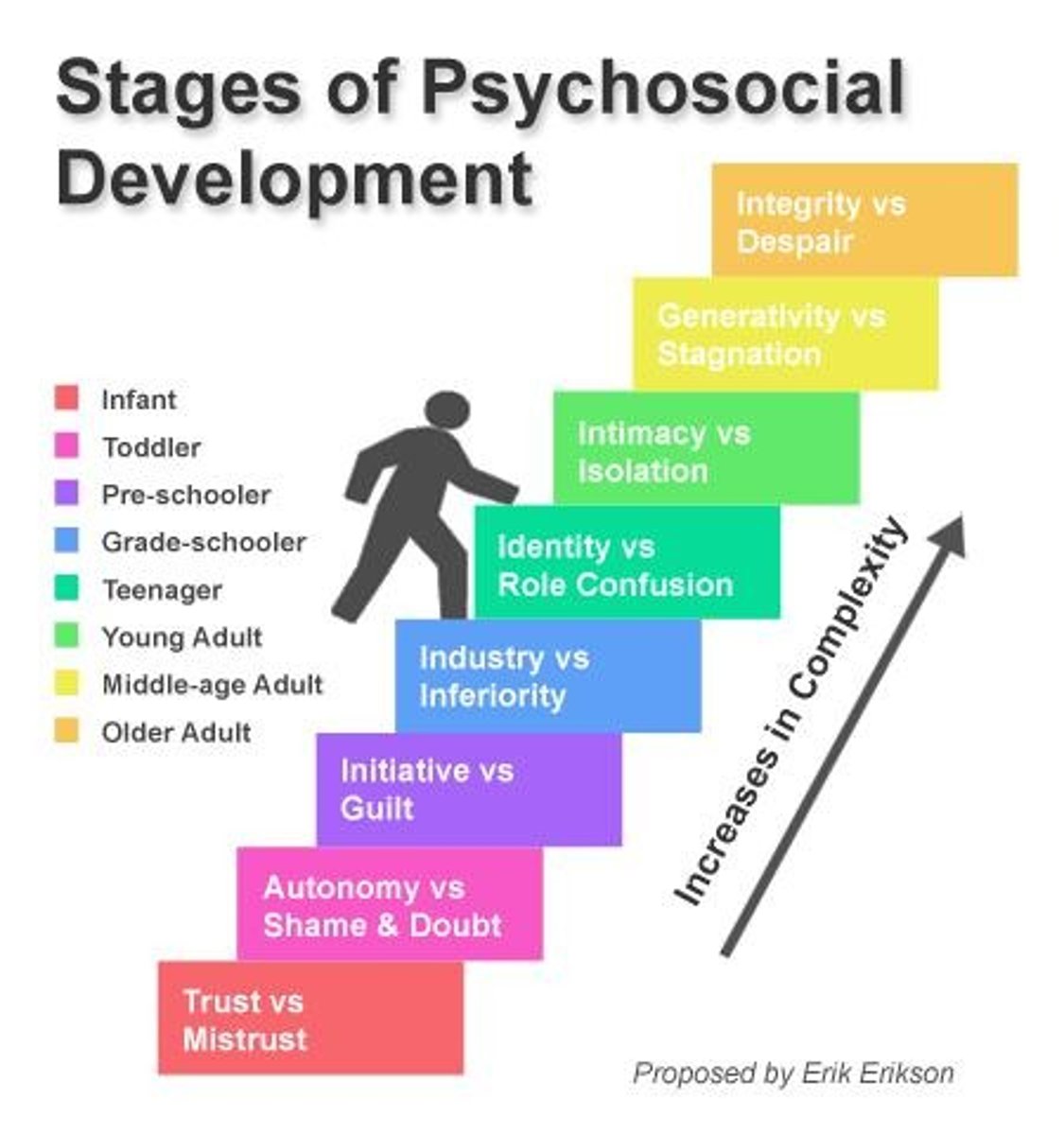
Evaluation of Erikson's Theory
Places emphasis on the importance of human consciousness and choice.
Daniel Levinson's Theory
Believed that an interaction among environment, culture, and the individual was the 'fabric of life'.
Pre-Adult Stage
Ages 17-22, the pre-adult first leaves the protection of the family.
Early Adult Stage
Ages 22-44, at the height of vigor and vitality making important choices.
Middle Adult Stage
Ages 45-65, a transition phase with a gradual decrease of mental and physical functioning.
Late Adulthood
Grandparent generation whose task is to define new goals and levels of involvement with family, friends, and community.
Late-Late Adult
Involves tasks of facing death, although the individual often continues to be socially interactive.
Cognitive Theory (Jean Piaget)
A Swiss psychologist who emphasizes cognitive milestones in development.
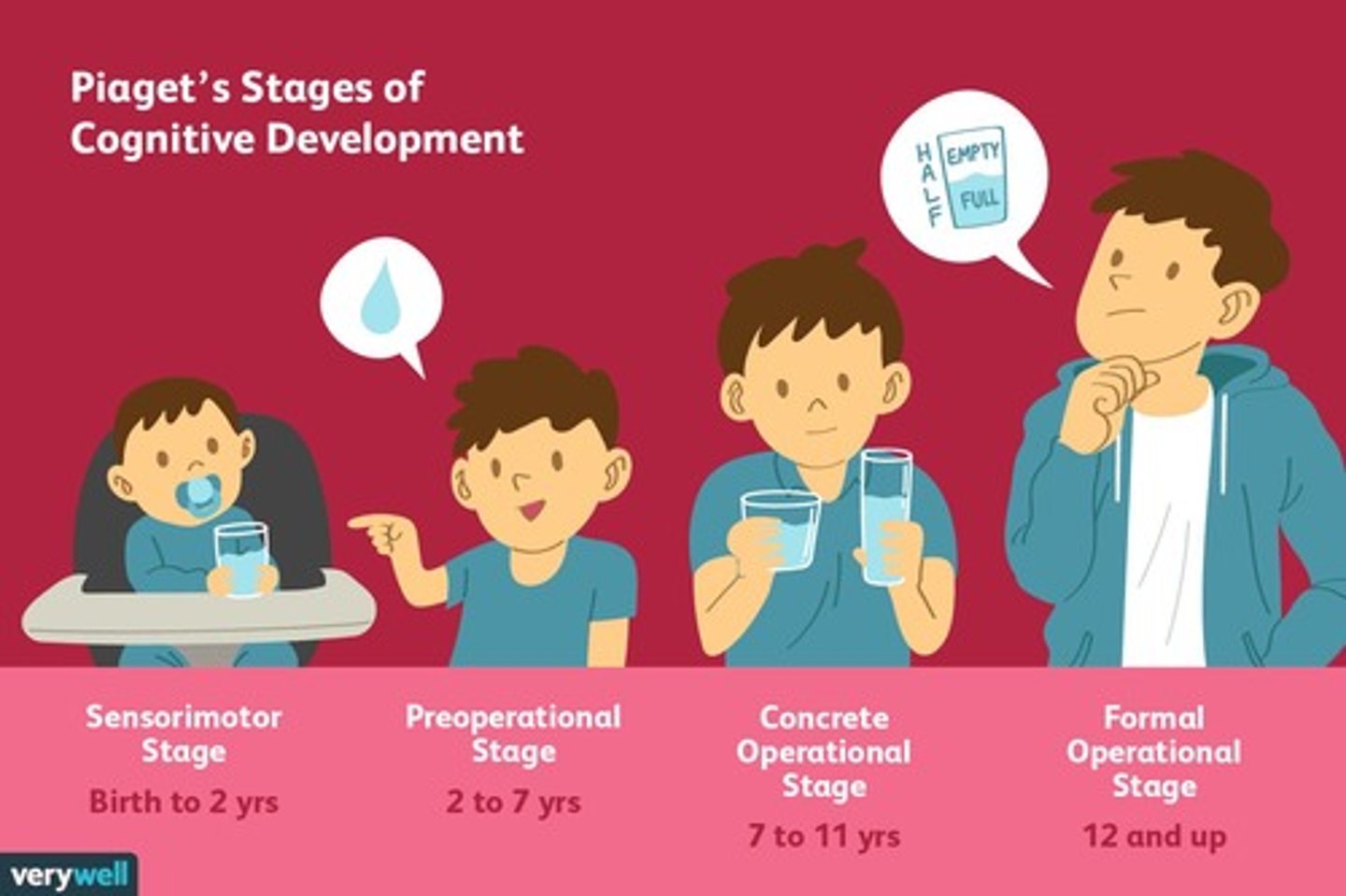
Four stages of development
Related to learning to understand and relate logically to the world.
Information-Processing Theory
Information is input, is processed mentally, and is often then followed by an output of judgement and decision-making.
Cognitive-Developmental Theory
Child's abilities to mentally represent the world and solve problems are a result of interaction of experience and maturation of neurological structures.
Scheme
Action pattern or mental structure involved in acquiring or organizing knowledge.
Information-Processing Theory (detailed)
Cognitive process of encoding information, storing information in long-term memory, retrieving information or placing it in short-term memory, manipulating information to solve problems.
Cognitive Theory (Jane Loevinger)
Extended Piaget's model of development into the stages of adulthood, believing that the ego adapts to demands and is an important basis for critical thinking.
Constructive Theory (Robert Kegan)
Expressed a constructive developmental theory similar to Piaget's, believing in a lifelong interaction with the environment.
Defense Mechanisms for Coping (Piaget)
Includes rationalization, repression, projection, displacement, reaction formation, regression, identification, and sublimation.
Rationalization
Developing a plausible excuse for unacceptable behavior.
Repression
Forgetting an unpleasant experience.
Projection
Attributing one's thoughts or feelings to another person.
Displacement
Expressing feelings (often anger) one has about a person towards another innocent person.
Reaction formation
Acting just the opposite of what one feels.
Regression
Reverting to immature behavior.
Identification
Joining a group so that its positive identity will be replaced on oneself.
Sublimation
Rechanneling unacceptable impulses into socially acceptable ones.
Theory of Language and Culture (Lev Vygotsky)
Social and cultural experiences are necessary for optimal growth and development.
Social Theory of Growth and Development (Urie Bronfenbrenner)
States that a combination of social and economic factors influence growth and development.
Hierarchy of Needs (Abraham Maslow)
If basic needs are met, the individual can move to higher levels of thought and self-fulfillment.
Environmental Theory (Carl Rogers)
People naturally form their own positive destiny, based on the concept of the self, if obstacles are removed.
Behaviorist Theory (John Watson)
The father of behaviorism; the environment and experiences mold the personality.
Behaviorism
Theory that human or animal psychology can be objectively studied through observable actions.
Reinforcement
Process of providing stimuli following responses that increase its frequency.
Positive reinforcers
Increase the frequency of behaviors when they are applied.
Negative reinforcers
Increase the frequency of behaviors when they are removed.
Extinction
Results from repeated performance of operant behavior without reinforcement.
Social-Learning Theories of Personality (Albert Bandura, Walter Mischel)
Social learning formed the basis for personality development.
Social-Learning Theories of Personality
Theories that emphasize the role of observation and reinforcement in the development of personality.
Walter Mischel
Stanford professor who conducted psychological studies on children's ability to delay gratification.
Marshmallow Experiment
Study where children chose to wait for a second marshmallow or eat the first one immediately.
Theory of Moral Development
Lawrence Kohlberg's theory focusing on the development of moral reasoning.
Moral reasoning
Development of a set of social rules that enables a person to differentiate right from wrong.
Looking-glass self
Charles Horton Cooley's concept of self-image formed through three steps: imagining how we portray ourselves, how others evaluate us, and combining these impressions.
Development of Self-Image
The process of forming self-image as proposed by Charles Horton Cooley and George Herbert Mead.
Developmental Tasks of the Older Adult
Coping with retirement, adapting to physiological decline, facing death, and maintaining self-worth.
Robert Havighurst
Theorized developmental tasks of late adulthood including adjusting to health status and income.
Developmental Stages of Retirement
Stages that individuals go through as they transition from work to retirement.
Cultural beliefs and practices
Influences on growth and development based on how children are treated in society.
Developmental tasks
Challenges to be met in each phase of development throughout the lifespan.
Social-Learning Theory
Theory that posits behavior is learned through observing others and the consequences of their actions.
Erik Erikson
Psychologist who proposed a psychosocial theory defining stages of life from infancy to older adulthood.
Jean Piaget
Psychologist known for his cognitive theory of development focusing on how children understand the world.
Abraham Maslow
Psychologist who created the hierarchy-of-needs theory leading to self-actualization.
Carl Rogers
Psychologist who believed individuals shape their own destinies through mastery of their environment.
Ivan Pavlov
Psychologist known for his work in classical conditioning.
B.F. Skinner
Psychologist known for his research in operant conditioning.
Lawrence Kohlberg
Psychologist who described personality development based on moral reasoning.
Freud
Psychoanalyst who identified the id, ego, and superego and described stages of psychosexual development.
Carl Jung
Psychologist who believed that development continues into adulthood, with age 40 as the 'noon of life'.