Mirco Econ: Topic 5
 Call Kai
 Learn
Learn Practice Test
 Spaced Repetition
 Match
Match Flashcards
 Knowt Play
1/38

There's no tags or description
Looks like no tags are added yet.
Name | Mastery | Learn | Test | Matching | Spaced | Call with Kai |
|---|
No analytics yet
Send a link to your students to track their progress
39 Terms
What is the price mechanism?
It determines the market price
Adam Smith called this ‘the invisible hand of the market’
Resources are allocated through the price mechanism in a free market economy
The price moves resources to where they are demanded or where there is a shortage, and removes resources from where there is a surplus
What are the 3 main functions of the price mechanism?
Rationing: When there are scarce resources, price increases due to the excess of demand. The increase in price discourages demand and consequently rations resources. Eg. plane tickets might rise as seats are sold, because spaces are running out. This is a disincentive to some consumers to purchase the tickets, which rations the tickets.
Incentive: This encourages a change in behaviour of a consumer or producer. Eg. a high price would encourage firms to supply more to the market, because it is more profitable to do so.
Signalling: The price acts as a signal to consumers and new firms entering the market. The price changes show where resources are needed in the market. A high price signals firms to enter the market because it is profitable. However, this encourages consumers to reduce demand and therefore leave the market. This shifts the demand and supply curves.
What is a market failure?
When a market leads to a misallocation of resources
A misallocation of resources is when resources are not allocated to the best interests of society. There could be more output in the form of goods and services if the resources were used in a different way
What are the types of market failure?
Externalities: the spillover effect of the production or consumption of a good or service. Negative externalities are caused by the consumption of demerit goods, such as cigarettes, and positive externalities are caused by the consumption of merit goods, such as recycling schemes
Information gaps (imperfect information): It is assumed that consumers and producers have perfect information when making economic decisions. However, this is rarely the case, and this imperfect information leads to a misallocation of resources
Monopolies: Since the consumer has very little choice where to buy the goods and services offered by a monopoly, they are often overcharged. This leads to the underconsumption of the good or service, and therefore there is a misallocation of resources, since consumer needs and wants are not fully met
Inequalities / distribution of income
What is the difference between complete / partial market failure?
Complete market failure occurs when there is a missing market. The market does not supply the products at all.
Partial market failure occurs when the market produces a good, but it is the wrong quantity or the wrong price. Resources are misallocated where there is partial market failure.
What are public goods?
Goods that are missing from the free market, but offer benefits to society (eg. flood lights)
They are non rival: the benefit other people get from the good does not diminish if more people consume the good
They are non excludable: by consuming the good, someone else is not prevented from consuming the good as well
What problems are associated with pubic goods?
The free rider problem (people who do not pay for the good still benefit from it): public goods are under provided by the private sector: they do not make a profit from providing the good since consumers do not see a reason to pay for the good, if they still receive the benefit without paying
Public goods are also under provided because it is difficult to measure the value consumers get from public goods, so it is hard to put a price on the good. Consumers will undervalue the benefit, so they can pay less, whilst producers will overvalue, so they can charge more
What are private goods?
They are rival: if one person uses or consumes the item, it is no longer available for anyone else to use
They are excludable: producers can prevent people who haven't paid for the good from getting it
What are quasi pubic goods?
Goods that have characteristics of both public and private goods
They are partially provided by free market (e.g. roads - can be semi excludable through tolls and semi non rival as consumers can benefit while others use)
What is an externality?
The spill over effect of of the production / consumption of a good or service
How do you find social costs?
Private cost: the cost to the individual or firm directly involved in the transaction (e.g. cost of materials, labour, fuel).
External cost: the cost imposed on third parties (e.g. pollution damage to local residents).
Social cost = Private cost + External cost - the total cost to society.
How do you find social benefits?
Private benefit: the benefit received by the individual or firm directly involved (e.g. enjoyment, profit).
External benefit: the benefit received by third parties (e.g. herd immunity from vaccinations).
Social benefit = Private benefit + External benefit - the total benefit to society.
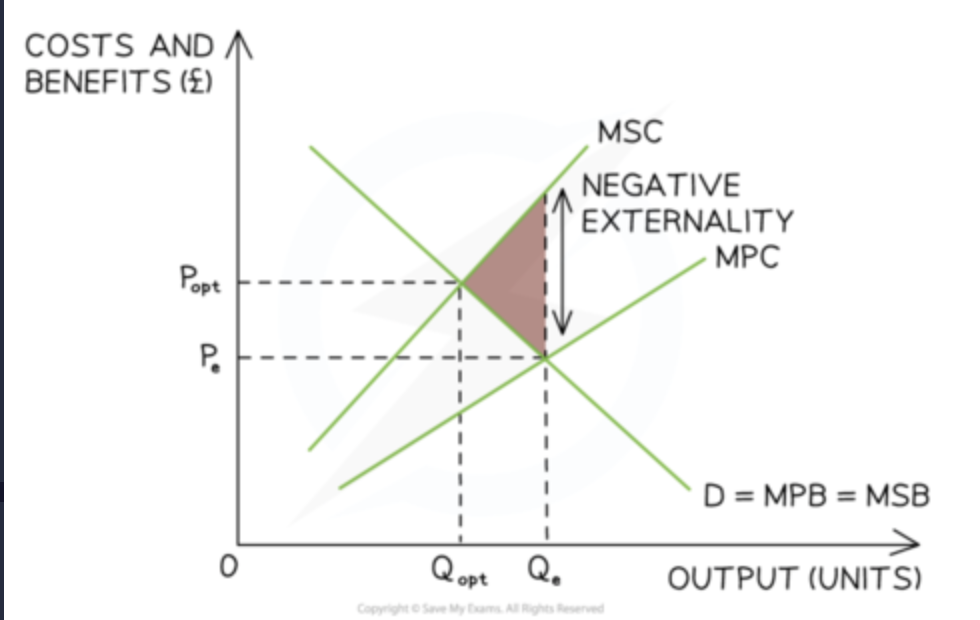
What is a negative externality of production?
External costs imposed on third parties when firms produce a good
A firm produces a good (e.g. steel) → in the production process, it releases pollution into the air and water → local residents suffer health problems and lower quality of life → fish and wildlife are damaged → the firm doesn't pay for these costs (they fall on third parties) → so social cost > private cost → the firm produces according to its private cost only → the market quantity exceeds the socially optimal quantity → market OVERPRODUCES the good → too many resources are devoted to this activity → society's welfare is reduced
When you make something and you don’t pay for the harm caused by you making it, you will make more
How do you represent a negative externality of production diagrammatically?
S (MSC) moves left
What is a positive externality of production?
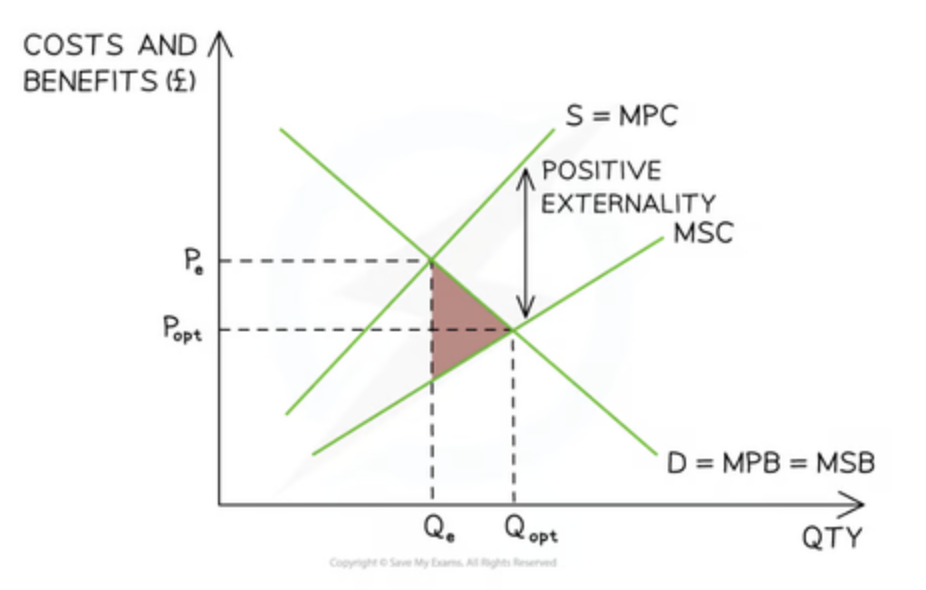
External benefits to third parties when firms produce a good
A firm produces a good (e.g. innovative technology) → in doing so, other firms gain valuable knowledge through spillovers, worker movement, or imitation → these other firms benefit without paying for it → so social cost < private cost (the cost to society is less than the cost to the firm) → the firm produces according to its private cost only → it doesn't account for the benefits its production gives others → market quantity is below the socially optimal quantity → market UNDERPRODUCES the good → too few resources flow to this activity → welfare is below its potential
"If doing something helps others but you don't get paid for it, you'll do less of it than you should."
How do you represent a positive externality of production diagrammatically?
S (MSC) moves right
What is a negative externality of consumption?
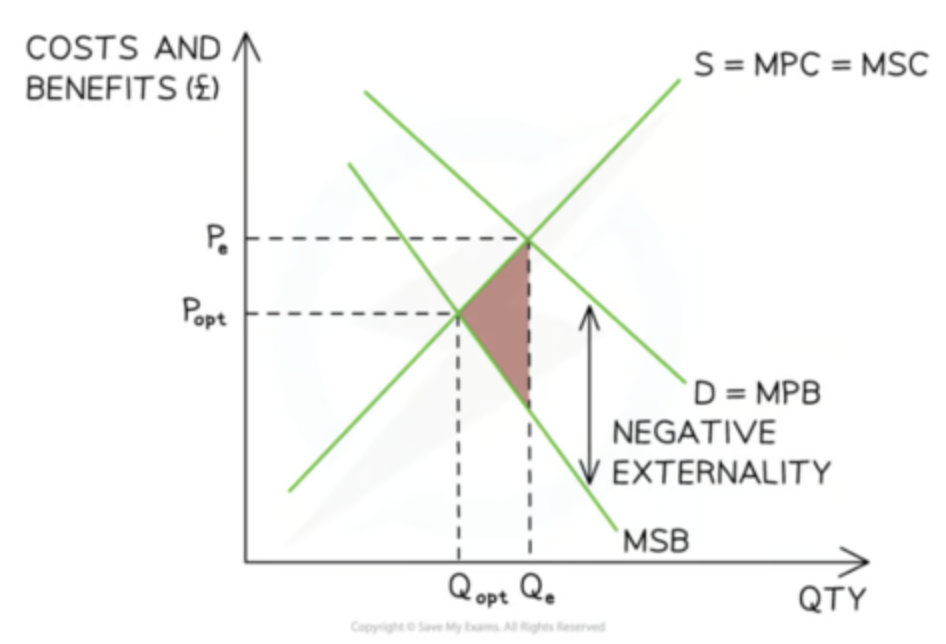
External costs imposed on third parties when consumers use a good
A consumer buys and uses a good (e.g. cigarettes) → in consuming the good, they impose costs on others (passive smoking, healthcare burden) → these costs are not factored into the consumer's decision → so social benefit < private benefit (the benefit to society is less than the benefit to the individual) → consumers buy according to their private benefit only → market consumption exceeds the socially optimal level → market OVERCONSUMES the good → too many resources flow to this activity → welfare is reduced
When you use something and you don’t pay for the harm caused by you using it, you will use it more
How do you represent a negative externality of consumption diagrammatically?
D (MSB) moves left
What is a positive externality of consumption?
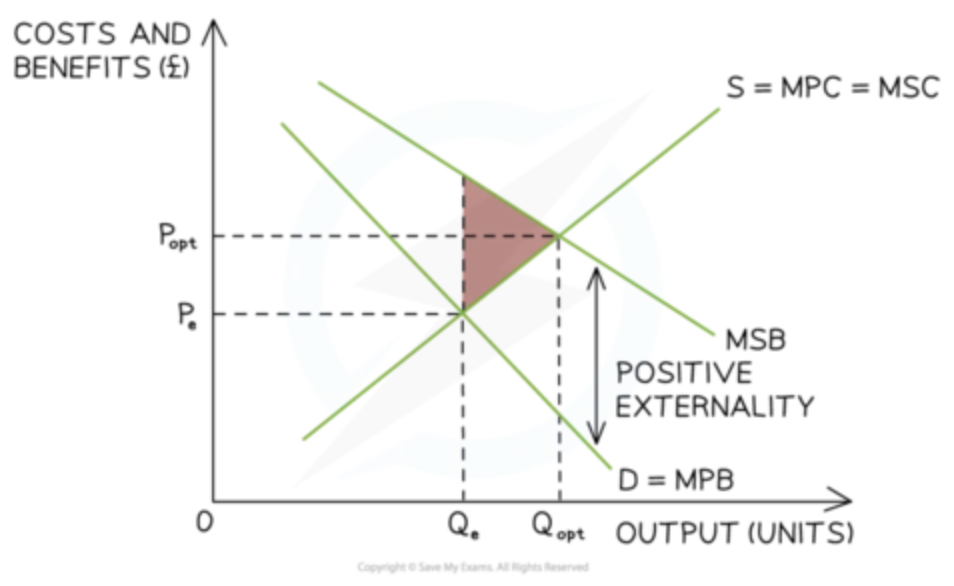
External benefits to third parties when consumers use a good
A consumer buys and uses a good (e.g. gets vaccinated) → others benefit from this consumption (reduced disease transmission, herd immunity) → these others gain without paying → so social benefit > private benefit → consumers buy according to private benefit only → they don't account for the benefits to others → market consumption is below the socially optimal level → market UNDERCONSUMES the good → welfare is below its potential
"If using something helps other people but they don't pay you for it, you'll use less of it than society needs."
How do you represent a positive externality of consumption diagrammatically?
D (MSB) moves right
How does an externality lead to market failure?
Markets work by allocating resources based on prices → prices reflect private costs and private benefits → consumers and firms make decisions based on these private signals → but when there are external costs or benefits, prices DON'T reflect the full social cost/benefit → so consumers and firms produce/consume the "wrong" quantity → resources are misallocated → society's welfare is below what it could be → this is market failure.
What are merit / demerit goods?
Merit goods: society thinks people should consume MORE than they actually choose to → typically have positive externalities AND/OR involve imperfect information about long-term benefits. Examples: education, healthcare, museums.
Demerit goods: society thinks people should consume LESS than they choose to → typically have negative externalities AND/OR involve imperfect information about long-term harms. Examples: tobacco, alcohol, junk food, recreational drugs.
What is symmetric / asymmetric information?
Symmetric information: Consumers and producers having perfect information to make decision resulting in efficient allocation of resources
Asymmetric information: When information is missing so an informed decision cannot be made
Leads to misallocation of resources - consumers may pay too much and firms may produce wrong amount (e.g. monopoly exploiting consumers)
How can a monopoly power lead to market failure?
Higher prices, profits and inefficiency result in misallocation of resources
Monopolies exploit consumers by high price charges resulting in the good being under-consumed and allocatively inefficient leading to market failure
Loss of consumer surplus and gain of producer surplus
What will happen to a market in the absence of government intervention?
The market mechanism is likely to result in a very unequal and inequitable distribution of income and wealth
An unequal distribution can lead to negative externalities, such as social unrest
In a market economy, an individual’s ability to consume goods and services depends upon their income and wealth, and an inequitable distribution of income and wealth is likely to lead to a misallocation of resources and hence market failure
What is the purpose of government intervention?
Free markets, left alone, often fail to allocate resources efficiently or equitably. This is market failure. Government intervention aims to correct these failures and improve overall welfare.
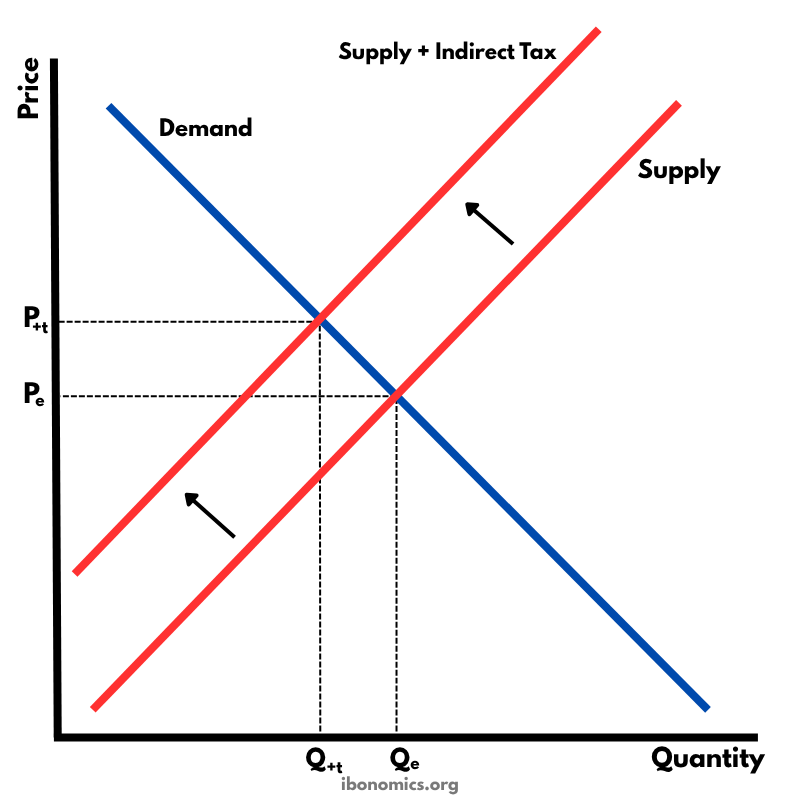
How are indirect taxes used as government intervention?
The government imposes a tax on a good causing a negative externality (e.g. cigarettes / tobacco) → the tax raises the firm's cost of production → the supply curve shifts to the left (or up by the size of the tax) → the new equilibrium has a higher price and lower quantity → consumers cut back on the harmful good → external costs are reduced → ideally, the tax equals the external cost so social and private costs align → market output moves closer to the socially optimal level → welfare improves.
How would you represent an indirect tax on a diagram?
Advantages + disadvantages of indirect taxes
Uses the price mechanism - efficient signal
Generates government revenue → can be used to fund other policies
Lets consumers decide their own responses
Can create black markets (eg. illegal tobacco)
Setting the right tax level requires info the government may not have
Inelastic demand (due to addiction) may mean tax actually raises the firms revenue but not change the consumers behaviours
Regressive - takes more from the poorer
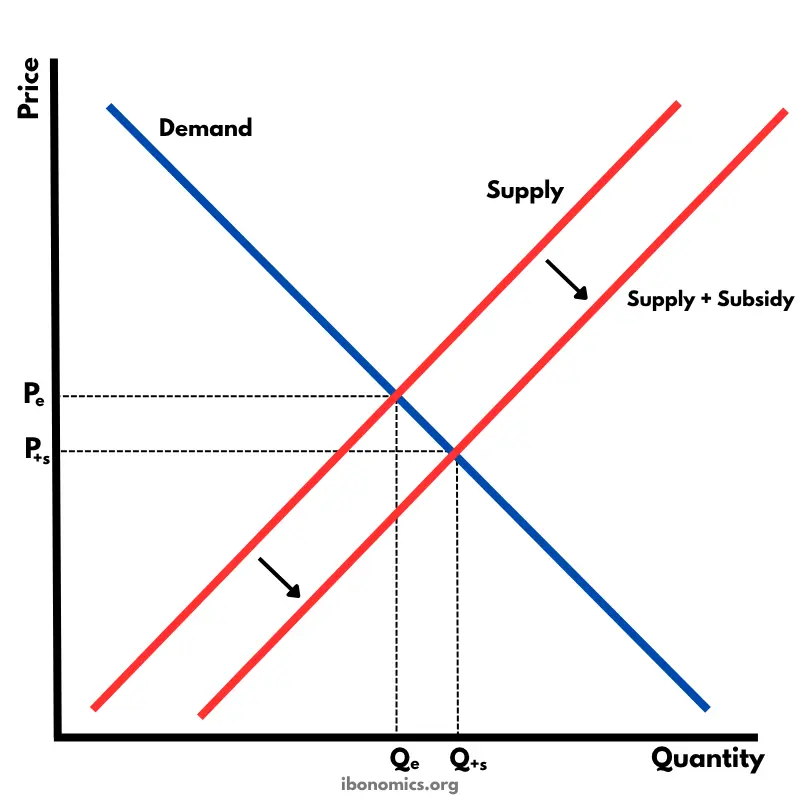
How are subsidies used as government intervention?
Subsidy: a payment by the government to a producer / consumer to encourage production / consumption of a good
The government provides a subsidy on a beneficial good (e.g. solar panels) → producers' costs effectively fall → supply curve shifts right → equilibrium price falls and quantity rises → more consumers buy the good → external benefits to society increase → ideally, the subsidy equals the external benefit so private and social benefits align → output moves to the socially optimal level → welfare improves.
How would you represent a subsidy on a diagram?
Advantages + disadvantages of subsidies
Directly encourages desired behaviour
Helps makes beneficial goods affordable for poorer households
Supports emerging industries (eg. renewable energy, EVs)
Expensive - must be funded through taxation / borrowing
Opportunity cost - money could’ve been spent elsewhere
Subsidies may be captured by producers (raising profits) rather then benefitting consumers
How are maximum prices used as government intervention?
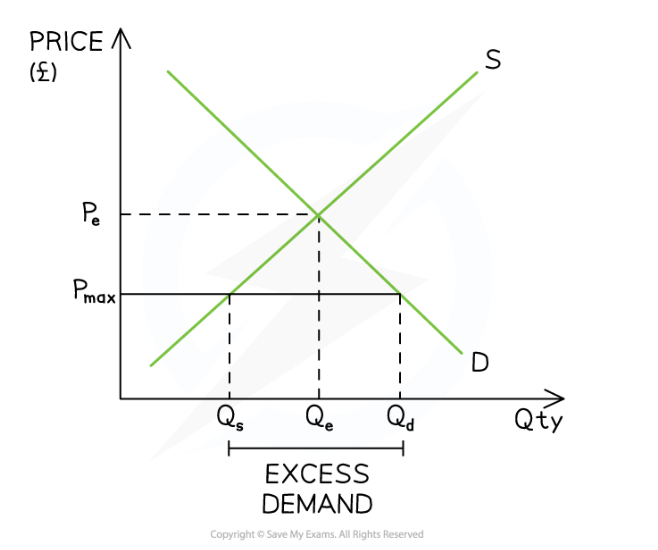
Maximum price: A legal limit on the price a producer can charge, set BELOW the market equilibrium price.
The government sets a maximum price below market equilibrium → at this price, quantity demanded exceeds quantity supplied → excess demand (a shortage) emerges → consumers benefit from lower prices, but only those who can actually obtain the good → others go without → black markets may emerge as some consumers willing to pay more find ways around the rule → the policy redistributes benefit from producers to consumers.
Example: price caps on expensive medicines
How would you represent a maximum price on a diagram?
Advantages + Disadvantages of Maximum Prices
Makes essential goods affordable
Protects consumers from exploitation
Can address monopoly pricing
Can encourage black markets
Discourages producers from supplying
Can misallocate resources (those who get the good first aren’t necessarily those who value it the most)
How are minimum prices used as government intervention?
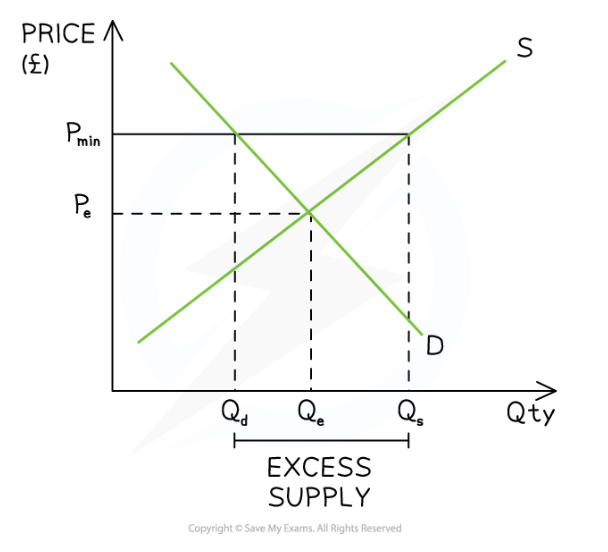
A legal minimum on the price a producer must receive (or consumer must pay), set ABOVE the market equilibrium price.
The government sets a minimum price above market equilibrium → at this price, quantity supplied exceeds quantity demanded → excess supply (a surplus) emerges → producers benefit from guaranteed higher prices → consumers pay more and buy less → if the government buys the surplus (e.g. EU CAP historically), there's a cost to taxpayers and storage problems.
Ex: minimum alcohol pricing in Scotland (50p per unit) + National Minimum Wages
How would you represent a minimum price on a diagram?
Advantages + Disadvantages of Minimum Prices
Protects producers from low prices
Discourages consumption of harmful goods
Raises low wages
If government buy supply → opportunity cost
Excess supply may lead to wasted resources
By guaranteeing profits, minimum prices can encourage inefficient production and the misallocation of resources