Topical Anaesthetics
 Call Kai
 Learn
Learn Practice Test
 Spaced Repetition
 Match
Match Flashcards
 Knowt Play
1/22

There's no tags or description
Looks like no tags are added yet.
Name | Mastery | Learn | Test | Matching | Spaced | Call with Kai |
|---|
No analytics yet
Send a link to your students to track their progress
23 Terms
What are Analgesics ?
Give relief from pain without loss of sensation/feeling
Paracetamol , ibuprofen
What are anaesthetics?
Give relief from pain but also cause loss of sensation/feeling
E.g Ketamine
What are topical Anaesthetics?
local anaesthetics acting on surface of body → skin , eyes etc
E.g Lidocaine
How do Local Anaesthetics work?
are chemical agents which reversibly block the transmission of nerve impulses along sensory fibres
— Nerve function recovers completely
— Loss of sensation without loss of consciousness
— Dif sensations lost according to SIZE OF AXONS
pain axons smallest and pain sensation lost first , followed by touch and temperature
Pressure lost last if at all
POM use
Use in practice but NEVER supply to px
What do Topical anaesthetics do ?
Block nerve conduction
prevent nerve impulses by blocking Na+ channels preventing transmission of action potentials
What properties do we need in an Ideal Topical anaesthetic ?
Quick onset of action
Reasonable duration of action
Provide enough depth of anaesthesia
Reversible action
No pain at site of instillation
No hypersensitivity or allergic reactions
Non-toxic
Good ocular penetration →amphiphilic
No effect on pupil size, accommodation or IOP
compatible with other drugs
What is the structure of local anaesthetics
Lipophilic ring
Intermediate chain linkage → ester or amide
Hydrophilic group → allows agent to be ionised and water soluble
Ester or Amide linkage
Ester linkages broken down more easily
amide linkages last longer → longer duration of action
Ester types local aesthetics onset, duration and biotransformation
Onset ~1 min
Duration ~20-30 mins
Biotransformed in most cells by esterase
Amide types onset,duartion,bio
Onset ~1 min
Duration ~30-60 mins
Biotransformed in liver → transported there first
Lidocaine onset, classification, formula, storage
takes 60 seconds to start working
lasts up to 25 mins
Amide , POM,Minims
4% Lidocaine HCl, 0.25% fluroescein
Below 25 degrees , protect from light
Tetracaine, Proxymetacaine, Oxybuproacine
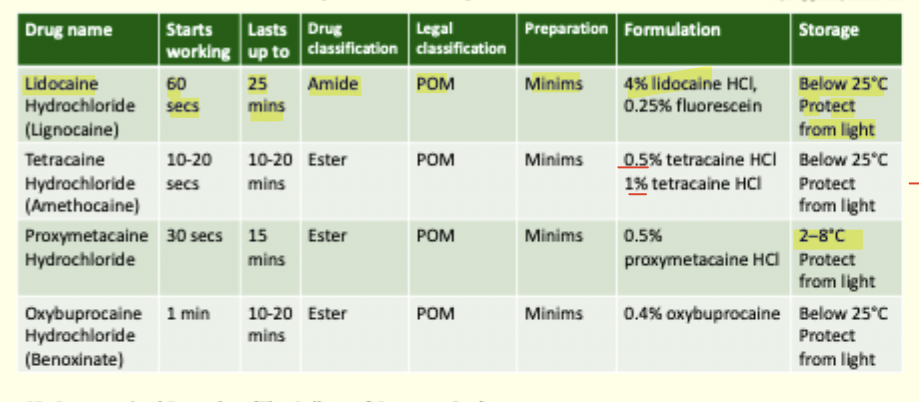
Where is Proxymetacaine stored?
In the fridge
let px know it feels cold on instillation
What are the indications for use of Topical Anaesthetics?
Contact Tonometry → GAT
Fitting CL → scleral lens impressions
FB removal
Gonisocopy
Surgery (opthalmology)
Contraindications for topical anaesthetics
Where wound healing should not be compromised
Known hypersensitivity (ester/amide)
What are the side effects of using topical anaesthetics ?
Sting on installation
Warn px of risk of FB damage for approx 30 mins after instillation → no eye rubbing
reduced blink rate
delay wound healing - delay cell division
may produce mild punctate keratitis
repeated installation → corneal epithelial desquamation
can lower IOP
Proxymetacaine has least antibacterial action
What is the order of stinging of topical anaesthetics
Proxymetacaine → stings least
Oxybuprocaine
Lidocaine
Tetracaine → stings most
What are the Pros of using topical anaesthetics ?
Good (short) duration of action
localised effect
cheap
easy to administer
fast onset
very effective → cornea completely anaesthetised
Cons of topical anaesthetics
If px rubs their eyes or FB gets in they won’t feel it
heavily legislated → dangerous if px has constant supply → whatever causing the pain isn’t being addressed
What is the best Topical Anaesthetic for GAT
Proxymetacaine is the gentlest option → least epithelial toxicity
causes least stinging
depth of anaesthesia light but sufficient for Contact Tonometry
works fast
Best Topical anaesthetic for Gonioscopy
Oxybuprocaine 0.4% provides slightly deeper anaesthesia and longer duration than proxymetacine which helps maintain comfort during lens manipulation
stinging mild to moderate but usually well tolerated
Proxymetacine alternative for px who are sensitive to stinging or anxious → most confortable on instillation and has lowest epithelial toxicity
its shorter duration still effective for Gonio
Which Topical Anaesthetic for Foreign body removal
Tetracaine 0.5–1% is preferred choice because it provides the deepest and most sustained anaesthesia
allowing comfortable and safe manipulation of the cornea during foreign body removal
However, causes significant stinging on instillation and has higher epithelial toxicity, so repeated dosing should be avoided