2.1 Theories and Concepts in Demography
 Call Kai
 Learn
Learn Practice Test
 Spaced Repetition
 Match
Match Flashcards
 Knowt Play
1/12

Earn XP
Description and Tags
Flashcards covering Malthusian theory, its criticisms, and the stages of the theory of demographic transition.
Name | Mastery | Learn | Test | Matching | Spaced | Call with Kai |
|---|
No analytics yet
Send a link to your students to track their progress
13 Terms
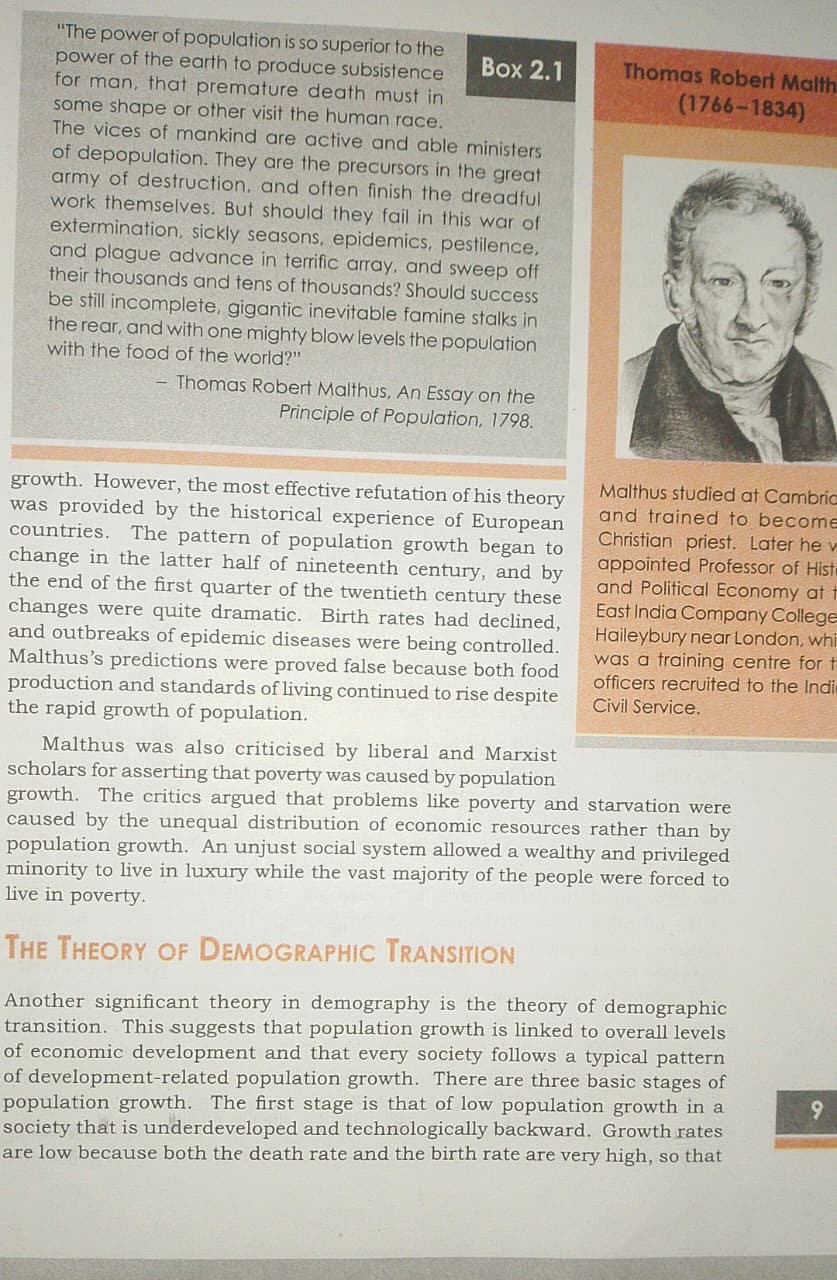
Who is the English political economist associated with a pessimistic theory of population growth outlined in his 1798 essay?
Thomas Robert Malthus
What is the full title of the essay published by Thomas Robert Malthus in 1798?
Essay on Population (or An Essay on the Principle of Population)
According to Malthusian theory, at what rate does the human population grow compared to agricultural production?
Population rises in geometric progression (2,4,8,16,32,etc.), while agricultural production grows in arithmetic progression (2,4,6,8,10,etc.).
What are Malthus’s 'preventive checks' for controlling population growth?
Voluntarily reducing population growth through postponing marriage, practicing sexual abstinence, or celibacy.
How does Malthus define 'positive checks' to population growth?
Famines and diseases that act as nature's way of dealing with the imbalance between food supply and an increasing population.
Why were Malthus’s predictions proved false by the experience of European countries in the late nineteenth and early twentieth centuries?
Both food production and standards of living continued to rise despite rapid population growth, and birth rates eventually declined.
What was the liberal and Marxist critique of Malthus’s assertion that population growth causes poverty?
They argued that poverty and starvation are caused by the unequal distribution of economic resources and an unjust social system, rather than population growth.
What is the core suggestion of the theory of demographic transition?
That population growth is linked to overall levels of economic development and follows a typical three-stage pattern.
What characterizes the first stage of the demographic transition?
Low population growth in an underdeveloped society where both the death rate and the birth rate are very high.
What characterizes the third stage of the demographic transition?
Low population growth in a developed society where both the death rate and birth rate have been reduced considerably.
Why does a 'population explosion' occur during the second (transitional) stage of demographic transition?
Because death rates are brought down quickly through advanced disease control and better nutrition, while birth rates remain high as society takes longer to alter its reproductive behavior.
What is the current status of the demographic transition in India according to the text?
It is not yet complete because the mortality rate has been reduced, but the birth rate has not been brought down to the same extent.