CMPG 315 Les 2 OUtcomes
 Call Kai
 Learn
Learn Practice Test
 Spaced Repetition
 Match
Match Flashcards
 Knowt Play
1/51

There's no tags or description
Looks like no tags are added yet.
Name | Mastery | Learn | Test | Matching | Spaced | Call with Kai |
|---|
No analytics yet
Send a link to your students to track their progress
52 Terms
What is Transmission media?
Transmission media are the physical or wireless paths used to carry data signals from one device to another.
What are the two main categories:
Guided transmission media
Wireless / unguided transmission media
What does Guided Transmission Media use to guide the signal?
Guided media use a physical path to guide the signal.
Examples of Guided Transmission Media.
Examples include:
Twisted pair cable
Coaxial cable
Fibre optic cable
Power lines
Magnetic/persistent storage
What is Twisted Pair Cable?
Twisted pair cable consists of pairs of copper wires twisted around each other.
The twisting helps reduce electromagnetic interference and crosstalk between wires.
Name the advantages and disadvantages of Twisted Pair cable.
Advantages
Cheap
Easy to install
Commonly used in LANs
Flexible
Disadvantages
Affected by electromagnetic interference
Lower bandwidth than fibre
Shorter transmission distance than fibre
Explain the structure of a coaxial cable and discuss why it provides better protection against electromagnetic interference compared to twisted pair cable.
Coaxial cable has a central copper conductor surrounded by insulation and shielding.
The shielding protects the signal from interference better than twisted pair.
Name the advantages and disadvantages of Coaxial Cable.
Advantages
Better shielding than twisted pair
Higher bandwidth than basic twisted pair
Useful for cable TV and broadband
Disadvantages
Bulkier than twisted pair
Less flexible
Less common in modern LANs
Example
Cable TV and cable Internet connections.
Describe how fibre optic cables transmit data and identify the two main types of fibre optic cable used in networking.
Fibre optic cable transmits data as light pulses through glass or plastic fibres.
There are two important types:
Multi-mode fibre
Single-mode fibre
Discuss the characteristics of multi-mode fibre optic cable and evaluate its advantages and disadvantages in network communication.
Multi-Mode Fibre
Multi-mode fibre allows light to travel along multiple paths.
Advantages
Cheaper than single-mode fibre
Good for shorter distances
Easier to install
Disadvantages
More distortion/dispersion
Shorter range
Lower performance over long distances
Explain the operation of single-mode fibre optic cable and analyse its advantages and disadvantages for use in modern communication networks.
Single-Mode Fibre
Single-mode fibre allows light to travel along one main path.
Advantages
Very high bandwidth
Very long distance
Low attenuation
Excellent for backbone networks
Disadvantages
More expensive
More difficult to install
Requires precise equipment
Discuss the use of power lines as a transmission medium for data communication and explain the advantages and disadvantages associated with this technology.
D. Power Lines
Power lines can be used to transmit data through existing electrical wiring.
Advantages
Uses existing infrastructure
Useful where new cables are difficult to install
Disadvantages
Noisy medium
Interference from electrical devices
Performance can be unreliable
Explain the concept of magnetic or persistent storage as a data transmission method and discuss its advantages and disadvantages in comparison to real-time communication media.
E. Magnetic / Persistent Storage
Data can be stored on physical media and physically transported.
Advantages
Very high bulk data transfer
Cheap for massive data movement
Disadvantages
Very high delay/latency
Not useful for real-time communication
Define wireless transmission media and identify the different types of wireless technologies used for data communication.
Wireless media transmit data using electromagnetic waves through air or space.
Examples include:
Radio waves
Microwaves
Infrared
Light / laser transmission
Satellites
Explain how radio transmission is used in wireless communication and evaluate its advantages and disadvantages in data networking.
Radio Transmission
Radio waves are used for long-distance wireless communication.
Advantages
Can travel long distances
Can pass through buildings
Useful for broadcasting and mobile communication
Disadvantages
Interference
Less secure because signals spread widely
Spectrum must be regulated
Explain the principle of microwave transmission in wireless communication and critically evaluate its advantages and limitations in modern networking systems.
Microwave Transmission
Microwaves are high-frequency waves that usually travel in straight lines.
Advantages
High bandwidth
Good for point-to-point links
Used in cellular and satellite communication
Disadvantages
Needs line of sight
Affected by weather and obstacles
Requires towers or antennas
Describe how infrared transmission is used in wireless communication and assess its advantages and limitations in short-range networking applications, using appropriate examples.
Infrared Transmission
Infrared is used for short-range communication.
Advantages
Cheap
Directional
Does not pass through walls, so less interference between rooms
Disadvantages
Short range
Cannot pass through solid objects
Limited use in networking
Example
TV remote controls.
Explain the principle of laser (light-based) transmission in wireless communication and critically evaluate its advantages and disadvantages in high-speed data networking environments.
Light / Laser Transmission
Laser transmission uses light beams through open air.
Advantages
Very high bandwidth
Secure because the beam is narrow
No radio licence needed
Disadvantages
Must be aimed accurately
Affected by fog, rain, heat, and obstacles
Usually needs line of sight
Comparison Table
Medium | Type | Main Advantage | Main Disadvantage | Best Use |
Twisted pair | Guided | Cheap and common | EMI and shorter range | LANs |
Coaxial cable | Guided | Better shielding | Bulky | Cable TV/Internet |
Multi-mode fibre | Guided | Good speed, cheaper fibre | Shorter distance | Buildings/campuses |
Single-mode fibre | Guided | Long distance, high bandwidth | Expensive | Backbones |
Power lines | Guided | Existing wiring | Noisy | Home networking fallback |
Radio | Wireless | Long range | Interference | Broadcasting/mobile |
Microwave | Wireless | High bandwidth | Needs line of sight | Point-to-point/cellular |
Infrared | Wireless | Cheap and secure in room | Cannot pass walls | Remote controls |
Laser/light | Wireless | High bandwidth | Weather/aiming issues | Building-to-building links |
When signals travel through a transmission medium, they do not remain perfect. Two major problems are:
Attenuation
Distortion
Define attenuation in data communication and explain how it affects signal transmission in networking systems, using a simple real-world analogy.
Attenuation means the loss of signal strength over distance or time.
As a signal travels, some of its energy is lost.
Simple Explanation
If you shout across a field, your voice becomes weaker the farther it travels. A data signal behaves similarly.
Explain the main causes of attenuation in data communication and analyse how each factor contributes to signal loss across different transmission media.
Causes of Attenuation
Long transmission distance
Resistance in copper cables
Absorption or scattering in fibre
Obstacles in wireless transmission
Weather conditions
Poor-quality medium
Explain why attenuation is a critical issue in data communication systems and discuss its impact on signal integrity and accurate data interpretation at the receiver.
Why Attenuation Matters
If the signal becomes too weak, the receiver may not be able to correctly identify the bits.
For example:
A strong signal may clearly represent a 1.
After attenuation, it may become too weak and be confused with a 0.
Discuss the methods used to reduce attenuation in data communication systems and explain how each technique improves signal quality and transmission reliability.
How Attenuation Can Be Reduced
Use repeaters or amplifiers
Use better-quality media
Use fibre instead of copper for long distances
Reduce transmission distance
Increase signal strength, within legal and technical limits
Define distortion in data communication and explain how it differs from attenuation, using a simple analogy to illustrate the concept.
Distortion means the change in the shape of a signal.
A signal may arrive looking different from how it was sent.
Simple Explanation
If attenuation is the signal getting quieter, distortion is the signal getting “bent out of shape.”
Explain the causes of signal distortion in data communication systems and analyse how each factor affects the integrity of transmitted signals across different media.
Causes of Distortion
Different frequencies being weakened by different amounts
Limited bandwidth
Interference
Noise
Dispersion in fibre
Multipath propagation in wireless transmission
Explain why signal distortion is a significant problem in digital communication systems and discuss its effect on data accuracy and bit interpretation at the receiver.
Why Distortion Matters
Digital signals depend on clear differences between 1s and 0s. If the signal shape changes too much, the receiver may decode the wrong bits
Compare attenuation, distortion, and noise/interference in data communication systems, clearly explaining how each affects signal transmission and reception.
Attenuation vs Distortion
Concept | Meaning | Main Problem |
Attenuation | Signal becomes weaker | Receiver may not detect it |
Distortion | Signal changes shape | Receiver may misread it |
Noise/interference | Extra unwanted signal is added | Signal becomes corrupted |
Define Modulation.
Modulation is the process of converting bits into signals and signals back into bits.
Computers use digital data, but transmission media carry physical signals such as voltage, current, light, or electromagnetic waves.
There are two main types:
Baseband modulation
Passband modulation
Explain baseband modulation in data communication systems and discuss how it is implemented using line coding in guided transmission media.
1. Baseband Modulation
Baseband transmission sends signals directly over the medium, starting from 0 up to a maximum frequency.
Baseband is mainly used in guided media such as cables.
Baseband modulation uses line coding.
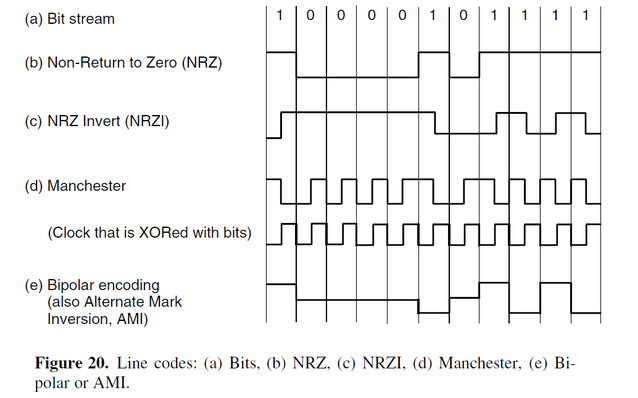
Describe NRZ (Non-Return to Zero) line coding and evaluate its advantages and disadvantages in digital baseband transmission, particularly in relation to synchronization and signal reliability.
A. NRZ — Non-Return to Zero
NRZ represents bits using different signal levels.
Usually:
High signal = 1
Low or zero signal = 0
Advantages
Simple
Easy to implement
Disadvantages
Long strings of 1s or 0s cause synchronization problems
Not very efficient for reliable communication
Explain NRZI (Non-Return to Zero Invert) line coding and critically evaluate how it improves synchronization compared to NRZ, including its limitations in long sequences of identical bits.
B. NRZI — Non-Return to Zero Invert
NRZI uses signal changes or transitions to represent bits.
Instead of only looking at high or low levels, the receiver looks for whether the signal changes.
Advantages
Better synchronization than NRZ
Used in real technologies such as USB
Disadvantages
Long sequences without transitions can still cause problems
May require extra encoding such as 4B/5B
Explain Manchester encoding in data communication systems and evaluate how it achieves synchronization, including its advantages and disadvantages in terms of bandwidth efficiency.
Manchester Encoding
Manchester encoding combines data with a clock signal.
There is a transition in every bit period, which helps synchronization.
Advantages
Excellent synchronization
Receiver can keep track of timing
Disadvantages
Uses more bandwidth
Less efficient than some other methods
Exam Trap
Manchester is good for synchronization but bad for bandwidth efficiency.
Explain bipolar encoding in digital data transmission and evaluate how the use of alternating positive and negative voltage levels improves signal reliability, including its advantages and disadvantages.
Bipolar Encoding
Bipolar encoding uses positive and negative voltage levels.
This helps keep the average voltage balanced around zero.
Advantages
Reduces problems caused by long periods of positive voltage
Helps reduce certain types of attenuation problems
Disadvantages
More complex
Requires careful encoding
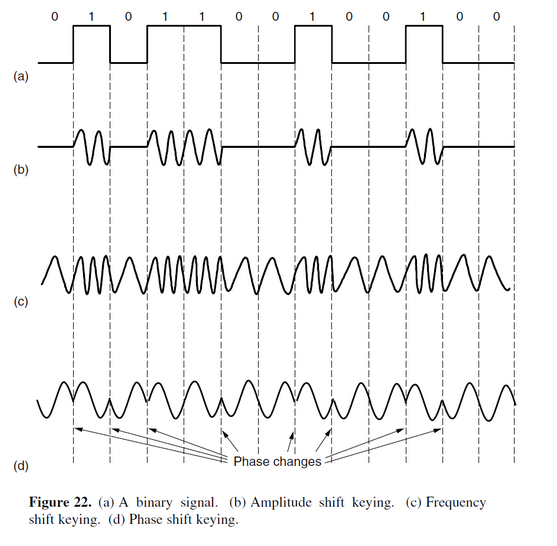
Explain passband modulation in data communication systems and describe how it differs from baseband transmission, including how carrier wave properties are modified to encode digital data.
Passband Modulation
Passband transmission shifts the signal into a higher frequency range.
It is used especially in wireless communication because wireless systems must transmit in assigned frequency bands.
Passband modulation changes one or more properties of a carrier wave:
Amplitude
Frequency
Phase
Explain ASK (Amplitude Shift Keying) in passband modulation and critically evaluate how changes in amplitude are used to represent digital data, including its advantages and disadvantages in noisy communication environments.
ASK — Amplitude Shift Keying
ASK changes the amplitude of the carrier wave.
Larger amplitude may represent 1.
Smaller amplitude may represent 0.
Advantages
Simple
Easy to understand
Disadvantages
Sensitive to noise
Sensitive to attenuation
Explain FSK (Frequency Shift Keying) in passband modulation and critically discuss how it represents binary data using different frequencies, including an evaluation of its performance in noisy communication channels and its advantages and disadvantages compared to other modulation techniques.
FSK — Frequency Shift Keying
FSK changes the frequency of the carrier wave.
One frequency represents 1.
Another frequency represents 0.
Advantages
More resistant to amplitude noise than ASK
Useful in many communication systems
Disadvantages
More complex than ASK
Requires frequency space
Explain PSK (Phase Shift Keying) in passband modulation and analyse how changes in the phase of a carrier wave are used to encode binary data, including its advantages and disadvantages in modern communication systems.
PSK — Phase Shift Keying
PSK changes the phase of the carrier wave.
The wave shifts position in its cycle to represent different bits.
Advantages
Efficient use of bandwidth
Common in modern digital communication
Disadvantages
More complex
Requires accurate timing and electronics
Explain QAM (Quadrature Amplitude Modulation) in passband transmission and evaluate how combining amplitude and phase variations allows higher data rates, including its advantages and disadvantages in modern digital communication systems.
QAM — Quadrature Amplitude Modulation
QAM combines changes in:
amplitude
phase
This allows multiple bits to be sent per symbol.
Advantages
Very efficient
Sends more bits per signal change
Used in modern networks
Disadvantages
More sensitive to noise
More complex
Exam Trap
More QAM levels means more bits per symbol, but also greater risk of errors because the signal points are closer together.
Modulation Comparison Table
Technique | What Changes? | Type | Main Strength | Main Weakness |
NRZ | Signal level | Baseband | Simple | Synchronization problems |
NRZI | Transitions | Baseband | Better synchronization | Long no-change runs |
Manchester | Clock transitions | Baseband | Excellent synchronization | Uses more bandwidth |
Bipolar | Positive/negative voltage | Baseband | Balanced signal | More complex |
ASK | Amplitude | Passband | Simple | Noise-sensitive |
FSK | Frequency | Passband | More robust than ASK | Uses frequency space |
PSK | Phase | Passband | Bandwidth efficient | Complex |
QAM | Amplitude + phase | Passband | High data rate | Noise-sensitive |
The four line codes that you need to know are shown in the diagram below. They are all briefly discussed below the diagram.
The three baseband modulation techniques that you should know, which are shown in the diagram below, represent these three different methods.
Explain the concept of multiplexing in data communications. In your answer, discuss how multiplexing enables efficient use of a communication channel and why it is necessary in modern networking systems.
Multiplexing is the method of allowing multiple users or signals to share the same communication channel.
The three main methods for Multiplexing are:
The three main methods are:
Frequency Division Multiplexing
Time Division Multiplexing
Code Division Multiplexing
Discuss Frequency Division Multiplexing (FDM) as a channel sharing technique in communication systems. In your answer, explain how FDM allocates bandwidth to multiple users, and critically evaluate its advantages and disadvantages, including the role of guard bands and their impact on spectral efficiency. Provide a real-world example to support your explanation.
. Frequency Division Multiplexing — FDM
FDM divides the available bandwidth into separate frequency bands.
Each user gets a different frequency band and can transmit all the time.
Simple Explanation
FDM is like different radio stations. Each station broadcasts at a different frequency.
Advantages
Users can transmit continuously
Good for radio, TV, cellular, and satellite systems
Simple idea
Disadvantages
Requires guard bands
Guard bands waste bandwidth
Interference can happen if frequencies overlap
Example
AM/FM radio stations.
Critically discuss Time Division Multiplexing (TDM) as a method of channel sharing in digital communication systems. In your answer, explain how TDM allocates time slots to multiple users sharing a single communication channel, and evaluate its advantages and disadvantages, including the need for synchronization and the potential inefficiency caused by idle time slots. Provide relevant real-world applications to support your discussion.
Time Division Multiplexing — TDM
TDM divides the channel into time slots.
Each user gets the full bandwidth, but only during their assigned time slot.
Simple Explanation
TDM is like students taking turns to speak in class.
Advantages
Each user gets full bandwidth during their turn
Useful for digital communication
Common in telephone and cellular systems
Disadvantages
Requires synchronization
Users must wait for their turn
Slots may be wasted if a user has nothing to send
Explain Code Division Multiplexing (CDM) as a channel access technique in modern digital communication systems. In your answer, describe how CDM enables multiple users to transmit simultaneously over the same frequency band using unique spreading codes. Critically evaluate its advantages and disadvantages, including its resistance to interference, computational complexity, and requirements for signal processing. Provide relevant real-world applications such as cellular communication systems.Multiplexing Comparison Table
Code Division Multiplexing — CDM
CDM allows all users to transmit at the same time over the same frequency band, but each user has a unique code.
The receiver uses the code to extract the correct signal.
Simple Explanation
CDM is like many people speaking at once in different languages. If you understand only English, you focus on English and ignore the rest.
Advantages
Users can transmit at the same time
Uses the full frequency band
More tolerant of interference
Disadvantages
Complex
Requires coding theory
Needs careful signal processing
Multiplexing Comparison Table
Method | Divides Channel By | User Gets | Analogy | Main Weakness |
FDM | Frequency | Part of bandwidth all the time | Radio stations | Guard bands/interference |
TDM | Time | Full bandwidth for a time slot | Taking turns | Synchronization needed |
CDM | Code | Full bandwidth all the time | Different languages | Complex |
What does Baseband Transmission do? What are the Characteristics? And give an example.
Baseband Transmission
Baseband transmission sends signals directly over the medium.
The signal starts at 0 and extends up to a maximum frequency.
Characteristics
Used mainly in guided media
Does not require shifting to a carrier frequency
Uses line coding
Examples include NRZ, NRZI, Manchester, and Bipolar
Example
Ethernet communication over copper cable.
What does Passband Transmission do? What are the Characteristics? And give an example.
Passband Transmission
Passband transmission shifts the signal to a higher frequency range.
It uses a carrier wave, and the data is placed onto that carrier wave.
Characteristics
Used mainly in wireless communication
Needed when only certain frequency bands are available
Uses modulation techniques such as ASK, FSK, PSK, and QAM
The lowest frequency is greater than 0
Example
WiFi transmitting in the 2.4 GHz or 5 GHz frequency bands
Baseband vs Passband Table
Feature | Baseband | Passband |
Frequency range | Starts at 0 | Shifted to higher frequency |
Carrier wave | Not usually required | Required |
Common use | Guided/wired media | Wireless media |
Techniques | NRZ, NRZI, Manchester, Bipolar | ASK, FSK, PSK, QAM |
Example | Ethernet cable | WiFi/radio |
Main issue | Synchronization and attenuation | Noise, spectrum allocation, interference |