iGCSE Chemistry: Principles of Chemistry
 Call Kai
 Learn
Learn Practice Test
 Spaced Repetition
 Match
Match Flashcards
 Knowt Play
1/37

There's no tags or description
Looks like no tags are added yet.
Name | Mastery | Learn | Test | Matching | Spaced | Call with Kai |
|---|
No analytics yet
Send a link to your students to track their progress
38 Terms
Give the electronic configuration of an atom of silicon. (1)
· 2,8,4 / 2.8.4
Explain, in terms of electron configuration, why sodium is more reactive than lithium. (3)
1. the outer shell is further from the nucleus in sodium/sodium has more shells
2. there is less attraction to the nucleus for the outer electron/outer shell in sodium
3. so the (outer) electron is more easily lost
Explain, in terms of electron configuration, why neon is unreactive. (2)
1. full outer shell / 8 electrons in outer shell
2. does not need to lose or gain (or share) electrons / e(-)
Explain the relative reactivities of fluorine and chlorine using their electronic configurations. (4)
1. fluorine is more reactive than chlorine
2. the outer shell is closer to the nucleus in fluorine / fluorine has fewer shells / fluorine has a smaller atomic radius
3. there is a stronger attraction to the nucleus for an electron in fluorine
4. so fluorine accepts an electron more readily
Pb(NO3)2(aq) + 2NaBr(aq) → PbBr2(s) + 2NaNO3(aq)
Scientist reacts an excess of lead(II) nitrate solution with 25cm3 of sodium bromide solution of concentration 2.0mol/dm3 .
Show that the amount of sodium bromide used is 0.050mol. (1)
· 2(.0) x 0.025 = 0.05(0) (mol)
Show that the maximum theoretical mass of lead(II) bromide is approximately 9g. [for PbBr2 Mr = 367] (2)
1. (n PbBr2) = 0.05(0) ÷ 2 = 0.025
2. 0.025 x 367 = 9.175 (g)
OR
3. 0.05 x 367 = 18.35 (g)
4. 18.35 ÷ 2 = 9.175 (g)
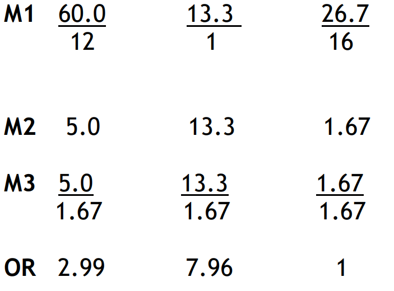
Propanol has this percentage composition by mass.
C = 60.0% H = 13.3% O = 26.7%
Show by calculation that the empirical formula of propanol is C3H8O. (3)
A student finds that 15.00cm3 of sulfuric acid of concentration 0.180mol/dm3 neutralises 25.0cm3 of potassium hydroxide solution.
This is the equation for the reaction. 2KOH + H2SO4 → K2SO4 + 2H2O
Calculate the concentration of the potassium hydroxide solution. (3)
1. n(H2SO4) = 0.0150 × 0.180 or 0.0027(0) (mol)
2. n(KOH) = 0.0027(0) × 2 or 0.0054(0) (mol)
3. conc = (0.0054(0) ÷ 0.0250) = 0.216 (mol/dm3 )
CH4(g) + H2O(g) -> CO(g) + 3H2(g)
Calculate the volume, in dm3 , of methane gas at rtp needed to produce 6.6 tonnes of hydrogen gas.
[at rtp, molar volume = 24dm3 1 tonne = 106 g] Give your answer in standard form. (4)
1. n(H2) = 6.6 × 10⁶ ÷ 2 OR 3.3 × 10⁶ (mol)
2. n(CH4) = 3.3 × 10⁶ ÷ 3 OR 1.1 × 10⁶ (mol)
3. vol(CH4) = 1.1 × 106 × 24 OR 26 400 000 (dm3 )
4. 2.6 × 10⁷
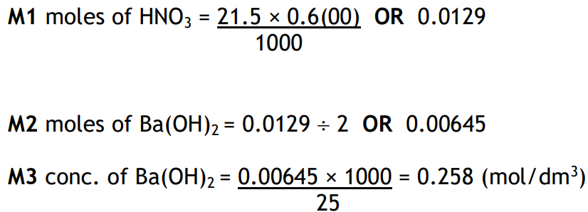
Ba(OH)2 + 2HNO3 → Ba(NO3)2 + 2H2O
The student finds that 21.50cm3 of nitric acid of concentration 0.600mol/dm3 neutralises 25.0cm3 of barium hydroxide solution. Calculate the concentration, in mol/dm3 , of the barium hydroxide solution. (3)
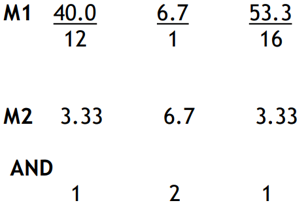
An organic compound has this percentage composition by mass.
C = 40% H = 6.7% O = 53.3%
Show that the empirical formula of the compound is CH2O (2)
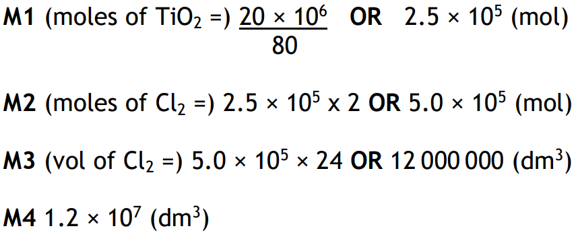
TiO2 + 2Cl2 + C → TiCl4 + CO2
Calculate the volume, in dm3 , of chlorine gas at rtp needed to react completely with 20 tonnes of titanium dioxide. Give your answer in standard form.
[1 tonne = 106 g Mr of TiO2 = 80] [molar volume of chlorine gas at rtp = 24dm3 ] (4)
In one experiment, the student burns 0.92g of ethanol. The student calculates that the heat energy absorbed by the water is 18.2kJ.
Show that the results of this experiment give an approximate value for the enthalpy of combustion of ethanol of ΔH = –900kJ/mol. [Mr of ethanol = 46] (2)
1. amount of ethanol) = 0.92 ¸ 46 OR 0.02(0) (mol)
2. (-)18.2 ¸ 0.02(0) = (-)910 (kJ/mol)
Write a chemical equation for the reaction of lithium with chlorine. (1)
· 2Li + Cl2 → 2LiCl
Describe the changes in the electronic configurations when magnesium reacts with oxygen to form the ionic compound magnesium oxide, MgO (2)
1. magnesium/Mg loses two electrons/becomes 2.8
2. oxygen/O gains two electrons/becomes 2.8
Explain the different ways that magnesium and magnesium chloride conduct electricity. (4)
1. (magnesium) has delocalised electrons
2. electrons can move
3. (magnesium chloride) can only conduct when molten/in solution OR (magnesium chloride) cannot conduct when solid
4. ions are free to move
State, in terms of electrostatic attraction, what is meant by a covalent bond. (2)
1. (electrostatic) attraction between nuclei (of both atoms)
2. and a shared/bonding pair of electrons
Describe the structure of metals. (2)
· (giant structure of) positive ions
· (surrounded by) delocalised electrons
Explain why metals are a good conductor of electricity. (2)
· (delocalised / sea of) electrons
· move / flow (through structure) / are mobile (when voltage/potential difference applied)
Explain why metals are malleable (2)
· layers/sheets/planes/rows
· AND (positive) ions/atoms/particles slide (over each other)
Explain why lead(II) bromide needs to be molten rather than solid for electrolysis to occur. (3)
1. when solid the ions are in fixed positions/in a lattice
2. so there are no ions/electrons free to move
3. (when molten) the ions are free to move so can conduct electricity/carry a current
The electrolyte is at a temperature of 400°C. Explain a suitable material for the electrodes. (2)
1. Graphite
2. resistance to high temperature /has a high melting point
The scientist electrolyses molten lead(II) bromide. Give the half‑equation that occurs at the negative electrode. (1)
· Pb2+ + 2e(−) → Pb
This is the half‑equation for the reaction at the positive electrode. 2Br– → Br2 + 2e– (i) State what is observed at the positive electrode. (1)
· brown vapour/gas/fumes
State why the above half‑equation represents an oxidation reaction. (1)
· bromide (ions)/Br − loses electrons
Describe how the student could test a sample of copper(II) sulfate solution to show that it contains copper(II) ions. (2)
1. add sodium hydroxide (to the copper(II) sulfate solution)
2. blue precipitate (forms)
OR
3. flame test
4. blue-green (flame)
Describe how copper metal forms at the negative electrode during electrolysis of copper(II) sulfate solution. (3)
1. copper ions are positively charged / cations / Cu2+ (ions)
2. and are attracted to / travel to the negative electrode / cathode
3. where they accept electrons
4. and become (copper) atoms
State the appearance of the copper that forms on the negative electrode. (1)
· pink solid / deposit / coating / metal
Complete the half-equation for the formation of oxygen at the positive electrode. (2) 2H2O →
· 2H2O → 4H+ + O2 + 4e(−)
State why the formation of oxygen at the positive electrode is an oxidation reaction. (1)
· electrons are lost
Write an ionic half‑equation for the formation of chlorine at the positive electrode. (1)
· 2Cl- → Cl2 + 2e(-)
Al3+ + 3e– -> Al
Decide whether the underlined species is being oxidised/reduced and explain your answer (2)
· Reduced
· Gain of electrons
C + O2 -> CO2
Decide whether the underlined species is being oxidised/reduced and explain your answer (2)
· Oxidised
· Gain of oxygen/Loss of electrons
Write an ionic half-equation for the reaction of O2- at the positive electrode (2)
· 2O2– → O2 + 4e–
Write a chemical equation for the reaction between iron(III) oxide (Fe2O3) and carbon monoxide (CO) (2)
· Fe2O3 + 3CO → 2Fe + 3CO2
Explain which element is reduced in this reaction. (previous) (2)
· iron / Fe
· (it has) lost oxygen
The student writes this half-equation to show the reaction in which the brown substance forms. 2Br– + 2e– -> 2Br
Identify the two mistakes in her half-equation. (2)
· electrons on wrong side / should be on right
· 2Br should be Br2
Explain how hydrogen gas forms at the negative electrode during electrolysis of sodium chloride solution. (4)
· solution/water contains hydrogen ions/H+
· hydrogen ions/H+ are attracted to the negative electrode/cathode
· hydrogen ions/H+ gain electrons
· and (combine in pairs to) form hydrogen molecules/H2