Silk Road Civilizations: Sogdiana, Sasanian Empire, and Cultural Exchanges
 Call Kai
 Learn
Learn Practice Test
 Spaced Repetition
 Match
Match Flashcards
 Knowt Play
1/67

There's no tags or description
Looks like no tags are added yet.
Name | Mastery | Learn | Test | Matching | Spaced | Call with Kai |
|---|
No analytics yet
Send a link to your students to track their progress
68 Terms
Sogdiana
Ancient civilization and region in Central Asia (modern-day Uzbekistan/Tajikistan), centered on Samarkand and Panjikent; major Silk Road trading network
Panjikent
Major Sogdian city in modern-day Tajikistan; known for extensive mural paintings; destroyed by Arab armies in 8th century
Sasanian Empire
224-651 CE; Iranian neighbor of Sogdiana; Persian empire with major artistic and political influence on Silk Road
Tribhanga posture
"Three-bends" pose in Indian and Central Asian art; curved body stance often used for bodhisattvas and divine figures
Zoroastrianism
Religion of Sasanian Persia; prominent among Sogdians; involves burial in ossuaries to avoid contaminating earth with dead bodies
Ossuary
Container for bones of the dead after excarnation (exposure of flesh), used in Zoroastrian funerary practice
Chinvat Bridge
Zoroastrian "bridge of the separator"; souls cross after death; righteous cross to paradise, wicked fall to hell; depicted on Wirkak/Wiyusi sarcophagus
Sabao
Sogdian "caravan leader" or merchant commander; also Sogdian administrative title in Tang China
The nine Sogdian surnames in China
Surnames adopted by Sogdian immigrants in Tang China, including Shi (史), Kang (康), An (安), Mi (米), Cao (曹), He (何), etc.
Apsara
Heavenly female spirit/nymph in Buddhist, Hindu, and Jain art; often depicted flying or dancing; appears in Dunhuang and Kizil murals
Rustam
Legendary Persian hero; central figure in the Rustam Cycle (epic stories); appears in Panjikent murals
Rakhsh
Rustam's loyal and intelligent horse in Persian epic tradition
Samarkand
Major Sogdian city (capital of Sogdiana); modern-day Uzbekistan
Mangonel
Type of traction trebuchet (siege weapon); appears in "Siege of a Sogdian City" mural
Church of the East
Nestorian Christianity that spread along Silk Roads to China; documented by Xi'an Stele (781 CE)
Manichaeism
Religion founded by Mani (3rd century CE); combined Zoroastrian, Christian, and Buddhist elements; spread widely along Silk Roads
Proselytizing religion
Religion that actively seeks converts; examples include Buddhism, Manichaeism, Christianity, Islam
Kucha Kingdom
2nd century BCE - 648 CE; Buddhist kingdom in the Tarim Basin (Xinjiang, China); site of Kizil Caves
Central pillar cave
Buddhist cave temple design with a pillar (stupa) at center for circumambulation; common at Kizil
Jataka tale
Story of a previous life of the Buddha (before his final enlightenment as Siddhartha Gautama); frequently depicted in Buddhist mural cycles
Caisson ceiling
Recessed, coffered ceiling decoration; common in Dunhuang Mogao caves; often features lotus flowers or celestial motifs
Sutra
Buddhist scripture; a discourse attributed to the Buddha or his close disciples
Kumarajiva
344-413 CE; Buddhist monk and translator; translated The Lotus Sutra into Chinese; based in Kucha and Chang'an
The Lotus Sutra
Key Mahayana Buddhist scripture emphasizing universal salvation and skillful means; central text for East Asian Buddhism
"The Universal Gateway to Salvation"
Chapter 25 of the Lotus Sutra; focuses on bodhisattva Avalokitesvara (Guanyin) and her ability to save beings from suffering
Bodhisattva
Enlightened being who postpones nirvana to help all sentient beings achieve liberation
Avalokitesvara
Bodhisattva of compassion; known as Guanyin in China, Kannon in Japan; featured prominently in Lotus Sutra
Emperor Xuanwu
r. 499-515 CE; Northern Wei emperor; commissioned Binyang Cave at Longmen for his parents
Vairocana Buddha
Cosmic Buddha (the "Universal Sun Buddha"); central figure at Fengxian Temple, Longmen; also at Tōdai-ji, Nara
Sutra of Brahmā's Net
Key apocryphal text in East Asian Buddhism; outlines Bodhisattva precepts; associated with the "Brahmā's Net" imagery
Apocryphal text
Religious text not directly from the Buddha (or not canonical in origin) but treated as authentic; often composed in China
Empress Wu
624-705 CE; Only female emperor in Chinese history; ruled as Wu Zhao; her self-proclaimed Zhou Dynasty (690-705 CE) sponsored Fengxian Temple at Longmen
Zhou Dynasty (690-705 CE)
Short-lived dynasty declared by Empress Wu between Tang Dynasty reigns
Silla Kingdom
c. Mid-4th century - 668 CE; Korean kingdom that eventually unified most of the peninsula
Unified Silla
668-935 CE; Korean kingdom after Silla conquered Baekje and Goguryeo with Tang Chinese help
Gyeongju
Capital of both Silla Kingdom and Unified Silla; site of Hwangnam daechong tomb, Gyerim-ro tomb, and Seokguram Grotto
Tōdai-ji Temple
Major Buddhist temple in Nara, Japan; houses the Great Buddha (Vairocana); commissioned by Emperor Shōmu
Shōsō-in Treasury
Imperial repository at Tōdai-ji; contains over 9,000 artifacts from 8th-century Japan, Silk Road, and Sasanian Empire
Emperor Shōmu
701-756 CE (r. 724-749 CE); Commissioned Tōdai-ji and the Great Buddha to establish Buddhist protection for Japan
Empress Kōmyō
701-760 CE; Consort of Emperor Shōmu; major patron of Buddhism; instrumental in establishing Tōdai-ji and Shōsō-in
Empress Kōken-Shōtoku
r. 749-758 and 764-770 CE; Female emperor who reigned twice; continued Buddhist patronage
The eye-opening ceremony
Buddhist ritual to consecrate a Buddha image by "opening its eyes"; held for Tōdai-ji Great Buddha in 752 CE
Gigaku
Ancient Japanese masked dance-drama originating from Central Asia/Silk Road; performed at Buddhist temples; masks like "Drunken Persian King" survive at Shōsō-in
Belitung Shipwreck
c. 826-890 CE; Arab sewn-plank dhow wrecked off Belitung Island, Indonesia; carried Tang dynasty cargo (Changsha and Gongxian ceramics)
Abbasid Caliphate
750-1258 CE; Islamic empire centered in Baghdad; contemporary of Tang Dynasty; possible destination of Belitung ship
Changsha Kilns
Tang dynasty kilns in Hunan, China; produced painted and inscribed ware (e.g., bowls with dates/poems) found on Belitung ship
Gongxian Kilns
Tang dynasty kilns in Henan, China; produced white ware and green-glazed (celadon) ware with molded decoration; found on Belitung ship
Radiocarbon dating
Scientific dating method used to determine age of organic materials from the Belitung shipwreck (e.g., wood, resin)
Sewn-plank ship-building technique
Ship construction method where planks are "sewn" or lashed together with cordage (not nails); Belitung ship was a sewn-plank dhow
GEOGRAPHY & SITES
Panjikent (modern-day Tajikistan) Sogdian city with extensive mural paintings; repeatedly besieged by Arab armies in 711 and 721 CE; surrendered in 723 CE
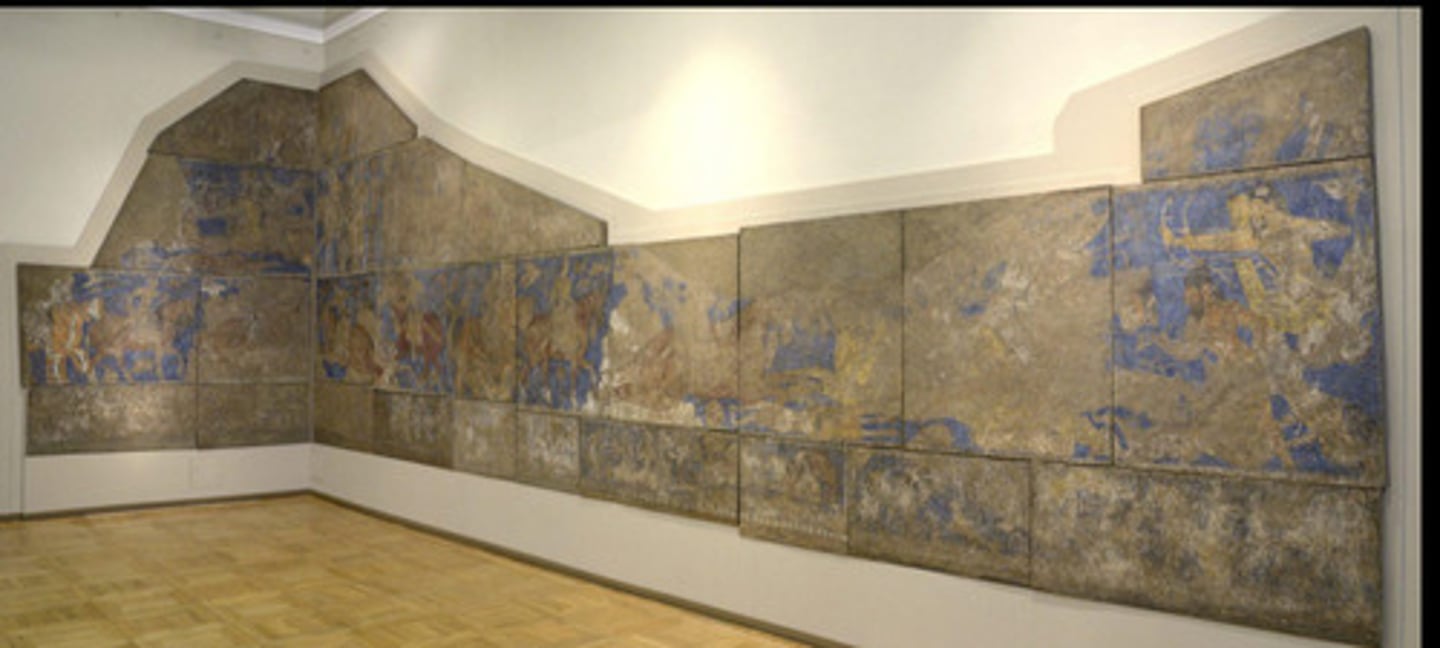
Varakhsha - Sogdian site with palace murals; located in Bukhara oasis (modern Uzbekistan)
Afrasiab : Ancient site of Samarkand, Sogdiana; famous for Afrasiab murals (7th-century)
Mount Mugh : Site in Sogdiana where the final Sogdian ruler Divashtich surrendered to Arab army in 723 CE; archive of Sogdian documents found there
Tillya Tepe : "Golden Hill" in Bactria (northern Afghanistan); 1st-century BCE/CE nomadic burial site with gold objects; pre-Sogdian but relevant to Silk Road art
Gandhara Region : Ancient region in modern Pakistan/Afghanistan; major center of Greco-Buddhist art; influenced Sogdian and Chinese Buddhist art
Kushan Empire : Central Asian empire (c. 1st-3rd century CE); patron of Buddhism and Silk Road trade; connected Gandhara with Central Asia and China
Pazyryk : Scythian burial site in Siberian permafrost (Altai Mountains); preserved organic materials (textiles, felt, tattoos); 5th-century BCE; shows early Silk Road exchange
Luoyang : Ancient Chinese capital (Eastern Han, Northern Wei, Tang); site of Longmen Caves; mentioned in Sogdian Ancient Letters as burned and destroyed
Ye : Ancient Chinese city; mentioned in Sogdian Ancient Letter No. 1 as "no more" (destroyed)
Chang'an : Ancient Chinese capital (modern Xi'an); capital of Tang Dynasty; site of Wirkak/Wiyusi sarcophagus, Nestorian stele; capital for Northern Zhou
Dunhuang : Buddhist cave complex (Mogao Caves) on eastern edge of Taklamakan Desert; major Silk Road hub; thousands of murals and manuscripts
Kizil : Buddhist cave complex in Kucha, Xinjiang, China; earliest major Buddhist cave site in China; known for central pillar caves and Jataka murals
Bamiyan : Buddhist cave complex in central Afghanistan; monumental standing Buddhas (destroyed); hybrid Gandharan-Sasanian-Central Asian art
Gyeongju : Capital of Silla and Unified Silla; location of gold crowns, Seokguram Grotto, and key tombs
Nara : Capital of Japan (710-784 CE); site of Tōdai-ji Temple and Shōsō-in Treasury
Nishapur : Major city in Abbasid Caliphate (eastern Iran); trade hub on Silk Road; possible destination for Belitung ship cargo
Muscat : Port city in Oman; location of ship repair mentioned on Belitung shipwreck map