I_Bus Exam 3 - Module 6
 Call Kai
 Learn
Learn Practice Test
 Spaced Repetition
 Match
Match Flashcards
 Knowt Play
1/131

Earn XP
Description and Tags
Terms - missing Global Market Opportunity
Name | Mastery | Learn | Test | Matching | Spaced | Call with Kai |
|---|
No analytics yet
Send a link to your students to track their progress
132 Terms
Global Market Opportunity
Favorable combination of circumstances, locations, or timing that offer prospects for exporting, investing, sourcing, or partnering in foreign markets
Global Market Opportunity Assessment (GMOA) Steps
1) Analyze organizational readiness to internationalize
2) Assess the suitability of products + services for foreign markets
3) Screen countries to identify attractive target markets
4) Assess industry market potential for the products/services in selected target markets
5) Choose qualified biz partners (such as distributors or suppliers)
6) Estimate company sales potential for each target market
Products that are best suited for internationalization
Sell well in domestic market
Cater to universal needs
Address a need not well served in foreign market
Address new or emergent need abroad
Screen countries to identify attractive target markets - country screening
To identify target markets
Identify 5-6 countries that hold best potential
Country screening techniques
Gradual elimination - lot of prospective target countries — narrow choices based on increasingly specific information
Indexing and ranking - assign scores to countries based on market attractiveness
Variables used in market potential index
Market size
Market growth rate
Market intensity
Market consumption capacity
Commercial infrastructure
Market receptivity
Economic freedom
Country risk
Assess industry market potential for the products/services in selected target markets
Considers all firms in a particular industry during a specific time period
Uber saw demand, increase urbanization, increase phone usage, congested traffic in India - and expanded to india
What kind of data is need to assess market potential?
Size and growth rate, industry trends
Tariffs and non-tariff barriers to entry
Standard and regulations
Availability and sophistication of distribution
Unique customer requirements and preference
Competitor performance
Choose qualified biz partners
Need to decide what activities they want to delegate to international partners + select based on their experience
Different internationalization strategies may choose different partners
Organizational readiness
Question their own competitive advantage (how many resources can they put towards internationalization)
Assess company strengths and weaknesses for international biz
Assess the suitability of products + services for foreign markets
Conduct a systematic assessment of the company offerings for international customers
Evaluate the fit between offerings and foreign customer needs
For each target market - identify factors that may hinder market potential + determine how offerings may need to be adapted for each market
Assess factors (such as foreign cultures, laws, competition)
Exporting
Producing goods or services in one country, selling in another
Common service exports
Professional services (accounting, consulting)
Digital (software development, tech support)
Education (international students, study abroad)
Travel and tourism
Advantages of service exports
Increases market share
Increases economies of scale
Minimizes cost of foreign entry
Minimizes risk
Flexible
Leverages the capabilities of foreign partners
Disadvantages of service exports
Fewer opportunities to learn foreign markets
Tariff and nontariff trade barriers \
Exchange rate fluctuations
Types of exporting
Indirect
Direct
Company-owned foreign subsidiary
Indirect exporting
Contract with an intermediary in the firm’s home country
Export management company or trading company
Direct exporting
Contracting with intermediaries in foreign market - perform downstream value-chain activities in target market
Distributors or agents
Company-owned foreign subsidiary export
Like direct exporting - exporters owns the foreign intermediation operation
Export documentation
Quotation or pro forma invoice
Comercial invoice
Bill of lading
Shipper’s export declaration
Certificate of origin
Insurance certificate
Quotation or pro forma invoice - export doc
Send to buyer before shipment
Estimated costs and terms of sale
Used to secure payment or apply for a letter of credit
Commercial invoice - export doc
From exporter to importer
Specify goods sold, prices, terms of sale, and payment details
Primary doc for customers clearance
Bill of lading - export doc
Basic contract - exporter and shippers
Authorizes shipping company to transport goods
Shipment receipt, contract, and docu of title for the goods
Shipper’s export declaration - export docu (maybe remember for exam)
Filed with the gov
Provides export statistics
Ensures compliance with regulations
Typically required when value of shipment exceeds a certain threshold
Certificate of origin - export doc
“Birth certificate” of goods
Where product originated
Required by some country to determine tariff or comply with trade agreements
Insurance certificate - export doc
Shipment is insured against loss or damage during transmit
Required to comply with sales contract terms (especially when using certain INCOTEMERS)
INCOTERMS
International Commerce Terms = system of universal terms for sale and delivery
Commonly used in insurance contracts
Clarifies tasks, costs, and risks - avoids cultural misunderstandings
Common INCOTERMS
EXW
FOB
CIF
EXW - common INCOTERMS
Ex Works = buyers arrange transportation from the seller’s premises
FOB - common INCOTERMS
Free On Board = sellers delivers goods to the port; buyer assumes risk from there
CIF - common INCOTERMS
Cost, Insurance, and Freight = seller covers costs, insurance, and freight to the destination port
Methods of payment
Cash in advance
Open account
Letter of credit
Cosignment
Cash in Advance - Method of payment
Payment made before goods are shipped
pro = Low risk for sellers - payment is secured
con = high risk for buyer
Open account - Method of payment
Seller ships goods and invoices buyer - who pays at a later date
pros = convenient for buyer - relationship with strong trust
cons = high risk for seller
Letter of credit - Method of payment
Bank guarantees payment on behalf of buyer - seller must meet specific conditions
pros = reduces risk for both parties
cons = can be complex and costly - bank fees
Cosignment - Method of payment
Exporter ships goods to importer, payment made when goods are sold
pros = can help build market presence + gain trust with foreign partners
cons = high risk for the exporter - payment is dependent on sale of goods
Letter of credit steps
1) Buyer and seller agree to terms, buyer requests letter from bank
2) Bank issues, promising to pay upon submission of specific documents
3) Seller ships goods and submits documents to bank for payment
Countertrade
Paying for goods or services using other goods or services - when conventional means are difficult
10-33% of all world trade
Common in large-scale government procurement
Risky - hard to price goods, may lead to price fixing, time consuming, complex
Types of Countertrade
Barter
Compensation Deal
Counterpurchase
Buy-back agreement
Barter - types of countertrade
Goods directly exchanged - no transfer of money
PepsiCo traded Pepsi for Soviet Union vodka
Compensation deal - types of countertrade
Payment in goods and cash
Saudi Arabia purchased aircrafts from Boeing. Paid partly in cash and in oil
Counterpurchase - types of countertrade
Two distinct contracts
1) seller agrees to set price of goods + receives cash from buyer
2) seller agrees to purchase gods from buyer
General motors sold auto techo to Poland. GM agreed to purchase goods in the future
Buy-back agreement - types of countertrade
Seller agrees to supply technology or equipment and receives payment in forms of goods produced by it
McDonnell Douglas helped China build aircraft manufacturing. MDD agreed to buy aircrafts.
Foreign intermediaries
Exporter relies on intermediaries for marketing, physical distribution, and customer service in the export market
Types of foreign intermediaries
Foreign distributor
Manufacturer’s representative
Trading company
Export management company (EMC)
Foreign distributor - foreign intermediaries
Base in foreign market
Under contract
Titled to and distributes products in national market
Marketing functions - sales, promotion, and after-sales
Manufacturer’s representative - foreign intermediaries
Contracted by exporter to represent and sell its merchandise or services in designated country
Trading company - foreign intermediaries
Engages in import and export - variety of commodities, products, and services
Export Management company - foreign intermediaries
Based in home market - act as export agent on behalf of client firm
Global sourcing
Procurement of products or services from suppliers located abroad for consumption in home country/3rd country
Benefits of global sourcing
Cost efficient b/c of lower wages abroad + potentially cheaper materials
Access to quality partners, tech, goods, etc
Market expansion opportunities
Faster speed to market
Risks of global sourcing
Outside risk factors (exchange rate fluctuations, trade barriers)
Weak legal environment
Low-skilled workers
Over-reliance on suppliers
Risk of creating competitors
Erosion of morale and commitment among home-country employees due to outsourcing jobs
Drivers of global sourcing
Tech advances
Digitalization
Increased knowledge and com
Increase of free trade
Less trade barriers
International biz is cheaper
Emerging markets
Intellectual property
Patent
Trademark
Copyright
Patent - intellectual property
Exclusive right for invention - prevent others from making, using, selling invention for set period
Trademark - intellectual property
Legally registered symbol, name, phrase - to identify and distinguish company’s goods/services from others
*Nike swoosh
Copyright - intellectual property
Legal protection - gives creators exclusive rights to reproduce, distribute, and display original literary, artistic, musical, other creative works
Licensing
Contractual agreement - licensor permits licensee to use the IP (trademarks, patents, tech, brand names) under defined condition - for royalties or fees
Licensing - IP usage
Licensee gains rights to use IP without owning
Licensing - Royalties and fees
Licensee pays the licensor for IP usage
Licensing - defined scope
Specifies duration, territory, and purpose of use
Licensing - quality control
Licensor may enforce standards to protect IP value
Types of licensing
Trademark licensing
Copyright
Patent
Trademark licensing
Permits use of trademark/brand name for specified products/services, maintaining brand consistency
*Clothing company licenses use of team’s logo for merchandise
Copyright licensing
Grant permission to use, reproduce, distribute, or display a creator’s original work - owner retains ownership
*Author licenses their novel to a publisher for printing and sales
Patent licensing
Licensee can make, use, sell, or import invention under agreed terms/conditions
*Tech company licenses patented tech to manufacturers for production
Licensing advantages
Low investment and involvement
Low effort once established
Avoid some country risk or trade barriers
Able to test foreign markets
Licensing disadvantages
Performance depends on licensee
Licensor has limited control over assets abroad
IP risks
Lower revenue than some other entry strategies
Franchising
Franchisee can operate a biz using franchisor’s brand, trademark, products and operation methods - for fees/royalties - more comprehensive and longer-term than licensing
Franchising - brand usage
Operate under an established brand name and trademark
Franchising - Standardized operations
Adherence to franchisor’s proven biz model and guidelines
Franchising - Support and training
Franchisor provides initial training and ongoing assistance in marketing, management, and operations
Franchising - Fees and royalties
Franchisee pays initial franchise fee plus ongoing assistance in marketing, management, and operations
Franchising - Markets
Often in advanced economies or select emerging markets
Franchising advantages - franchisee
Use well-known brand
Acquire training and operations knowledge
Already tested biz
Franchising disadvantages - franchisee
Must pay royalty fees
Franchisor has some overarching control
Franchising advantages - franchisor
Low investment
Internationalize quickly to multiple markets
Low effort once established
Leverage franchisee local knowledge
Franchising disadvantages - franchisor
Maintaining control over franchisees may be difficult
Franchiser has limited control over assets abroad
Risk creating a future competitor
Foreign direct investment (FDI)
Strategy - firm establishes physical presence abroad - by acquiring productive assets (capital, tech, labor, land, plant, equipment)
International collaborative venture (*don’t worry)
Cross-border biz alliance - partnering firms pool their resources and share costs/risks of a venture
Joint venture (JV)
Form collaboration between 2+ firms to create jointly-owned enterprise
FDI Destinations
Advanced economies in Europe, Japan, N Am = popular destinations
Emerging markets and developed economies = recently gained appeal as destination
China, Mexico, Eastern Europe = targeted for low-cost manufacturing and easy access to adjoining regional markets
FDI - key features
High ownership and control
Transfer of capital between firms or countries
Increased market access/expansion
Tech and expertise transfer
Employment and economic development
Low-term commitment
Motives
Market-seeking motives = expand to new markets/customers
Resource-seeking = access to new tech/knowledge from new partners
Efficiency-seeking = ease market entry + regulations - reduce financial + operational risks
Marketing-seeking motives
Gain access to new markets/opportunities = Boeing, Coca-cola, McDonald = more sales abroad
Follow key customers = Company that supplies plastic to Procter & Gamble - built a plant in China after P&G did
Compete with key rivals in their own markets = Caterpillar entered Japan to tie up Komatsu (rival), to hamper Komatsu’s ability to expand its activities in the US
Resource-seeking motives
Access raw materials needs = Mining and oil industries must go to raw materials
Gain access to knowledge or other assets = partnering with international firms - can make entry internationally easier
Access technological + managerial know-how available in key market = firm may benefit by establishing presence in key industrial cluster like robotics industry in Japan
Efficiency-seeking motives
Can increase economies of scale = reduce sourcing and production costs - allow resources to be effectively allocated
Physical presence in markets = production closer to customers - increase speed to market
Avoid trade barriers = direct market entry - avoid tariffs and other trade barriers
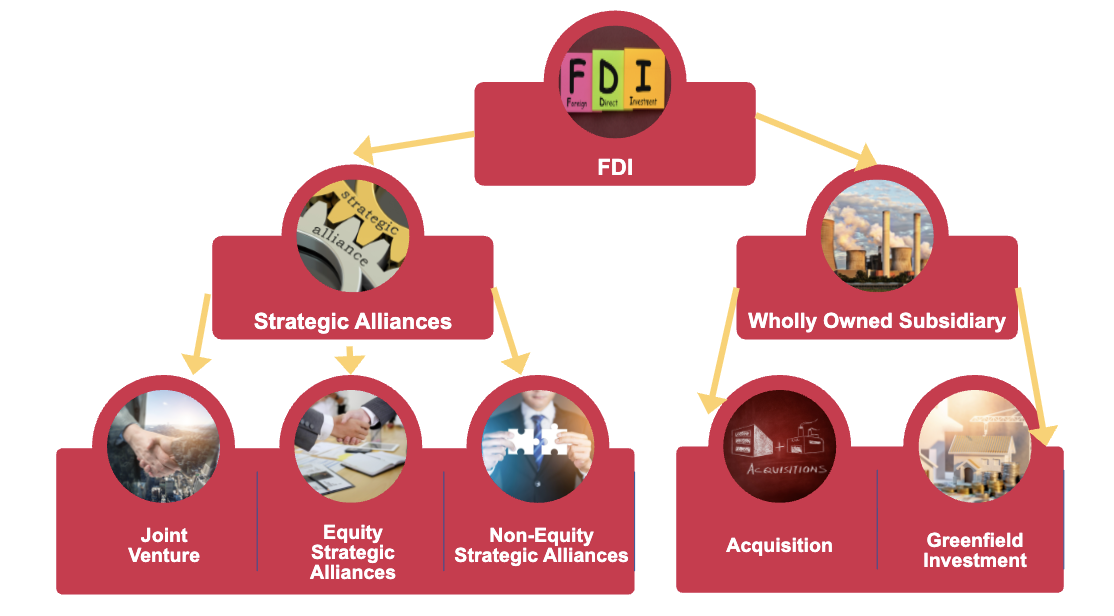
Types of FDI
Greenfield investment
Acquisition
Merger
Greenfield investment - types of FDI
Firms invest to build new manufacturing, marketing, or administrative facility - opposed to acquiring existing facilities
Acquisiton - types of FDI
Purchase existing company or facility
*Majority of FDI inflows through acquisitions
Merger - types of FDI
Special type of acquisition - two companies join to form larger firm
Acquisition benefits
Quicker to execute than greenfield investment
Gain access to valuable strategic assets = brand loyalty, customer relationships, trademarks/patents, distributions and production systems
Increase efficiency of acquired unit by transferring capital, tech, or management skills
Acquisition benefits
Vertical integration = arrangement - firm owns or seeks to own multiple stages of value chain for producing, selling, or delivering
Horizontal integration = expanding at same production level - often by acquiring competitors to increase market share and achieve econ of scale - Microsoft acquired foreign subsidiaries - make different types of software they haven’t covered yet
Categories of strategic alliance
Joint venture
Equity Strategic Alliance
Project-based strategic alliance
Joint venture - categories of strategic alliances
New independent entity jointly created and owned by 2+ parent companies
Equity strategic alliance - categories of strategic alliances
2+ partners have different relative ownership shares
*Small firm may contribute local knowledge to larger firm
Project-based strategic alliance - categories of strategic alliances
Shorter-term - often focused on developing a product/facility that benefits both firms - no new firm is legally created
Marketing Mix components
Product, Price, Promotion, Place