RT 206 RADIATION EFFECTS TOPIC 1 PREFINALS (copy)
 Call Kai
 Learn
Learn Practice Test
 Spaced Repetition
 Match
Match Flashcards
 Knowt Play
1/51

Earn XP
Description and Tags
RT 206 RADIATION EFFECTS TOPIC 1 PREFINALS by YJV
Name | Mastery | Learn | Test | Matching | Spaced | Call with Kai |
|---|
No analytics yet
Send a link to your students to track their progress
52 Terms
Atom
Molecules
Organelles
Cells
Tissues
Organs
Organ System
Organism/Human
Biological Hierarchy Order:
Deterministic
Threshold
High dose radiation
Non Linear
Early Effects
Stochastic
Non threshold
Low dose of radiation
Late Effects
Linear
Threshold
A specific dose is needed to achieve respone
Non-Threshold
Any dose produces response
Linear
Response is proportional to dose
Non-Linear
Response is not proportional to dose
Cataracts
Erythema
Sterility
Examples of Deterministic:
Cancer
Genetic Mutation
Examples of Stochastic:
Main-Chain Scission
Cross-Linking
Point Lesion
IRRADIATION OF MACROMOLECULES:
Main-Chain Scission
Breakage of the backbone the long chain macromolecule
= Reduction into many smaller molecules (still considered as macromolecule)
=↓ Size ↑ Viscosity
Cross-Linking
Spurlike side structures that extend off the main chain
= Side structures that behave like sticky substance on the end and attach neighboring macromolecule or another segment of the molecule
= ↑ Viscosity
Point Lesion
Result in disruption of single chemical bonds
= Are not detectable but can cause minor modification which in turn can cause malfunction in the cell
1. Main-Chain Scission with only one side rail severed
2. Main-Chain Scission with both side rail severed
3. Main Chain Scission with cross-linking
4. Rung Breakage causing separation of bases
5. Change in or loss of a base
RADIATION RESPONSE OF DNA:
Point Mutation
Chromosomal Aberration
2 Forms of Genetic Mutation:
Point Mutation
Small Scale
Alteration that occurs in the DNA base sequence of a gene
Single gene alteration
Chromosomal Aberration
Larger Scale
Alteration in the structure of the chromosome of the organism
Many gene alterations
After irradiation
Chromosomal Aberrations are the structural changes to the chromosome __________
Aberrations, Lesions, or Anomalies
Chromosomal Aberrations can be called:
Karyotype
Is a chromosome map used for cytogenetic analysis of chromosomes.
Metaphase
Photomicrographs are taken during _____ that demonstrates each chromosome separately
Single-Hit Chromosomal Aberration
Multi-Hit Chromosomal Aberrations
2 Forms of Chromosomal Aberrations:
Chromatid deletion
If irradiation occurs in G1, a breakage in the chromosome will occur, termed as __________
form a chromosome
During S phase, both the remaining chromosome and deletion will be duplicated to ____________
isochromatids
During Metaphase, this will appear as a normal chromosome with materials missing from the ends of two sister chromatids and two acentric fragments called
one arm or both
If the irradiation occurs in G2, a chromatid deletion may occur in just _________
ring chromosome
If irradiation occurs in G1, If two hits occur on one chromatid, a ________ will be produced
dicentric chromosome
When neighboring chromatids each suffer one hit and recombine, this will produce _________
occur, rare
During G2 phase of the cell cycle, similar chromosomal abnormalities can _____ but are ______
Reciprocal Translocation
Multi-hit chromosomal Aberrations,
If chromosomes experience this type of alteration, they do not lose any genetic material, but instead the genes become rearranged.
sequenced incorrectly
In Reciprocal Translocation, This results in all genetic codes being available, but __________
Before DNA
Chromosomal Aberration is chromosomal damage that occurs ____ synthesis
Chromatid Aberration
Chromosomal Damage that occurs AFTER DNA synthesis
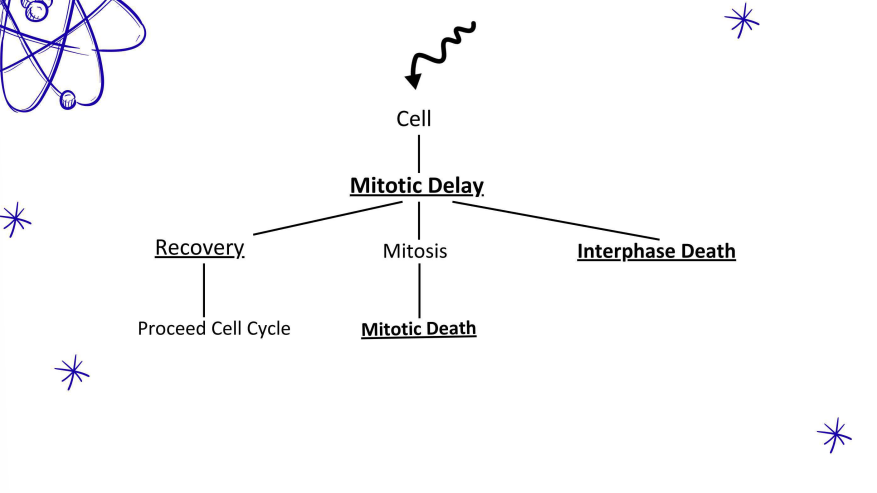
1. It can be delayed from going through division
2. It can die before it divides
3. It can die when attempting mitosis
One of the three things can happen to a cell after irradiation:
Mitotic Delay
Dose Dependent Response
Temporary postponement of cell division after irradiation
Cells under mitosis during time of irradiation completes division while those under G2 are delayed to avoid catastrophic mitosis
catastrophic mitosis
In Mitotic Delay, Cells under mitosis during time of irradiation completes division while those under G2 are delayed to avoid __________
Longer Delay, Lower Dose
Higher Dose = ????
??? = Shorter Delay
Higher Dose, Shorter Delay
???? = Longer Delay
Lower Dose = ????
Interphase Death
Death BEFORE the cell enters mitosis
Rapid Cell Death
Occurs even before the cell tries to divide
Apoptosis
Apoptosis
“falling off” (g)
programmed self-destruction
Mitotic Death
Death DURING/AFTER the cell enters mitosis
“Reproductive Death”
Delayed Cell Death
Misrepair of DNA and Errors accumulate
fails to divide properly
produce nonviable daughter cells
Mitotic Death occurs due to sufficient DNA damage:
MEMORIZED
MEMORIZE THE IMAGE OKAY???
G0
cell cycle arrest
G1
Cellular contents, excluding the chromosomes are duplicated
S
Each of the 46 Chromosomes is duplicated by the cell
G2
The cell “double checks” the duplicated chromosomes for error, making any needed repairs
Single Chromatid
in G1, Each Chromosome is a ________
Pair of sister chromatids
After S phase, Each chromosome is now a __________
Single-Hit Chromosomal Aberration
If irradiation occurs in G1, a breakage in the chromosome will occur, termed as chromatid deletion.
During S phase, both the remaining chromosome and deletion will be duplicated to form a chromosome
During Metaphase, this will appear as a normal chromosome with materials missing from the ends of two sister chromatids and two acentric fragments called isochromatids
If the irradiation occurs in G2, a chromatid deletion may occur in just one arm or both
Multi-Hit Chromosomal Aberrations
If irradiation occurs in G1, If two hits occur on one chromatid, a ring chromosome will be produced
When neighboring chromatids each suffer one hit and recombine, this will produce dicentric chromosome
During G2 phase of the cell cycle, similar chromosomal abnormalities can occur but are rare
Interphase Death
Mitotic Death
Cell Death