chap 45 - animal movement
 Call Kai
 Learn
Learn Practice Test
 Spaced Repetition
 Match
Match Flashcards
 Knowt Play
1/69

There's no tags or description
Looks like no tags are added yet.
Name | Mastery | Learn | Test | Matching | Spaced | Call with Kai |
|---|
No analytics yet
Send a link to your students to track their progress
70 Terms
______ ______ is found in every organ
muscle tissue
what are the four functions of muscle tissue
resist movement, maintain posture, maintain blood pressure, generate heat
all muscle cells have mechaism of action - they _______ then ______
contract (shorten) relax (lengthen)
group of muscle cells with same origin, insertion, and function consisting of multiple fascicles
skeletal muscle
bundles of muscle cells are wrapped with connective tissue (fascia)
fascicles
multinucleated muscle cell, consisting of many myofibrils
skeletal muscle fiber
cylindrical contractile structures inside muscle cells that contain the proteins acting and myosin
myofibrils
fiber is ____
fibril is _____
cell, tube inside cells
the contractile unit of a skeletal and cardiac myofibril extending from one z line to the next
sarcomere
attachment points between sarcomeres made of many proteins include alpha-actin
z lines
what are the two main contractile proteins
myosin and actin
protein that forms thick filaments in muscle
myosin
protein that forms thin filaments in muscle
actin
specialized muscle cell membrane
sarcolemma
invaginations of the cell membrane in cardiac and skeletal muscle
t-tubule
specialized muscle cell endoplasmic reticulum
sarcoplasmic reticulum (SR)
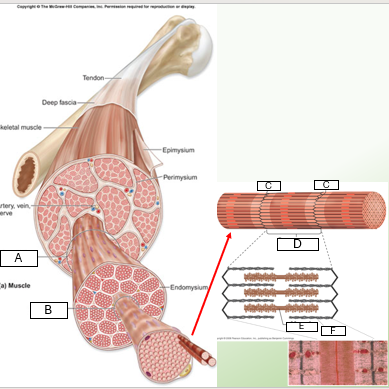
a?
fascicle
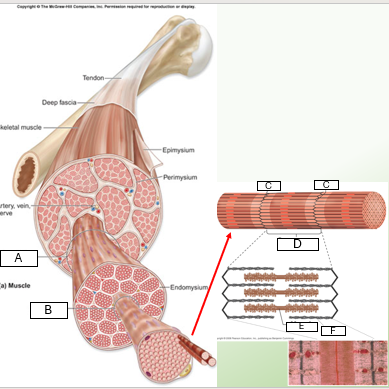
b?
muscle fiber
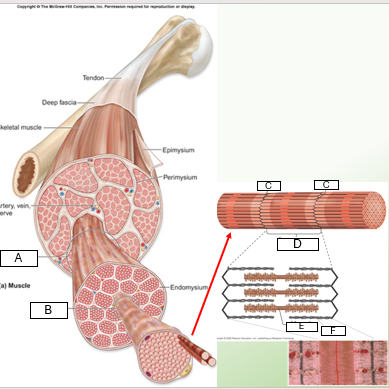
c?
z line
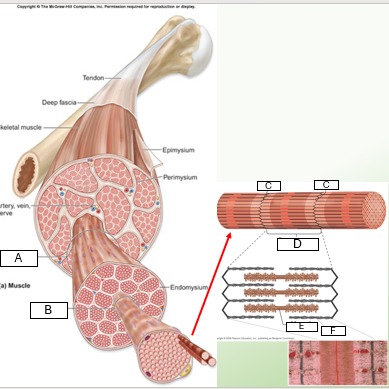
d?
sarcomere
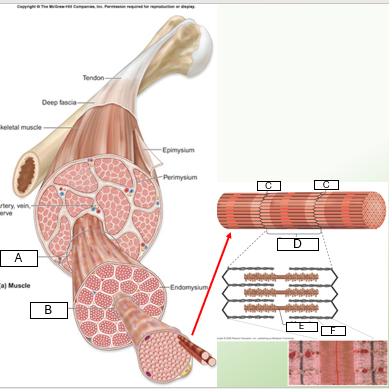
e?
myosin
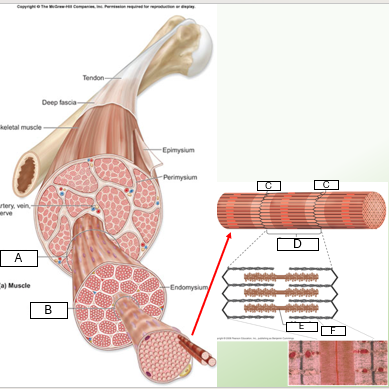
f?
actin
all the muscle cells innervated by a single neuron
motor unit
synapse with and can stimulate
innervate
at rest there is a slight _____ ___ concentration on the inside of the muscle cell membrane
negative ion
a higher ________ Na+ concentration outside the muscl ecell
positive
a motor neuron releases the neurotransmitter acetylcholine at the neuromuscular junction (NMJ)
1st step of neurons initiating contraction
acetylcholine binds receptor proteins on muscle that open Na+ channels
2nd step of neurons initiating contraction
action potential Na+ rushes into the muscle cell depolarizing the membrane which opens a cascade of ion channels along the muscle membrane
3rd step of neurons initiating contraction
action potential passes into membrane extensions called t-tubules (transverse tubules)
4th step of neurons initiating contraction
impulse reaches the sarcoplasmic reticulum which opens calcium (Ca2+) channels
5th step of neurons initiating contraction
Ca2+ binds troponin, which moves tropomyosin, opening myosin binding sites on actin
6th step of neurons initiating contraction
two inhibitor proteins that surround actin filaments preventing myosin from interacting
troponin and tropomyosin
myosin heads bind actin to form cross-bridges (this shortens the sarcomere)
7th step of neurons initiating contraction
•ATP binds Myosin “heads” to ______ ____ from actin during contraction.
detatch them
when nerve activation ends, _____ ____
activation ends
membrane transport protein that uses ATP to pump calcium ions from the cytosol back into the sarcoplasmic reticulum
Sarcoplasmic / Endoplasmic Reticulum Ca2+ ATPase (SERCA):
muscles require ___ to contract and relax
ATP
_______, ___, and _______ are broken down into components that can enter the mitochondria & the TCA cycle that makes ATP.
glucose, fats, protein
a molecule that transfers a phosphate molecule to ADP during strenuous exercise when ATP levels are low
phosphocreatine
short, intense resistance training that builds more myofibrils (NO NEW MUSCLE CELLS)
strength training
cells near muscles receive signals to become myofibrils
satellite cells
builds endurance by signaling cells to increase production of mitochondria, myoglobin, and capillaries to muscle cells
aerobic trainin
protein that stores oxygen in muscle cells
myoglobin
muscle composition depends on:
aerobic v anaerobic respiration use, myoglobin levels, mitochondria number, myosin isoforms
Muscle cells that have slow contractions, primarily use aerobic respiration for ATP, have more mitochondria, and have more capillaries supplying myoglobin.
slow twitch (type 1) muscle fibers
Muscle cells that have fast contractions, rely on anaerobic respiration, and creatine phosphate for energy.
fast twitch (type 2a) muscle fibers
Cells have fast contractions, primarily use anaerobic glycolysis but also use aerobic respiration.
intermediate (type 2b) muscle fibers
proteins derived from the same gene but are spliced into different amino acid sequences
isoforms
myosins spliced such that they have different ATPase activity (break down ATP at different rates)
myosins isoforms
Muscle cells that have myosin isoforms that break down ATP slowly.
-The cells also have more mitochondria, and increased blood supplies.
slow twitch (type 1) muscle fibers
Muscle cells that have myosin isoforms that break down ATP quickly.
-They rely on more anaerobic respiration and creatine phosphate for energy.
fast twitch (type 2a) muscle fibers
the end of the muscle that is attached to the non moving bone
origin
the end of the muscle that is attached to the movable bone
insertion
groups of muscles that work in opposition to each other
antagonistic muscle groups
muscles that pull bones closer together, decreasing joint angles (eg hamstring)
flexors
muscles that increase the angle of a joint, straightening it out (eg quadriceps)
extensors
what are the three types of skeletal systems
hydrostatic, endo and exoskeletons
use hydrostatic pressure of enclosed body fluids (or soft tissues) to support body
hydrostatic skeletons
have rigid structures inside the body
endoskeletons
have rigid structures on the outside of the body (often made of the carbohydrate chitin)
exoskeletons
squeeze coelomic fluid, and pressure pushes outward, extending longitudinal muscles and lengthening the segment
circumferential muscles contract
pull the body forward (for hydrostatic skeletons)
longitudinal muscles contract
alternating contractions of longitudinal and circumferential muscles pass down earthworm in waves
peristalsis
cells that secrete collagen and the organic matrix of bone (osteoid) which becomes calcified (bone)
osteoblasts
osteoblasts that become trapped in the matrix they secrete, that form star shaped canals to exchange nutrients and waste
osteocytes
bone cells responsible for removing and reabsorbing of old bone during remodeling
osteoclasts
bands of fibrous connective tissue that binds bones to other bones
ligaments
tissue with cells in a gelatinous matrix of polysaccharides and protein fibers that provides a smooth surface for bones to move against each other
cartilage
tissue with hard extracellular matrix that stores minerals
bone