StemUp: AQA A level Physics 3.4.2 Materials
 Call Kai
 Learn
Learn Practice Test
 Spaced Repetition
 Match
Match Flashcards
 Knowt Play
1/55

There's no tags or description
Looks like no tags are added yet.
Name | Mastery | Learn | Test | Matching | Spaced | Call with Kai |
|---|
No analytics yet
Send a link to your students to track their progress
56 Terms
What is density? (1)
Density is the mass of a substance per unit volume.
What is the equation for density? (2)
- Density = mass / volume.
- Where density is in kg/m³, mass is in kg, and volume is in m³.
What is Hooke's law? (2)
- Hooke's law states that extension is directly proportional to force applied.
- This applies under the condition that the material is within its elastic limit.
What is the equation for Hooke's law? (2)
- Force = k × extension.
- Where force is in newtons (N), k is either the stiffness constant or spring constant and is in newtons per metre (N/m), and extension is in metres (m).
How is Hooke's law shown on a force-extension graph? (1)
Hooke's law is shown as a straight line starting from the origin.
What does a force-extension graph showing Hooke's law look like? (2)
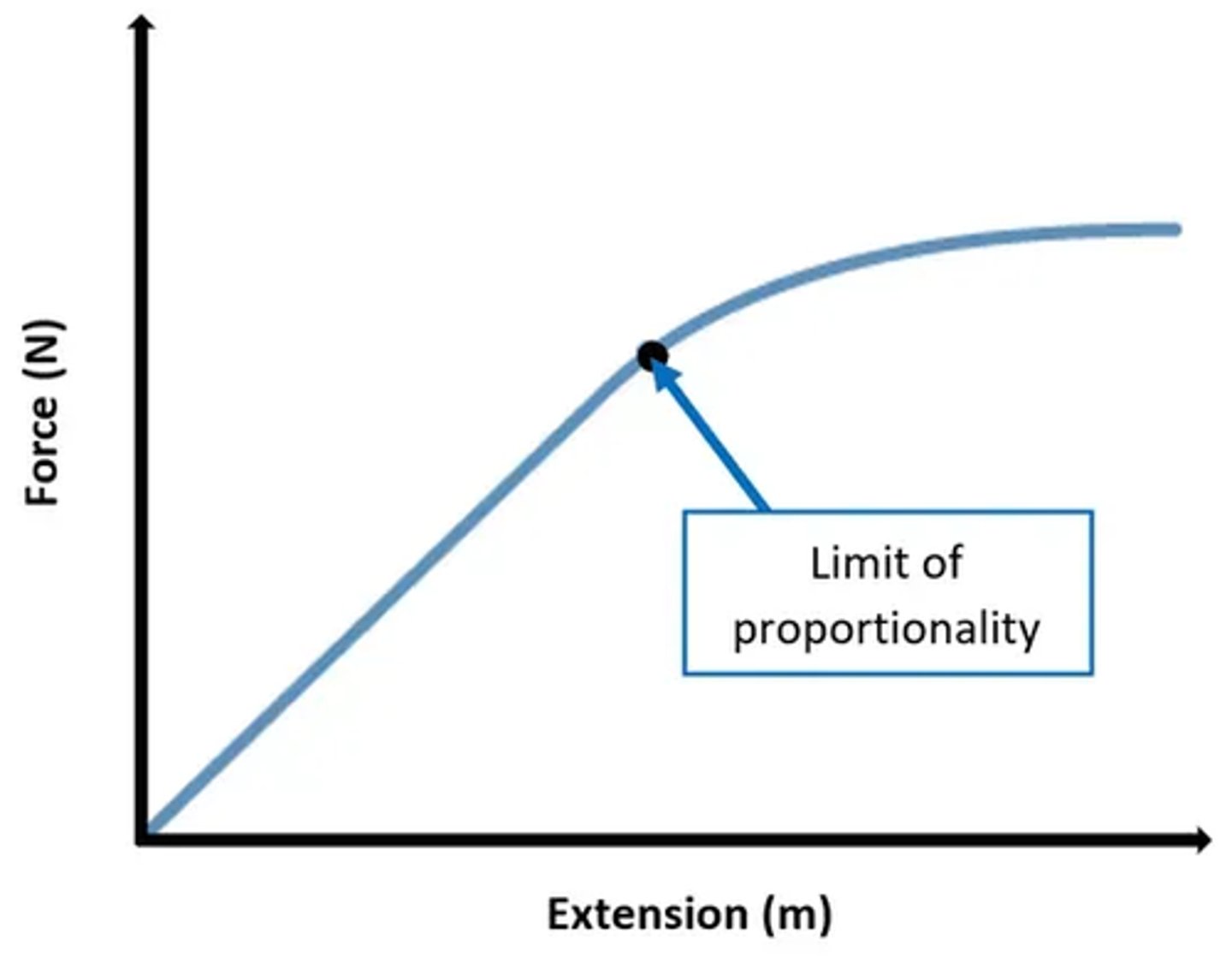
What does the gradient of a force-extension graph represent? (1)
The gradient of the linear section is the spring constant, k.
What does the area under a force-extension graph represent? (1)
The area under a force-extension graph represents the elastic strain energy stored in the material.
What is the limit of proportionality? (3)
- The limit of proportionality is the point beyond which extension is no longer directly proportional to force.
- Hooke's law no longer applies beyond the limit of proportionality.
- The force-extension graph is no longer a straight line.
What is the elastic limit? (1)
The elastic limit is the maximum extension a material can undergo and still return to its original shape when the force is removed.
What are the properties of an elastic material? (3)
- The material will return to its original shape and size if the force stretching or compressing it is removed.
- Atoms can move small distances from their equilibrium without affecting the material shape.
- The material will return to its original shape as long as the elastic limit of the object is not reached.
What is tensile stress? (1)
Tensile stress is the force applied per unit cross-sectional area.
What is the equation for tensile stress? (2)
- Stress = force / area.
- Where force is in newtons (N), area in m², and stress in pascals (Pa).
What is tensile strain? (1)
Tensile strain is the extension of a material divided by its original length.
What is the equation for tensile strain? (2)
- Strain = extension / original length.
- Where strain has no units since both extension and original length are in metres (m).
What is the equation for elastic strain energy? (3)
- Energy = 0.5 force extension.
- If Hooke's law is obeyed (force = k extension) the energy is : Energy = 0.5 k extension^2.
- Where energy is in joules (J), force in newtons (N), k is either the stiffness constant or spring constant and is in newtons per metre (N/m), and extension in metres (m).
What is breaking stress? (1)
Breaking stress is the maximum stress a material can withstand before it breaks.
How does a material behave plastically on a force-extension graph? (1)
The material extends significantly beyond the elastic limit and does not return to original length after unloading.
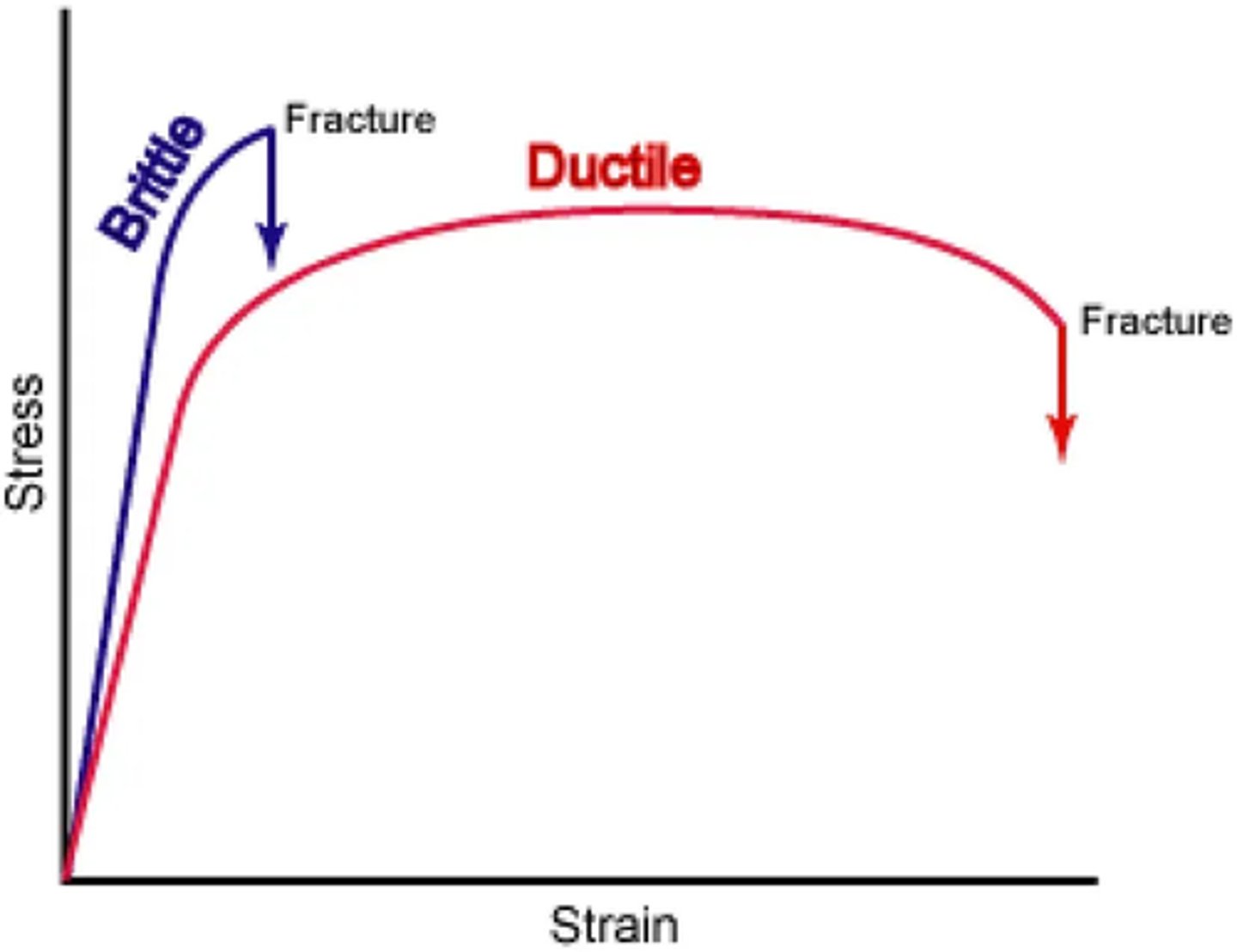
How does a brittle material behave on a force-extension graph? (1)
It stretches very little and breaks suddenly with no noticeable plastic deformation.
What does the force-extension graph of a brittle material look like? (1)
The material fractures at a low extension without any curve beyond the elastic region.
How does a ductile material behave on a force-extension graph? (1)
A ductile material undergoes significant plastic deformation before breaking.
What does the force-extension graph of a ductile material show? (2)
- The graph displays a long, curved section beyond the elastic limit.
- This indicates that the material continues to extend significantly under force without immediately breaking.
Why are ductile materials useful in engineering? (2)
- Ductile materials absorb significant energy before fracturing.
- This provides flexibility and toughness.
What does a force-extension graph show at the point of fracture? (1)
At the point of fracture, the graph will show a sudden drop, indicating the material has broken and can no longer withstand any load.
How do brittle and ductile materials fracture differently? (2)
- Brittle materials fracture quickly with little warning.
- Ductile materials fracture after large plastic deformation.
What does a force-extension graph look like for plastic and brittle materials? (2)
What does the force-extension graph of loading and unloading of a plastically deformed material show? (2)
- The unloading line does not return to the origin.
- This indicates permanent deformation.
What does the force-extension graph of loading and unloading look like for a plastically deformed material? (2)
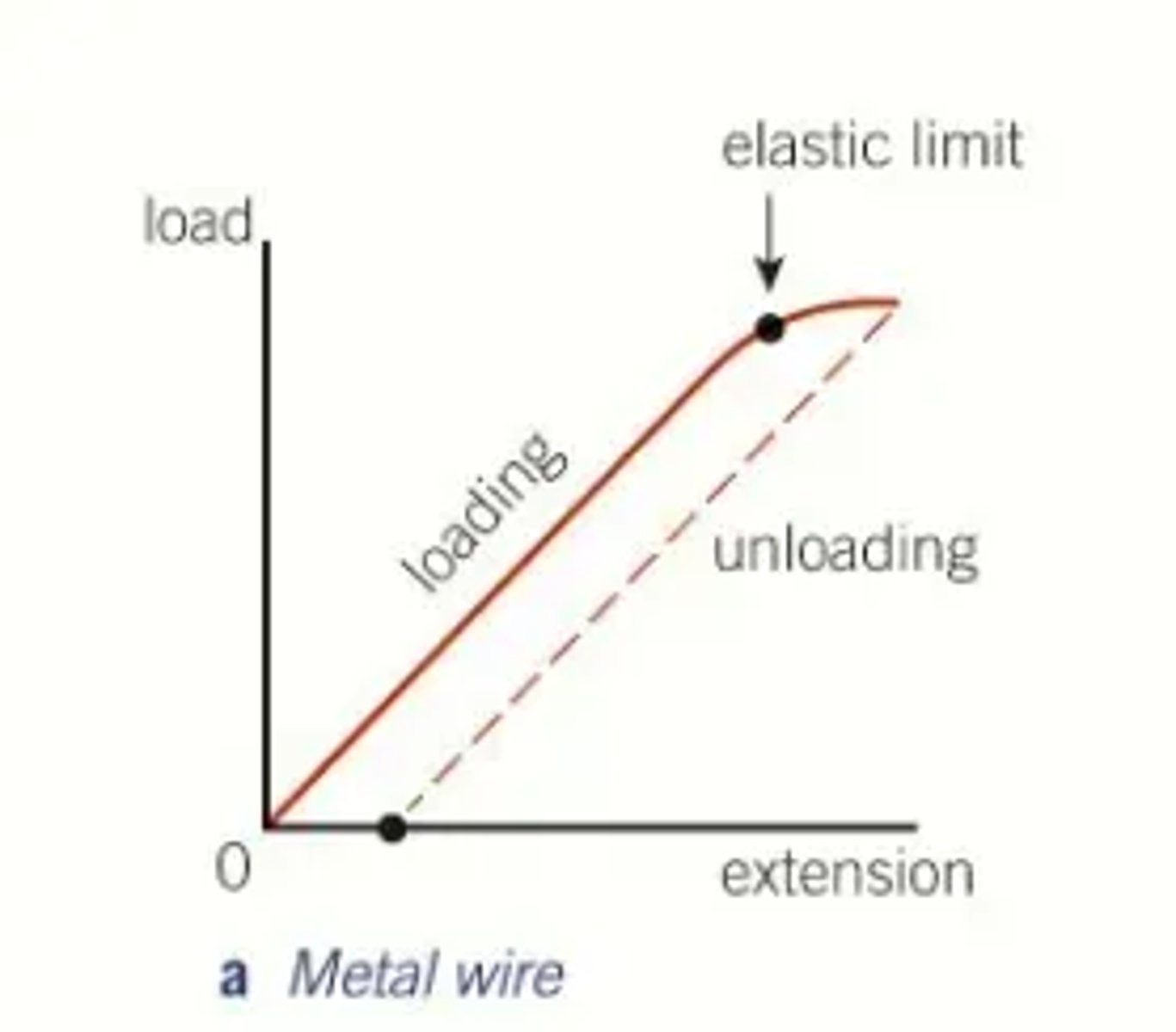
What does the area between loading and unloading lines on a force-extension graph represent? (1)
This area represents the work done to deform the material permanently and is dissipated as heat.
What happens to energy when a material stretches elastically? (1)
All work done is stored as elastic strain energy and is fully recoverable.
What happens to energy when a material stretches plastically? (1)
Energy is used to move atoms apart and is dissipated as heat, not stored.
How is plastic deformation useful in car safety design? (1)
Crumple zones use plastic deformation to reduce the car's kinetic energy in a crash.
How do crumple zones protect passengers? (1)
Crumple zones deform plastically to absorb kinetic energy during collisions.
How do seat belts reduce injury in a crash? (2)
- Seatbelts stretch slightly.
- This stores energy as elastic strain energy and reduces the force on the passenger.
What are the energy transfers when a spring is stretched and released? (3)
- Stretching the spring converts kinetic energy to elastic strain energy.
- Releasing the spring converts the elastic strain energy back to kinetic.
- Then to gravitational potential energy as it rises.
What does a stress-strain graph show? (1)
A stress-strain graph shows how a material behaves in terms of stress and strain.
How does a stress-strain graph differ from a force-extension graph? (2)
- A stress-strain graph gives information about the material itself.
- Not a specific object, like force-extension graphs.
What can be learned from a stress-strain graph? (2)
- Stress-strain graphs show properties like ultimate tensile stress.
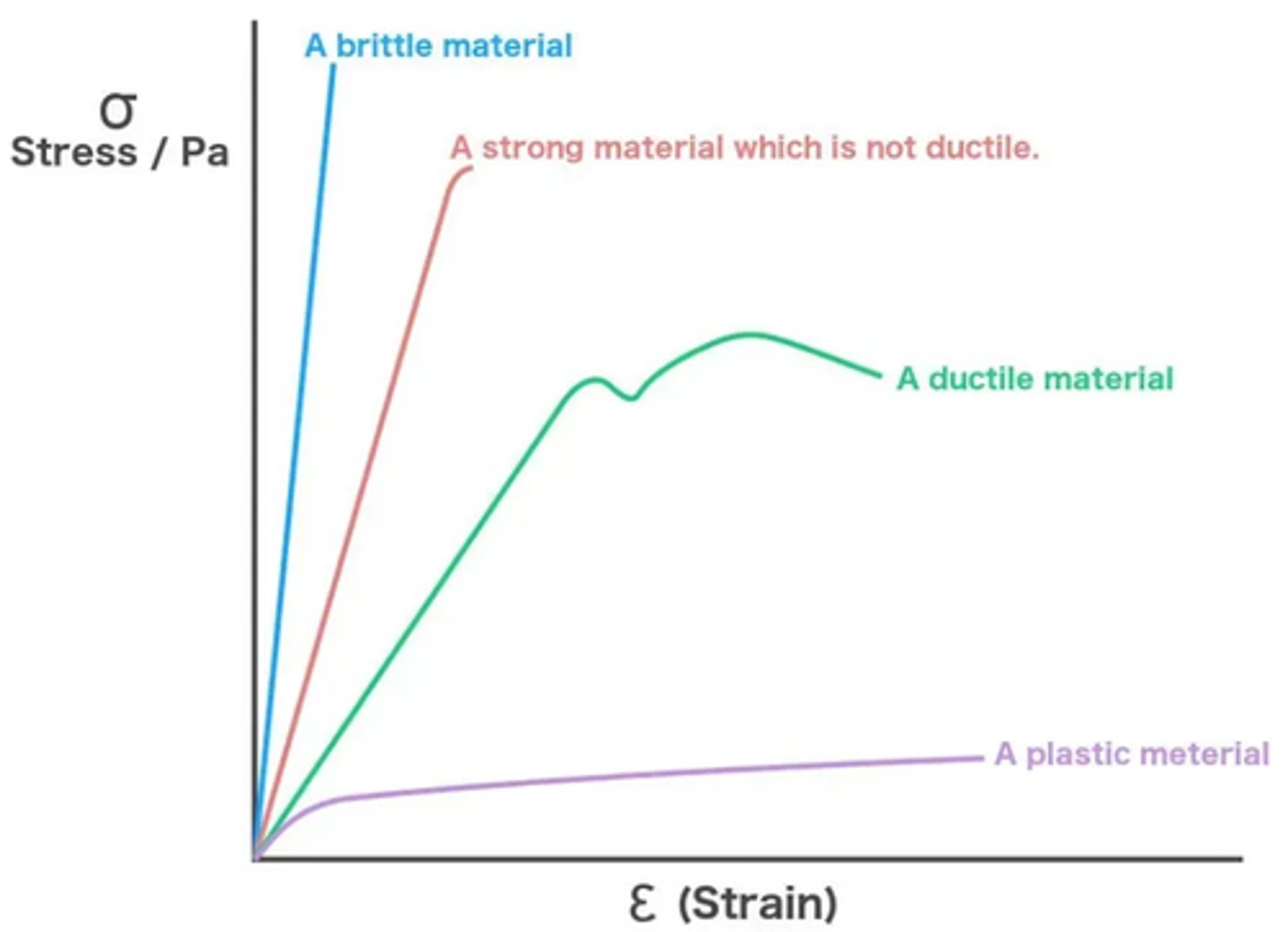
- Stress-strain graphs also show whether a material is brittle, ductile, or plastic.
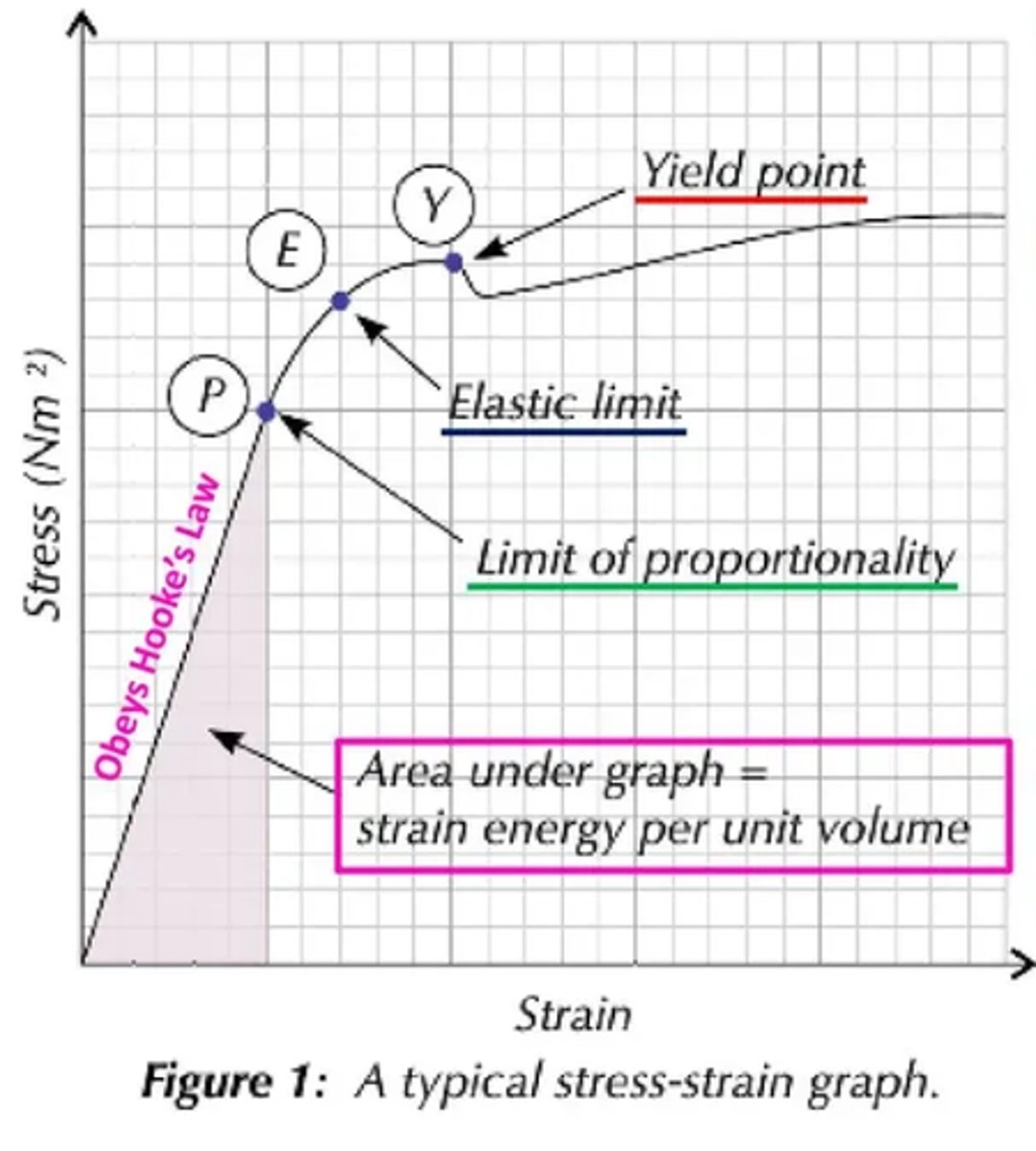
What is the limit of proportionality on a stress strain graph? (2)
At the limit of proportionality the material no longer obeys Hooke's law.
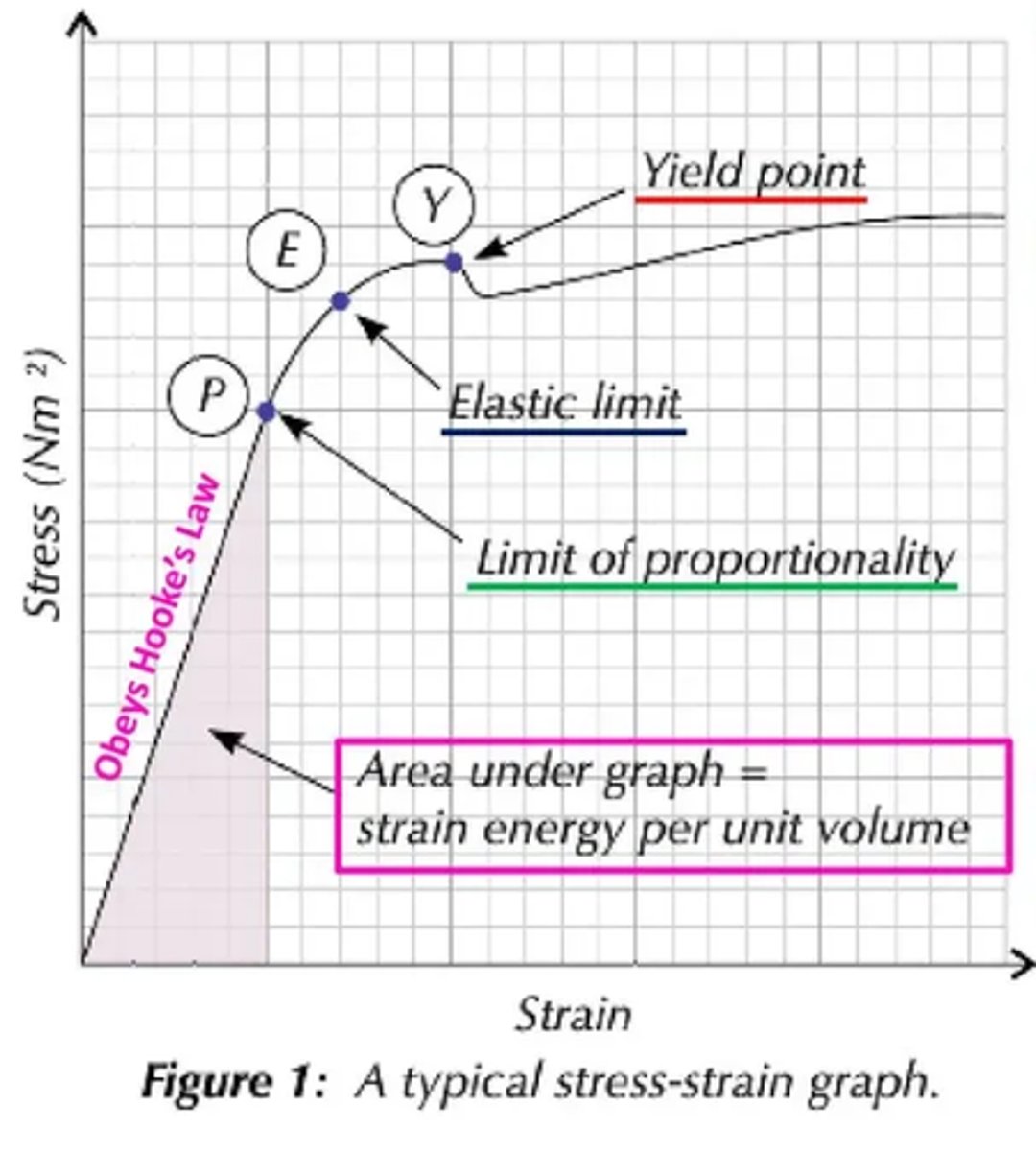
What is the elastic limit on a stress strain graph? (3)
- At the elastic limit the material behaves plastically.
- The material will no longer return to its original shape if the stress is removed.
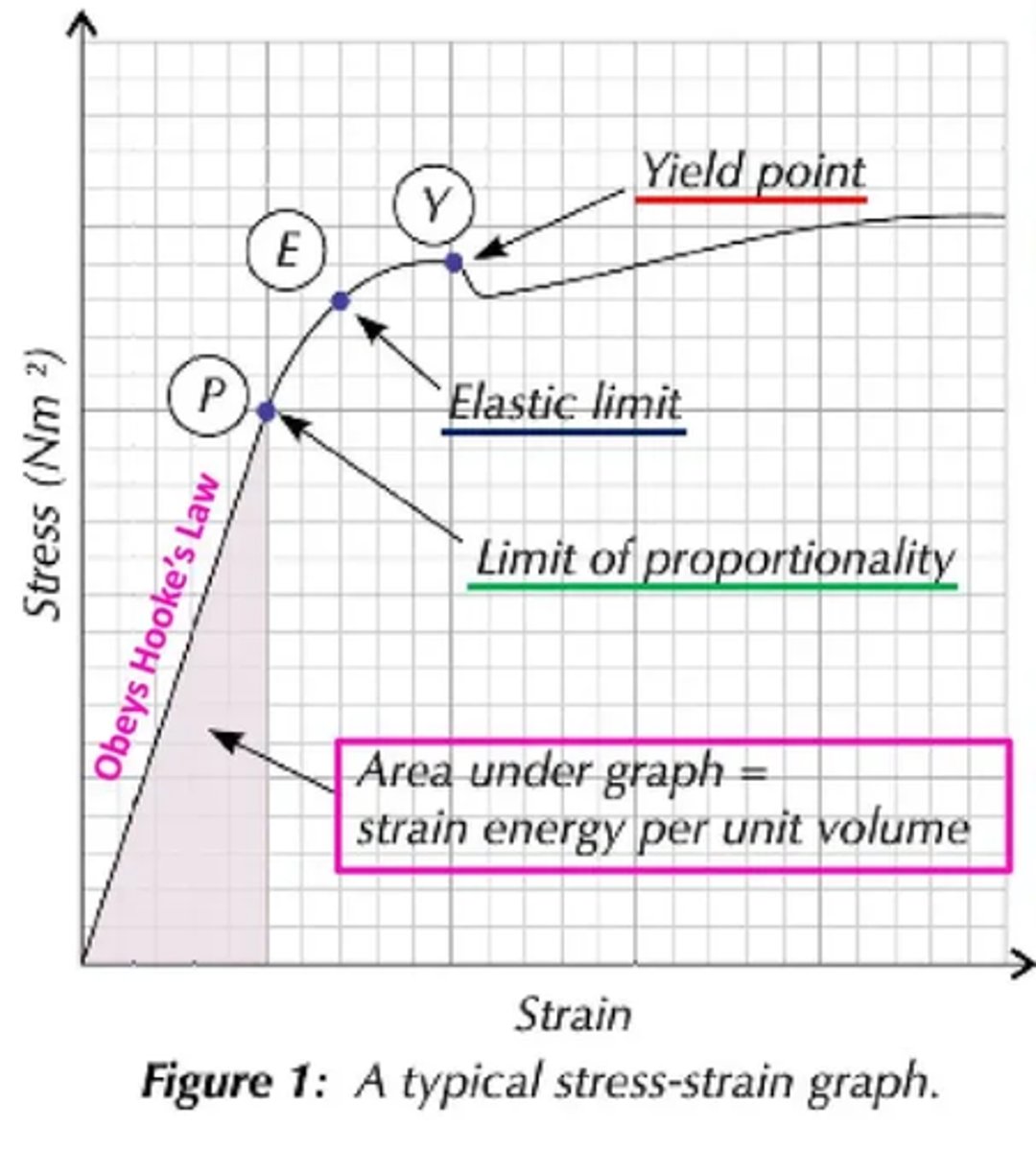
What is the yield point on a stress strain graph? (3)
- At the yield point the material starts to stretch without any extra load.
- A large amount of plastic deformation takes place with a constant load or smaller load.
What do brittle, ductile and plastic materials look like on a stress-strain graph? (3)
What is the ultimate tensile stress (UTS)? (1)
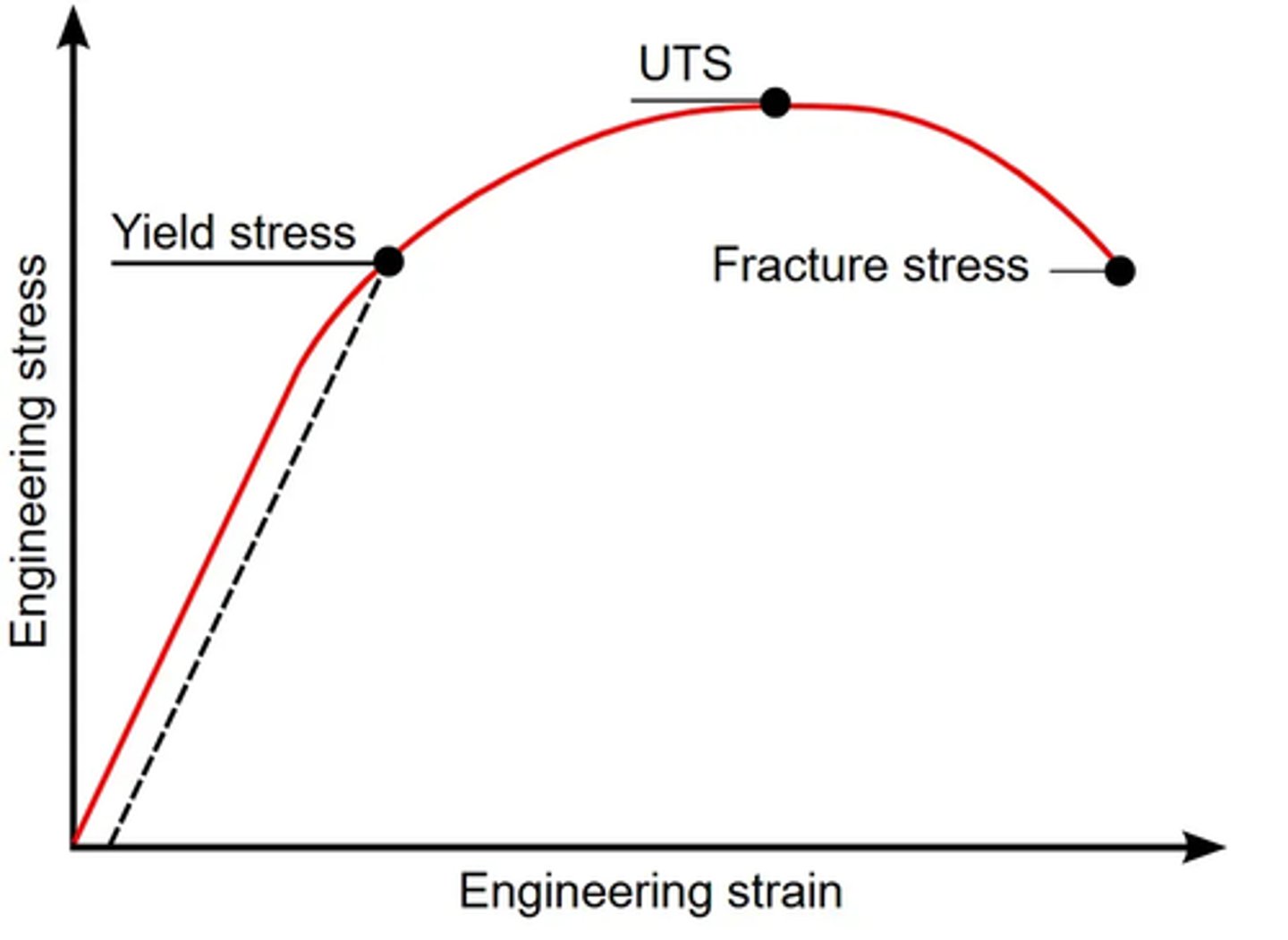
UTS is the maximum stress a material can withstand before necking or breaking.
What is the difference between ultimate tensile stress and breaking point? (2)
- UTS is the maximum stress a material can withstand before necking.
- Breaking point is when the material fractures.
Where is the ultimate tensile stress (UTS) shown on a stress-strain graph? (1)
UTS is the highest point on the graph before the material begins to break.
What does the ultimate tensile stress (UTS) look like on a stress-strain graph? (2)
How does ethical transport design involve energy conservation? (1)
Ethical transport design focuses on reducing harm by managing how kinetic energy is absorbed in a crash.
How do safety features support ethical transport design? (1)
Crumple zones and seat belts convert kinetic energy into other forms to reduce injury.
Why are energy-managing designs in transport considered ethical? (1)
They prioritise passenger safety by safely dissipating energy away from the human body.
What is the Young modulus? (1)
The Young modulus describes the stiffness of a material.
What does it mean if a material obeys Hooke's law up to the limit of proportionality? (1)
It means that the stress is directly proportional to strain within that region.
How is the Young modulus defined when Hooke's law is obeyed? (2)
- The ratio of stress to strain remains constant.
- And this constant is the Young modulus.
What is the equation for the Young modulus? (2)
- E = FL / (ΔL × A).
- Where E is the Young modulus (Pa), F is the applied force (N), L is original length (m), ΔL is extension (m), and A is cross-sectional area (m²).
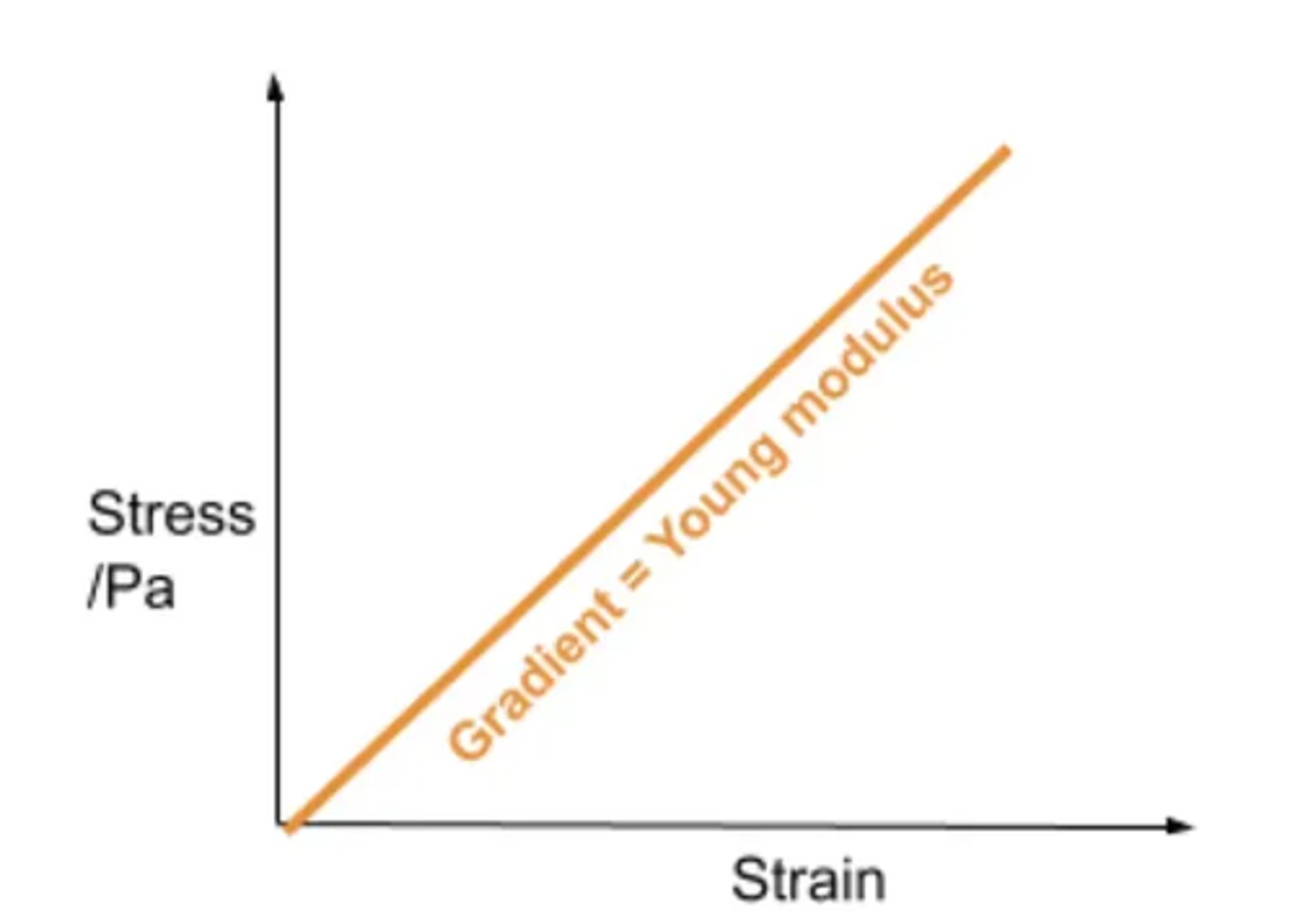
How is the Young modulus found from a stress-strain graph? (1)
The Young modulus is equal to the gradient of the straight-line (linear) section of the graph.
What does finding the Young modulus from a stress-strain look like? (2)
When does the gradient on a graph method for finding the Young modulus apply? (2)
- It applies only within the linear (elastic) region of the stress-strain graph.
- This is where stress is directly proportional to strain, obeying Hooke's Law.