ECON 2010 Master set
 Call Kai
 Learn
Learn Practice Test
 Spaced Repetition
 Match
Match Flashcards
 Knowt Play
1/465

There's no tags or description
Looks like no tags are added yet.
Name | Mastery | Learn | Test | Matching | Spaced | Call with Kai |
|---|
No analytics yet
Send a link to your students to track their progress
466 Terms
Financial capital is the ___________.
money used to buy stocks and bonds
money used to buy physical capital
funds that households save to accumulate wealth
money in the bank
money used to buy physical capital
In the loanable funds market, an increase in ________.
the real interest rate increases the demand for loanable funds
expected profit increases the demand for loanable funds
expected profit doesn’t change the demand for loanable funds, but the quantity of loanable funds demanded increases
the real interest rate doesn’t change the demand for loanable funds, but the quantity of loanable funds demanded increases
expected profit increases the demand for loanable funds
The supply of loanable funds increases ________.
when the demand for loanable funds increases
when people increase saving as the real interest rate rises
when disposable income increases or wealth decreases
if net taxes decrease or expected future income increases
when disposable income increases or wealth decreases
An increase in expected profit _______ the real interest rate and ________ the quantity of loanable funds.
decreases; decreases
increases; decreases
decreases; increases
increases; increases
increases; increases
A government budget surplus _______.
increases the supply of loanable funds
raises the real interest rate
decreases the demand for loanable funds and lowers the real interest rate
decreases net taxes, increases disposable income, and increases saving
increases the supply of loanable funds
Crowding out occurs when ______.
households’ budgets are in deficit and saving decreases
the government budget is in surplus, so people have paid too much tax
the government budget is in deficit and the real interest rate rises
the government budget is in deficit but taxpayers are rational and the Ricardo-Barro effect operates
the government budget is in deficit and the real interest rate rises
An increase in the government budget deficit _______.
increases private saving and investment
increases private saving and decreases investment
increases the supply of private saving and decreases investment
decreases private saving and investment
increases private saving and decreases investment
The Zomano company started last year with $10 million of capital on hand and invested $15 million in new capital throughout the year. At the end of the year, the company's capital stock was $17 million. Hence, for the year, depreciation equaled ________ and net investment equaled ________.
$8 million; $7 million
$7 million; $8 million
$8 million; $15 million
$5 million; $5 million
$8 million; $7 million
On January 1, Derek had CD recording devices valued at $30,000. During the year, the value of Derek's devices depreciated by $20,000. He spent $30,000 on new devices. Derek's net investment was ________ and at the end of the year Derek had capital valued at ________.
$10,000; $40,000
$30,000; $40,000
$20,000; $60,000
$40,000; $70,000
$10,000; $40,000
________ reflects a use of loanable funds, while ________ reflects a supply of loanable funds.
Business investment; the government budget deficit
International investment; business investment
The government budget deficit; private saving
A government budget surplus; a government budget deficit
The government budget deficit; private saving
The demand for loanable funds_________, and the supply of loanable funds_________.
increases in an expansion and decreases in a recession; increases when people's expected future incomes fall
decreases in an expansion and increases in a recession; decreases when the fall in the value of the stock market decrease people's wealth
increases if the expected rate of profit decreases; decreases if current disposable income increases
decreases when the real interest rate increases; increases when the real interest rate increases
increases in an expansion and decreases in a recession; increases when people's expected future incomes fall
The demand for loanable funds curve illustrates_______, and the supply of loanable funds schedule shows that the________.
the quantity of loanable funds demanded at any given level of disposable income; higher the real interest rate, the lower the profit from making new investment
the quantity of loanable funds demanded at any given level of the real interest rate; higher the real interest rate, the greater the quantity of loanable funds supplied
the quantity of loanable funds supplied to the loanable funds market at any given level of disposable income; higher the real interest rate, the greater the opportunity cost of supplying loanable funds
how the quantity of loanable funds demanded changes when the people's expectations about their future income changes; lower the real interest rate, the greater the quantity of loanable funds supplied.
the quantity of loanable funds demanded at any given level of the real interest rate; higher the real interest rate, the greater the quantity of loanable funds supplied
When wealth ________, saving supply ________, and the supply of loanable funds curve shifts ________.
decreases; decreases; leftward
increases; increases; leftward
decreases; decreases; rightward
increases; decreases; leftward
increases; decreases; leftward
When the real interest rate ________ the equilibrium real interest rate, there is a ________ of loanable funds and the real interest rate ________.
exceeds; surplus; rises
is less than; surplus; rises
exceeds; shortage; rises
is less than; shortage; rises
is less than; shortage; rises
Suppose that there is an increase in disposable income and simultaneously an increase in the expected profitability of an investment. As a result, the equilibrium real interest rate ________ and the equilibrium quantity of loanable funds ________.
rises; increases
falls; increases
remains unchanged; increases
might rise, fall, or remain unchanged; increases
might rise, fall, or remain unchanged; increases
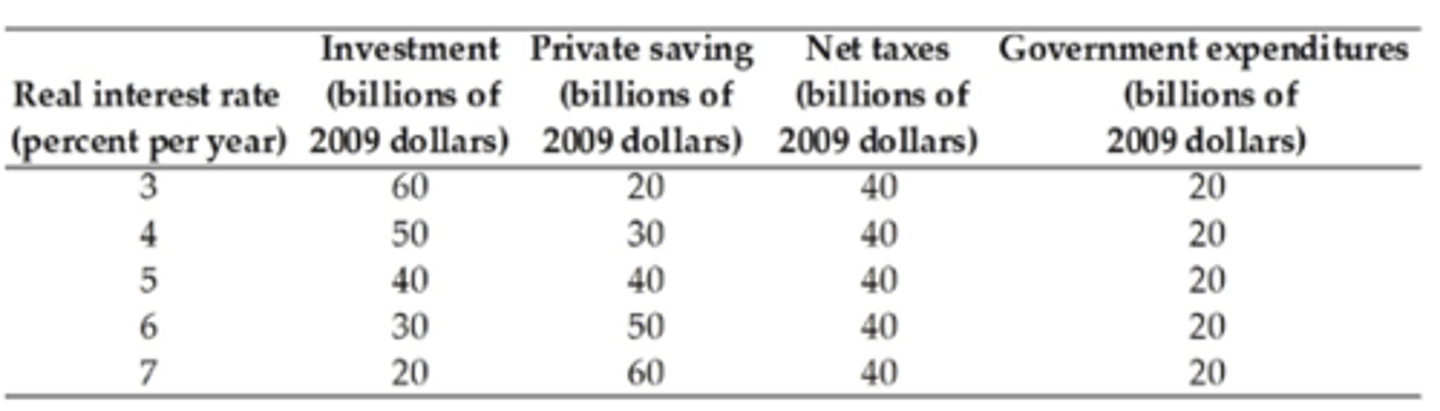
The table above gives a nation's investment demand and saving supply schedules. It also has the government's net taxes and expenditures. The government has a budget_____, the loanable funds market is in equilibrium when the real interest rate is ____.
surplus of $60 billion; 5 percent
surplus of $20 billion; 4 percent
deficit of $20 billion; 4 percent
deficit of $60 billion; 3 percent
surplus of $20 billion; 4 percent
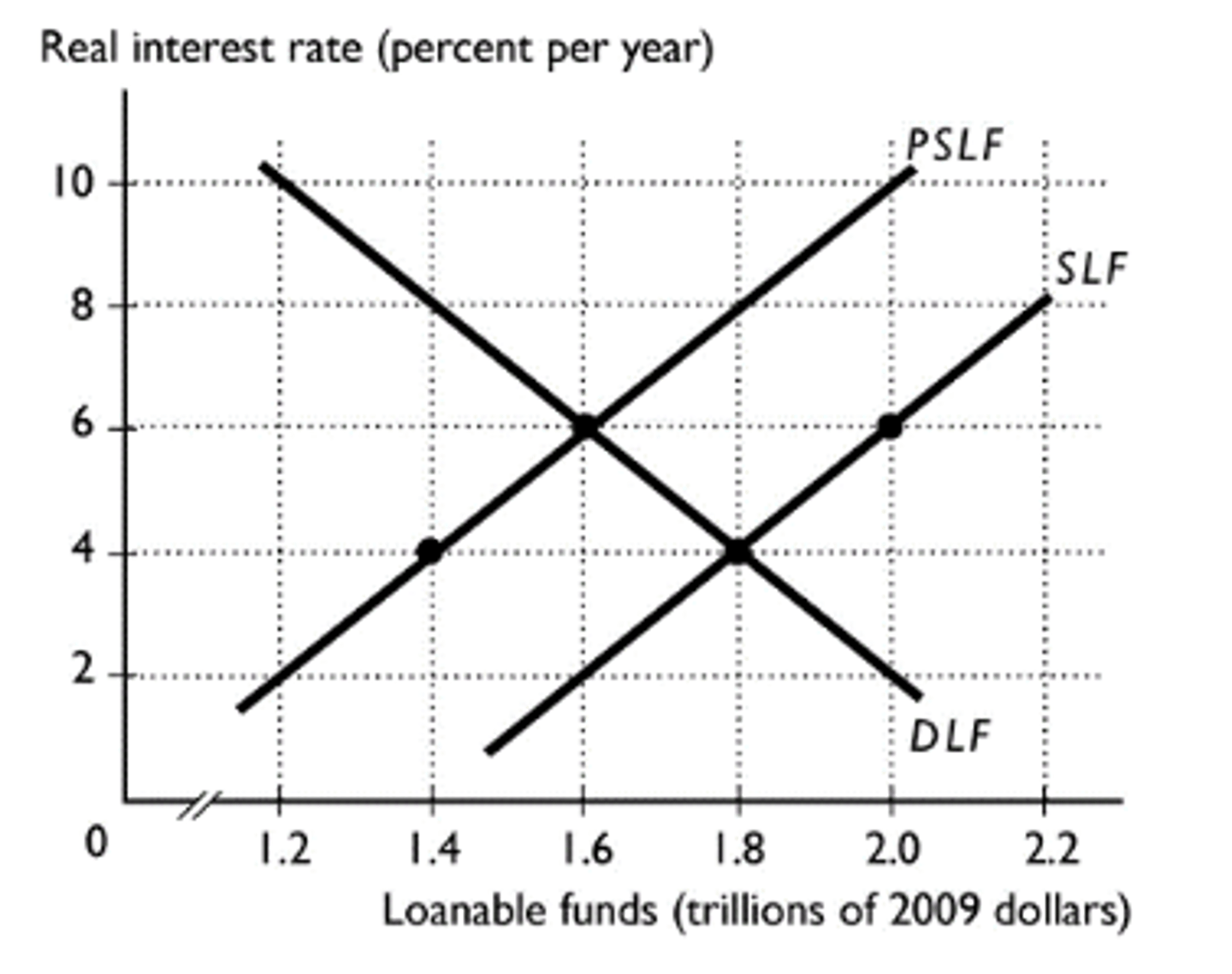
In the figure above, the SLF curve is the supply of loanable funds curve and the PSLF curve is the private supply of loanable funds curve. Given these curves, the equilibrium interest rate is ________ percent and the equilibrium quantity of loanable funds is ________, there is a government budget ________ and therefore the real interest rate is ________ than it would be otherwise.
6; $2.0 trillion; surplus; higher
4; $1.8 trillion; surplus; lower
4; $1.4 trillion deficit; higher
6; $1.6 trillion; deficit; lower
4; $1.8 trillion; surplus; lower
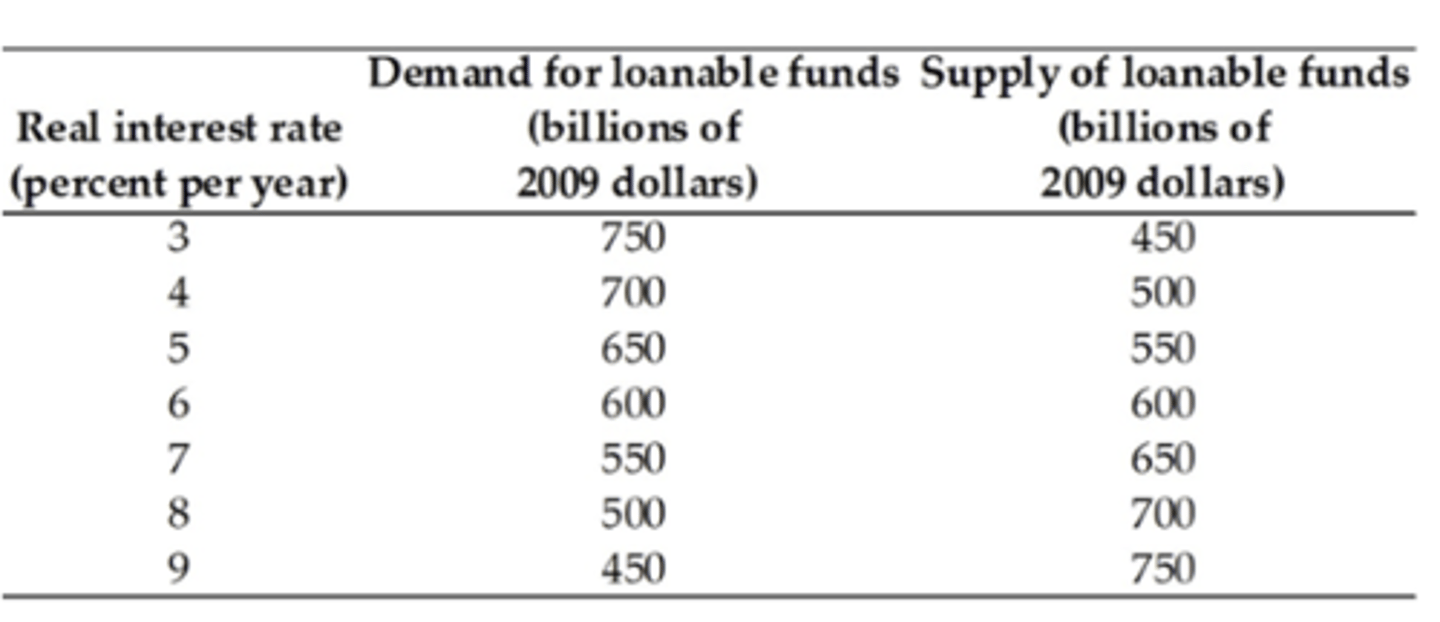
The above table has the private demand for loanable funds and the private supply of loanable funds schedules. If the government budget surplus is $200 billion, and there is no Ricardo-Barro effect, the equilibrium real interest rate is ________ and the equilibrium quantity of loanable funds is ________, but if there is a Ricardo-Barro effect, the equilibrium real interest rate is ________ and the equilibrium quantity of loanable funds is ________.
6 percent; $600 billion; 4 percent; $500 billion
4 percent; $700 billion; 6 percent; $600 billion
8 percent, $500 billion; 8 percent; $700 billion
8 percent; $700 billion; 8 percent, $500 billion
4 percent; $700 billion; 6 percent; $600 billion
An increase government budget surplus _______, and an increase in the government budget deficit _______.
increases the supply of loanable funds; increases private saving and decreases investment
raises the real interest rate; increases the supply of private saving and decreases investment
decreases the demand for loanable funds and lowers the real interest rate; decreases private saving and investment
decreases net taxes, increases disposable income, and increases saving; increases private saving and investment
increases the supply of loanable funds; increases private saving and decreases investment
Which of the following is true?
Aggregate supply is another name for potential GDP.
Potential GDP increases as the price level increases.
At full employment, aggregate supply is equal to potential GDP.
Potential GDP decreases as the price level increases.
At full employment, aggregate supply is equal to potential GDP.
The real wage rate definitely falls if the money wage rate ________ and the price level ________.
remains constant; rises
remains constant; falls
rises; falls
rises; rises
remains constant; rises
Moving along the AS curve, when the price level increases, the:
real wage rate falls, and there is an increase in the quantity of real GDP supplied.
real wage rate rises, and there is an increase in the quantity of real GDP supplied.
nominal wage rate falls, and there is an increase in the quantity of real GDP supplied.
nominal wage rate rises, and there is a decrease in the quantity of real GDP supplied.
real wage rate falls, and there is an increase in the quantity of real GDP supplied.
If there is a rise in the price level, there is ________ in the quantity of real GDP supplied and a movement ________ along the AS curve.
a decrease; downward
an increase; upward
an increase; downward
a decrease; upward
an increase; upward
The money wage rate is constant when moving along:
only the aggregate supply curve.
only the aggregate supply curve and the potential GDP line.
only the potential GDP line.
neither the aggregate supply curve nor the potential GDP line.
only the aggregate supply curve.
A rise in the price level brings a ________ in the real wage rate that ________ profits which leads to ________ production.
rise; reduces; decreasing
rise; reduces; increasing
fall; increases; increasing
rise; increases; decreasing
fall; increases; increasing
An increase in ________ increases potential GDP and ________ aggregate supply.
technology; increases
technology; decreases
the money wage rate; increases
the money price of oil; decreases
technology; increases
A rise in the price level brings a ________ in the buying power of money that ________ consumption expenditures and causes the quantity of real GDP demanded to ________.
rise; decreases; decrease
fall; decreases; decrease
fall; increases; increase
rise; increases; increase
fall; decreases; decrease
When the U.S. price level rises relative to other nations' price levels, then:
U.S. firms' profits increase and the aggregate demand curve shifts rightward.
U.S. exports increase and the aggregate demand curve shifts rightward.
U.S. exports decrease, U.S. imports increase, and the aggregate demand curve shifts leftward.
U.S. exports decrease, U.S. imports increase, and there is a movement upward along the aggregate demand curve.
U.S. exports decrease, U.S. imports increase, and there is a movement upward along the aggregate demand curve.
Aggregate demand ________ and shifts the AD curve ________ when ________.
increases; rightward; government expenditure increases
increases; rightward; taxes increase
increases; rightward; future expected profit decreases
decreases; leftward; foreign income increases
increases; rightward; government expenditure increases
Suppose the exchange rate in the year 2010 was 4 yuan per dollar and in 2011 the exchange rate fell to 3 yuan per dollar. If the price of a Chinese sweater was 120 yuan in both years, the new dollar price in 2011 would be ________ and imports of Chinese sweaters would ________.
$40; increase
$30; decrease
$40; decrease
$30; increase
$40; decrease
A change in any component of aggregate demand creates a larger change in overall aggregate demand. This is the ________ effect, and it means, for example, that a ________ in consumption will cause an even larger ________ in AD.
multiplier; increase; decrease
liquidity; decrease; decrease
growth; increase; decrease
multiplier; decrease; decrease
multiplier; decrease; decrease
Macroeconomic equilibrium occurs when:
there is no inflation.
real GDP is equal to potential GDP.
the aggregate quantity demanded is equal to the aggregate quantity supplied.
the economy is fully employed.
the aggregate quantity demanded is equal to the aggregate quantity supplied.
If real GDP is less than potential GDP, then the money wage rate ________, aggregate supply ________ so that the price level ________.
rises; decreases; rises
falls; increases; falls
rises; increases; falls
falls; decreases; rises
falls; increases; falls
If the economy is above full employment, there is ________ gap and as the economy adjusts toward full employment the price level ________.
an inflationary; rises
an inflationary; falls
a recessionary; rises
a recessionary; falls
an inflationary; rises
When the macroeconomic equilibrium is such that real GDP exceeds potential real GDP, the economy is suffering from ________, and the government policy to eliminate this gap will ________ real GDP and to ________ the price level.
an inflationary gap; increase; increase
a recessionary gap; decrease; decrease
an inflationary gap; increase; decrease
an inflationary gap; decrease; decrease
an inflationary gap; decrease; decrease
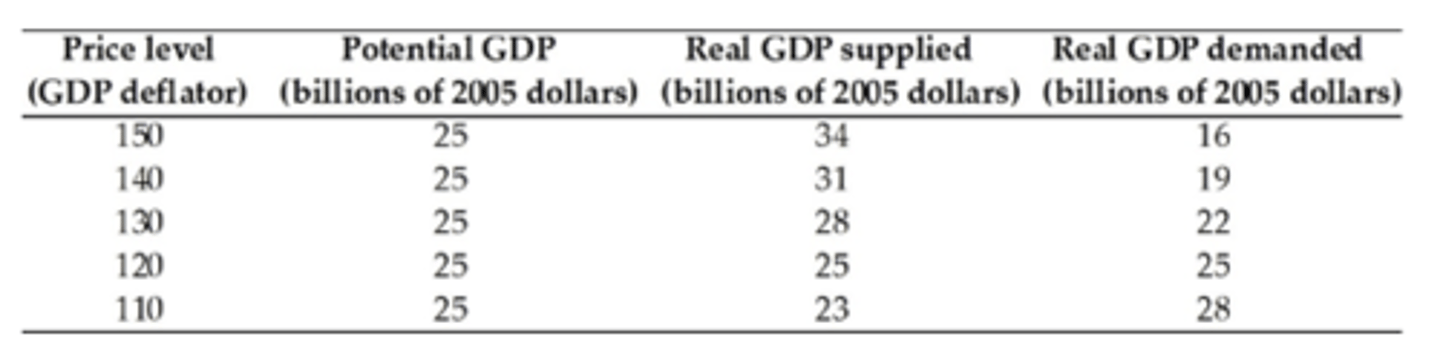
The table above gives data for the nation of Pearl, a small island in the South Pacific. The economy is at full employment when real GDP is______, and the price level is______; however,
if a supply shock decreases the quantity of real GDP supplied by $6 billion at each price level, the new equilibrium real GDP will be _____, and if aggregate demand increases so that the quantity of real GDP demanded is $6 billion more at each price level, the new equilibrium real GDP will be ______
$25 billion; 120; $22 billion; $28 billion.
$28 billion; 130; $19 billion; $34 billion.
$22 billion; 110; $16 billion; $25 billion
$25 billion; 120; $31 billion; $19 billion
$25 billion; 120; $22 billion; $28 billion.
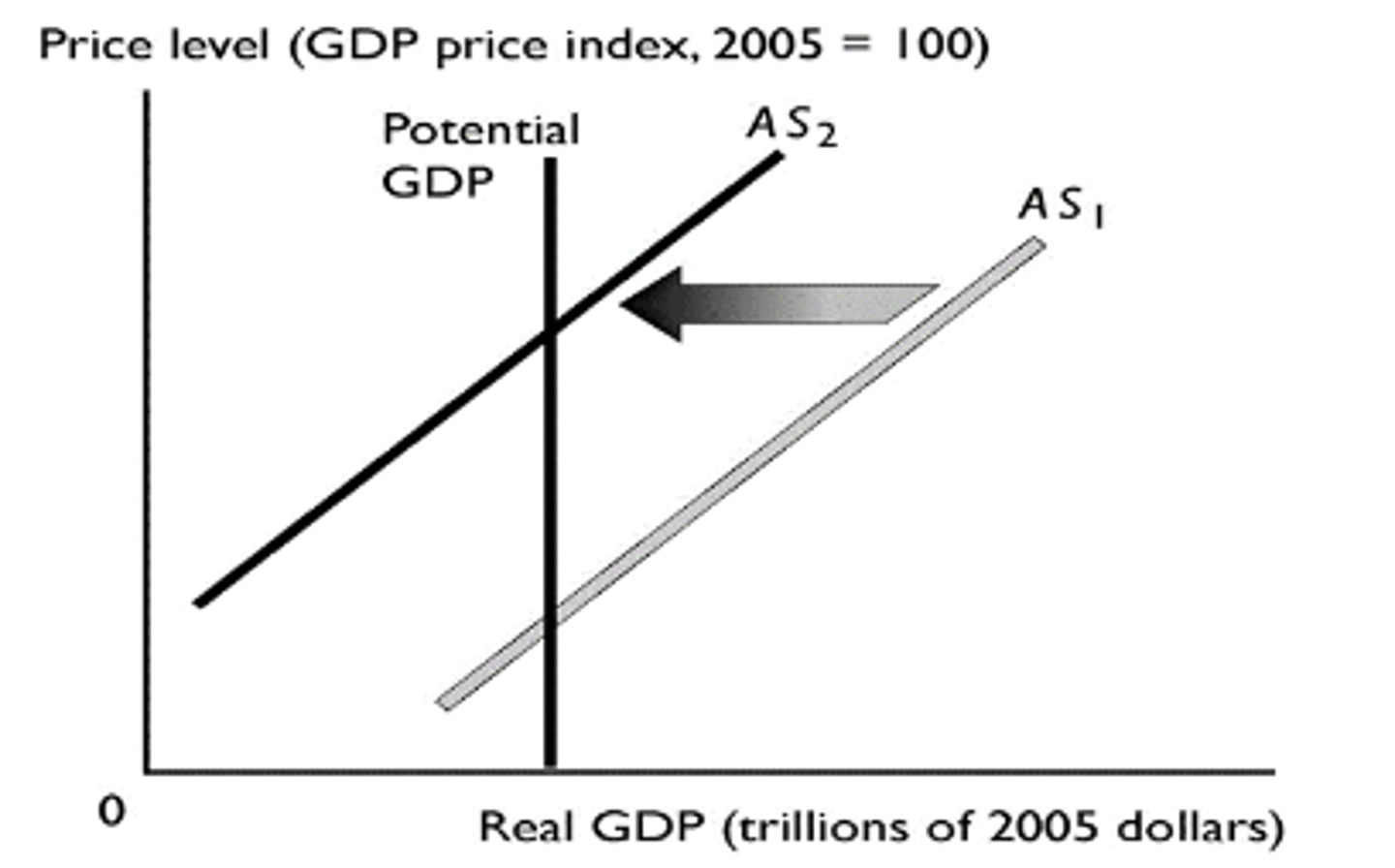
The change reflected in the above figure might be a result of:
a decrease in the quantity of capital.
an increase in the quantity of labor.
a rise in the money wage rate.
a decrease in the money prices of resources other than labor.
a rise in the money wage rate.
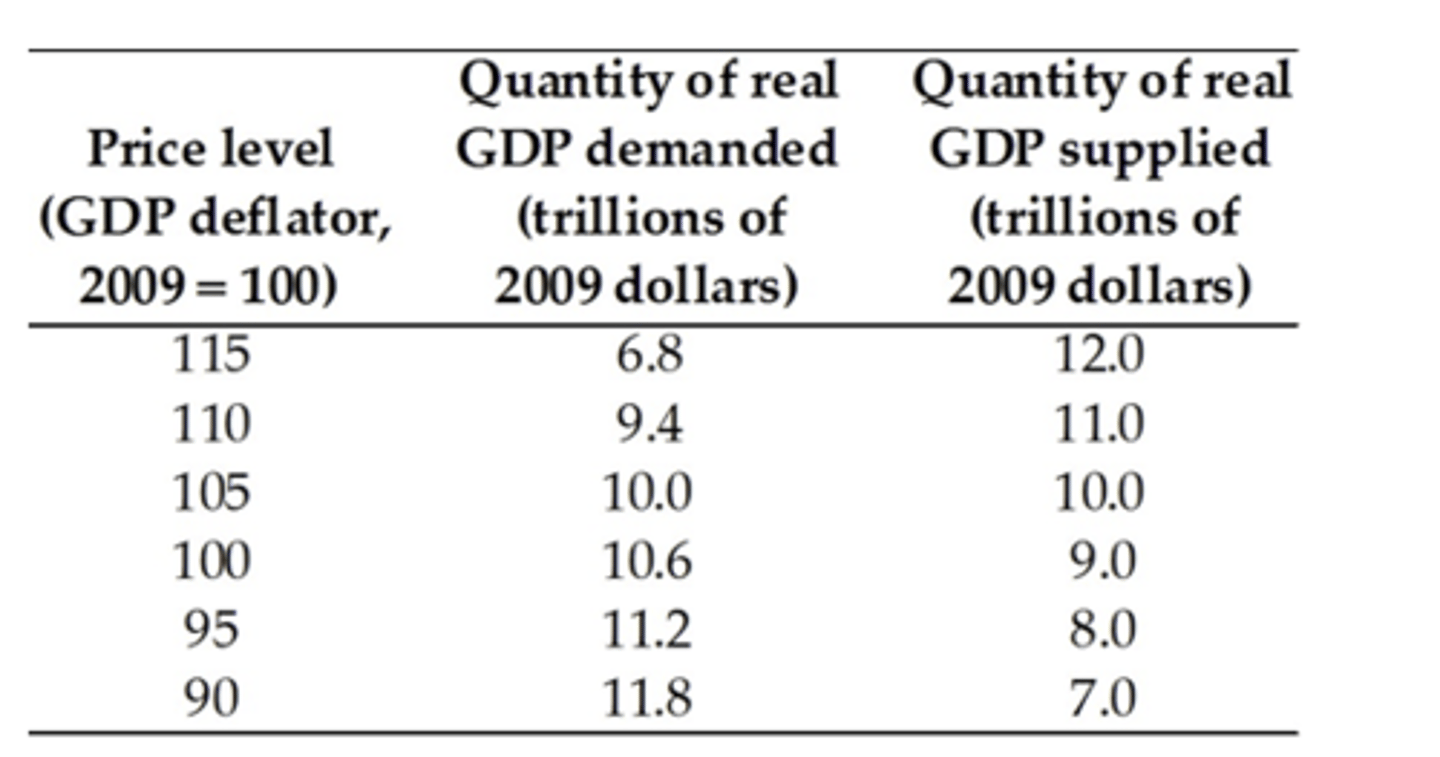
The table gives the aggregate demand and aggregate supply schedules in the economy of Emeraldesh. If the potential GDP in Emeraldesh is $9.0 trillion, the economy is now at ______ equilibrium, with a(n) ______, and its unemployment rate is _____ the natural rate of unemployment.
above full employment; recessionary gap; above
above full employment; inflationary gap; below
below full employment; inflationary gap, below
below full employment; recessionary gap; above
above full employment; inflationary gap; below
The global economy enters an economic expansion, and real GDP in the rest of the world increases. As a result, in the United States, _________; if the aggregate supply curve does not shift, then aggregate demand will ________, real GDP will ________, and the price level will ________.
government expenditure will decrease; decrease; decrease; increase
all will remain the same; not change; remain the same; will remain the same
level of exports will increase; increase; increase; increase
level of imports will decrease; decrease; increase; decrease
level of exports will increase; increase; increase; increase
According to the Keynesian macroeconomic model, which of the following was responsible for starting the Great Depression?
too little private spending
too little government spending
high taxes
decreases in the quantity of money
too little private spending
If New Zealand is operating at potential GDP, which of the following is true?
i) New Zealand only has frictional and structural unemployment.
ii) There is no inflation in New Zealand.
iii) New Zealand has positive net exports.
i, ii and iii
i only
i and ii
i and iii
i only
Suppose Germany's economy is experiencing full employment. This means that, in Germany,
the unemployment rate is equal to zero
real GDP is equal to potential GDP.
real GDP is greater than potential GDP.
potential GDP is greater than real GDP.
real GDP is equal to potential GDP.
The amount of real GDP produced at any one time depends on
i) a fixed amount of capital. ii) a fixed level of technology.
iii) decisions people make about leisure versus working.
ii only
ii and iii
i and ii
i, ii and iii
i, ii and iii
The production function is a relationship between the amount of labor employed and
the maximum quantity of real GDP that can be produced.
the maximum quantity of nominal GDP that can be produced.
the wage rate paid to the workers.
all other resources at different levels of employment.
the maximum quantity of real GDP that can be produced.
Diminishing returns means that
each additional unit of labor produces successively less real GDP.
hiring more labor results in less real GDP.
each extra unit of real GDP produced requires less labor.
each additional unit of labor produces successively more real GDP.
each additional unit of labor produces successively less real GDP.
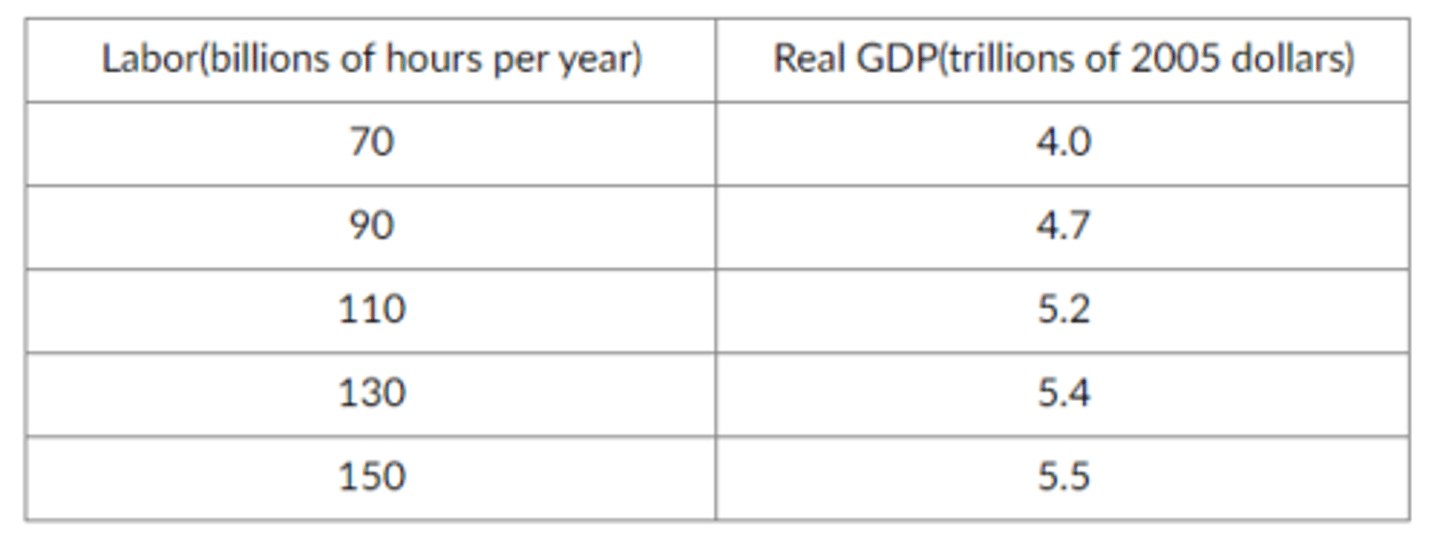
The table below gives a nation's production function. Which of the following is NOT an attainable combination of real GDP and labor?
Real GDP of $4.0 trillion and labor of 90 billion hours per year.
Real GDP of $4.7 trillion and labor of 110 billion hours per year.
Real GDP of $4.0 trillion and labor of 70 billion hours per year.
Real GDP of $5.2 trillion and labor of 90 billion hours per year.
Real GDP of $5.2 trillion and labor of 90 billion hours per year.
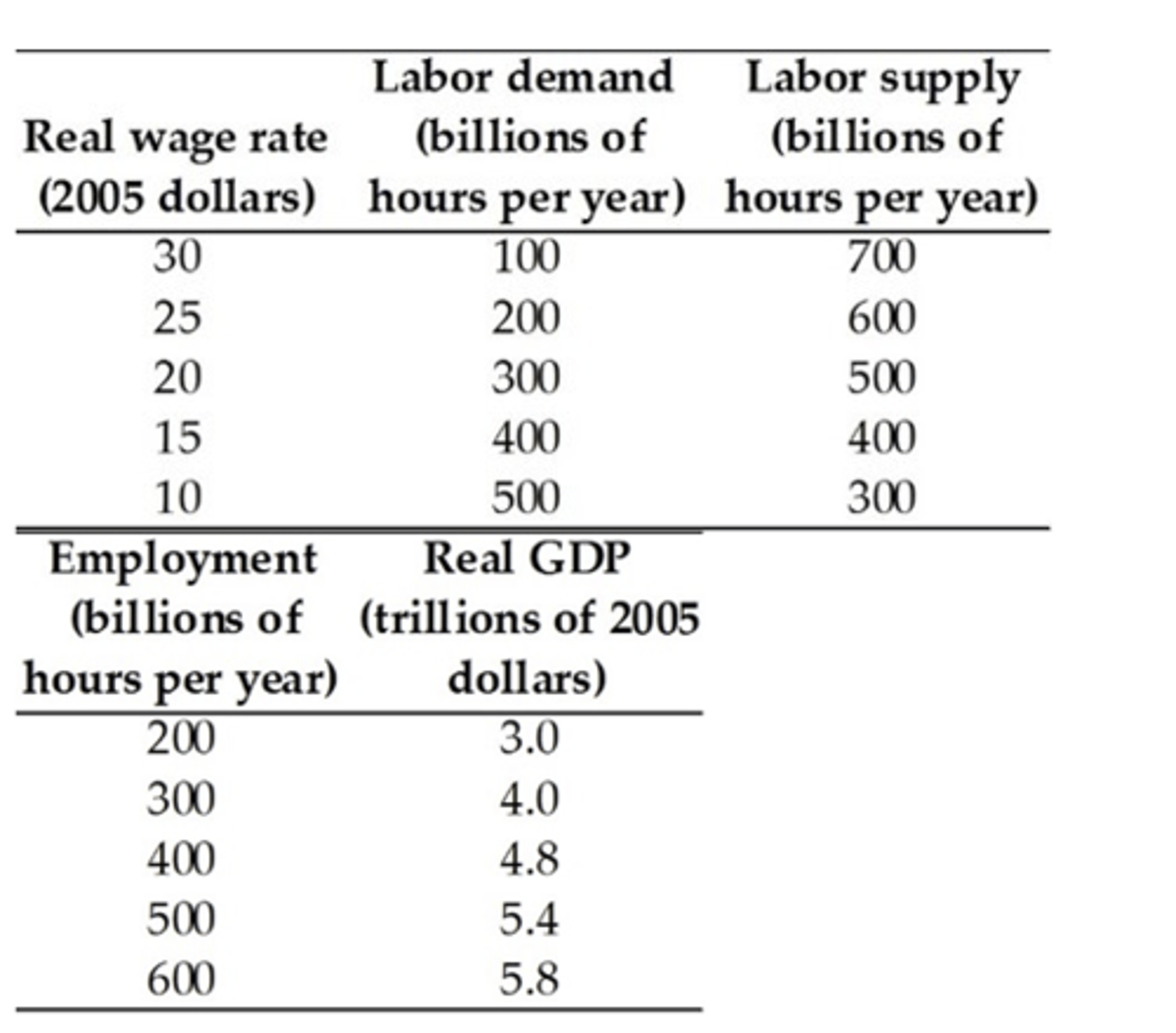
An increase in the real wage rate ________ the quantity of labor demanded and ________ the quantity of labor supplied.
increases; increases
increases; decreases
decreases; increases
decreases; decreases
decreases; increases
The Bubby Gum factory produces bubble gum. Joanne is one of the employees, and she produces 10 packs of bubble gum per hour. Joanne's money wage rate is $12 per hour. If a packet of bubble gum sells for $1.00, then
Joanne is creating a $2.00 per hour loss for the firm.
Joanne is creating a $2.00 per hour profit for the firm.
the Bubby Gum company should decrease the price of the bubble gum so it sells more and makes a larger profit.
the Bubby Gum company should pay Joanne more.
Joanne is creating a $2.00 per hour loss for the firm.
A surplus of labor is eliminated by ________ in the real wage rate and a shortage of labor is eliminated by ________ in the real wage rate.
an increase; an increase
an increase; a decrease
a decrease; an increase
a decrease; a decrease
a decrease; an increase
Based on the tables above the equilibrium real wage rate is ________ , the equilibrium quantity of labor is ________ billions of hours per year and the potential GDP is_______.
$25; 200; 4.8 trillion of dollars
$20; 500; 5.4 trillion of dollars
$15; 300; 4.0 trillion of dollars
$15; 400; 4.8 trillion of dollars
$15; 400; 4.8 trillion of dollars
Job rationing occurs when the real wage is ________ the equilibrium level and there is a ________ of labor, and it ________.
above; shortage; has no effect on the natural unemployment rate
above; surplus; increases the natural unemployment rate
below; shortage; increases labor turnover as firms compete for high quality labor
below; surplus; decreases the demand for labor, which lowers the real wage rate
above; surplus; increases the natural unemployment rate
If the government raises income taxes, then the equilibrium amount of employment ________ and potential GDP ________.
increases; increases
increases; decreases
decreases; increases
decreases; decreases
decreases; decreases
The demand for labor curve shows the relationship between _________, and the supply of labor is the relationship between __________.
the quantity of labor employed and firms' profits; the quantity of labor supplied and leisure time forgone
all households' willingness to work and the real wage rate; firms' willingness to supply jobs and the real wage rate
the quantity of labor businesses are willing to hire and the real wage rate; the real wage rate and the quantity of labor supplied
the labor force and the real wage rate; the labor force participation rate and the real wage rate
the quantity of labor businesses are willing to hire and the real wage rate; the real wage rate and the quantity of labor supplied
Households’ labor supply decisions are influenced by all of the following except _______.
the opportunity cost of taking leisure and not working
the after-tax wage rate
unemployment benefits
the number of full-time jobs available
the number of full-time jobs available
The full-employment quantity of labor _______.
increases if labor becomes more productive
cannot increase because everyone who wants a job has one
increases as the economy moves along its production function
decreases if the income tax rates decrease
increases if labor becomes more productive
The natural unemployment rate _______.
increases if unemployment benefits become more generous
increases in a recession
increases as the average age of the labor force rises
decreases as firms outsource manufacturing jobs
increases if unemployment benefits become more generous
An efficiency wage results in all of the following except _________.
a decrease in the rate of labor turnover
an increase in the full-employment quantity of labor
greater work effort
no change in the cost of monitoring work effort
an increase in the full-employment quantity of labor
If real GDP increases from $5 billion to $5.25 billion and the population increases from 2 million to 2.02 million, real GDP per person increases by ___ percent.
5.0
1.0
2.5
4.0
4.0
If the population growth rate is 2 percent, real GDP per person will double in 7 years if real GDP grows by ______ percent per year.
7
10
12
14
12
All of the following increase labor productivity except _________.
the accumulation of skill and knowledge
an increase in capital per hour of labor
an increase in consumption
the employment of a new technology
an increase in consumption
The increase in real GDP per hour of labor that results from an increase in capital per hour of labor ________.
is constant and independent of the quantity of capital
is larger at a small quantity of capital than at a large quantity of capital
is smaller at a small quantity of capital than at a large quantity of capital
decreases as technology advances
is larger at a small quantity of capital than at a large quantity of capital
The increase in real GDP per hour of labor that results from an advance in technology makes labor _______ productive ________.
more; at all quantities of capital
less; and capital more productive
more; only at a large quantity of capital
more; and capital less productive
more; at all quantities of capital
The classical growth theory is that real GDP per person ______.
only temporarily rises and then returns to the subsistence level
grows forever
is constant and does not change
increases as the population grows
only temporarily rises and then returns to the subsistence level
In the new growth theory, the source of economic growth is ______.
more leisure
new and better jobs
the persistent want for a higher standard of living
an ever increasing growth rate of capital per hour of labor
the persistent want for a higher standard of living
An economy can achieve faster economic growth without ______.
markets and property rights
people being willing to save and invest
incentives to encourage the research for new technologies
an increase in the population growth rate
an increase in the population growth rate
Economic growth is a sustained expansion of production possibilities, as measured by the increase in ________ over time.
real GDP
population
inflation
the price level
real GDP
U.S. real GDP in 2007 was $13.25 trillion and U.S. real GDP in 2008 was $13.31 trillion. What was the economic growth rate of the United States during this period?
18 percent
-1.36 percent
0.45 percent
6.9 percent
0.45 percent
Real GDP in the country of Oz is growing at 5 percent and its population is growing at 2 percent. In the country of Lilliput, real GDP is growing at 4 percent and its population is growing at 0.5 percent. Thus,
real GDP per person in Oz is growing at a faster rate than in Lilliput.
real GDP per person in Lilliput is growing at a faster rate than in Oz.
real GDP per person in Lilliput is growing at the same rate as in Oz.
real GDP per person in Lilliput is growing at a rate that is not comparable to that in Oz.
real GDP per person in Lilliput is growing at a faster rate than in Oz.
If Country A's real GDP is growing at 6 percent per year and Country B's real GDP is growing at 6 percent per year, then the standard of living is
growing more rapidly in Country A.
higher in Country B.
changing at the same rate in Country A and Country B.
changing at the same rate in Country A and Country B only if the rate of population growth is the same in both countries.
changing at the same rate in Country A and Country B only if the rate of population growth is the same in both countries.
Approximately how long will it take Ethiopia to double its real GDP per person of $100 if its growth rate of real GDP per person is 0.9 percent?
63 years
77.7 years
70 years
109 years
77.7 years
In this year, Country A has a real GDP per person that is 4 times greater than that of Country B. Country B's growth rate of real GDP per person is 3.5 percent per year. How many years will it take for Country B's real GDP per person to reach the same level that Country A had this year?
10 years
20 years
40 years
60 years
40 years
Which of the following are required for economic growth?
i) more goods and services produced per hour of work
ii) an increase in the average hours of labor per person
iii) an increase in prices
i and iii
i and ii
ii and iii
i only
i and ii
The productivity curve is a relationship between ________ and ________.
real GDP; hours of labor
real GDP; capital
real GDP per hour of labor; capital
real GDP per hour of labor; capital per hour of labor
real GDP per hour of labor; capital per hour of labor
Suppose that an Intel worker rearranges existing machines and labor and increases the quantity of chips Intel can produce. Using the productivity curve graphed, this innovation would be described as
a movement upward along the curve.
a movement downward along the curve.
a shift of the curve upward.
a shift of the curve downward.
a shift of the curve upward.
If real GDP is $1,200 billion, the population is 60 million, and aggregate hours are 80 billion, labor productivity is
$5.00 an hour.
$6.67 an hour.
$15.00 an hour.
$20,000
$15.00 an hour.
Which of the following are predicted by the classical growth theory?
i) Population growth will end economic growth.
ii) Real GDP per person will return to the subsistence level.
iii) Technology drives persistent economic growth.
i and ii
i, ii and iii
i only
ii only
i and ii
According to the new growth theory, which of the following promote economic growth?
i) discoveries that bring profit
ii) choices that expand human capital
iii) random events that create technology change
i and iii
i and ii
i, ii and iii
ii only
i and ii
If Turkey wants to promote faster economic growth, it will need to:
promote incentive systems to encourage saving, research and development, increased trade and improved education.
restrict economic freedom so the government has better control of markets.
restrict international trade to protects its own workers.
promote government intervention to help markets determine incentives.
promote incentive systems to encourage saving, research and development, increased trade and improved education.
If the income elasticity of SUVs is greater than 1, what is the good considered?
a. a necessity
b. a luxury
c. a substitute good
d. an inferior good
b. a luxury
When demand is inelastic, what is the relationship between price and total revenue?
a. They move in the same direction.
b. They move in opposite directions.
c. They always remain unchanged.
d. They are entirely unrelated.
a. They move in the same direction.
If you know the value for price elasticity of demand, then which of the following can you compute?
a. the effect of a price change on the quantity demanded
b. the responsiveness of the quantity supplied of a good to changes in its price
c. the price elasticity of supply
d. all are correct
a. the effect of a price change on the quantity demanded
What is the name given to the responsiveness of the quantity supplied of a good to a change in its price?
a. price elasticity of supply
b. price elasticity of demand
c. income elasticity
d. cross-price elasticity
a. price elasticity of supply
Which of the following does the midpoint formula use to compute elasticity?
a. the averages of the initial and final quantity and the initial and final price
b. the differences between initial and final prices and quantities
c. the sums of the initial and final prices and quantities
d. the product of the initial and final prices and quantities
a. the averages of the initial and final quantity and the initial and final price
Fill in the blanks: An increase in the price of a substitute for iPods will lead to___in quantity demanded of iPods, so the cross-price elasticity of demand will be___.
a. an increase; positive
b. an increase; negative
c. a decrease; positive
d. a decrease; negative
a. an increase; positive
How is the responsiveness of the quantity demanded to a change in price measured?
a. by dividing the percentage change in the product’s price by the percentage change in the quantity demanded of a product
b. by multiplying the percentage change in the product’s price by the percentage change in the quantity demanded of a product
c. by dividing the percentage change in the quantity demanded of a product by the percentage change in the product’s price
d. by multiplying the percentage change in the quantity demanded of a product by the percentage change in the product’s price
c. by dividing the percentage change in the quantity demanded of a product by the percentage change in the product's price
Which of the following is true if quantity demanded is not very responsive to price?
a. The percentage change in quantity demanded will be less than the percentage change in price.
b. The price elasticity of demand will be less than 1 in absolute value.
c. Demand is inelastic.
d. All are true
d. All are true
When the percentage change in quantity demanded is greater than the percentage change in price, which of the following is true?
a. The price elasticity of demand will be greater than 1 in absolute value.
b. Demand is inelastic.
c. There are few substitutes for the good in question.
d. All are true
a. The price elasticity of demand will be greater than 1 in absolute value.
If demand is perfectly elastic, then what is the impact of an increase in price?
a. a decrease in quantity demanded to zero
b. no change in quantity demanded
c. a change in quantity demanded exactly equal to the change in price
d. a very small change in quantity demanded
a. a decrease in quantity demanded to zero
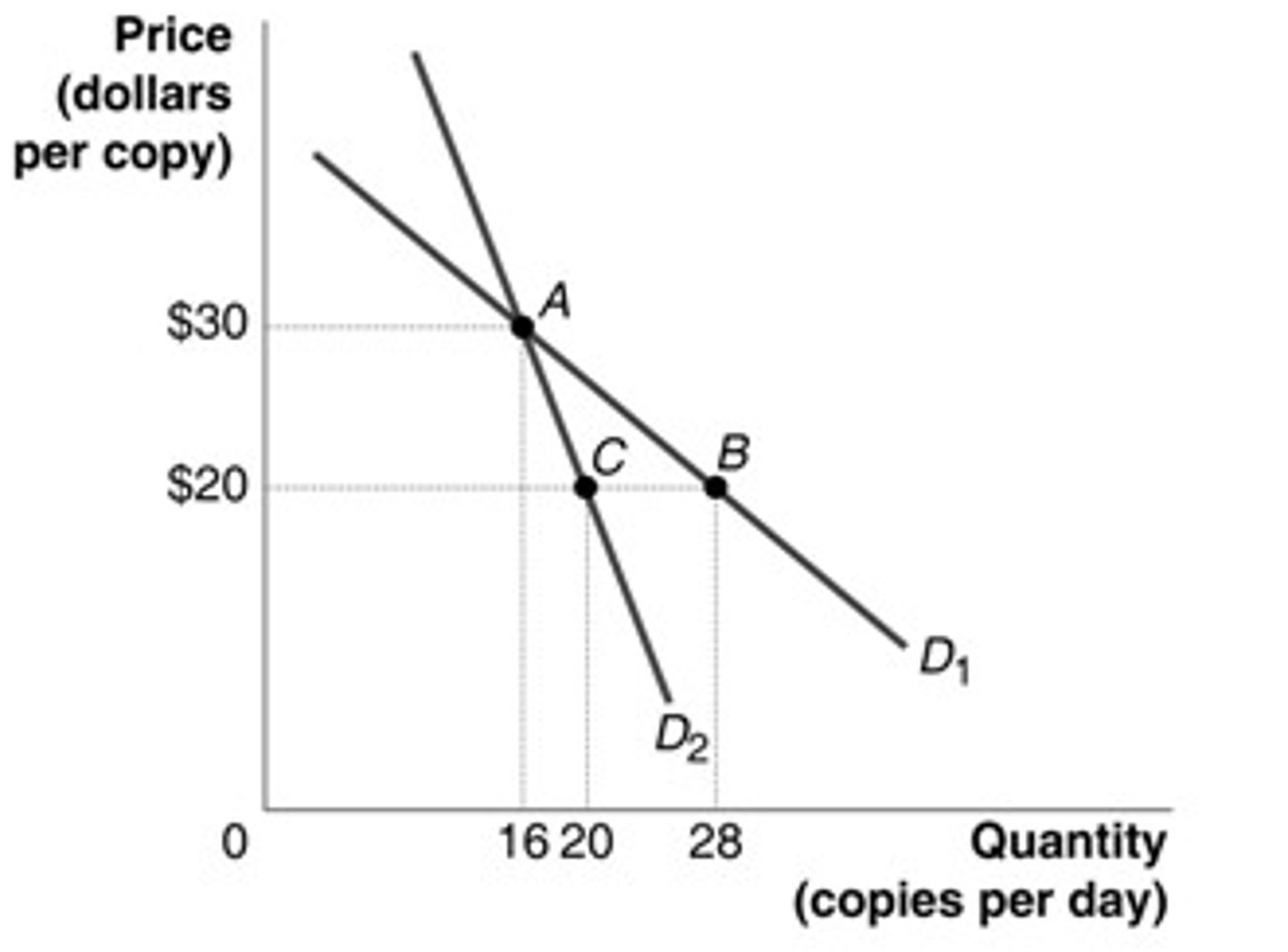
Refer to the graph below which shows two potential demand curves in the market for photocopies at a printing company. If you start at point A on D1, what is the percentage change in price when price falls from $30 to $20? Use the midpoint formula to calculate this percentage change
a. price falls by 10%
b. price falls by 25%
c. price falls by 40%
d. price falls by 45%
c. price falls by 40%
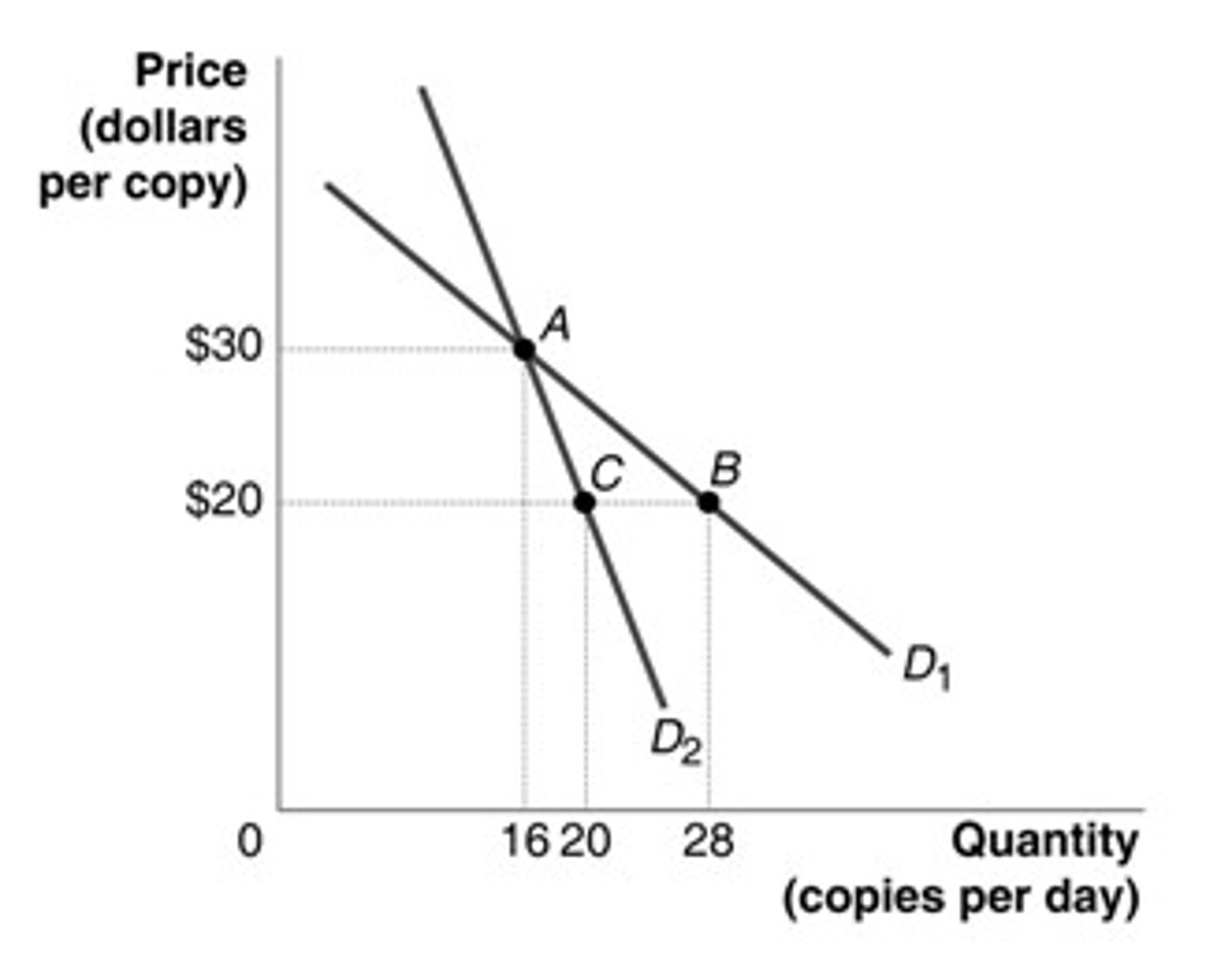
Which of the following is a true statement?
a. The more substitutes available for a product, the greater the absolute value of the price elasticity of demand.
b. The more time that passes, the more elastic the demand for a product becomes.
c. The demand curve for a luxury is more elastic than the demand curve for a necessity.
d. All are true
d. All are true
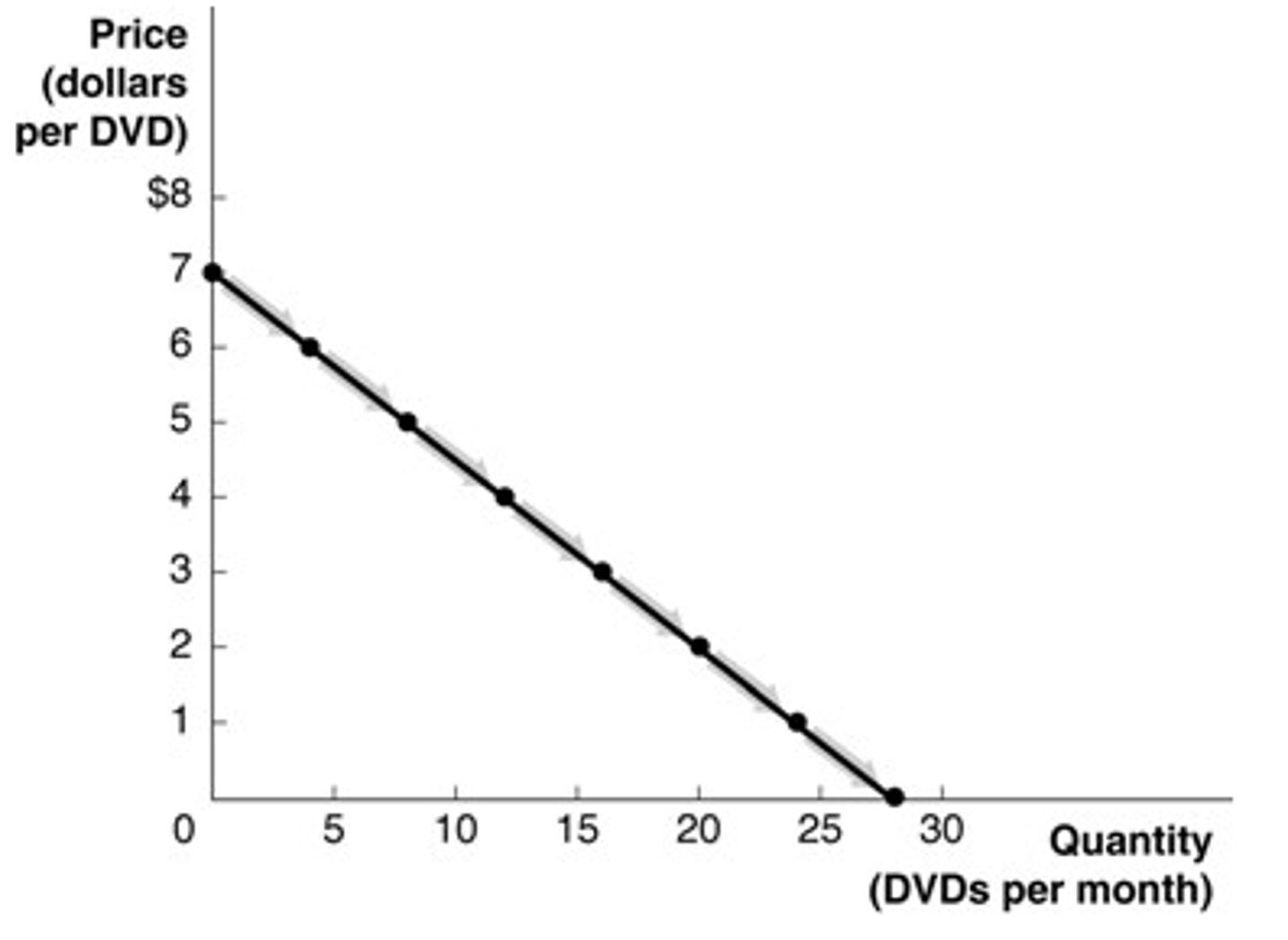
Refer to the graph below which shows the demand for DVDs. What happens to total revenue as we move down the demand curve?
a. It rises.
b. It falls.
c. It remains the same.
d. It rises up to the midpoint, and then it falls.
d. It rises up to the midpoint, and then it falls.
If Amazon.com raises its prices by 10 percent and, as a result, the quantity of books demanded on Barnesandnoble.com increases by 35 percent, what do consumers consider the two Web sites to be?
a. close substitutes
b. close complements
c. unrelated
d. identical
a. close substitutes
Refer to the graph below which shows two potential demand curves in the market for photocopies at a printing company. If you start at point A on D1, what is the percentage change in quantity demanded when price falls from $30 to $20? Use the midpoint formula to calculate this percentage change.
a. quantity demanded rises by 22%
b. quantity demanded rises by 4%
c. quantity demanded rises by 55%
d. quantity demanded falls by 40%
c. quantity demanded rises by 55%
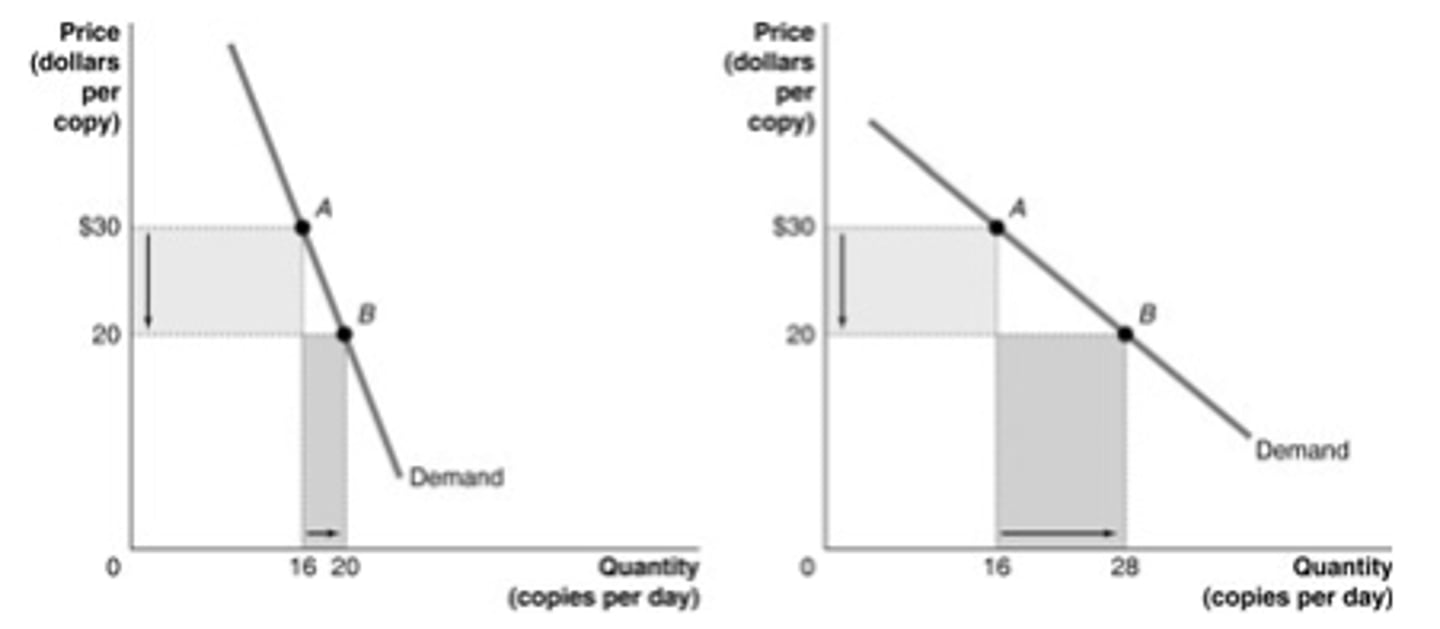
Refer to the graphs below which show two potential demand curves in the market for photocopies at a printing company. In which of the two graphs does a price decrease lead to an increase in total revenue?
a. in the graph on the left
b. in the graph on the right
c. in both graphs
d. in neither graph
b. in the graph on the right
Which of the following would occur when calculating price elasticity between two points on a demand curve if we are not using the midpoint formula?
a. The value of elasticity we would get would be the same whether we apply it to price increases or to price decreases.
b. We would get a different value for price increases than for price decreases.
c. The values we would get would be the same if the demand curve is downward sloping.
d. The values would always coincide with the value of the slope of the demand curve, especially if the demand curve is linear.
b. We would get a different value for price increases than for price decreases.
How do economists avoid confusion over units in the computation of elasticity?
a. by using index numbers rather than whole numbers
b. by using percentage changes rather than simple differences
c. by using aggregate values rather than single values
d. by using the same number as the value of the slope of the curve
b. by using percentage changes rather than simple differences
Fill in the blanks: An increase in the price of a complement for DVDs will lead to____in the quantity demanded of DVDs, so the cross-price elasticity of demand will be____
a. an increase; positive
b. an increase; negative
c. a decrease; positive
d. a decrease; negative
d. a decrease; negative
Which of the following is true about what happens to the quantity demanded of an inferior good?
a. It rises when income rises.
b. It falls when income increases.
c. It does not change with changes in price.
d. It does not change with changes in income.
b. It falls when income increases.
What is the cross-price elasticity of demand for two products that are unrelated?
a. zero
b. 1
c. infinite
d. negative
a. zero
What is true about quantity demanded if a good is considered a necessity?
a. It is very responsive to changes in income.
b. It is not very responsive to changes in income.
c. It is unrelated to changes in income.
d. It is always the same regardless of price changes.
b. It is not very responsive to changes in income.