Toxicology - Absorption, Distribution and Excretion
 Call Kai
 Learn
Learn Practice Test
 Spaced Repetition
 Match
Match Flashcards
 Knowt Play
1/23

There's no tags or description
Looks like no tags are added yet.
Name | Mastery | Learn | Test | Matching | Spaced | Call with Kai |
|---|
No analytics yet
Send a link to your students to track their progress
24 Terms
What impacts the passability of a cell membrane (absorption)?
the fatty environment
Water-soluble compounds would not like this
the lipid bilayer
polar heads on the outside
the outer charge of the membrane
How do chemicals/xenobiotics pass through the cell membrane?
passive diffusion through membrane phospholipids
passive diffusion through aqueous pores
active transport
facilitated diffusion
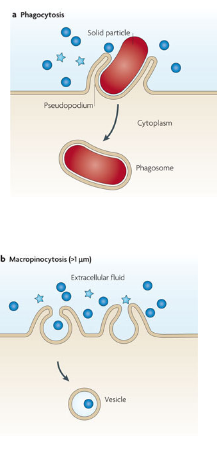
phagocytosis and pinocytosis
What is passive diffusion and filtration?
When small molecules up to 100-200 MW (ethanol, ureum) follow the concentration gradient through the membrane (high to low conc.). It is influenced by lipophilicity, ionisation, and blood flow.
What is the role of ionisation during passive diffusion and filtration?
Weak organic acids or bases are ionized because a chemical with a charge cannot pass the membrane.
Is a chemical more abundant in an ionized or non-ionized state?
Ionized because there is less charge, so it can pass through membranes.
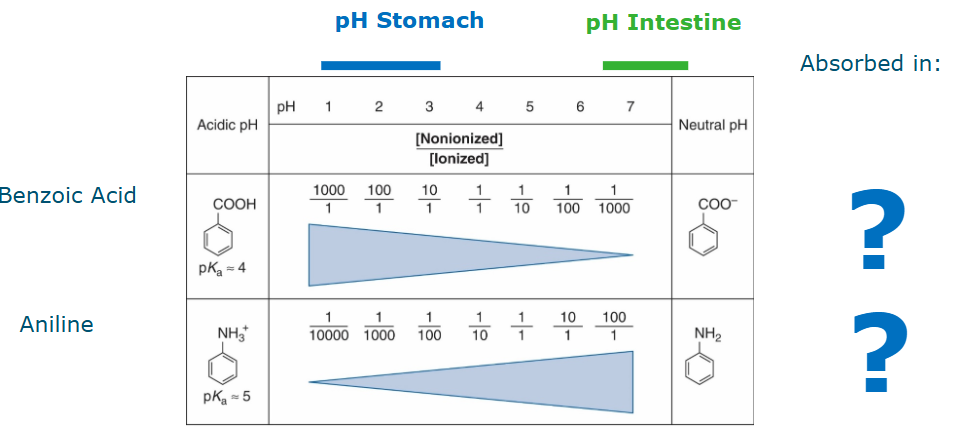
Benzoic acid —> more likely absorbed in stomach
Aniline —> more likely absorbed in intestine
What is the role of blood flow in passive diffusion and filtration?
The blood flow creates a gradient across the membrane and flushes away the chemicals.
What happens during active transport?
Chemicals are moved up a concentration gradient (ATP needed), making it sensitive to metabolic inhibitors. The transport system is selective and has a potential for competitive inhibition.
What is facilitated diffusion?
It does not require energy input and transports molecules down the concentration gradient. But there are two groups of integral membrane proteins involved. Being the carrier proteins (hexose/glucose transporters) and ion channels.
Can a chemical that is not glucose pass through a facilitated glucose transporters?
Yes, if it is bonded to a glucose.
what does phagocytosis and pinocytosis mean and is it energy consuming?
It is cell eating and drinking and requires energy.
What is cell eating and cell drinking?
Cell eating is the ingestion of particles by specialized cells (neutrophils, macrophages).
Cell drinking is the ingestion of drops or small particles (<1 micro. m) by all cells.
What are exposure routes through which chemicals can enter the human body?
skin
vein (drug injections)
gut (eat &drink)
lungs (inhale)
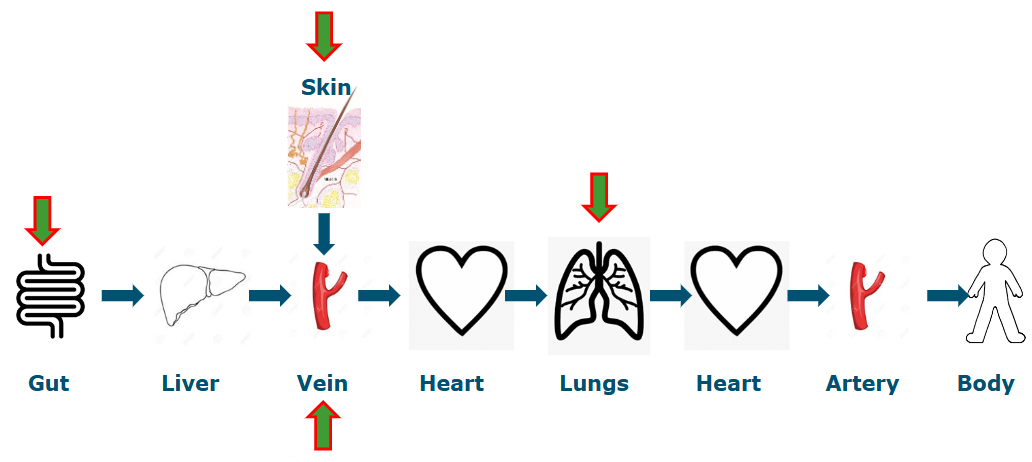
What is unique about the gut exposure route?
Everything that goes through the gut also goes through the liver.
What is unique about the skin exposure route?
It takes the longest because the skin is a thick barrier.
What body parts are in the gastrointestinal tract when something is consumed through oral exposure?
mouth
stomach (acidic)
duodenum
ileum
colon
rectum
What is oral exposure route dependent on?
concentration
duration + level exposure
area of exposure (villi)
epithelial layer
sub epidermal blood flow
physico-chemical properties
Are the chemicals that end up in our body the same as what we are initially exposed to?
No, they are usually different.
What part are all chemicals taken up oraly first absorbed by?
they are first absorbed by the portal vein and then go to the liver.
Which organ changes chemicals taken up?
The liver.
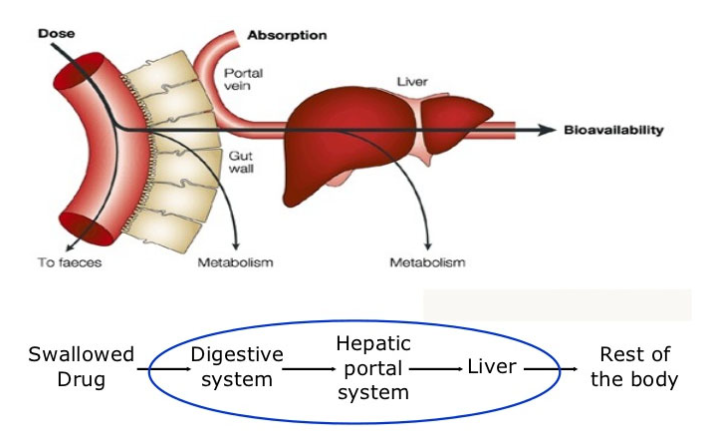
what is the entrohipatic cylce (first pass effect)?
The liver excretes chemicals (that were initially taken up from the intestine) via the bowel, going back to the intestine.
Does the route of exposure impact the effect of the chemical?
Yes.
What does ADME stand for?
absorption
distribution
metabolism
excretion