Waves for detection and exploration
 Call Kai
 Learn
Learn Practice Test
 Spaced Repetition
 Match
Match Flashcards
 Knowt Play
1/7

There's no tags or description
Looks like no tags are added yet.
Name | Mastery | Learn | Test | Matching | Spaced | Call with Kai |
|---|
No analytics yet
Send a link to your students to track their progress
8 Terms
echo sounding (ultrasound)
ultrasound are very high frequency waves (so they have a short wavelength)
this means they can be sent out as a narrow beam
ultrasound can be used to measure distances as we know it’s speed in different materials
echolocation is there and back so when calculating speed needs to be halved
(use the eq S=D/T)
used by bats
SONAR
used by ships and submarines to detect objects underwater that we cannot see
the wave reflects off of the object allowing us to calculate how far away it is
sound navigation ranging (sonar)
ultrasound
can be used for medical imaging
waves emitted by transmitter
when a wave crosses from one substance to another some of the wave is reflected
→ they are picked up by the receiver to build an image on screen
How is a computer able to build the picture of a baby using ultrasound scanning?
waves only partially reflected → allows wave to continue to travel and reflect off multiple objects
so different distances will reflect back at different times (eg scanning babies)
Name some advantages of using ultrasound instead of other methods of seeing inside the body eg x-ray when scanning a pregnant woman.
no risks
It does not use ionising radiation which could harm the developing baby
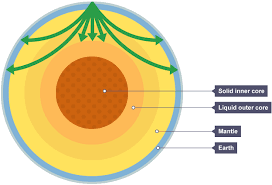
seismic waves
produced by earthquakes in the Earth’s crust
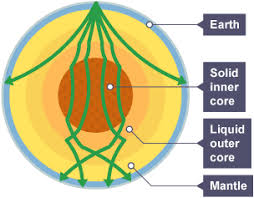
p-wave
s-waves
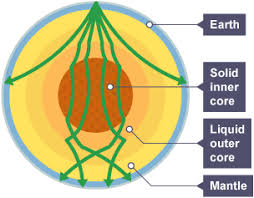
P-waves
longitudinal
fast(er) moving
travel through solids and liquids
refracted so that there are zones where none are detected →indicates there’s a solid core
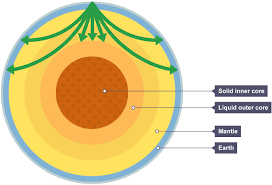
S-waves
transverse
slow(er) moving
travel through solids only
aren’t detected on the other side on the earth → suggests the outer core must contain liquid but the mantle has solid properties