Hell World: Term 1 Week 5: Rome and the Hellenistic World
 Call Kai
 Learn
Learn Practice Test
 Spaced Repetition
 Match
Match Flashcards
 Knowt Play
1/36

There's no tags or description
Looks like no tags are added yet.
Name | Mastery | Learn | Test | Matching | Spaced | Call with Kai |
|---|
No analytics yet
Send a link to your students to track their progress
37 Terms
Which of the Hellenistic Kingdoms did the Romans absorb and when?
Antigonids (168 BCE)
Attalids (133 BCE)
Ptolemies (30 BCE)
But not the seleucid empire (only a part of it, 64 BCE)
The Mithridatic Wars (88-63 BCE)
What is the context of Rome’s first interactions with Hellenistic powers: their war with Hannibal?
Roman interests in Illyria in late third century BCE (Illyrian alliance with Rome- 3rd century BCE)
The antigonis king Philip V wanted ti gain control over Illyria
Phili began negotiating with Hannibal in Italy (in the context of the second punic war)
The Romans thereafter regarded Philip as an enemy
How did the Romans react to this new (rivalry?) with Philip?
Strengthened fleet in Illyria
Negotiated alliances with Philip’s enemies in Greece (the Aetolian League, individual cities)
What did the Romans intrude on?
The Romans intruded on the organization of power in Greece forcing various states to choose sides in this wider conflict
To some extent the Romans have become a power in Greece even though they werent ruling it
What occured in 205 BC?
In 205 peace was agreed between Rome and Philip (very uneasy peace)
Who did the Attalids make an alliance with?
Philips activities in the northern Aegeans and South-west Asia Minor, aided by the Bthynian King
Opposed by Rhodes and the Attalids; the Attalids made an alliance with Rome (the Rhodes by this point were very powerful, had a very powerful navy)- they were a serious force in this period
What occurred after the defeat of Hannibal?
The end of the war, 203-201; peace treaty between Rome and Carthage
Romans were encouraged by the Attalids, Rhodes and Athens to view Philip as a threat
Two legions sent to Greece in 200
Battle of Cynoscephalae in Thessaly, 197
Who was Titus Quinctius Flaminius
He was a Roman politician and general instrumental in the Roman conquest of Greece
What did Titus Quinctius Flaminius do?
Declared the Greek cities free (196)- didn’t mean that they were completely free
The Antigonids were to evacuate Greece
Philip remained king
The Romans withdrew in 194
Who was Antiochus III?
the sixth ruler of the Seleucid Empire, reigning from 223 to 187 BC
What did Antiochus III do?
•Antiochus III took over many of the cities in south-west Asia Minor, where Philip V had been active
•The Attalid kingdom was reduced by Antiochus
Who appealed to Rome?
•Pergamum and Rhodes appealed to the Romans, who made various demands
•Antiochus seems to have proposed an alliance with Rome, but this bore no fruit
Where had the Romans managed to establish a sense of authority?
The Romans had managed to establish a kind of authority in Greece but nothing in Asia-minor
Explain Antiochus’ campaign in Greece
The Aetolian League felt the Romans had not rewarded them enough for their alliance
Invited Antiochus to Greece
He responded with a small invasion force in 192
The Aetolians did not prove much assistance
A Roman army defeated Antiochus at Thermopylae, and Antiochus withdrew to Asia Minor
How did the Romans defeat Antiochus?
The Romans defeated the Aetolians and effectively put an end to the influence of the Aetolian league as a major power in Greece
Antiochus had given asylum to Hannibal, which increased Roman Paranoia
They sent an army to Asia Minor, which defeated Antiochus at Magnesia (either 190 or 189 BCE)
Explain the Peace treaty of Apamea (made between the Romans and Seleucids- Antiochus)
Antiochus was to withdraw beyond the Taurus mountains
Former Seleucid lands given to states like Rhodes and Pergamum (the Attalids now gained a large territory)
The Seleucids to pay a war indemnity; controls were placed on their military sources- a maximum number of elephants they were allowed to have
How powerful were the Romans after this treaty?
Defeat of two major Hellenistic powers in quick successions made Rome very influential in the Greek world
No eastern provinces, but Romans decided on how to dispose of conquered territories
Diplomatic relations with the Roman Senate became important
Roman businessmen became prominent in the east
Explain the Roman destruction of Macedonia
Philip V died in 179, no longer a major power
His son Perseus succeeded
When Perseus’ sister was married to the king of Bithynia, fears of a revival of the old alliance
The Attalid king Eumenes II encouraged the Romans to view Perseus and the Attalid monarchy as a threat
The Romans decided to destroy the Macedonian monarchy
Their harsh treatment of Macedonia shocked even their allies
168 BCE: the Battle of Pydna
Macedonia broken up into four ‘republics’
After 148 Macedonia became a Roman province
Who was concerned by Romes treatment of Macedonia?
The Romans aim was to destroy Macedonia, encouraged by the Attalids
The harsh treatments of the Romans towards the macedonians began to concern even those who had encouraged them
List further Roman advances
Destruction of Cornith by Lucius Mummimus (146 BCE)
The Achean league was defeated and made to pay tax to Rome
No province created, but the governor of Macedonia was charged with overseeing the Greek cities
Manipulation of rivalry between Bithynian and Attalid kingdoms, and interference int he succession in the Seleucid empire
When and how did the Attalids become part of the Roman empire? Empire?
After 146 BCE the Attalids managed to remain on the side of Rome, and when the last king died in 133 BCE he bequeathed his kingdom to the Romans
What happened in 129 BCE?
In 129 BCE the province of Asia (the western part of asia-minor)created from the Attalid kingdom (the second major monarchy to fall to Rome)
Explain the start of the Mithridatic wars
Mithridates VI of Pontus- last major power that operated independently of the Romans
Killed the Cappadocian king and set up his son as king; Romans appointed an alternative king
An ally of Mithridates, Tigranes of Armenia, drove the Roman nominee out of Cappadocia
The Romans restored their nominee (92 BCE) and Mithridates drove him out
Mithridates also put his own nominee on the Bithynian throne
Continue explaining the Mithridatic Wars. (how were the Romans viewed? What happened in 88? How did the war conclude?)
•The Roman were generally unpopular and Mithridates had some support from cities and states in Asia Minor
•In 88 he attacked the Roman province of Asia and Roman allies
•The war concluded with an agreement by Mithridates to withdraw his interests in Bithynia and Cappadocia and to pay an indeminity
•The king of Bithynia died in 74 and bequeathed his kingdom to the Romans, and it was made a province
•Mithridates attacked Roman Bithynia in 74; he was eventually forced to seek refuge with Tigranes of Armenia (71)
Continue explaining the Mithridatic wars (the Tigranes section)
Pontus was made a province and the Romans demanded Tigranes surrender Mithridates
Tigranes refused so then the Romans invaded Armenia- the king of Armenia had become an independent power and he had extended his power out of Armenia to Syria. The Roman invasion of Armenia was a success as they were able to destroy the Armenian empire but not Tigranes
Mithridates escaped to Pontus, raised an army and defeated the Romans there (67)
Pompey drove Mithridates from Pontus in 66; he fled across the Black Sea, where he died in 63
Who is Tigranes?
Tigranes II, more commonly known as Tigranes the Great, was a king of Armenia. A member of the Artaxiad dynasty, he ruled from 95 BC to 55 BC.
How was Tigranes powerful?
In 67 Tigranes had been ay the height of his power, extending his kingdom at the expense of the parthians and the Seleucids
He had ousted the Seleucids from antioch, their seat of power
Why was Tigranes an enemy of Rome?
But his protection of Mithridates made him an enemy of the Romans, who reduced his kingdom to Armenia
Who created Syria?
Pompey dismissed the last seleucid king, Antiochus XIII, decided to make a new province called Syria- although he didn’t have much control over it
What was the only remaining powerful Hellenistic kingdom?
The Ptolemaic kingdom
Who were the last legitimate Ptolemies?
Death of Ptolemy XI Alexander II in 80 BCE
His successor: Ptolemy XII Neos Dionysus (Auletes)- he was not very popular only reigned for a few months
He didn’t reign very long but was the last legitimate ptolemy
Explain the beginning of the end of the Ptolemaic kingdom
•Death of Ptolemy XI Alexander II in 80 BCE
•His successor: Ptolemy XII Neos Dionysos (Auletes)
•Allegedly one of his predecessors had left Egypt to Rome in the event that he died without an heir. Auletes’ legitimacy was inevitably questioned; he bribed Roman commanders not to annex his kingdom (although they annexed Cyprus in 58)
•In 60 he travelled to Rome and made a treaty with Caesar and Pompey for an enormous sum of money
Explain Ptolemy XII Auletes
•In 58 there was a rebellion against him in Egypt; high taxation and his failure to hold Cyprus discredited him and he was deposed
•Ptolemy XII fled to Rome, and his daughter Berenice ruled Egypt
•He bribed the governor of Syria, Aulus Gabinius, to restore him in 55 BCE
•Berenice was executed and a Roman garrison established in Alexandria to keep Ptolemy XII in power
•He died in 51 and was succeeded by his daughter, Cleopatra VII
How secure/stable was Cleopatras Ptolemaic ruling?
•Unable to operate independently of Rome
•Made alliances with Julius Caesar and then Mark Antony
•But unable to secure her kingdom with Octavian
When did the Hellenistic world end?
With the Battle of Actium in 31 BCE
Rome as a Hellenistic power?
Hellenistic art was adopted and promoted by Octavian, during his rule
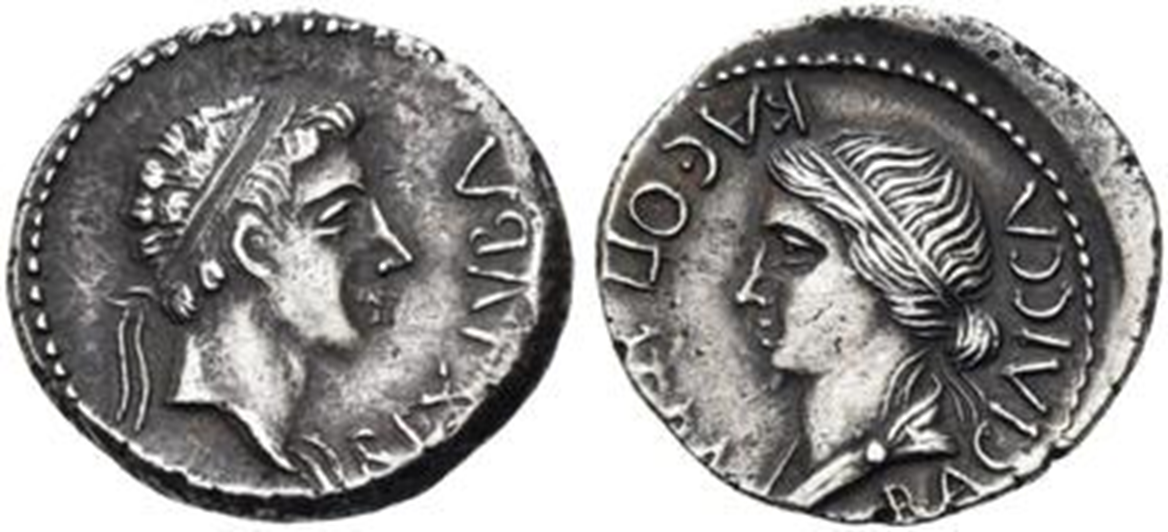
King Juba of Mauretania was married to a daughter of Cleopatra VII (Juba on a coin was presented as wearing a hellenistic diadem)
Did elements of the Hellenistic world continue after it had ended?
Yes