AP Microeconomics Unit 4: Imperfect Competition
 Call Kai
 Learn
Learn Practice Test
 Spaced Repetition
 Match
Match Flashcards
 Knowt Play
1/63

There's no tags or description
Looks like no tags are added yet.
Name | Mastery | Learn | Test | Matching | Spaced | Call with Kai |
|---|
No analytics yet
Send a link to your students to track their progress
64 Terms
lower their price (no longer a price taker)
In order to sell additional units in an imperfectly competitive market, what must a firm do?
high fixed/start-up costs (economies of scale), legal barriers to entry, exclusive ownership of key resources, government-created (patents)
What are some examples of barriers to entry?
monopoly, oligopoly, and monopolistic competition in the product market and monopsony in factor markets
What are some examples of imperfectly competitive markets?
one, no
In a monopoly, there is ___________ producer of a good that has ___________ close substitutes.
- only one producer of the good
- no close substitutes for that good
- other firms are prevented from entering the market because of barriers to entry
- firms are able to make a long-run profit
- firms are price makers
What are some characteristics of a monopoly?
- few firms (2-5) produce almost all the output in the industry
- strong barriers to entry (typically because of high fixed costs)
- economies of scale exist
- firms must consider the actions of other firms when making production and pricing decisions
- the opportunity for cartels and collusion exists
What are some characteristics of an oligopoly?
- more firms than oligopoly, but less than perfect competition
- products can be differentiated
- no barriers to entry or exit in the long run
- firms cannot earn a long run profit
What are some characteristics of monopolistic competition?
it has a downward sloping demand curve
If a firm is a price maker, what does that tell us about its demand curve?
if a monopoly lowers the price, it will sell more goods
If a monopoly lowers its price, what happens to the number of goods it sells?
When a monopoly lowers its price, marginal revenue will be lower than the price. When price is lowered, marginal revenue is not equal to the price. Marginal revenue is the difference between total revenue at the previous output and the total revenue at the current output.
What happens to marginal revenue when a monopoly lowers this price? How does this distinguish it from perfect competition?
decline
For a monopoly as each successive unit is sold, the marginal revenue from each unit will...
all units (not just the additional unit)
To sell another unit, the monopoly must lower the price of...
On the elastic portion of the demand curve, a decline in price will increase in total revenue and marginal revenue is positive.
What is true of total revenue and marginal revenue when the demand curve is elastic?
On the inelastic portion of the demand curve, a decline in price will decrease total revenue and marginal revenue is negative.
What is true of total revenue and marginal revenue when the demand curve is inelastic?
When marginal revenue is equal to zero and the demand curve is at its unit elastic point.
At what point on the graph is total revenue maximized?
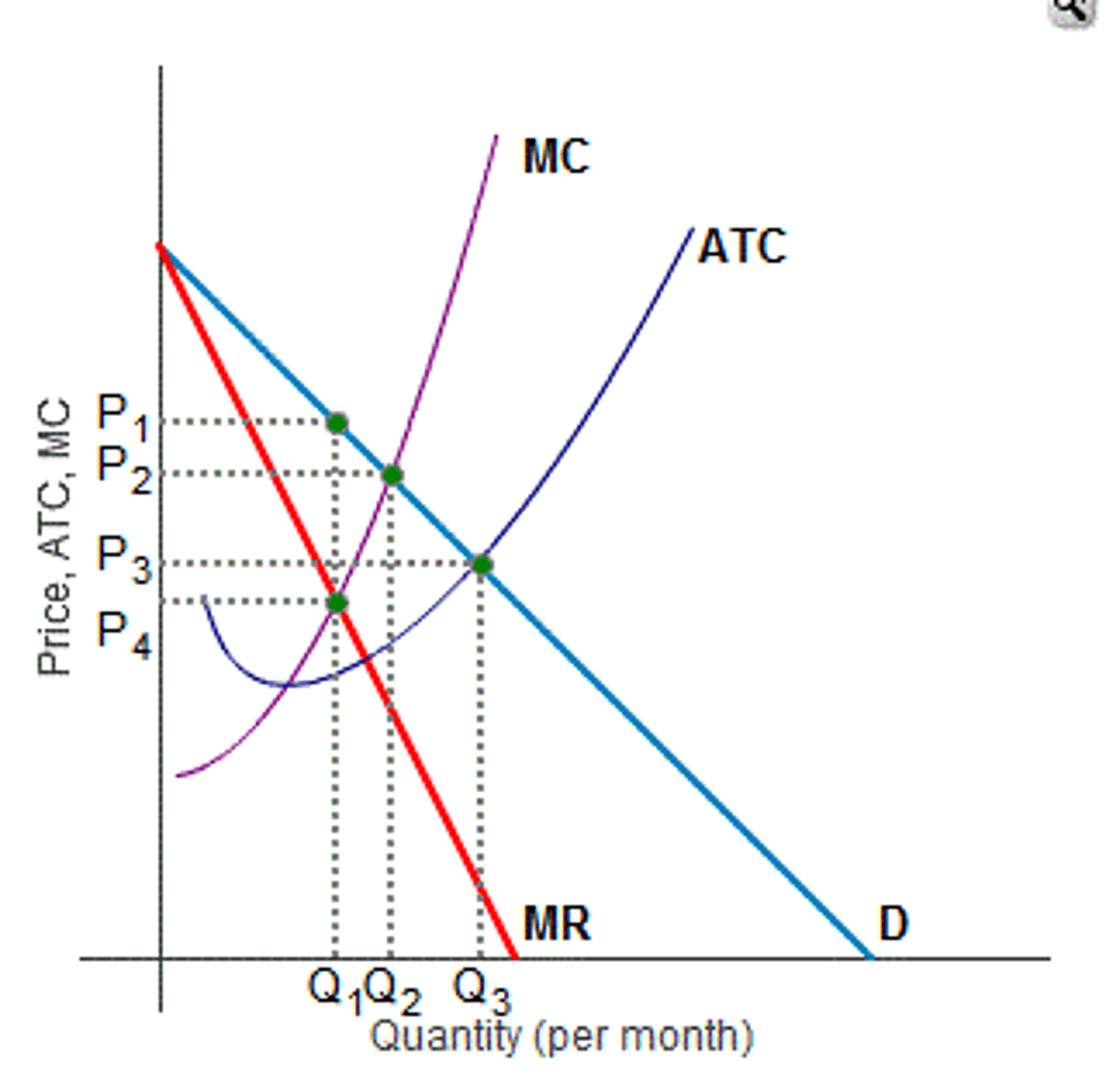
because past the unit elastic point marginal revenue would be negative and total revenue would be declining
Why will a monopoly never produce in the inelastic portion of the demand curve?
The monopolist will produce where MR = MC. The price will be higher than MR at P = D. At this point on the demand curve the greatest profit will be made.
Where does the monopolist produce? Where does the monopolist set their price?
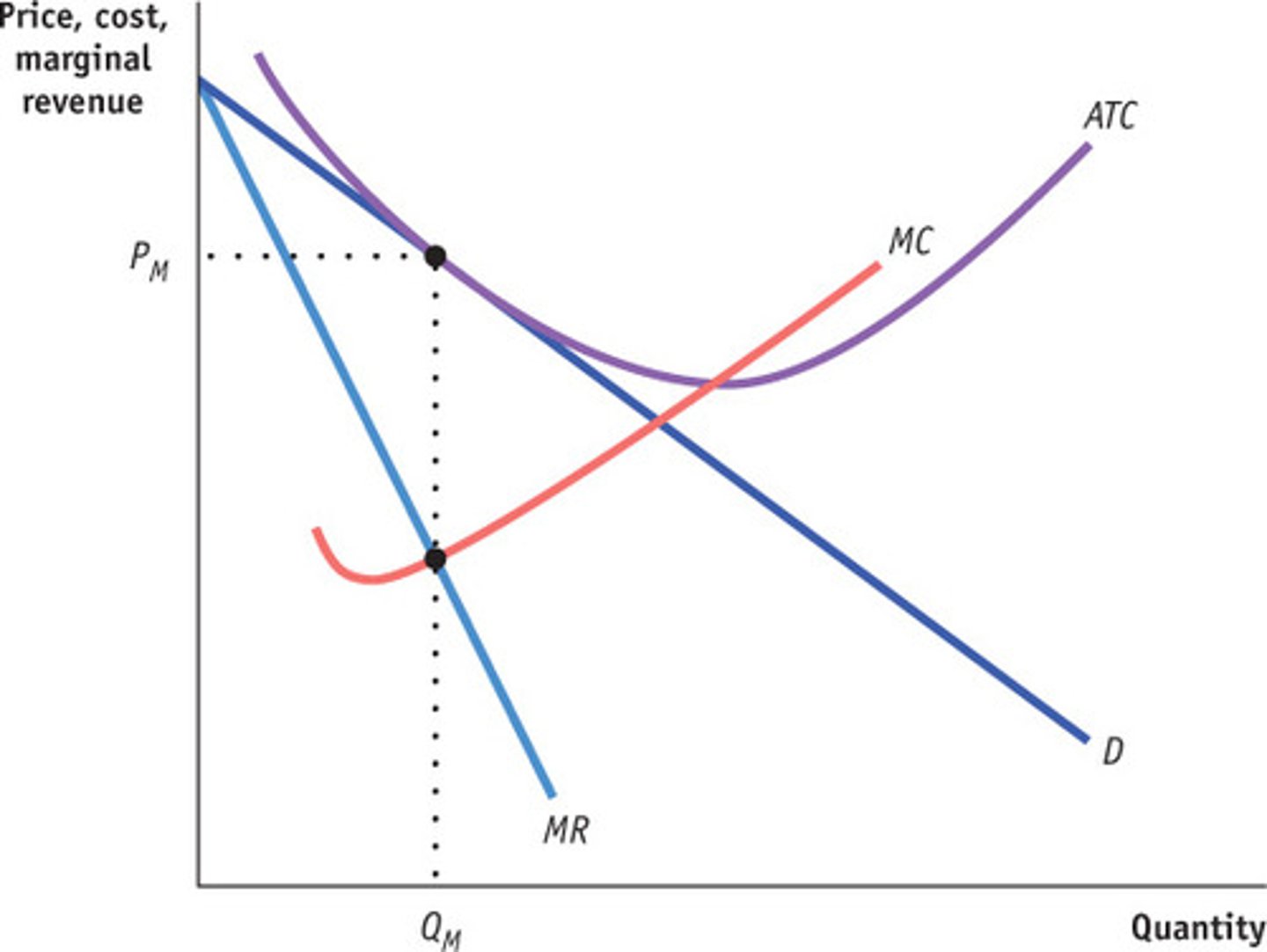
A monopolist has control over what price they charge and choose to charge the price that maximizes their profit.
What is the significance that the monopolist is a price maker?
the slope of the demand curve (because the MR curve results from)
On what does the monopolist depend to determine its output?
Because they have a downward-sloping demand curve
Why is the monopolist interested in total profits, not per unit profits?
If demand is weak a monopoly may suffer a loss (P < ATC at MR = MC). As long as the firm is covering its average variable costs, it will continue to produce.
Can a monopoly make a loss? When will it continue to produce?
natural monopoly
a monopoly that arises because a single firm can supply a good or service to an entire market at a smaller cost than could two or more firms
Natural monopolies exist when the quantity produced must be very high to accommodate the very high fixed costs. ATC continues downward over a large quantity and economies of scale exist for a single firm throughout the entire effective demand of its product. It is natural for only one firm to produce because they can produce at the lowest cost.
Under what conditions do natural monopolies exist?
P = MC
What is socially optimal pricing?
P = MC
What is allocatively efficient pricing?
The government would place a ceiling on the price to achieve allocative efficiency.
How can the government achieve socially optimal pricing by regulating a monopoly?
deadweight loss = 0
What is true of deadweight loss when a firm is allocatively efficient?
Benefits: takes away a firm's desire to restrict output, no deadweight loss, produces the quantity wanted by society
Drawbacks: does not allow the firms to maximize profits and may cause them to earn a loss, meaning that they must be subsidized
What are benefits and drawbacks of socially optimal pricing?
The monopoly is producing the right amount of goods for consumers and is thus using resources for what people want them to be used for.
What is true if a firm is allocatively efficient?
P = ATC
What is fair return pricing (normal profit pricing)?
Benefits: The monopoly will earn a normal profit
Drawbacks: efficiency is not achieved because the monopoly is not producing where P = MC and there will be deadweight loss
What are benefits and drawbacks of fair return pricing (normal profit pricing)?
For a monopoly, producer surplus is the area between the MC curve (supply curve) and the price. This is the area below P1 but above the MC curve.
Where is producer surplus for a monopoly?
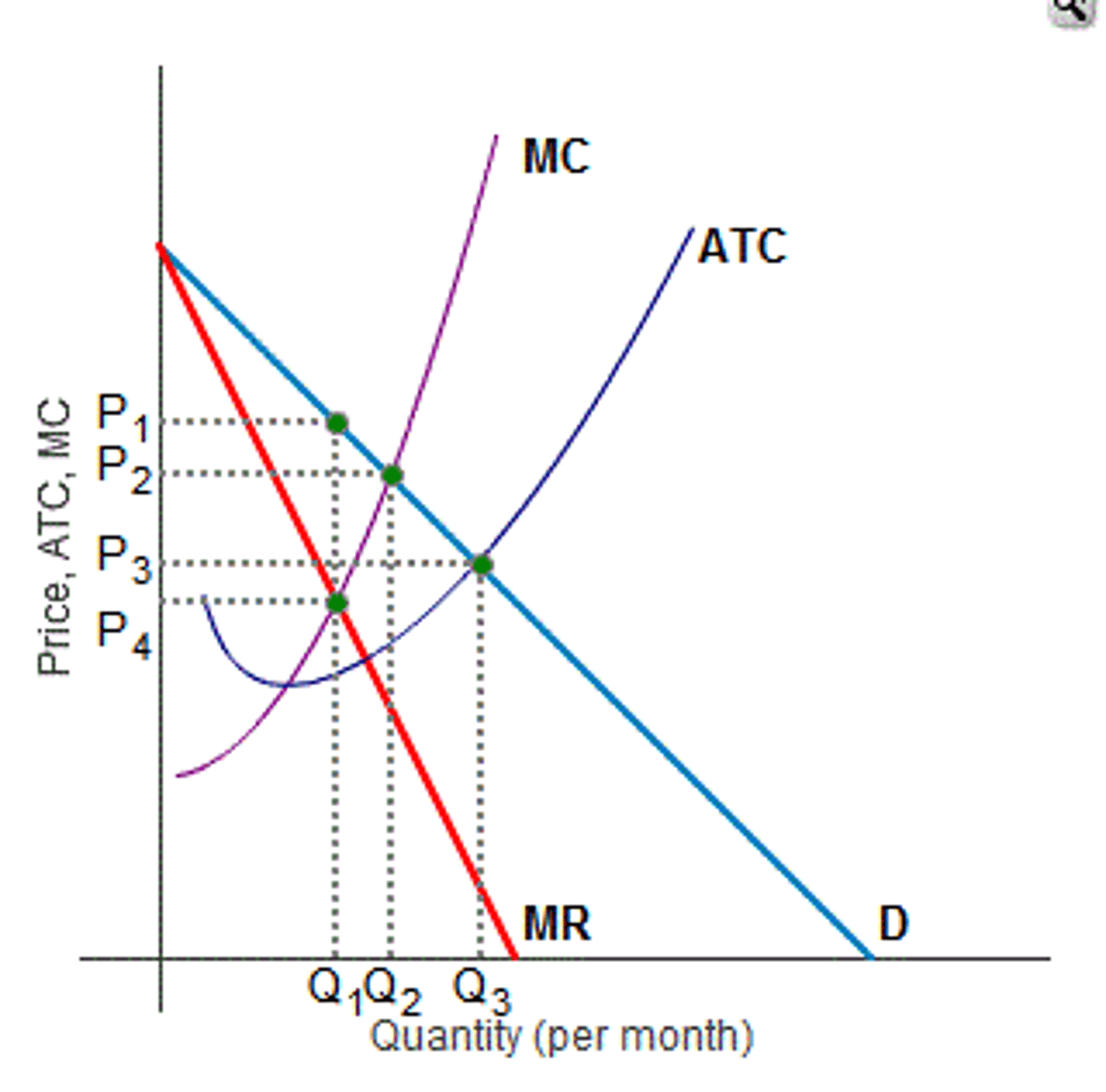
The consumer surplus is the area between the price and the demand curve. This is the triangle above P1.
Where is consumer surplus for a monopoly?
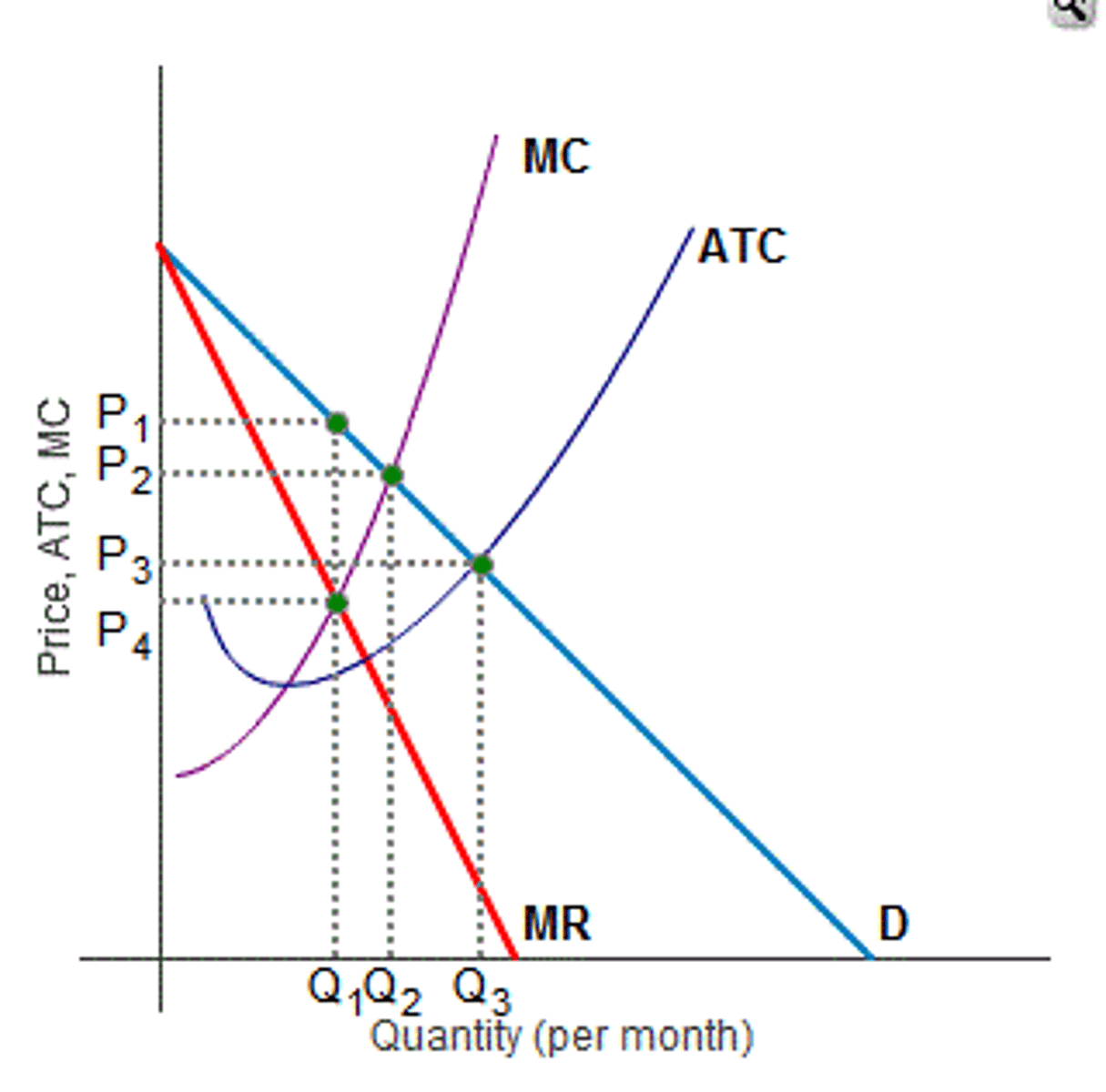
Compared to allocatively efficient pricing, the profit maximizing price is higher, so there is less consumer and more producer surplus.
What is the difference between consumer surplus and producer surplus with profit maximizing pricing and allocatively efficient pricing?
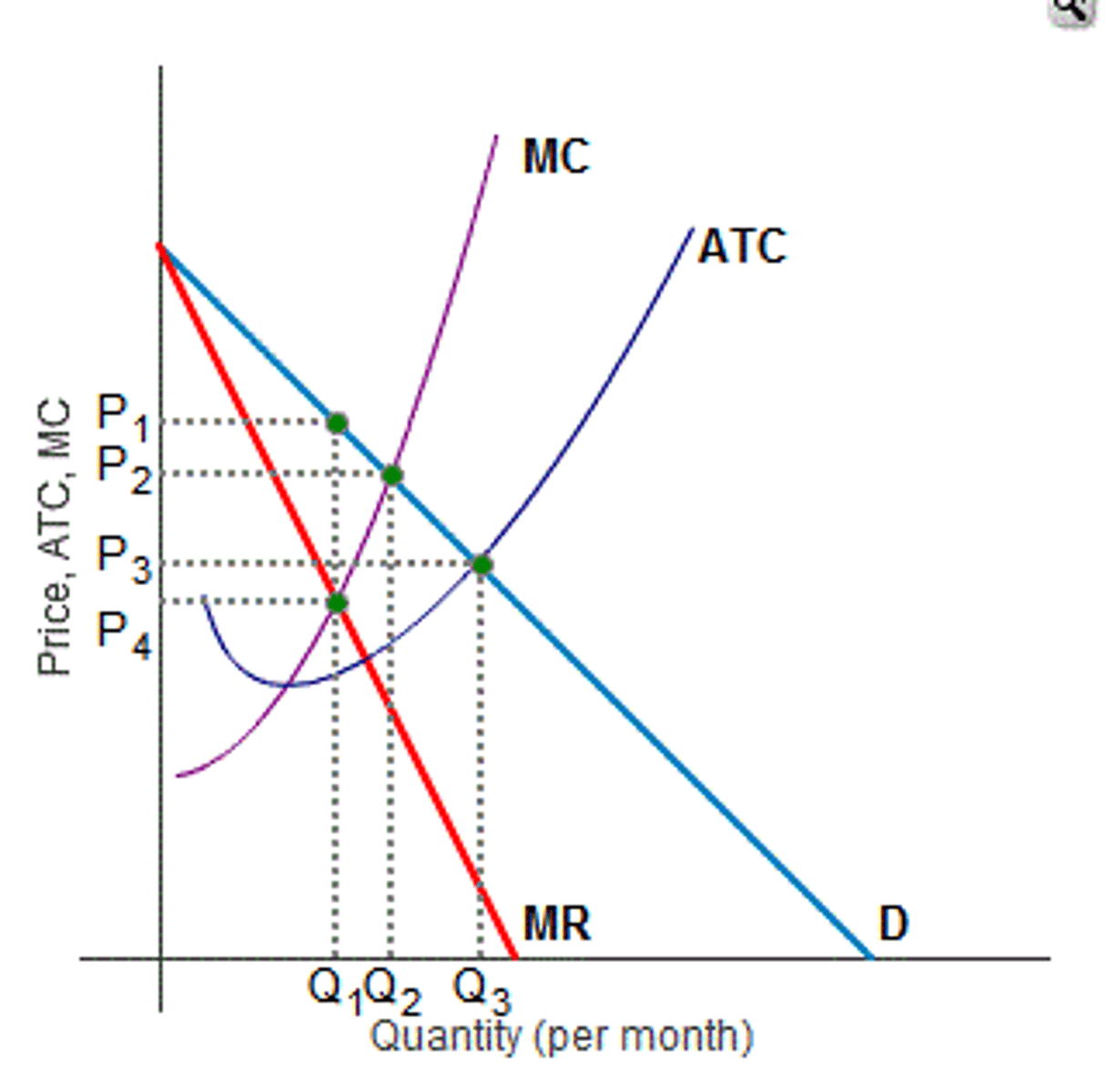
price discrimination
the business practice of selling the same good at different prices to different customers
With perfect price discrimination, a monopolist produces the quantity where price equals marginal cost (just as a competitive market would) but extracts all economic surplus associated with its product and eliminates all deadweight loss. The monopolist can increase their profits and capture additional consumer surplus.
What happens when a monopolist price discriminates? Why does it benefit them?
the triangle formed by the area between Qm and the intersection of the MC and D curves
Where is deadweight loss on this graph?
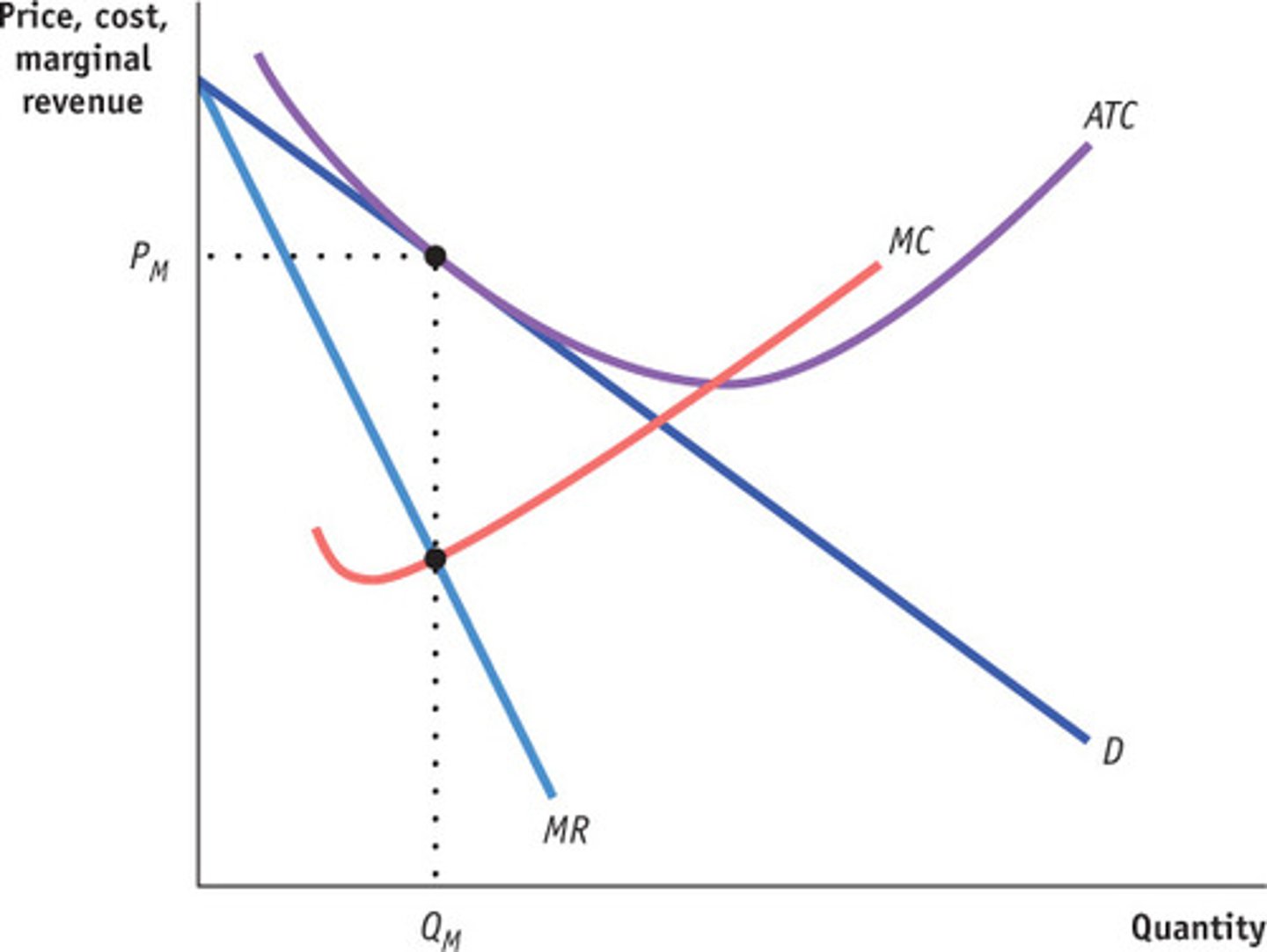
When the monopoly charges different prices for the same good, the MR achieved from selling another unit is the same as the price, meaning the monopolist does not have to lower the price on previous units. MR = D = AR = P
What is true of marginal revenue when a monopoly price discriminates?
With price discrimination, the monopoly takes all the consumer surplus. There is no deadweight loss.
Compare the areas of consumer and producer surplus before and after price discrimination. What is the effect on consumer surplus?
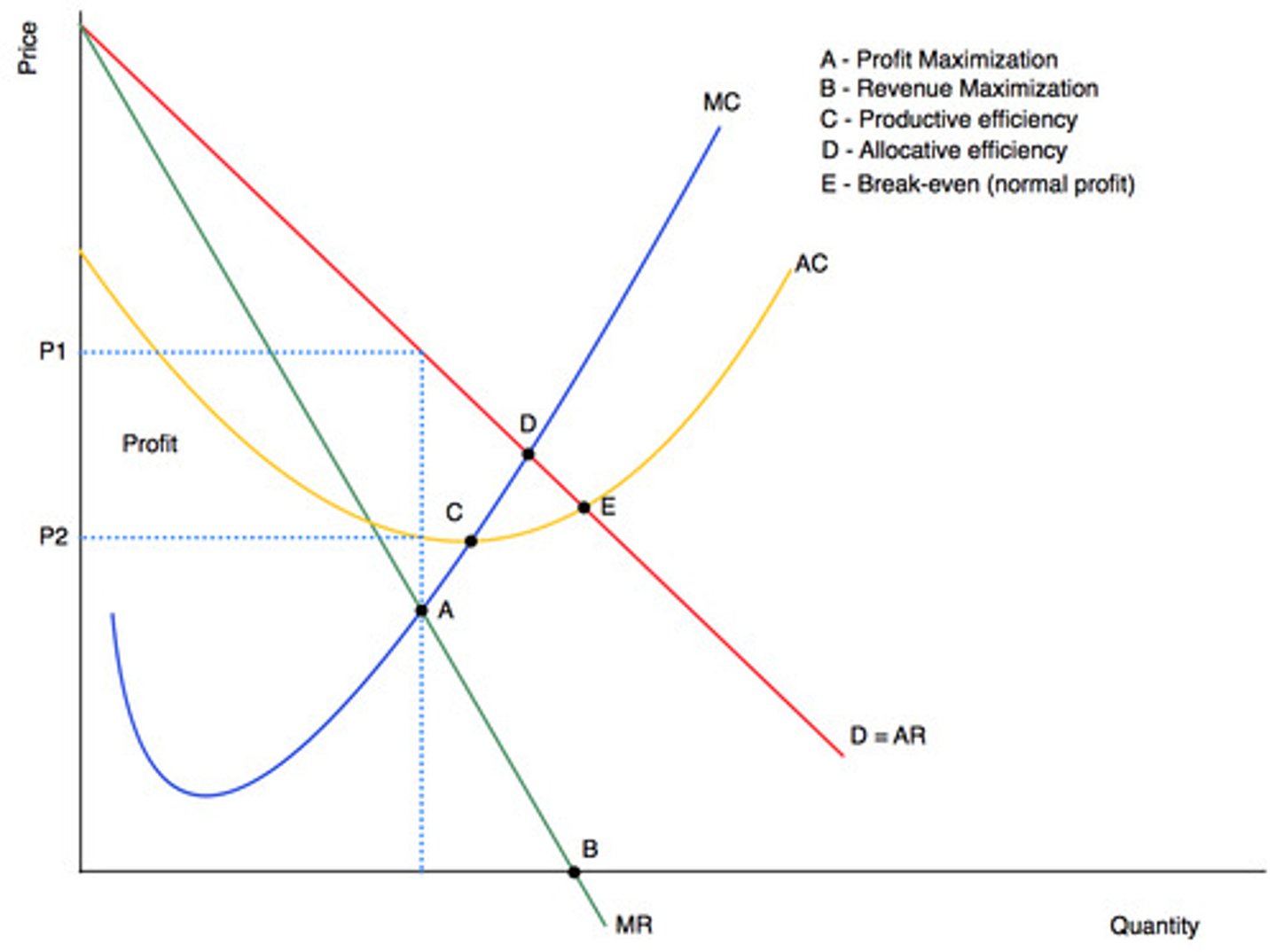
there is no single price -- they charge all the prices along the demand curve until MR (=D) equals MC.
What is the price charged by a price discriminating monopolist?
It produces where MC = D. This allows them to produce more units than they otherwise would have produced.
Where does a company produce when it can perfectly price discriminate?
It takes the consumer surplus and deadweight loss and turns it into producer surplus.
What is the net effect of price discrimination for the firm?
monopolistic competition / oligopoly
In what market structure(s) do firms use advertising as a means of differentiating their products?
The output level in the market is smaller than the output level needed to minimize average total costs even at equilibrium -- firms could produce more, but they don't.
Explain why there is excess capacity in monopolistically competitive markets.
price is not equal to MC in the long run, so there is deadweight loss.
Explain why monopolistically competitive markets are allocatively inefficient.
The demand curve for a monopolistically competitive firm is highly elastic but not perfectly elastic.
Explain the demand curve for a monopolistically competitive market.
the number of competitors
What is the elasticity of the demand curve in a monopolistically competitive market dependent on?
Since the firm faces a downward sloping demand curve, it will have profit maximization and loss minimization situations similar to a monopoly
Explain how a monopolistically competitive market is similar to a monopoly in the short run.
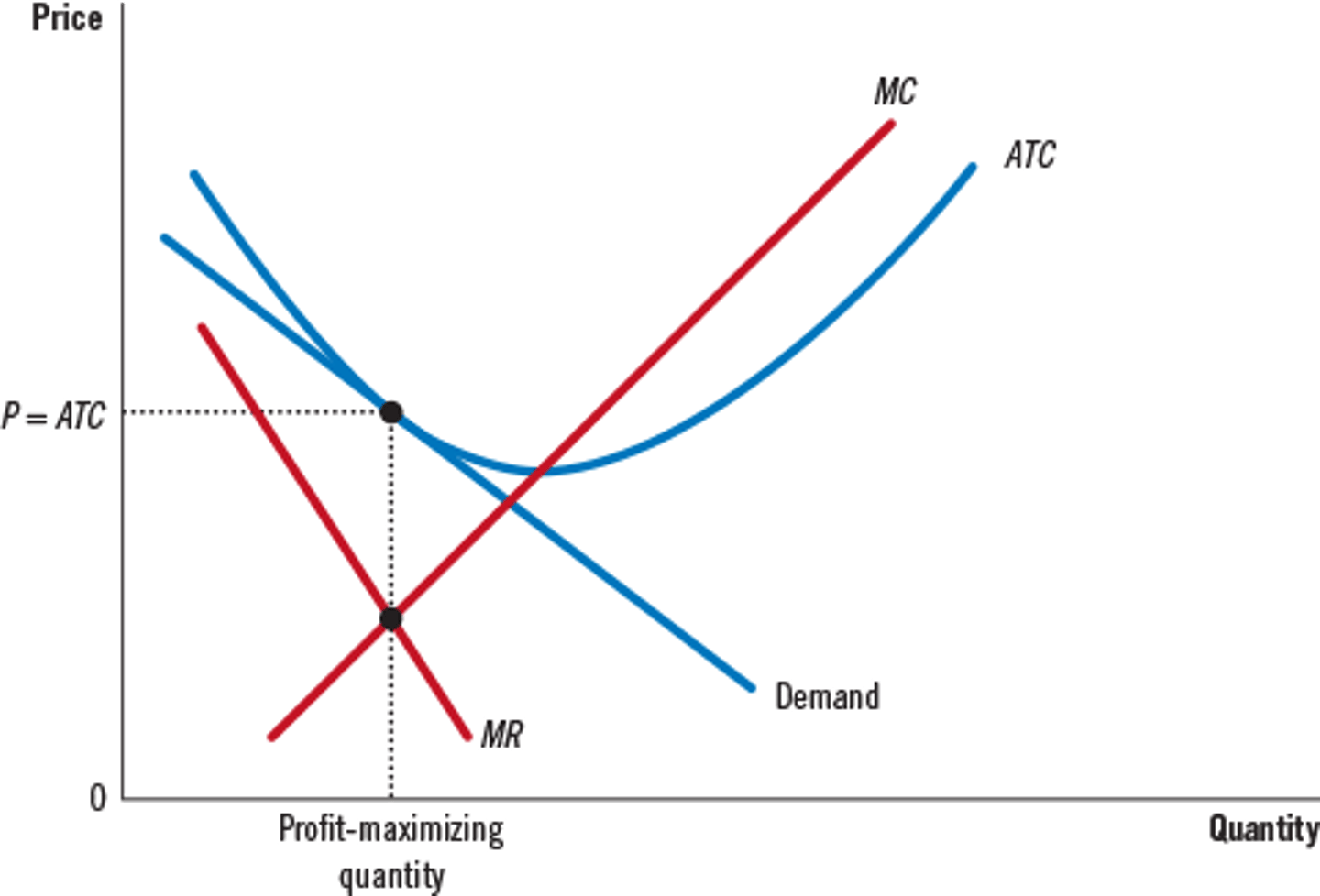
Since there are low barriers to entry, if firms are currently earning economic profits, other firms will enter. Entry of additional producers will shift the demand curves for individual firms to the left (because there are less people buying from any given firm) until it intersects with ATC at the profit maximizing quantity. Firms will earn zero economic profit in the long run.
How does a monopolistically competitive market shift and reach long-run equilibrium in the long run?
the profits of each firm are dependent on the actions of other firms in the market.
What is the defining characteristic of an oligopoly?
multiple companies joining together and acting like a monopoly
What is a cartel?
Collusion offers the opportunity for firms to earn monopoly profits
What are the benefits of collusion in an oligopoly?
Firms will realize that though they may maximize their combined profits by colluding, cheating on the agreement allows a firm to maximize their individual profit.
Why are attempts at collusion in oligopolies often unsuccessful?
game theory
the study of behavior in situations of interdependence
there is price strategy in deciding what price to charge depending on the actions of the other firm
What role does game theory play in studying oligopolies?
payoff matrix
a table that shows the payoffs that each firm earns from every combination of strategies by the firms
the strategy that would serve you best regardless of what the other firm does.
What is a dominant strategy in game theory?
The outcome that occurs when participants take actions that are best for them, given the actions taken by other players. Players do not consider the effect of their actions on others.
What is Nash equilibrium (non-cooperative equilibrium)?
the firm's own pricing strategy and the pricing strategy of its rivals.
In an oligopoly, profits depend on...
the more firms in the industry, the less likely tacit collusion will be successful.
How is the number of firms in the industry related to the success of tacit collusion?
It is easier to tacitly agree to keep a price high if the product is similar and there are few ways price can be set.
How is the complexity of the product and pricing schemes related to the success of tacit collusion?
If firms have diverse characteristics and interests, it will be more difficult to establish and maintain tacit agreements.
How is the diversity of interests among firms related to the success of tacit collusion?
If the buyers of a product operate in a competitive retail environment, tacit agreements to keep prices high are unlikely to succeed.
How is the bargaining power of buyers related to the success of tacit collusion?
Firms use tactics such as advertising, new packaging, and location to create the perception that their product is superior.
What is non-price competition?