Micro - Lab exam 2
 Call Kai
 Learn
Learn Practice Test
 Spaced Repetition
 Match
Match Flashcards
 Knowt Play
1/90

There's no tags or description
Looks like no tags are added yet.
Name | Mastery | Learn | Test | Matching | Spaced | Call with Kai |
|---|
No analytics yet
Send a link to your students to track their progress
91 Terms
Molting
Periodic shedding and regrowth of an exoskeleton
Invertebrate
Animals that lack a backbone
Vector
An organism that transmits disease from host to host
Chitin
Polysaccharide in the cel walls of fungi and exoskeleton of arthropods
Ectoparasite
AN organism that lives on the outside of its host, deriving nutrients at the host’s expense
Mechanical vector
Pathogens are transmitted passively on the body of the carrier
Biological vectors
Pathogens live/replicate within a host and are transmitted typically through a bite
Definitive host
Host where parasite reaches full maturity and reproduces sexually
Intermediate host
Host where parasite reproduces asexually until becoming fully mature in a new host
Disease transmitted by: Pediculus
Typhus
Disease transmitted by: Xenopsylla
Bubonic plague
Disease transmitted by: Anopheles
Malaria
Disease transmitted by: Culex
Encephalitis
Antibiotics
A substance made and secreted by a living microorganism that kills or inhibits the growth of another microorganism
Saprophytic
Feeding on dead organic matter
Hyphae
Threadlike strands of fungal cells
Mycelium
Interwoven mass that makes up the main body of the fungus
Septa
Cells within the hyphae usually separated by cross-walls
Macrofungi
Multicellular fungi that have mycelia composed of filaments
Yeast
Single celled and globular fungi
Budding
Modified form of mitosis
Blastospores
Buds that form from each parent cell to form new yeast cell
Conidiospores
Asexual, non-motile fungal spores produced externally at the tips of specialized hyphae
Sporangiospores
Asexual, nonmotile spores produced inside a sac-like structure
Germination
Process in which a seed or spore wakes up from dormancy
Sporulation
Process of forming a highly resistant, dormant spores
Dimorphic
Capable of existing as a mold form and a yeast form
Candida (locations)
On the skin and in the genitourinary, respiratory, and gastrointestinal tracts
Candida (appearance)
Inflamed white patches and a characteristic white/yellow curd discharge
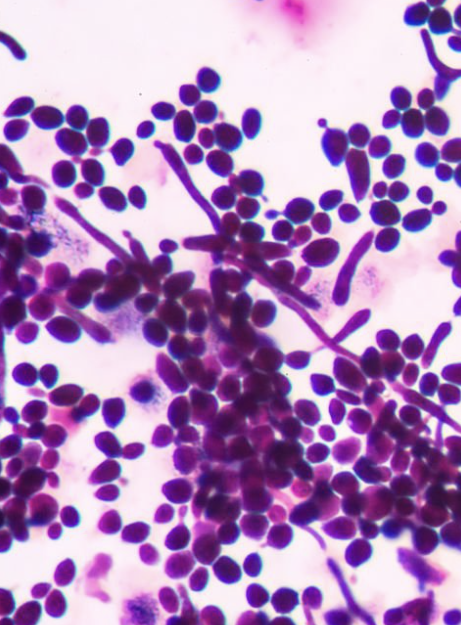
Pseudohyphae and Candida
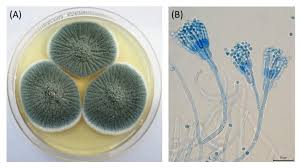
Penicillium (locations)
Decaying food, plant hosts, or animal hosts in the respiratory and cutaneous sites
Penicillium (appearance)
Green with a white border
Penicillium
Dermatophytes
Fungi that infect predominantly the epidermis but can also infect hair and nails
Dermaphytosis
An infection of the hair, skin, or nails
Keratinase
Enzyme that breaks down keratin
Trichophyton (location)
Causes infection on the feet, groin, scalp, nails, and smooth skin
Trichophyton (condida)
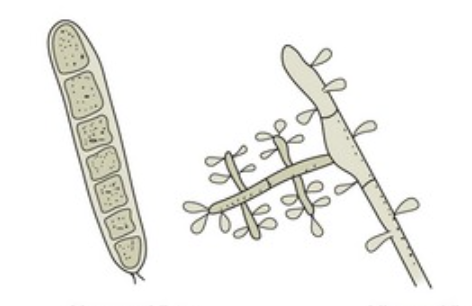
Macro- and micro-conidia
Macro- and micro-conidia
Rhizopus
Pathogens for immunocompromised patients (causes mucormycosis)
Rhizopus (locations)
Sinuses, can travel to brain, lungs, gastrointestinal, or blood vessels based on route of entry
Which ingredient makes MSA selective? What is it selecting for?
Salt: halophiles
Which ingredients make MSA a differential media?
Mannitol and Phenol Red
____ will grow yellow on the MSA plate
Staphylococcus aureus
Why would Micrococcus luteus not grow on the MSA plate?
M. luteus is not tolerant to high salt concentrations
Growth on MSA plate =
Staphylococcus
Lack of growth on MSA plate =
Micrococcus
Coagulase is a virulence factor because
the bacteria uses the blood clot to protect itself
Fibrinogen is a(n) ___ protein
Soluble
Fibrin is a(n) ___ protein
Insoluble
Staphylococcus epidermidis coagulase test results
Negative
Staphylococcus aureus coagulase test results
Positive
Why are hemolysins considered virulence factors?
They destroy red blood cells to get the iron
___ hemolysis completely destroys red blood cells, ___ hemolysis partially destroys red blood cells
Beta; alpha
Members of Streptococcus genus are oxidase…
Negative
Can Group A and group B strep be separated?
No
What test is a good indicator to differentiate Strep A and Strep B
Bacitracin sensitivity
Streptococcus pneumoniae is ___ hemolytic. It can be separated from the other organism with the same hemolytic reaction using ____.
alpha; optochin sensitivity
Which genus is not inhibited by 6.5% salt broth?
Enterococcus
What do the selective ingredients in MacConkey agar select for?
Gram (-), Enteric
What are the ingredients that make MacConkey agar a differential medium?
Lactose, Neutral red
What two groups of bacteria can be differentiated by the utilization of the differential ingredients?
Coliforms and Lactose nonfermentors
If you removed the ferrous sulfate from the tube, what would you no longer be able to detect?
Hydrogen Sulfide
What kind of cellular respiration is occuring with Salmonella typhimurium, and what final electron acceptor is being used?
anaerobic; thiosulphate
Phenol red detects the ___ of ___.
basicity; ammonia
Saprophytic
Organism that feeds on decaying matter
Coenocytic
Hyphae that are multinucleate
Arial Hyphae
Hyphae that bear reproductive spore
Mycelium
Main body of fungus
Arial Hyphae
Hyphae that bear reproductive spores
Systemic
Infection that spreads throughout the body
Dimorphic fungus
Mold form or yeast form depending on environment
Asexual sports produced inside of a sac
Sporangiospores
Pseudohyphae
Chains of yeast cells that don’t separate
Mitosome
Mitochondrial remnant seen in Giardia
Hydrogenosome
Mitochondrial remnant seen in Trichomonas
Axostyle
Supportive rod of microtubules seen in Trichomonas
Pseudopodia
Lobe-like cytoplasmic extensions that some protozoa can use to move and feed
Kinetoplast
Darkly staining mass of mitochondrial DNA found in some protozoa
Trophozoite
Actively feeding and reproducing stage of protozoa
Schizogony
Form of asexual reproduction that produces multiple daughter cells at once
Mixotrophic
Capable of both heterotrophy and autotrophy
Undulating membrane
Wave-like membrane attached to a flagellum seen in Trichomonas
Cyst
Dormant protective stage produced by many protozoa
Trypanosoma brucei’s infectious stage
Trypomoastigote
Plasmodium’s infectious stage
Sporozoite
Giardia intestinalis’ infectious stage
Cyst
Trichomonas vaginalis’ infectious stage
Trophozoite
Entamoeba histolytica’s infectious stage
Cyst
Leishmania’s infectious stage
Promastigote