StemUp: AQA A level Physics 3.6.1 Periodic motion
 Call Kai
 Learn
Learn Practice Test
 Spaced Repetition
 Match
Match Flashcards
 Knowt Play
1/102

There's no tags or description
Looks like no tags are added yet.
Name | Mastery | Learn | Test | Matching | Spaced | Call with Kai |
|---|
No analytics yet
Send a link to your students to track their progress
103 Terms
Why is an object moving in a circle at constant speed said to be accelerating? (2)
- The velocity of the object is continuously changing because its direction is constantly changing.
- Even though speed is constant.
What is the name of the acceleration in circular motion? (1)
The acceleration is called centripetal acceleration.
What is the direction of the acceleration in circular motion? (1)
The centripetal acceleration always acts towards the centre of the circle.
Why must an object in circular motion experience a resultant force? (2)
- According to Newton's first law, a force is required to change motion.
- Since the object is accelerating, there must be a resultant force acting on it.
What is the name of the force acting on an object in circular motion? (1)
The force is called centripetal force.
What is the purpose of the force acting on an object in circular motion? (1)
Centripetal force is responsible for maintaining circular motion.
What is angular speed? (2)
- Angular speed is the angle moved through per unit time.
- It is measured in radians per second (rad/s).
What is the equation for angular speed using linear speed? (2)
- The equation is ω = v / r.
- Where ω is angular speed (rad/s), v is linear speed (m/s), r is radius (m).
What is the equation for angular speed using time period? (2)
- The equation is ω = 2π / T.
- Where ω is angular speed (rad/s) and T is time period (s).
What is the equation for angular speed using frequency? (2)
- The equation is ω = 2πf.
- Where ω is angular speed (rad/s) and f is frequency (Hz or rev/s).
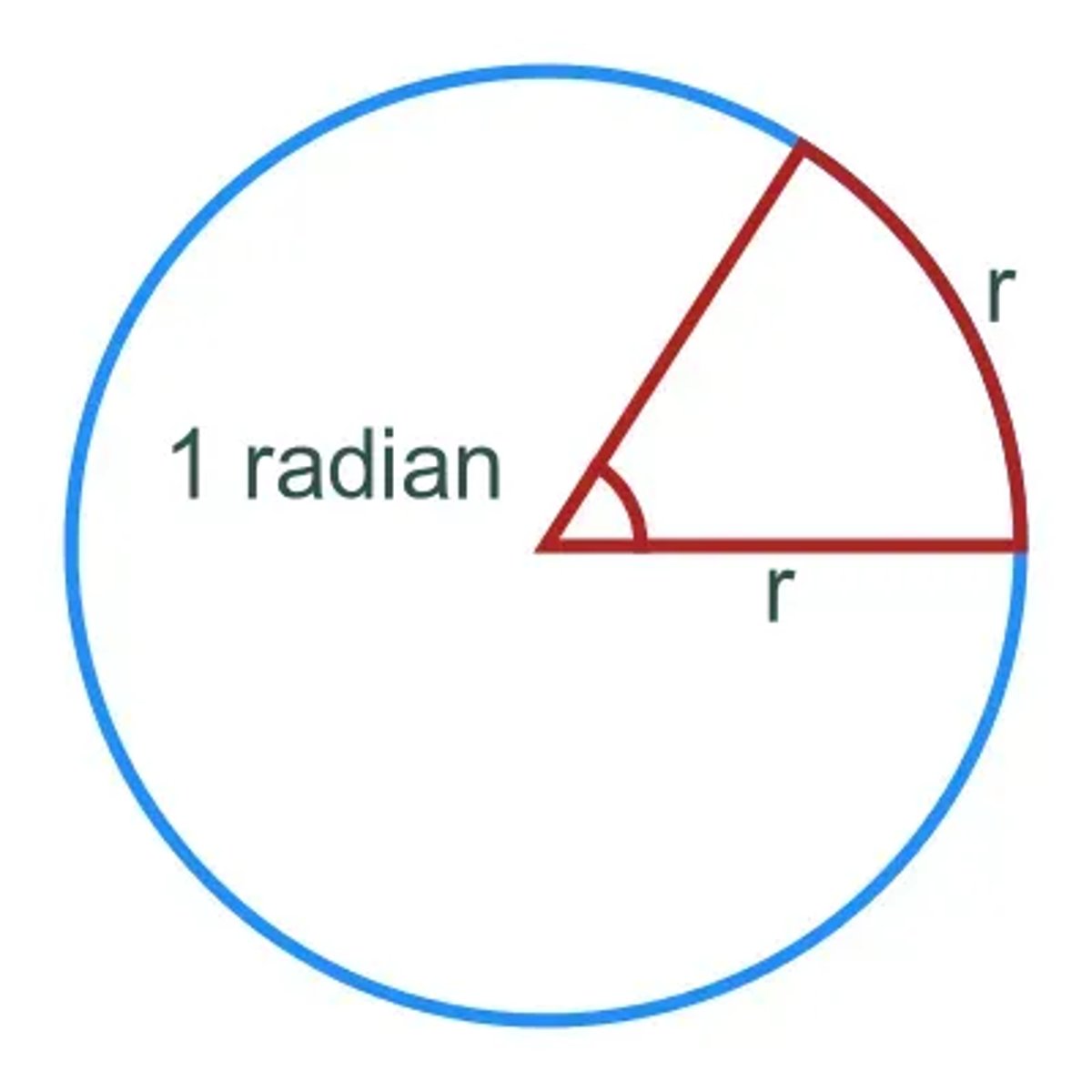
What is one radian? (1)
One radian is the angle formed at the centre of a circle when the arc length equals the radius.
What does one radian look like on a circle? (2)
How many radians are in a full circle? (1)
A full circle contains 2π radians.
How do you convert degrees to radians? (1)
To convert degrees into radians, multiply the degree value by π/180.
How do you convert radians to degrees? (1)
To convert radians to degrees, multiply the radian value by 180/π.
What is the equation for centripetal acceleration using linear speed? (2)
- The equation is a = v²/r.
- Where a is centripetal acceleration (m/s²), v is linear speed (m/s), and r is radius (m).
What is the equation for centripetal acceleration using angular speed? (2)
- The equation is a = ω²r.
- Where a is centripetal acceleration (m/s²), ω is angular speed (rad/s), and r is radius (m).
What is the equation for centripetal force using linear speed? (2)
- The equation is F = mv²/r.
- Where F is centripetal force (N), m is mass (kg), v is linear speed (m/s), and r is radius (m).
What is the equation for centripetal force using angular speed? (2)
- The equation is F = mω²r.
- Where F is centripetal force (N), m is mass (kg), ω is angular speed (rad/s), and r is radius (m).
How is the formula for centripetal force with linear speed derived from Newton's second law? (2)
- Newton's second law is F = ma.
- Substituting centripetal acceleration a = v²/r gives
F = mv²/r.
How is the formula for centripetal force with angular speed derived from Newton's second law? (2)
- Newton's second law is F = ma.
- Substituting centripetal acceleration a = ω²r gives F = mω²r.
How can centripetal force be used in force calculations? (1)
The centripetal force is set equal to the net inward force acting on the object to solve for quantities like speed, tension, or radius.
What is the definition of simple harmonic motion (SHM) in terms of acceleration and displacement? (2)
- SHM is when acceleration is directly proportional to the displacement from the equilibrium position.
- It is directed opposite to it.
What is the mathematical condition for simple harmonic motion (SHM)? (2)
- The condition is a ∝ -x.
- Where a is acceleration (m/s²) and x is displacement (m).
What is the equation for acceleration in simple harmonic motion (SHM)? (2)
- The equation is a = -ω²x.
- Where a is acceleration (m/s²), ω is angular speed (rad/s), and x is displacement from equilibrium (m).
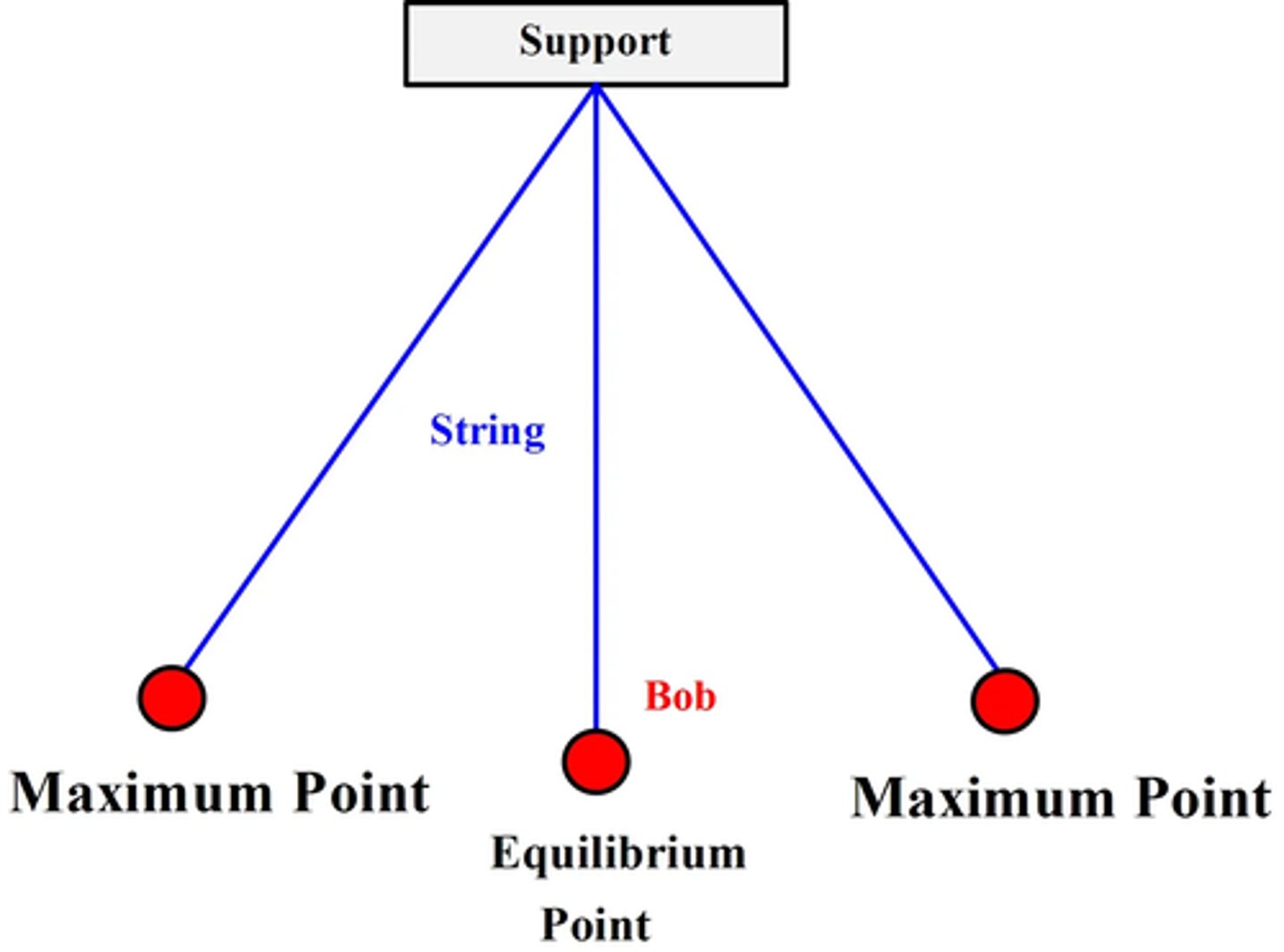
How does a simple pendulum behave as a simple harmonic oscillator? (3)
- A simple pendulum oscillates about a central equilibrium point where x = 0.
- It experiences a restoring force towards equilibrium.
- The pendulum moves from maximum displacement on one side to the other completing one full cycle in a time period T.
What is amplitude in simple harmonic motion (SHM)? (1)
Amplitude is the maximum displacement from the central equilibrium point.
What is the time period of a cycle in SHM? (1)
The time period of a cycle in SHM is the time taken to go from one maximum displacement to the opposite maximum and back again.
What is a restoring force in SHM? (1)
A restoring force in SHM is the force that pulls or pushes an object back towards the equilibrium position when displaced.
How is the magnitude of restoring force related to displacement? (1)
The magnitude of restoring force is directly proportional to displacement.
How is the direction of restoring force related to displacement? (1)
Restoring force moves in the opposite direction to displacement.
How does the restoring force affect an object in SHM? (1)
The restoring force in SHM causes the object to accelerate back toward equilibrium.
What is a full cycle of oscillation in SHM? (1)
A full cycle of oscillations in SHM is when the object moves from maximum positive displacement to maximum negative displacement and back again.
What does a full cycle of oscillation in simple harmonic motion (SHM) look like? (2)
A cycle of oscillation should go from maximum to maximum and back again, going through equilibrium twice.
What is frequency in SHM? (2)
- Frequency is the number of complete cycles per second.
- It is measured in hertz (Hz).
What is the period in SHM? (2)
- Period (T) is the time taken to complete one full cycle.
- It is measured in seconds.
What is angular frequency and its formula? (2)
- Angular frequency is given by ω = 2πf.
- Where f is frequency.
How does amplitude affect frequency and period in SHM? (1)
Frequency and period are independent of amplitude.
What is the displacement equation in SHM when starting at maximum displacement? (2)
- The equation is x = A cos(ωt).
- Where x is displacement (m), A is amplitude (m), ω is angular speed (rad/s), and t is time (s).
What is the velocity equation in SHM? (2)
- The equation is v = ±ω√(A² - x²).
- Where v is velocity (m/s), ω is angular speed (rad/s), A is amplitude (m), and x is displacement (m).
How kind of graph does displacement over time produce?
- Displacement follows a cosine or sine graph.
- Oscillating between +A and -A.
How does velocity vary with time in SHM? (2)
- Velocity is the derivative of displacement.
- It reaches its maximum when displacement is zero.
How does acceleration vary with time in SHM? (2)
- Acceleration is the derivative of velocity.
- It reaches its maximum when displacement is at its maximum.
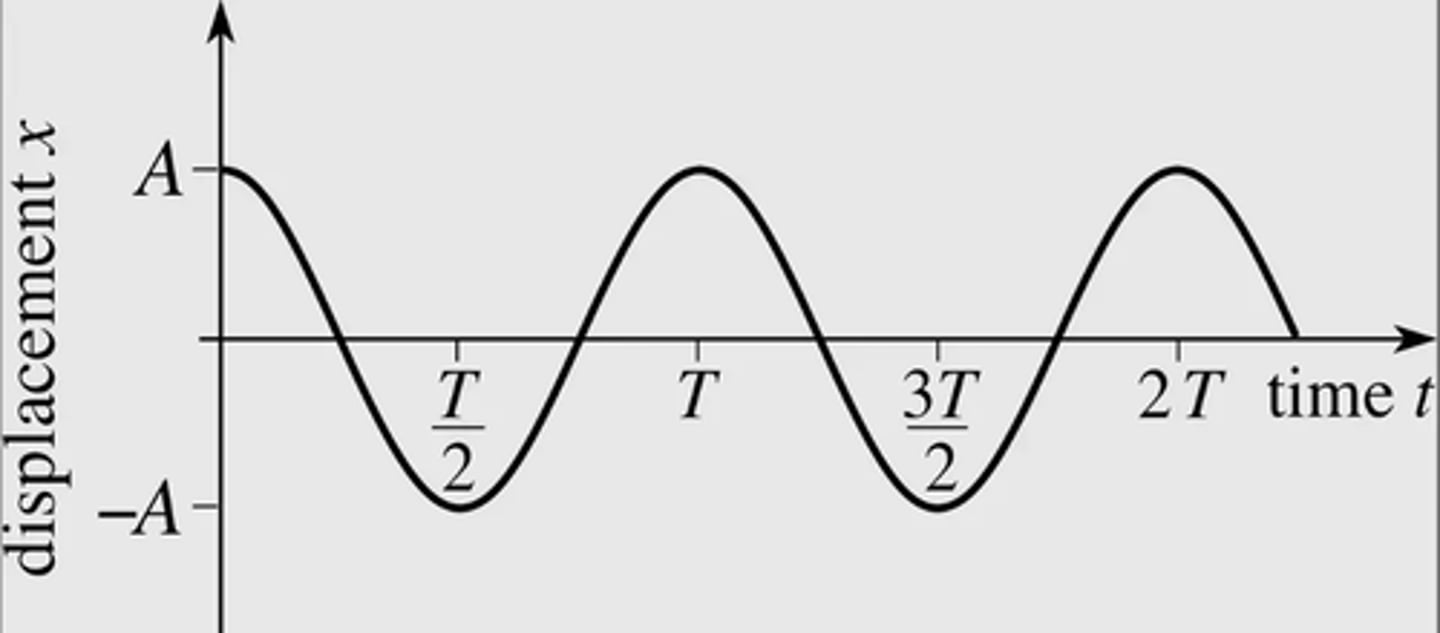
How can a displacement-time graph for SHM be described? (2)
- A displacement-time graph is a sine or cosine wave that oscillates between +A and -A.
- It repeats every period T.
How does the displacement-time graph behave over time? (1)
A displacement-time graph repeats with regular intervals and shows symmetrical oscillation.
What does a displacement-time graph for simple harmonic motion (SHM) look like? (2)
How can a velocity-time graph for simple harmonic motion (SHM) be described? (1)
A velocity-time graph is a sine or cosine wave that is a quarter cycle ahead of the displacement graph.
What does a velocity-time graph for simple harmonic motion (SHM) look like? (2)
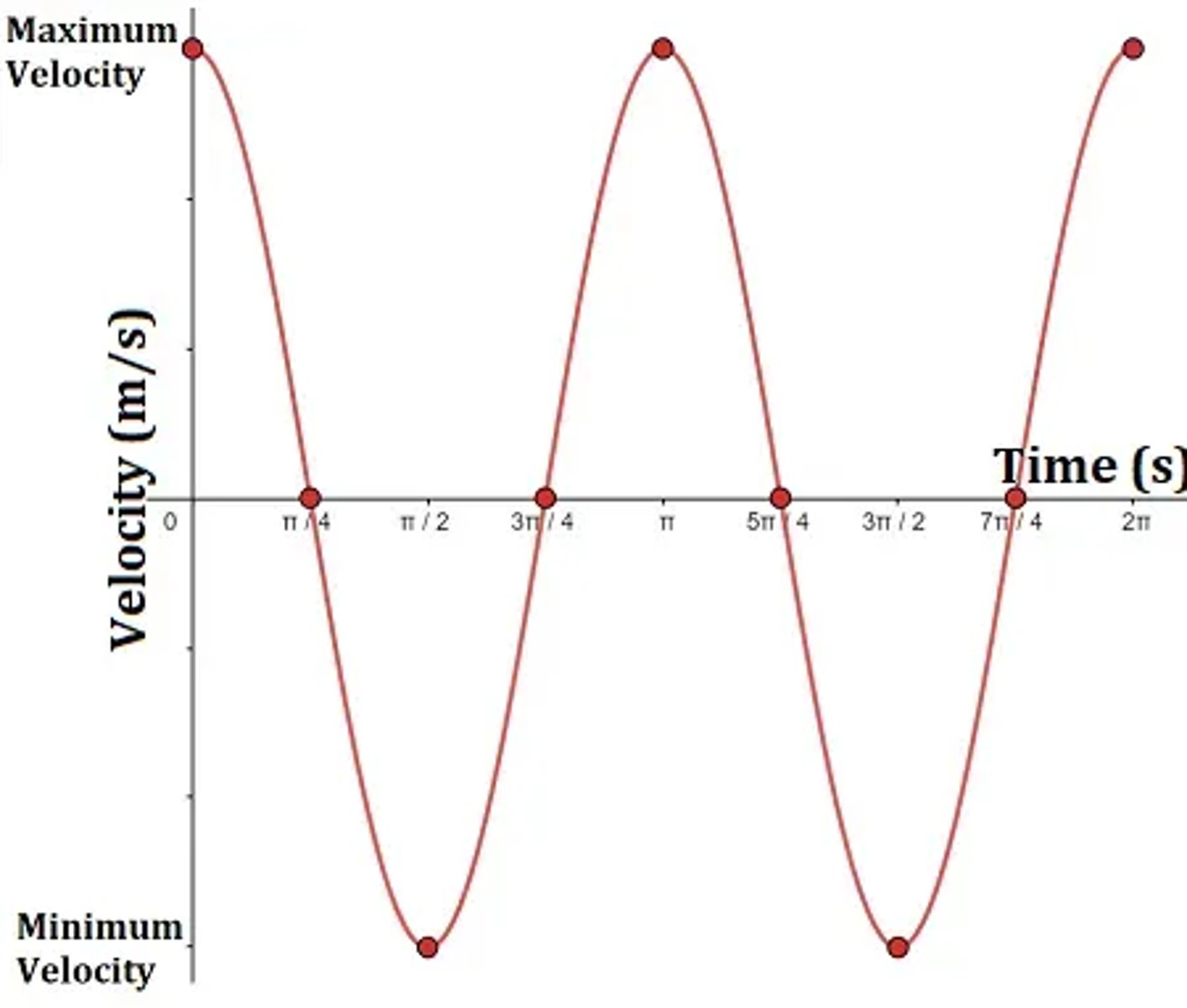
Where is maximum and zero velocity on the velocity-time graph? (2)
- Velocity is maximum at x = 0.
- It is zero at x = ±A.
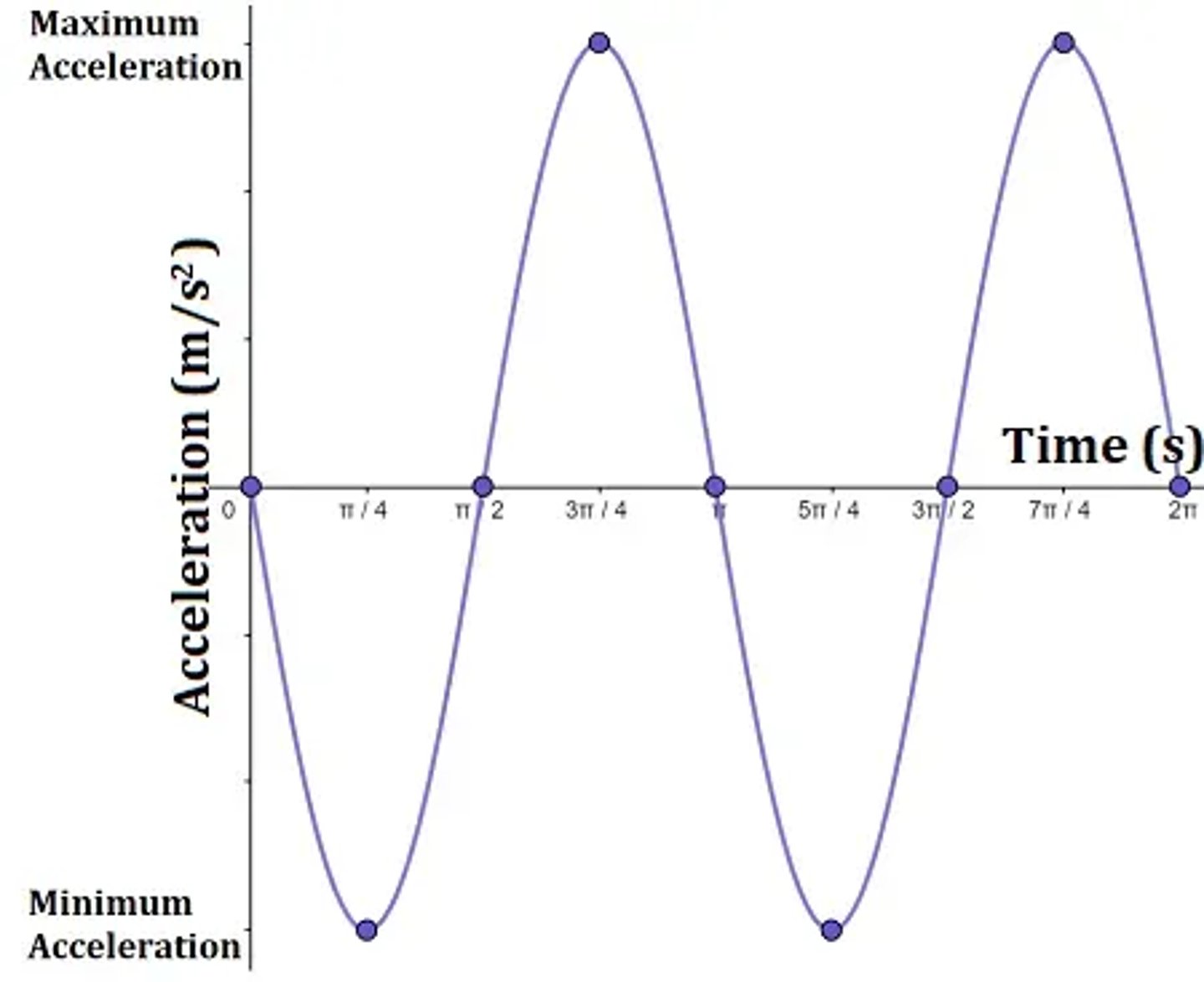
What is the shape of the acceleration-time graph for SHM? (1)
The acceleration-time graph is a sine or cosine wave in antiphase with displacement.
How does acceleration relate to displacement in SHM? (2)
- Acceleration is at maximum when displacement is at maximum.
- This will be directed in the opposite direction.
What does an acceleration-time graph for simple harmonic motion (SHM) look like? (2)
What is the maximum speed in SHM? (2)
- Maximum speed = ωA.
- Where ω is angular speed (rad/s) and A is amplitude (m).
What is the maximum acceleration in SHM? (2)
- Maximum acceleration = ω²A.
- Where ω is angular speed (rad/s) and A is amplitude (m).
What is a simple harmonic system? (2)
- A simple harmonic system is a system that oscillates with simple harmonic motion.
- In this system, acceleration is proportional to and opposite in direction to the displacement.
What are two examples of simple harmonic systems? (2)
- A simple pendulum.
- A mass-spring system.
What is the formula for the time period of a simple pendulum? (2)
- The formula is T = 2π√(l / g).
- Where T is the time period (s), l is the length of the pendulum (m), and g is the gravitational field strength (m/s²).
When is the formula for the time period of a simple pendulum valid? (1)
The formula is only valid for small angles (less than 10°).
What energy transfers occur during the motion of a simple pendulum? (2)
- Gravitational potential energy is converted to kinetic energy as it approaches equilibrium.
- Kinetic energy is converted back into gravitational potential energy as it moves away from equilibrium.
What is potential energy in SHM? (2)
- Potential energy is energy stored due to displacement in a system with a restoring force.
- This includes elastic or gravitational potential energy.
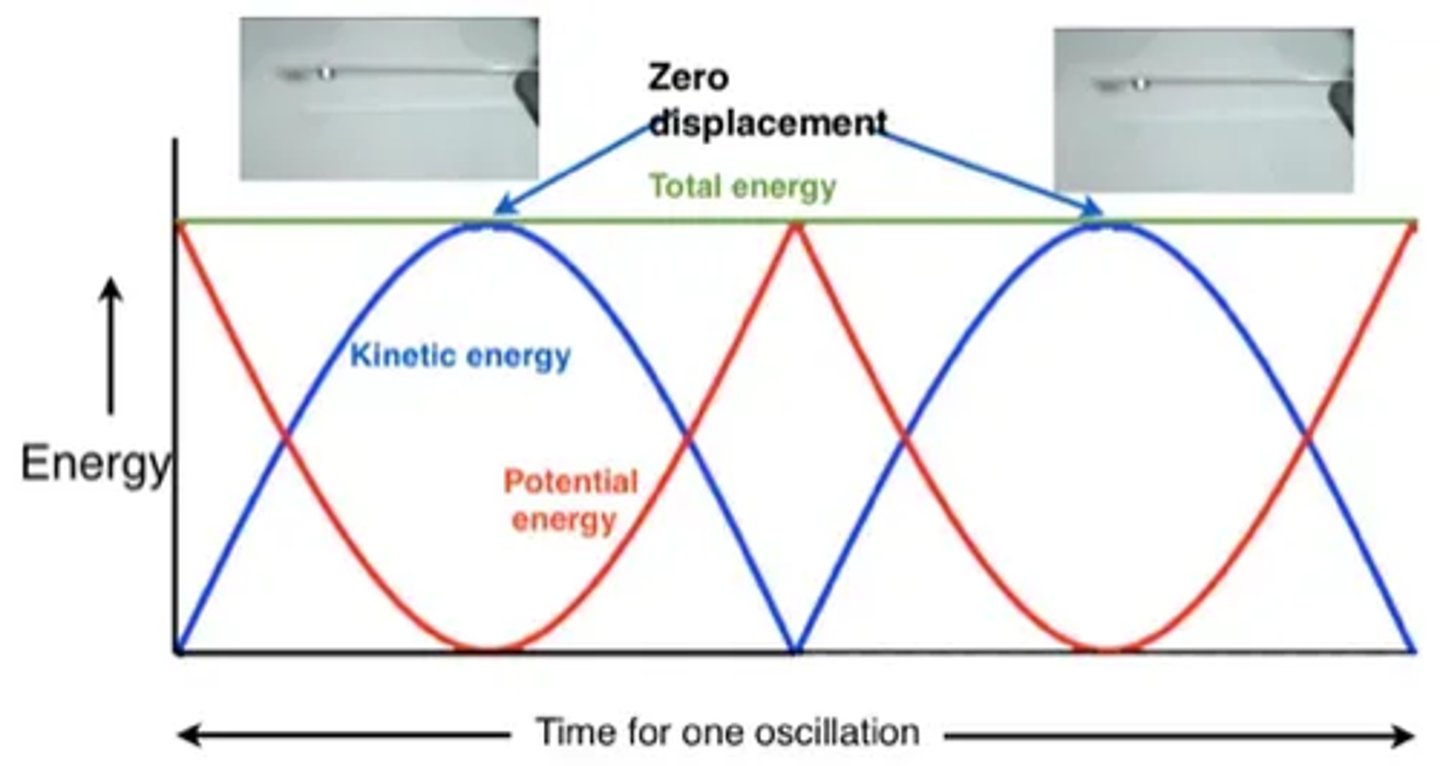
What happens to energy at maximum displacement in SHM? (2)
- Potential energy is at a maximum.
- Kinetic energy is zero.
What happens to energy at equilibrium in SHM? (2)
- Kinetic energy is at a maximum.
- Potential energy is zero.
How does mechanical energy behave in SHM with no resistive forces? (1)
Mechanical energy (kinetic + potential) remains constant in SHM either no resistive forces.
How do kinetic and potential energy vary with displacement in SHM? (3)
- As displacement increases, potential energy increases and kinetic energy decreases.
- At maximum displacement, potential energy is maximum and kinetic energy is zero.
- At equilibrium, potential energy is zero and kinetic energy is maximum.
What is the full cycle of energy transfers in a cycle of oscillation in a harmonic system? (3)
- The cycle begins from maximum displacement.
- The cycle is potential energy to kinetic energy to potential energy to kinetic energy to potential energy.
- Then the cycle repeats.
What does a graph of the variation of energy with displacement during simple harmonic motion look like? (2)
What is the time period for a mass-spring system? (2)
- The equation is T = 2π√(m / k).
- Where T is the time period (s), m is mass (kg), and k is spring constant (N/m).
How does energy transfer differ in a vertical mass-spring system? (1)
Energy is transferred between kinetic, elastic potential, and gravitational potential energy.
How does energy transfer differ in a horizontal mass-spring system? (1)
Energy is transferred only between kinetic and elastic potential energy.
What is damping? (2)
- Damping is energy loss from an oscillating system to the environment, typically as heat.
- It causes the amplitude of oscillations to decrease over time.
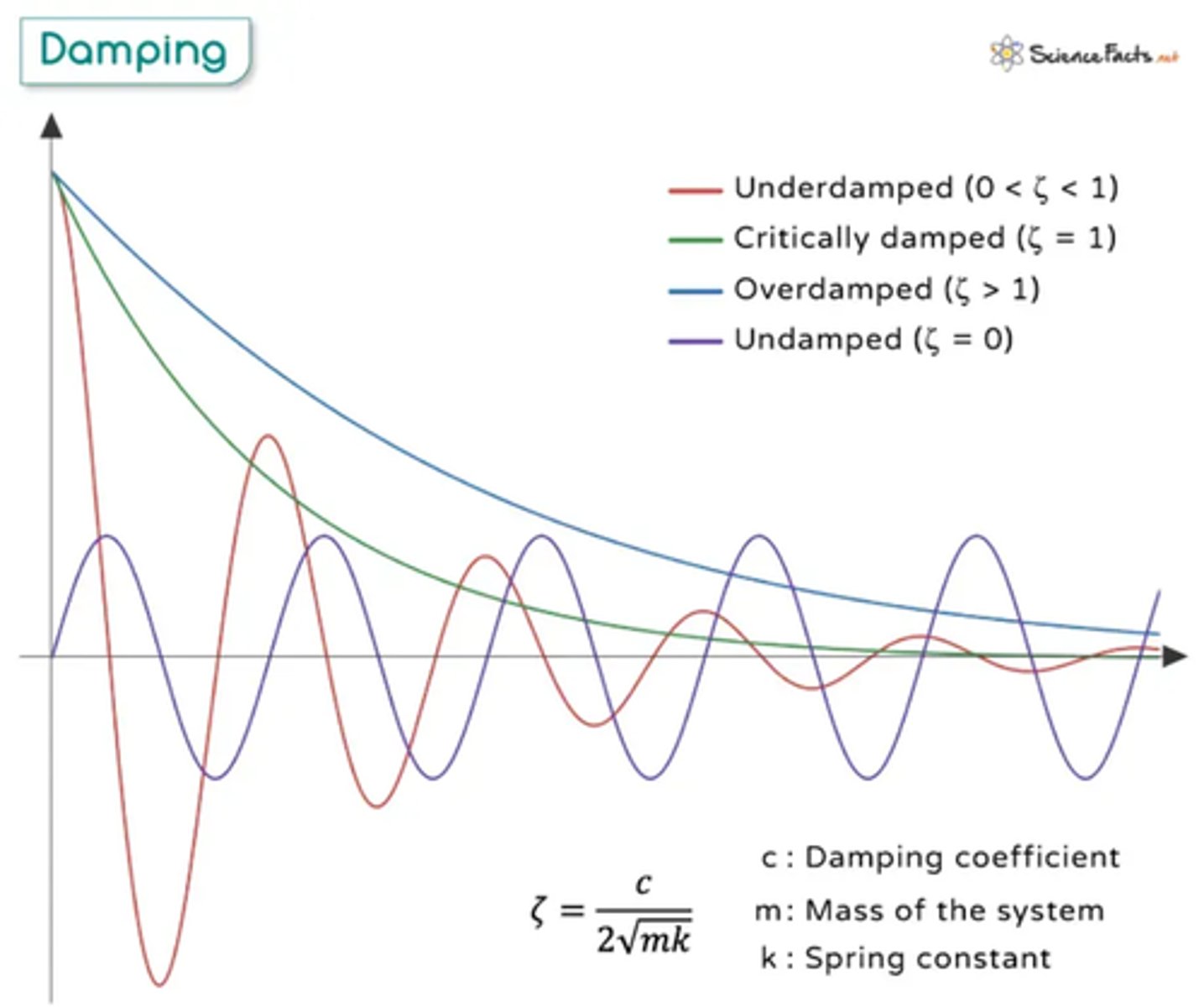
What is light damping (under-damping)? (1)
Light damping is when oscillations decrease in amplitude gradually over time.
What is critical damping? (1)
Critical damping is when the system returns to equilibrium in the shortest possible time without oscillating.
What is heavy damping (over-damping)? (1)
Heavy damping is when the system returns to equilibrium without oscillating but more slowly than with critical damping.
Why is damping used in some systems? (2)
- Damping is used to prevent or reduce unwanted oscillations.
- It is also used to minimise the effects of resonance.
What does a displacement-time graph show for light damping? (1)
A displacement-time graph shows a gradually decreasing sine wave when light damping occurs.
What does a displacement-time graph show for critical damping? (1)
A displacement-time graph shows a return to equilibrium with no oscillations when critical damping occurs.
What does a displacement-time graph show for heavy damping? (1)
A displacement-time graph shows a slow return to equilibrium with no oscillations when heavy damping occurs.
What does a displacement-time graph look like for the different types of damping? (3)
What are free vibrations? (2)
- Free vibrations occur when no external force is continuously acting on a system.
- The system vibrates at its natural frequency which depends on its physical properties.
What is meant by the natural frequency? (2)
- The natural frequency is the frequency at which a system vibrates during free oscillations.
- It depends on the physical properties of the material.
What happens to the amplitude of free vibrations if no energy is transferred away from the system? (1)
The system will oscillate with the same amplitude forever.
What are forced vibrations? (2)
- Forced vibrations occur when an external periodic force is applied to a system.
- The system oscillates at the frequency of the driving force (driving frequency), which may differ from its natural frequency.
How are driving frequency and natural frequency related in resonance? (1)
At resonance, the driving frequency equals the natural frequency of the system.
What happens if the driving frequency is much smaller than the natural frequency? (1)
The two frequencies are approximately in phase.
What happens if the driving frequency is much larger than the natural frequency? (1)
The two frequencies are out of phase.
What is the phase difference at resonance? (1)
The phase difference between the driving frequency and the natural frequency is 90° or π radians.
What is resonance? (2)
- Resonance is when the amplitude of oscillation increases significantly.
- This happens due to energy being added at the system's natural frequency.
What condition must be met for resonance to occur? (1)
The frequency of the driving force must equal the natural frequency of the system for resonance to occur.
How does resonance affect the amplitude of SHM? (1)
Resonance causes a large increase in amplitude when the driving frequency matches the natural frequency.
How does a displacement-time graph show the effect of resonance on amplitude? (2)
- A graph shows increasing amplitude when driven at the resonant frequency.
- The amplitude grows significantly over time until damping limits it.
What does a displacement-time graph of a system in resonance look like? (2)

What is one example of resonance in a musical instrument? (1)
In flutes, air resonates in tubes to form stationary sound waves.
What is one example of resonance in electronics? (1)
In radio circuits, components resonate at specific frequencies to receive desired signals.
What is one example of resonance in mechanical systems? (1)
In playground swings, pushing at the natural frequency causes larger amplitude oscillations.
What is one positive consequence of resonance? (1)
In musical instruments, resonance enhances sound quality and volume.
What is one negative consequence of resonance? (1)
In buildings or bridges, resonance can cause structural failure due to large oscillations.
What is damping? (1)
Damping is the process of reducing the amplitude of oscillations by dissipating energy from the system.
How does light damping affect resonance? (2)
- Light damping produces a sharp and tall resonance peak.
- This happens only when the driving frequency is very close to the natural frequency.
How does increasing damping affect the amplitude and frequency of resonance? (2)
- The maximum amplitude during resonance decreases.
- The resonant frequency shifts to a lower value.
How does heavier damping affect the resonance curve shape? (1)
Heavy damping makes the curve broader and flatter, reducing the sharpness of resonance.