AAMC Full Lengths error log
 Call Kai
 Learn
Learn Practice Test
 Spaced Repetition
 Match
Match Flashcards
 Knowt Play
1/26

There's no tags or description
Looks like no tags are added yet.
Name | Mastery | Learn | Test | Matching | Spaced | Call with Kai |
|---|
No analytics yet
Send a link to your students to track their progress
27 Terms
I missed a question involving NADH and electron transport. What organic transformation should I associate with NADH/NAD⁺?
NADH is a reducing agent and becomes oxidized to NAD⁺.
Alcohol ⇌ Carbonyl
NAD⁺ → NADH = carbonyl → alcohol (reduction)
NADH → NAD⁺ = alcohol → carbonyl (oxidation)
I missed a question asking for the component found in FAD, FMN, and riboflavin. What structure should I recognize?
FAD, FMN, and riboflavin are flavin cofactors.
They all contain an isoalloxazine ring, the redox-active flavin structure.
Shortcut:
Adenine = part of FAD only
Flavin/isoalloxazine = FAD, FMN, riboflavin
Ubiquinone = quinone + long hydrophobic tail
Histidine = imidazole side chain
I missed a question asking why an exergonic electron transport reaction does not release much heat. What should I think when a gradient is formed?
The energy is being stored in an electrochemical gradient, not released as heat.
MCAT rule:
Exergonic reaction + active transport = energy coupling
Examples:
ETC → proton gradient
Na⁺-NQR → sodium gradient
ATP hydrolysis → ion pumping
Enzymes change activation energy, not ΔG. 🚨 Common trap.
I missed a question asking for the molecular formula of pyrrole. What should I know?
Pyrrole is:
A 5-membered aromatic ring
4 carbons + 1 nitrogen
Lone pair participates in aromaticity
Pyridine = 6-membered aromatic N ring
I missed a protein digestion + SDS-PAGE question. What happens to bands over time during proteolysis?
Proteolysis cuts a large protein into smaller fragments.
On SDS-PAGE:
Larger proteins stay near the top
Smaller fragments travel farther down
Over time: intact band fades, smaller lower bands increase
Digestion = smaller pieces = lower bands.
I missed a question asking about the precursor of progesterone. What should I remember about steroid hormone synthesis
All steroid hormones are derived from cholesterol.
Do not confuse with:
Tyrosine → catecholamines
Tryptophan → serotonin/melatonin
Histidine → histamine
Fusion = overcome electrostatic repulsion to reach strong-force range
I missed a question asking which residue could be selectively modified. How do I identify selective modification?
Selective modification means:
One residue is modified while others are not.
Look for a condition where:
Target residue = modified
All other residues = 0% (or minimal modification)
I missed a question because I focused on Trp instead of the residues interacting with Trp. What heterocycle is found in histidine?
Histidine contains an imidazole ring.
Key amino acid heterocycles:
Histidine → Imidazole
Tryptophan → Indole
Proline → Pyrrolidine
Electron-withdrawing groups (Cl, F, NO₂, carbonyls) increase acidity when nearby.
MCAT acidity trend:
\text{CCl}_3\text{COOH} > \text{CH}_2\text{ClCOOH} > \text{CH}_3\text{COOH}
More electron withdrawal → more stable conjugate base → lower pKa.
I missed a deprotonation-order question with two carboxylic acids. How do I decide which deprotonates first?
The most acidic proton (lowest pKa) is removed first.
Look for electron-withdrawing groups near the acidic proton.
More EWG → more stable conjugate base → lower pKa → deprotonates first.
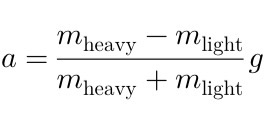
Atwood machine formula
I missed a CD spectroscopy question. What feature of proteins gives rise to circular dichroism?
CD spectroscopy detects chirality.
In proteins, chirality primarily arises from the α-carbons of amino acids.
Most amino acids have a chiral α-carbon attached to:
NH₂
COOH
H
R group
MCAT shortcut:
CD spectroscopy → chirality → α-carbon.
I missed a mutation question involving Leu → Ser. What property remains unchanged?
Leucine:
Nonpolar
Hydrophobic
Neutral
Serine:
Polar
Can H-bond
Neutral
Changes:
Molecular weight ✓
Hydrophobicity ✓
H-bonding ✓
Unchanged:
Net charge (0)
I missed a chromatography question involving addition of a carboxylic acid group. How do I choose the separation method?
First ask:
What property changed?
Adding a carboxylic acid:
At pH 8 → COO⁻
Protein becomes more negatively charged
Use:
Anion-exchange chromatography for negatively charged proteins
MCAT chromatography map:
Charge → Ion exchange
Size → Size exclusion
Binding affinity → Affinity chromatography
Polarity → TLC/HPLC
I missed a table interpretation question. What should I do before using outside biology knowledge?
For table questions:
Read the question.
Look only at the relevant columns.
Identify substrate and product.
Match directly to answer choices.
MCAT rule:
If the answer is in the table, don’t invent a harder explanation.
What makes a membrane transporter electrogenic?
A transporter is electrogenic if it produces a net movement of charge across the membrane.
I missed a passage question asking about the benefit of a modified protein therapy. How should I reason through it?
Identify:
Desired effect
Undesired effect
Choose the answer that:
Keeps the desired effect
Removes the consequence of the undesired effect
EPO example:
Desired: prevent neuronal apoptosis
Undesired: increase RBC production
Benefit:
→ Neuroprotection without increased blood viscosity.
Why do some human proteins expressed in E. coli lose biological activity?
E. coli lacks many eukaryotic post-translational modifications.
Most important:
Glycosylation
If a protein is a glycoprotein:
Amino acid sequence may be correct
Carbohydrate chains may be missing
Protein may be nonfunctional
MCAT shortcut:
Human glycoprotein + E. coli = think glycosylation problem.
A dominant mutation causes increased physiological activity. What type of mutation should I suspect?
Usually a gain-of-function mutation.
Examples:
Increased ligand affinity
Increased protein expression
Constitutive receptor activation
Increased signaling
MCAT rule:
More phenotype → more pathway activity → gain-of-function.
How do I identify evidence that invalidates a scientific model?
Identify the model’s central prediction.
Find the observation that directly contradicts that prediction.
Unit Membrane Model:
Proteins remain on membrane surfaces.
Proteins do not penetrate the bilayer.
Observation:
Proteins inside the hydrophobic region
→ Invalidates the model.
MCAT shortcut:
“Invalidate” = “contradict a required prediction.”
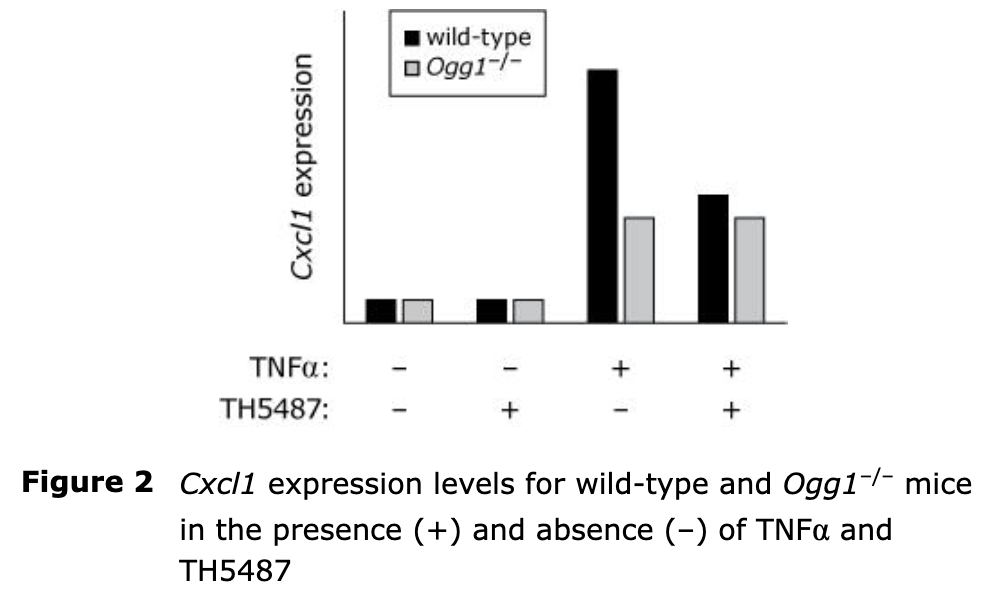
If Cxcl1 is lower in Ogg1-/- mice, that means normal OGG1 must stimulate TNFα-induced Cxcl1 expression.
So statement II is true: OGG1 stimulates the TNFα induced Cxcl1 expression.
-/- means absence, so wt has OGG1 normal
How do I identify the independent variable in an experiment?
The IV is what the researchers manipulate or assign.
The DV is what the researchers measure.
Example:
Researchers create dating profiles that are:
Similar to actual self
Similar to ideal self
IV = profile similarity
DV = attraction to the date
A person stops attending events because attending causes feelings of inferiority. What operant conditioning principle is occurring?
Behavior:
Attending events ↓
Consequence:
Unpleasant feeling added
Result:
Positive punishment
Rule:
Positive = added
Negative = removed
Reinforcement = behavior increases
Punishment = behavior decreases
MCAT shortcut:
If behavior decreases, think punishment first.
When you see:
sociological conceptualization
immediately think:
institutions
social structures
social construction
norms
stratification
How do I approach MCAT questions that ask about results from multiple studies?
Summarize each study in one sentence.
Identify the main finding of each.
Look for the answer that combines both findings.
Which theories are most similar to the life course perspective?
Life course perspective:
Early experiences affect later outcomes
Cumulative risk
Protective factors
Development over time
Most similar:
Potentiator model (risk accumulation)
Protective model (buffering effects)
MCAT shortcut:
Life course = risk factors + protective factors across development.