HC 5: Microbial community analysis using High Throughput Sequencing
 Call Kai
 Learn
Learn Practice Test
 Spaced Repetition
 Match
Match Flashcards
 Knowt Play
1/10

There's no tags or description
Looks like no tags are added yet.
Name | Mastery | Learn | Test | Matching | Spaced | Call with Kai |
|---|
No analytics yet
Send a link to your students to track their progress
11 Terms
Sanger sequencing
The strands of different lengths will be separated using gel electrophoresis onto 4 lanes, one for each ddNTP reaction
you make 4 reactions where each one of them has this dideoxynucleotide (A, G, C or T) and the idea is that if one gets incorporated, the chain stops.
You get a fragment of a certain length.
Wherever a portion of the fragments that stopped (on the gel) at this nucleotide, then it must have been that nucleotide in the sister chain (??)
You read this out for your 4 different lanes.
used to be done with radioactivity. Eventually thy could make these dideoxynucleotides attached to a fluorescent marker/ Then you could run them all in the same gel and then when everything would come by your fluorescent detector, you could see whether you had red (A), blue(G), green (C) or yellow (T) come by and then assign it this way.
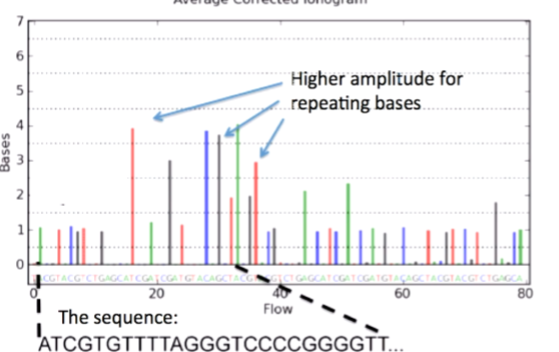
Roche 454 (the 1st Next Gen sequencing technology)
you burn off (instead of building)
so instead of building a DNA sequencing chain and then seeing where it stops, you burn things off and see which bases are coming off
you get light coming off for different base pairs
Every time that you had a light of a certain insanity (for a certain colour), you would have that base. If you had sequential base pairs, they added up with each other
problem: sometimes you got f.e. 3,5 so you had to guess if it were 3 of 4 bases (especially with T’s)
potential errors and biases
PCR bias
chimeras
sequencing errors
PCR bias:
if you have just a small difference in gene amplification between two different species, this gets amplified millions of times —> gives you an unrealistic representation of the population, because one has been amplified more.
Chimeras:
if you have incomplete PCR products that haven’t been amplified all the way through, these can function as primers for another sequence.
What you end up getting is a sequence half from one species and one from another.
Sequencing errors:
If you don’t do any kind of filtering, you end up with a lot of OTUs.
If you do all of the filtering and correcting, you end up with way less.
Errors can especially occur in the rare diversity tale.
OTU’s vs. ASV’s
OTU:
DNA is extracted from a sample and a marker gene (16S rRNA) is PCR-amplified and sequenced.
The obstained sequence (amplicon reads) are grouped into OTUs based on similarity.
Sequences that are close enough are grouped together and treated as on "species-like" unit.
ASV:
The same sequencing data is used.
Instead of grouping by similarity, sequencing errors are identified and removed using error-correction algorithms.
Each unique DNA sequence is kept as its own Amplicon Sequence Variant (ASV)
Using co-occurrence to infer microbial networks
Generalists: things that are found in most studied habitats
Specialist: They don’t occur in many places, but where they do occur, they are the most dominant.
Majority: Quite rare and only found in a few samples. Or occur in more samples, just not found.
Co-occurrence patterns:
which microbes occur with or specifically without each other
Whenever we want to examine the community. we…
throw some soil in a bead beating machine. This beats all the microbes to death so all the DNA comes out. Then we try to piece back together the interactions that where present in the beginning.
An analysis of individual soil grains is less relevant than taking analysis of individual soil pores, because
it is those spaces between them where you can really see all the interactions