Phonons
 Call Kai
 Learn
Learn Practice Test
 Spaced Repetition
 Match
Match Flashcards
 Knowt Play
1/25

There's no tags or description
Looks like no tags are added yet.
Name | Mastery | Learn | Test | Matching | Spaced | Call with Kai |
|---|
No analytics yet
Send a link to your students to track their progress
26 Terms
Total heat capacity of a crystal
CV=CVphonons+CVelectrons+CVmagnetic
CVphonons applies for all solids,
CVelectrons applies only for metals,
CVmagnetic applies only for magnets.
Heat capacity
CV=(𝜕T𝜕ε)V for a non-magnetic insulator, where CV is only due to phonons.
Dulong and Petit law
Classically, for a solid with Natoms atoms in 3D, the equipartition theorem leads to CV=3NatomskB.
This law holds for some solids at room temperature, but fails at lower temperatures where QM is necessary.
Single QHO energy eigenvalues and equilibrium occupancy
Energy eigenvalues are given by εn=(n+21)ℏ𝜔.
Equilibrium occupancy is given by the Bose-Einstein distribution: ⟨n⟩=eℏω/kBT−11 (the mean number of excitations present in thermal equilibrium at temperature T).
These can be used to find the average energy via εˉ=(⟨n⟩+21)ℏ𝜔 and then the CV via CV=(𝜕T𝜕εˉ)V.
Equipartition theorem
Total energy of a lattice
The total energy of a lattice is calculated by summing over all modes k, but as the spacing between the states Δk=2𝜋/L is very small compared to the width of the BZ, can write the sum as an integral:
ε=∫0∞g(ω)ℏω(n(ω)+21)dω
Density of states
g(ω) is the density of states, where g(ω)dω is the number of states between ω and ω+dω.
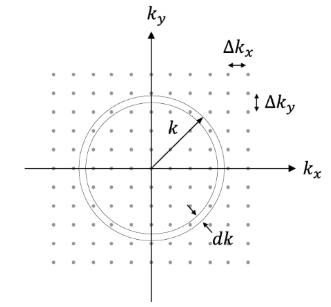
Density of states per unit wavenumber (2D derivation)
In 2D, the interval between wavenumbers is Δkx=Δky=2π/L, so each allowed state occupies an area of (2π/L)2.
The annulus of area 2πkdk contains a number of g(k)dk=2πkdk(2π)2L2.
The density of states per unit wavevector in 2D can then be written as g(k)=2πL2k.
Density of states per unit wavenumber (3D derivation)
In 3D, the interval between wavenumbers is Δkx=Δky=Δkz=2π/L , so each allowed state occupies an area of (2π/L)3.
The number of states in a shell of volume 4πk2dk is g(k)dk=4πk2dk(2π)3V=2π2Vk2dk
giving g(k) the density of states per unit wavevector.
Assumptions of Debye theory
The crystal is harmonic (so the phonon modes are independent)
Elastic waves are non-dispersive (𝜔=vsk)
The crystal is isotropic (so that frequency depends only on ∣k∣, and not the direction of k)
There is a high-frequency cut off 𝜔D chosen in such a way that the total number of modes is correct, i.e., that per branch ∫0𝜔Dg(𝜔)d𝜔=Natoms, the total number of modes should be the number of atoms in the crystal.
Assumes all the modes lie in the acoustic branches, and so the optical branches are ignored.
How is the Debye frequency calculated?
Using ∫0𝜔Dg(𝜔)d𝜔=Natoms per branch, and using ω=vsk to find dk/dω.
Total number of modes is 3Natoms for 3D.
Dispersion relation for Einstein’s model
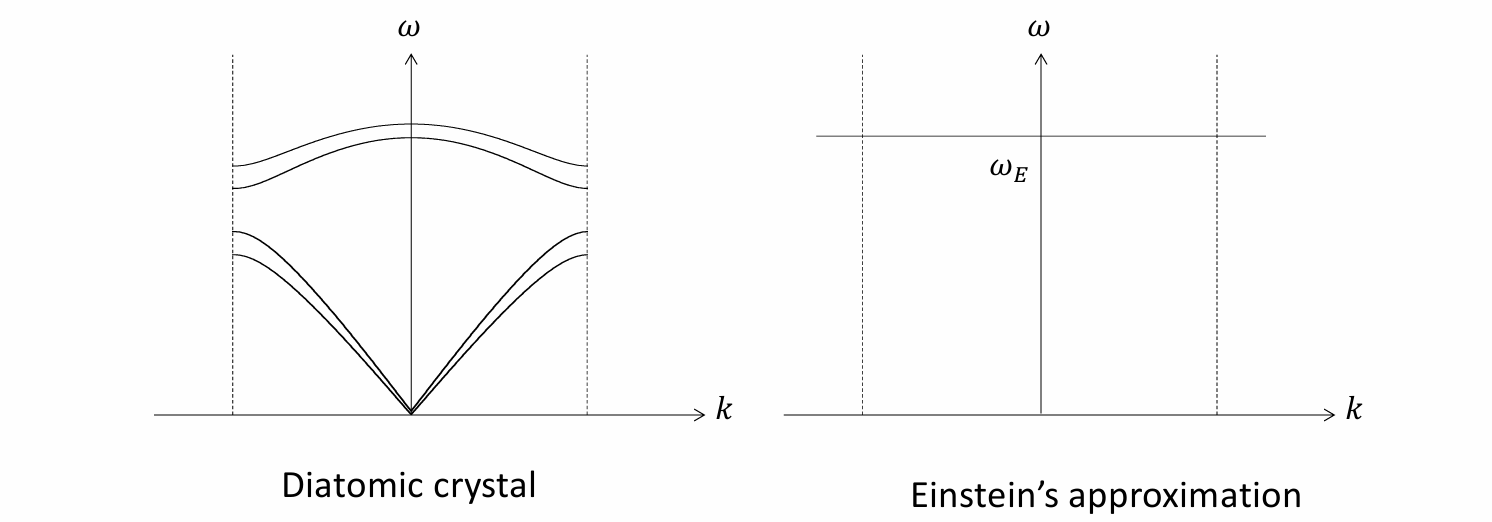
where CV∝e−ΘE/T at low T, which is not accurate to reality.
Dispersion relation for Debye’s model
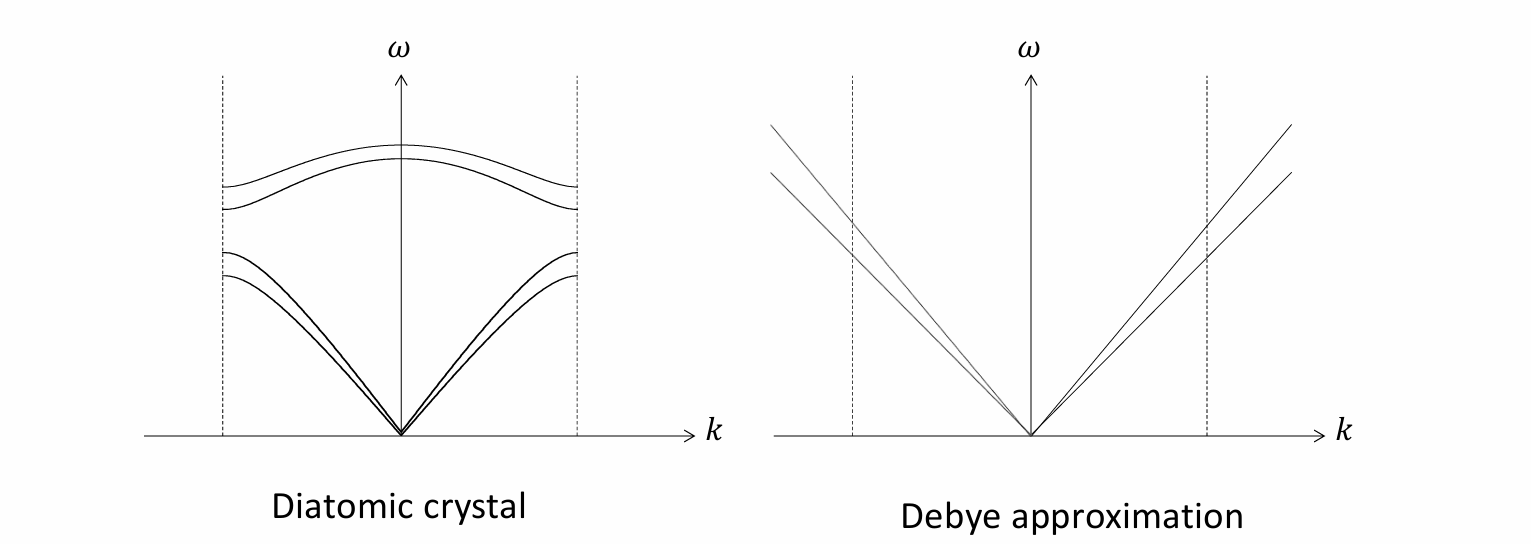
where CV∝(T/ΘD)3 at low T, which is much better than Einstein’s model.
When can the harmonic approximation not be used for phonons?
The harmonic approximation works well for small deviations from the equilibrium positions.
However, for large displacements (high 𝑇) it no longer works well, and anharmonic terms in U(r) must be included.
Terms beyond second order are anharmonic.
Consequences of including anharmonic terms
Thermal expansion: The average interatomic distance 〈𝑟〉 > 𝑎 (it costs less energy to expand than to contract).
Phonons interact with each other, and they are no longer pure normal modes: In an anharmonic crystal, a phonon causes momentary local contraction/expansion of the lattice. This causes a second phonon to ‘see’ a different spring constant and the modes are therefore not independent; phonons scatter off each other and this determines the thermal conductivity of the solid.
i.e., there are collisions between phonons.
Phonon scattering events
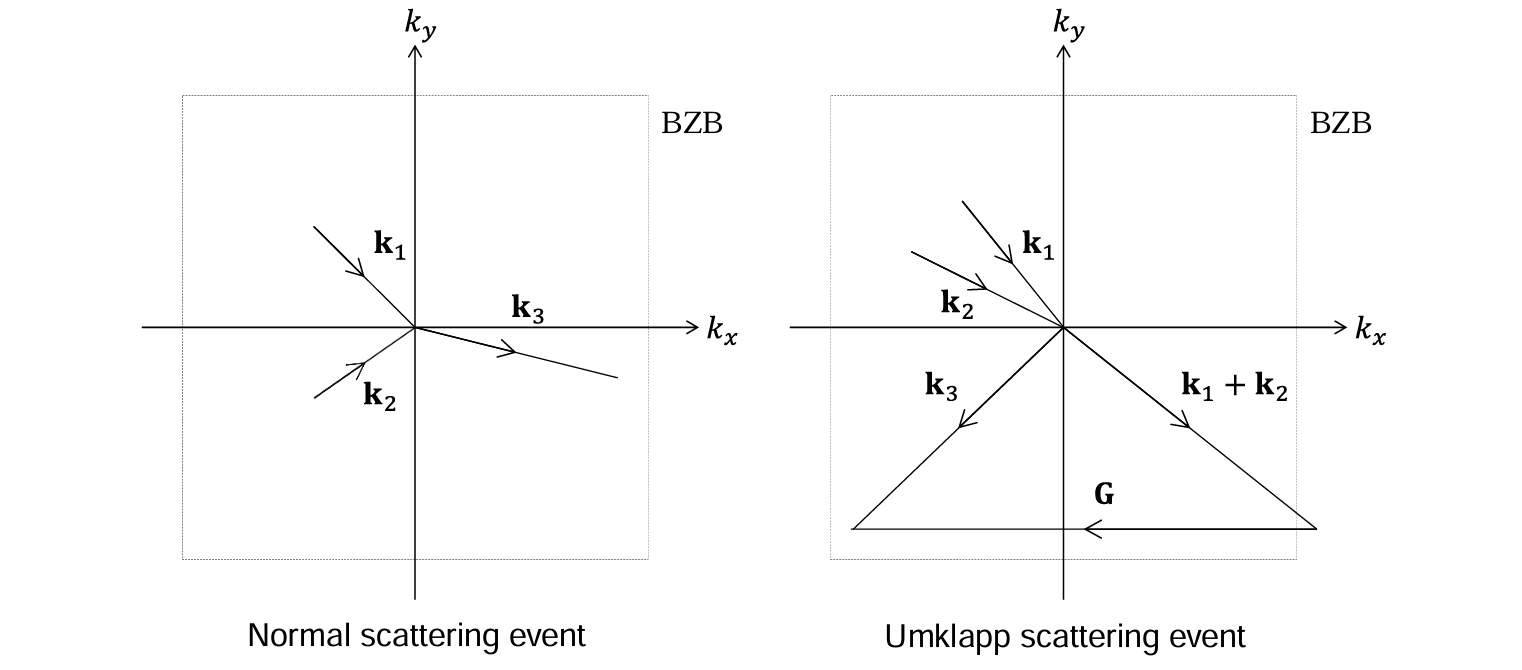
Normal scattering event
In a Normal scattering event, the resulting wavevector k3 lies within the 1BZ.
In an N event, two phonons travelling to the right combine to produce a phonon travelling to the right.
Umklapp scattering event
In an Umklapp event, the resulting wavevector k3 lies outside the 1BZ, but can be translated into the 1BZ by a reciprocal lattice vector G.
In a U event, two phonons travelling to the right combine to produce a phonon travelling to the left.
In the event, the total crystal momentum of the phonons changes by ℏ times a non-zero reciprocal lattice vector.
How is heat flow affected by different scattering events?
Heat flow carried by phonons is unaffected by N events, but is impeded by Umklapp scattering. Hence U events contribute to thermal resistivity (i.e., 1/thermal conductivity).
Conserved quantities in phonon-phonon collisions
Crystal momentum: ℏk1+ℏk2=ℏk3
Energy: ℏω1+ℏω2=ℏω3
Thermal conductivity
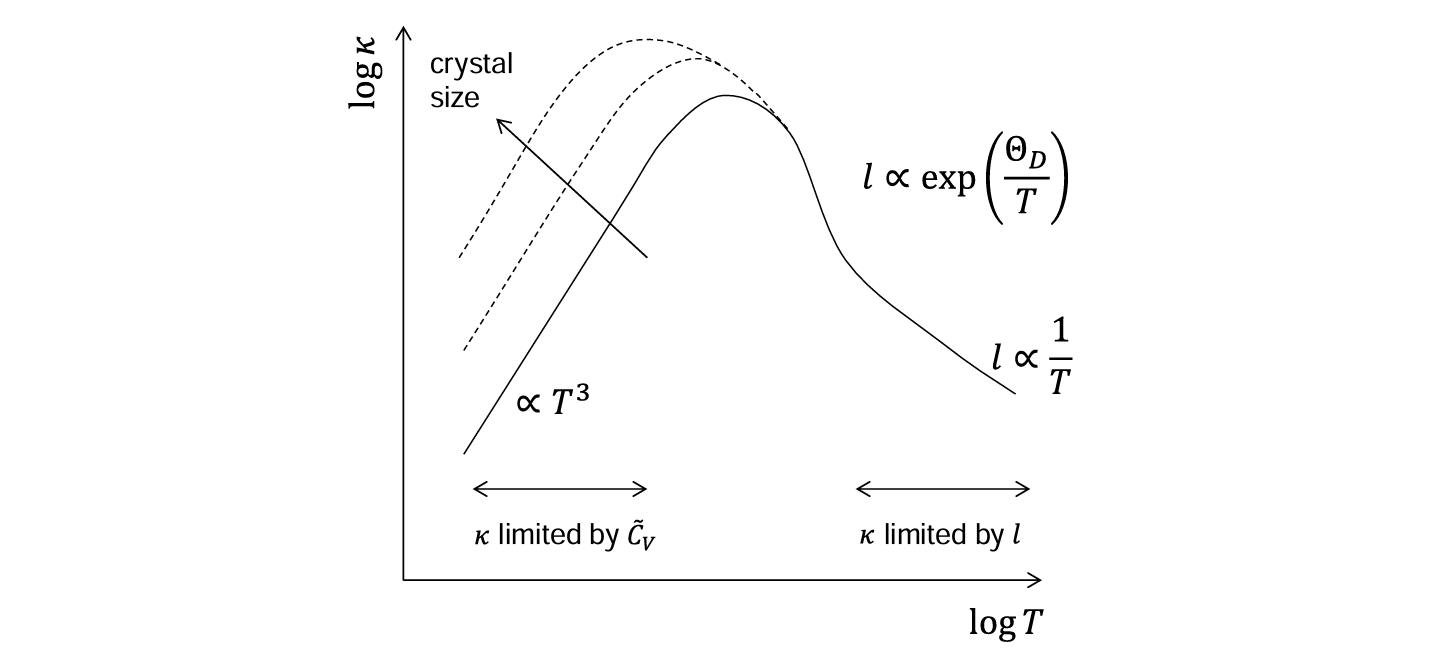
Thermal conductivity 𝜅 relates the steady-state flow of heat across a solid to the temperature gradient, i.e.,ju=−𝜅dxdT
where thermal current density has units [Wm−2], thermal conductivity has units [Wm−1K−1], and temperature gradient has units [Km−1].
From kinetic theory of gases, κ=31vˉlC~V where vˉ is the average particle velocity, 𝑙 is the mean free path, and C~V is the specific heat per unit volume.
How is mean free path related to phonons?
The mean free path 𝑙 is inversely proportional to the number of phonons.
High temperature limit: value of C~V
High T (T≫ΘD): all phonon modes up to ℏ𝜔D are excited; there are many phonons with large enough ∣k∣ to produce U-events.
The number of phonons is proportional to the thermal energy (kBT), hence l∝T−1.
The heat capacity C~V is approximately constant (classical value).
Intermediate temperature limit: value of C~V
Intermediate T (T∽ΘD): U-processes start to freeze out, as average energy of phonons decreases.
The number of phonons ∽exp(−ΘD/T), hence l∝exp(ΘD/T).
The heat capacity C~V is approximately constant (classical value).
Low temperature limit: value of C~V
Low T (T≪ΘD): all U-processes stop.
𝑙 is constant, and is limited by the size and shape of the crystal.
The temperature dependence comes entirely from C~V∽(T/ΘD)3.
Thermal conductivity with temperature graph shape