the cell
 Call Kai
 Learn
Learn Practice Test
 Spaced Repetition
 Match
Match Flashcards
 Knowt Play
1/53

There's no tags or description
Looks like no tags are added yet.
Name | Mastery | Learn | Test | Matching | Spaced | Call with Kai |
|---|
No analytics yet
Send a link to your students to track their progress
54 Terms
fluid mosaic model
membranes are semi-fluid, not static
calpain
a protease activated by calcium, its secretion leads to inflammation and its activation can promote apoptosis
asymmetry of lipid bilayers
two layers have different lipid composition
transverse diffusion (flip-flop)
when a phospholipid moves from one layer to the other
phospholipids translocators - flipases:
catalyse the flip-flop process
flipases help maintain unequal distribution = membrane asymmetry
significance of ER in membrane synthesis
asymmetric distribution of lipids, proteins and carbon determined by membrane’s synthesis and modification by the ER
lipids of the membrane
phospholipids - phosphoglycerides and sphingolipids
glycolipids
cholesterol
fuel for metabolism in membranes
triacylglycerides (1 glycerol, 3 fatty acids) - store a large amount of energy efficiently
signalling molecules for membranes
steroid hormones (sex hormones + cortisol)
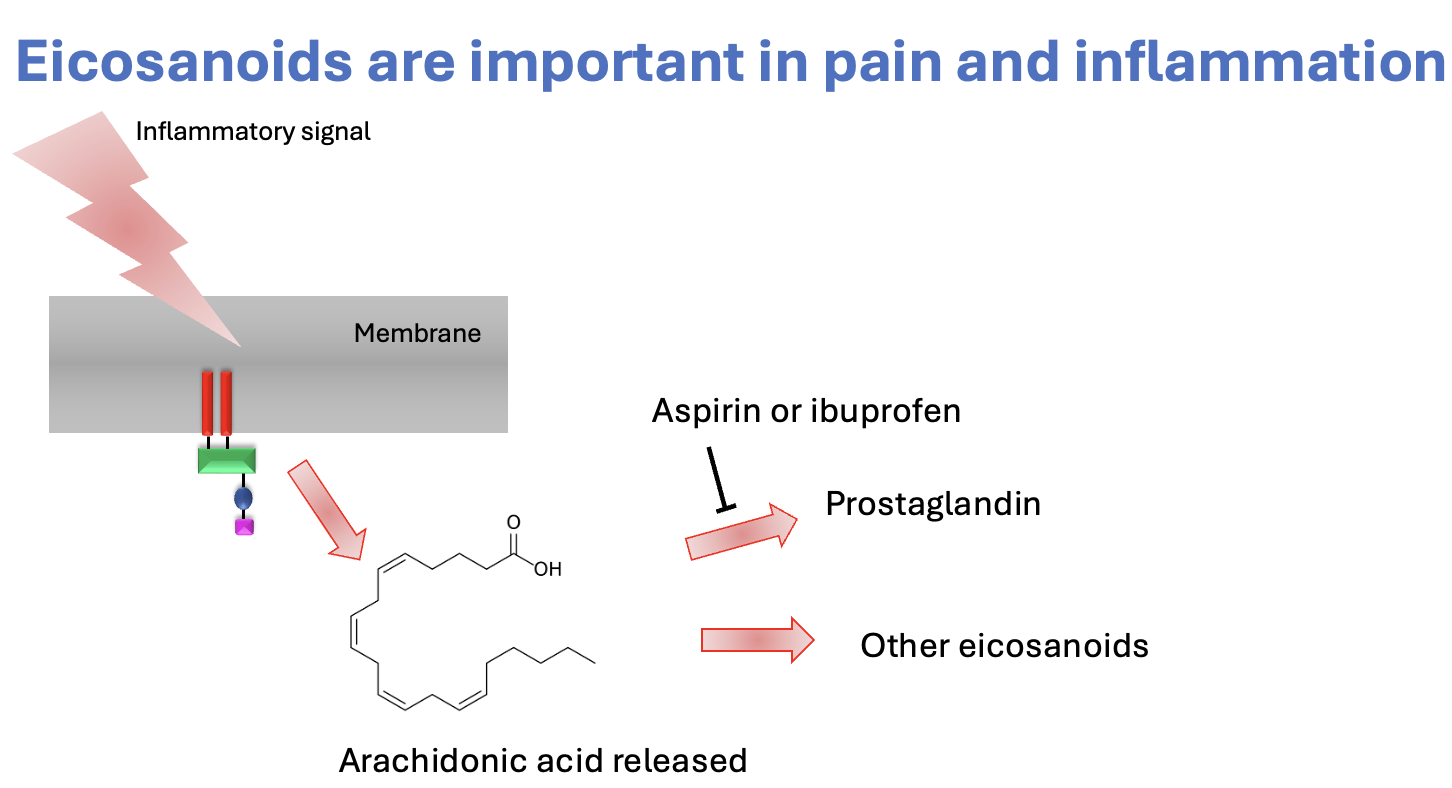
eicosanoids (involved in pain, inflammation)
difference between triacylglycerides and phosphoglycerides
triacylglycerides - glycerol + 3 fatty acids
phosphoglycerides - glycerol + 2 fatty acids + phosphate + hydroxyl group
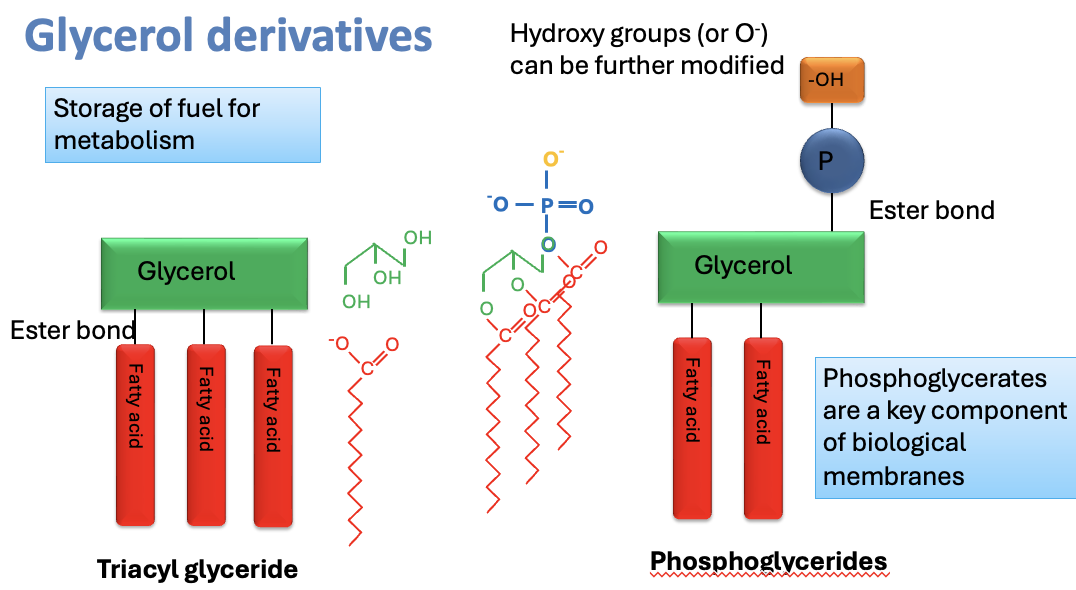
phospholipids structure
amphiphilic/ amphipathic ( = has both properties)
head - hydrophilic/ water loving
fatty acid chains - hydrophobic/ water fearing
fatty acid structure
long hydrocarbons of 14-24 carbons
saturated/ unsaturated
unsaturated = double bonds trans (almost straight chain), cis (kink in chain)
melting point increases with length
melting point decreases with increasing number of double bonds
C=C introduces a kink in the chain SO irregular packing
irregular packing = lower melting point, more fluidity
arachidonic acid
synthesised from linoleum acid
functions as part of phospholipids in membrane
precursor for eicosanoids - plays important role in inflammation
eicosanoids in role of pain and inflammation
inflammatory signal > membrane releases arachidonic acid > enzymes convert it to eicosanoids and prostaglandins > prostaglandins and eicosanoids trigger inflammation and pain responses
aspirin and ibuprofen inhibit the production of prostaglandins and eiconsanoids
common head groups in phospholipids
fatty acids + glycerol + phosphate + head group
serine
~choline
~ethanolamine
~linositol
~glycerol
functions of head groups
phosphatidylcholine + phosphatidylinositol - head groups can be cleaved
inositol and choline = important signalling molecules
sphingolipids
based on the amino alcohol sphingosine
important for:
membrane structure
cell signalling
nerve insulation
cell recognition
sphingomyelin
a type of sphingolipid found in cell membrane - especially nervous system
part of myelin sheath
significance of sphingomyelin
important in signal transduction and apoptosis
myelin sheath increases speed of electrical impulse
demyelination = disease (multiple sclerosis)
glycolipids
sugar instead of phosphate group
animal cells; derived from sphingosine not glycerol
functions: immune responses, cell-cell recognition, attachment
cholesterol
sterol - modified steroid (type of lipid made of four fused carbon rings)
effects membrane fluidity
planar structure
glycans
recognition and signalling
proteins - glycoproteins
lipids - glycolipids
importance of membrane fluidity
lipids diffuse laterally
proteins not involved in anchoring also diffuse
transport across by diffusion/ via transporter
vesicles need to bud off and fuse
how to measure rate of lateral diffusion (FRAP)
FRAP - fluorescence recovery after photobleaching
membrane with flourophores
intense light bleaches flourophores (destroying fluorescence there)
unbleached fluorescent molecules from nearby areas move into bleached spot by lateral diffusion
rate of diffusion of flourophores can be measured
lipid movement in the membrane
rotation + flexion
lateral diffusion
transverse diffusion (flip-flop)
membrane fluidity
temperature DECREASE, fluidity DECREASE
lipid molecules move slowly
membrane becomes less permeable
temperature INCREASE, fluidity INCREASE
lipid molecules move faster
membrane becomes more permeable
too fluid = membrane is disordered, too much permeability
too solid = gel slows down movement too much
how does lipid composition affect membrane fluidity
increases fluidity:
unsaturated lipids giving kinks
short chains allowing fewer interactions between lipids
decreases fluidity:
saturated chains
long chains
how do bacteria/plants regulate their lipid composition
bacteria = temperature sensitive proteins that help adapt membrane composition
plants = sensors in plasma membrane that detect changes in fluidity, fluidity increases indicates temperature is increasing - allows plant to prepare for heat stress
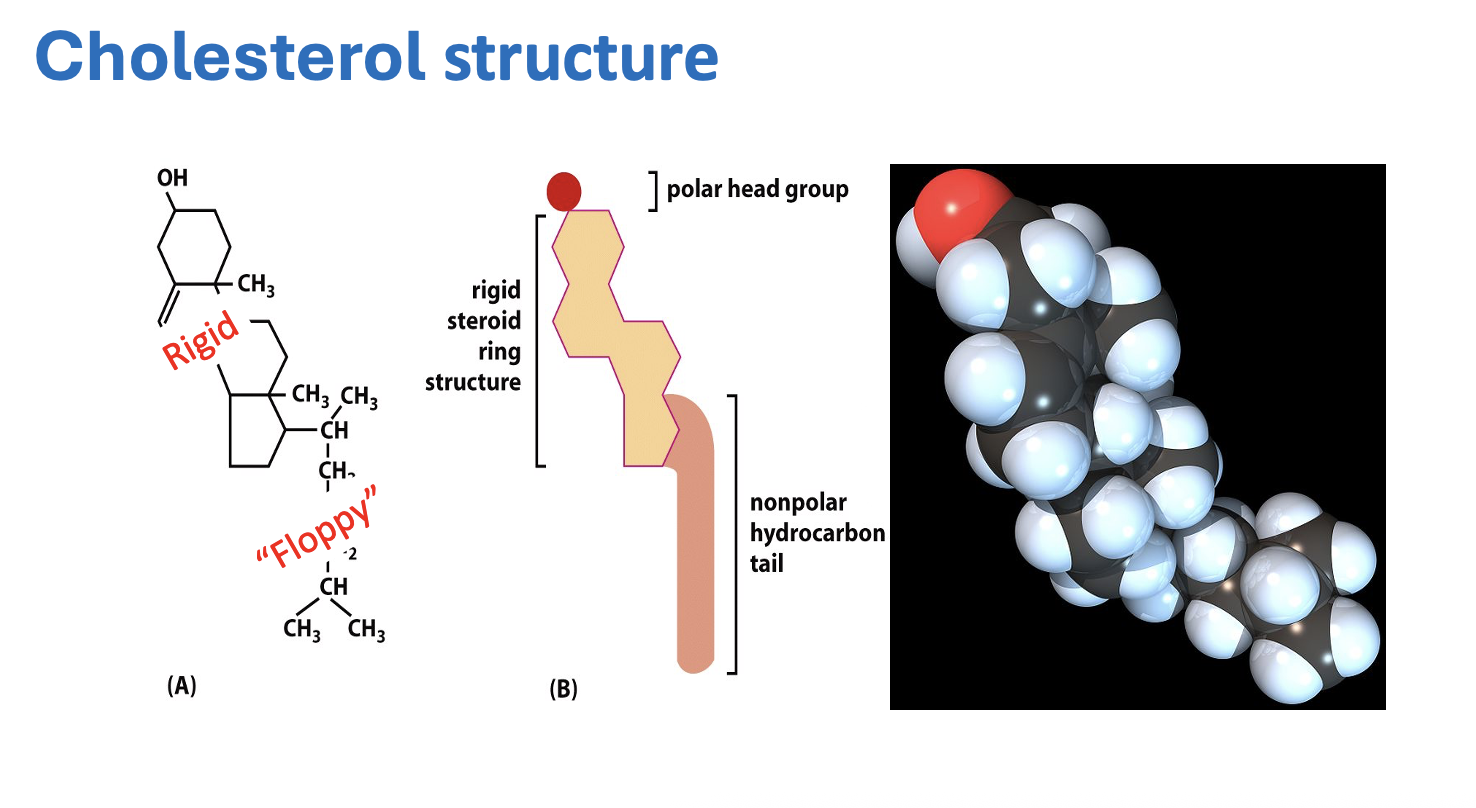
cholesterol structure
sterol lipid
4 fused hydrocarbon rings - rigid, non-polar
hydroxyl group - polar, hydrophilic
short hydrocarbon tail - more fluid, non polar, hydrophobic
increases fluidity in middle of membrane (flexible tail)
decreases fluidity at edge of membrane (steroid ring)
ethanol affect on membrane fluidity
increases membrane fluidity
membrane proteins
integral membrane proteins traverse (cross) membrane
peripheral membrane proteins associated with membrane face
proteins bind to surface of integral proteins
proteins covalently anchored to the membrane
integral membrane proteins
single span hydrophobic a-helix
multi-spanning containing a-helixes
B-barrel protein forming a pore
how is membrane topology maintained
by hydrophobic and electrostatic interactions
pos charged AA interact with neg charged lipid head groups
glycosylation of integral membrane proteins
glycosylation = attachment of carbohydrate chains (glycans) to proteins
integral membrane proteins = usually glycosylated, carbohydrate chains found on the extracellular side of the membrane
ICAM
involved in cell-cell adhesion
expressed on cells of the immune system and endothelial cells
unregulated during inflammation
bacteriorhodopsin
light causes conformation change in retinal
pumps protons from th ecytso to extracellular space
proton gradient used for photosynthesis
how can hydrophobicity predict secondary structure
hydrophobic amino acids, placed where they can interact with hydrophobic environments (lipid membranes) - transmembrane a-helix
hydrophilic amino acids prefer water regions
porins
barrel shaped structure with pore in centre
allows bacteria to take up sucrose
peripheral membrane proteins
don’t transverse the membrane
proteins - cytoplasmic or exoplasmic
interact with lipid head groups and integral membrane proteins
non-covalent interactions = electrostatic interactions, H-bands, vow bonds
proteins anchored to the membrane through hydrocarbon groups
protein is covalently attached to a hydrocarbon group
hydrophobic hydrocarbon group inserts into the lipid bilayer
palmitoylation
lipid modification where a fatty acid (palmitic acid) is covalently attached to a protein
ankyrin
spectrin
spectrin = cytoskelotn proteins creating a scaffold on intracellular side of membrane
ankyrin = binds to several integral membrane proteins AND binds to spectrin
maintains plasma membrane integrity via the spectrinf-actin based cytoskeletal structure
cells covered in carbohdyrates
found on the exoplasmic side of membranes
attached to both glycolipids and glycoproteins
glycocalyx = network of glycoproteins with mucus like consistency
carbohydrates also acts as a physical barrier (mechanosensing - ability to respond to mechanical forces )
membrane carbohydrates: structure
carbohydrate units exist as oligosaccharide chains or single sugar residues
glycoproteins = oligosaccharide chains
glycolipids = single sugar residues
membrane carbohydrates: function
cell-cel recognition, communication, adhesion
important in immune response: i