bio 212 | exam 2 written answer question bank
 Call Kai
 Learn
Learn Practice Test
 Spaced Repetition
 Match
Match Flashcards
 Knowt Play
1/47

There's no tags or description
Looks like no tags are added yet.
Name | Mastery | Learn | Test | Matching | Spaced | Call with Kai |
|---|
No analytics yet
Send a link to your students to track their progress
48 Terms
list three significant attributes of green algae
almost identical to true plants & considered the ancestors of true plants
green algae are multicellular & allow for many evolutionary possibilities in terms of body construction (motile/nonmotile, filamentous, parenchymatous, etc.)
alternation of heteromorphic generations is traced to green algae, and theory of life cycles are discussed through green algae
what is a monobiontic lifestyle? name one type of alga that has this type of life cycle?
distinguish between the following types of algae in terms of photosynthetic pigments and photosynthetic products:
green algae
red algae
brown algae
green algae: chlorophyll a/b, carotenoids, xanthophylls (pigments); starch (products)
red algae: phycobilisomes, phycoerythrin, phycocyanin, carotenoid, chlorophyll a (pigments, quantities of pigment vary by depth); floridean starch (products)
brown algae: chlorophyll a/c, xanthophyll, carotenes (pigments); laminarin, mannitol, fats (products)
state the life cycle of Ulva & describe the main characteristics of the life cycle in terms of haploid and diploid generations
state the life cycle of Derbesia & describe the main characteristics of the life cycle in terms of haploid and diploid generations
state the life cycle of red algae & describe the main characteristics of the life cycle in terms of haploid and diploid generations
state the life cycle of Focus & describe the main characteristics of the life cycle in terms of haploid and diploid generations
compare primary endosymbiosis to secondary endosymbiosis. which alga groups are derived from primary endosymbiosis, and which are derived from secondary endosymbiosis?
how do the light-dependent reactions and the stroma reactions function together?
list four important qualities of carbon dioxide and water as photosynthesis compounds
summarize the function of accessory pigments
accessory pigments strongly absorb wavelengths that are not absorbed by chlorophyll a, which broaden the action of chlorophyll a to overcome limitations in the energy level of the photons it absorbs; common pigments are chlorophyll b and carotenoids
summarize the process of glycolysis. which organisms conduct this process?
what type of respiration involves only glycolysis. what are the drawbacks to this respiration type in terms of the products that can form?
provide a summary of cellular respiration. include all three steps and general detail about each step. you do not need to include the names of the intermediate molecules, or the enzymes involved.
compare and contrast the processes of photosynthesis and cellular respiration. what features do they share in common and what features are different?
compare the organization of root systems of monocots to that of eudicots
monocots: MOST have a fibrous root system, adventitious in nature, most cannot undergo secondary growth
eudicot: perennial eudicots undergo production of wood, taproot system
list and describe or draw and label the components of external structure of an individual root
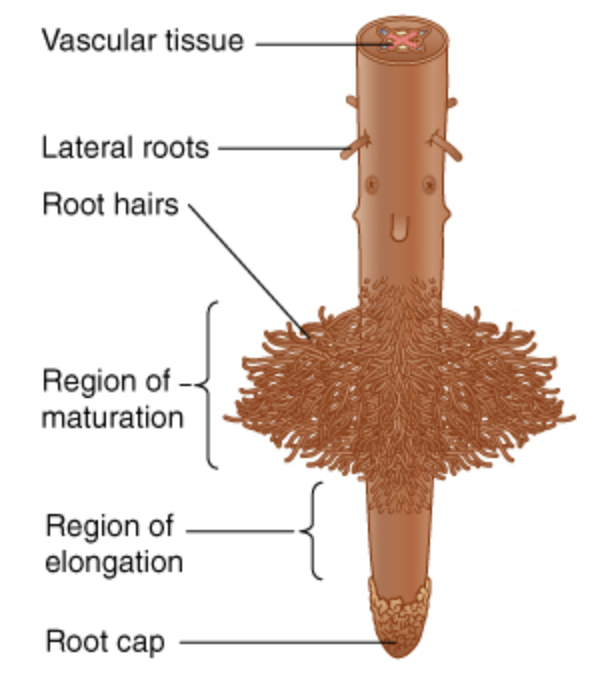
list and describe or draw and label the components of internal root structure
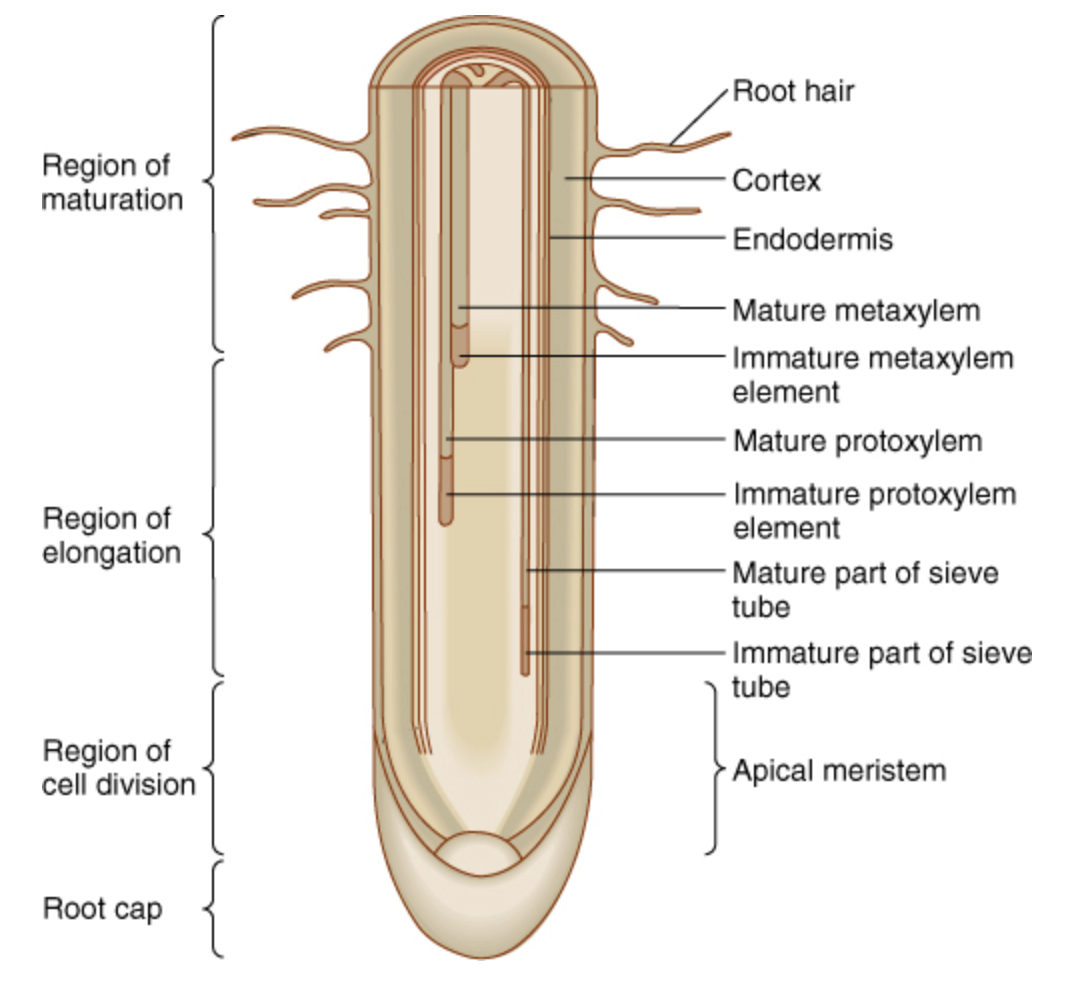
describe the process of lateral root formation
list and describe at least three root modifications or special types of roots
storage roots: provide long-term storage for carbohydrates that accumulate during summer photosynthesis, carbohydrates produce new shoots in the spring, less visible as food for foragers
prop roots: adventitious roots that grow in the air for additional nutrients and water, stem stability, and support against wind and water currents
contractile roots: important for stability and depth control, may anchor newly germinated seeds
root nodules: symbiotic relationship between legumes and bacteria for increased nitrogen
haustorial roots: modified roots of parasitic plants that attach parasite to host and penetrate the host vascular tissue
list and describe examples of autotrophic and heterotrophic tissues in plants
explain how plants use light to generate “reducing power”
draw and label a diagram that shows the location of photosynthesis within the leaf
explain the relationship between photosynthetic pigments and light harvesting complexes. how do photosynthetic pigments work? what is the main photosynthetic pigment in plants?
explain the relationship between PSII and PSI. where are they located? which stage of photosynthesis are they involved in? what are the overall products of this stage of photosynthesis?
what are the stroma reactions? what is the main enzyme involved in these reactions? what other components are associated with the energy requirement of the stroma reactions? what is the raw product of stroma reactions?
light-independent reactions/Calvin-Benson cycle; carbon is converted into carbohydrate in the stroma by the way of enzymes
ATP and NADPH interact with CO2 and produce carbohydrates
what are the two types of respiration? which type(s) of respiration can plants do? provide some examples.
list some components of plant anatomy that only perform respiration and do not do photosynthesis.
what type of respiration results in the formation of alcoholic beverages? list the three types of alcoholic beverages; include the types of plants used to make them and a description of the overall processes to make each
compare and contrast the following two root symbioses:
mycorrhizae
root nodule
mycorrhizae: symbiotic association between roots of seed plants and soil fungi; fungi gain carbohydrates, fungal hyphae aid plant in phosphorous uptake
root nodule: symbiotic relationship between nitrogen-fixing bacteria and root nodule of a plant; bacteria gets an oxygen-free atmosphere and sugar, legume gets nitrogen
explain the following statement: roots have localized growth
what is the root cap? describe how it develops and how it functions?
protects the root apical meristem; secretes mucigel that lubricates the root passage, releases nutrients in the soil & diffuse in the root, causing rapid growth of soil bacteria
what would happen if root hairs grew in the zone of elongation?
root hairs would be damaged from the pressure of elongation
which part of a root detects gravity? which organelles are responsible for this?
maturing cells in the root cap detect gravity through starch grains; the direction of where starch grains fall is where the plant continues to grow/push its way through the soil
describe the shape of the endodermis. what are casparian strips and where are they located? what is the function of a casparian strip?
the endodermis is cylindrical and composed of a single layer of cells
casparian strips control the minerals that enter the xylem
located on the endodermis
which part of the root produces the primordial for lateral roots? how does the vascular tissue of a lateral root connect with that of the parental root?
which group of algae appears to be most closely related to the ancestors of true plants? which features appear to be homologous?
green algae are most closely related to the ancestors of true plants;
what is unusual about spirogyra? what gives it its name? what is conjugation?
spirogyra is filamentous with a spiral chloroplast
conjugation: method of reproduction; each filament is haploid and is a unique mating type (- or +); if compatible filaments drift against each other, a conjugation tube forms between cells and - prop lasts migrate and fuse with + protoplasts, followed by karyogamy
describe monobiontic and dibiontic life cycles. mention all possible types. what is the difference between a spore and a gamete? what is the difference between a spore and a zygote?
does the entropy of a plant increase or decrease while it is alive? explain why.
when alive, entropy decreases; as it’s alive, plants absorb diffusely scattered minerals and organizes them into molecules, cells, tissues, and organs
what is the ultimate source of electrons in photosynthesis? what are the benefits of this molecules in terms of its toxicity and cost to the plant to obtain it?
describe the absorption spectrum of chlorophyll. why does it match the action spectrum of photosynthesis?
absorption spectrum: graph that shows which wavelengths are most strongly absorbed by a pigment
action spectrum: shows which wavelengths are most effective at powering a photochemical process
to initiate a photochemical process, light must first be absorbed when the action and absorption spectrum match; the absorption spectrum of chlorophyll a only absorbs red and blue light, accessory pigments allow the action spectrum of photosynthesis to match the absorption spectrum of chlorophyll a
how is ADP converted to ATP in photosynthesis?
most plants store excess energy from photosynthesis. name some times when recovery of stored energy may occur. does energy recovery always occur in the same sites where photosynthesis capture occurred?
the reduction of NAD+ to NADH during glycolysis is a problem during anaerobic respiration. why is it less of a problem if roots absorb nitrates and sulfates or if the plant is synthesizing fatty acids?
considering the negative aspects of anaerobic respiration, how could natural selection have produced something so inefficient?
what are the three basic parts of aerobic respiration. which steps occur in the mitochondria, and which occur in the cytosol?
where are the electron carries of the mitochondrial electron transport chain located? as they carry electro, some also deposit protons. where are these protons deposited?