Cost Exam 3
 Call Kai
 Learn
Learn Practice Test
 Spaced Repetition
 Match
Match Flashcards
 Knowt Play
1/37

Earn XP
Description and Tags
CH 10,14,12
Name | Mastery | Learn | Test | Matching | Spaced | Call with Kai |
|---|
No analytics yet
Send a link to your students to track their progress
38 Terms
Budget
A detailed plan for the acquisition and use of financial and other resources over a specified period of time
Operating Budget
Plans for all phases of operations, including production, purchasing, personnel, and marketing budgets (on income stmt)
Financial Budget
Identify sources and uses of funds for budgeted operations and capital expenditures
master budget
A comprehensive financial plan that consolidates all individual budgets and outlines an organization's overall financial goals and objectives.
The Master Budget
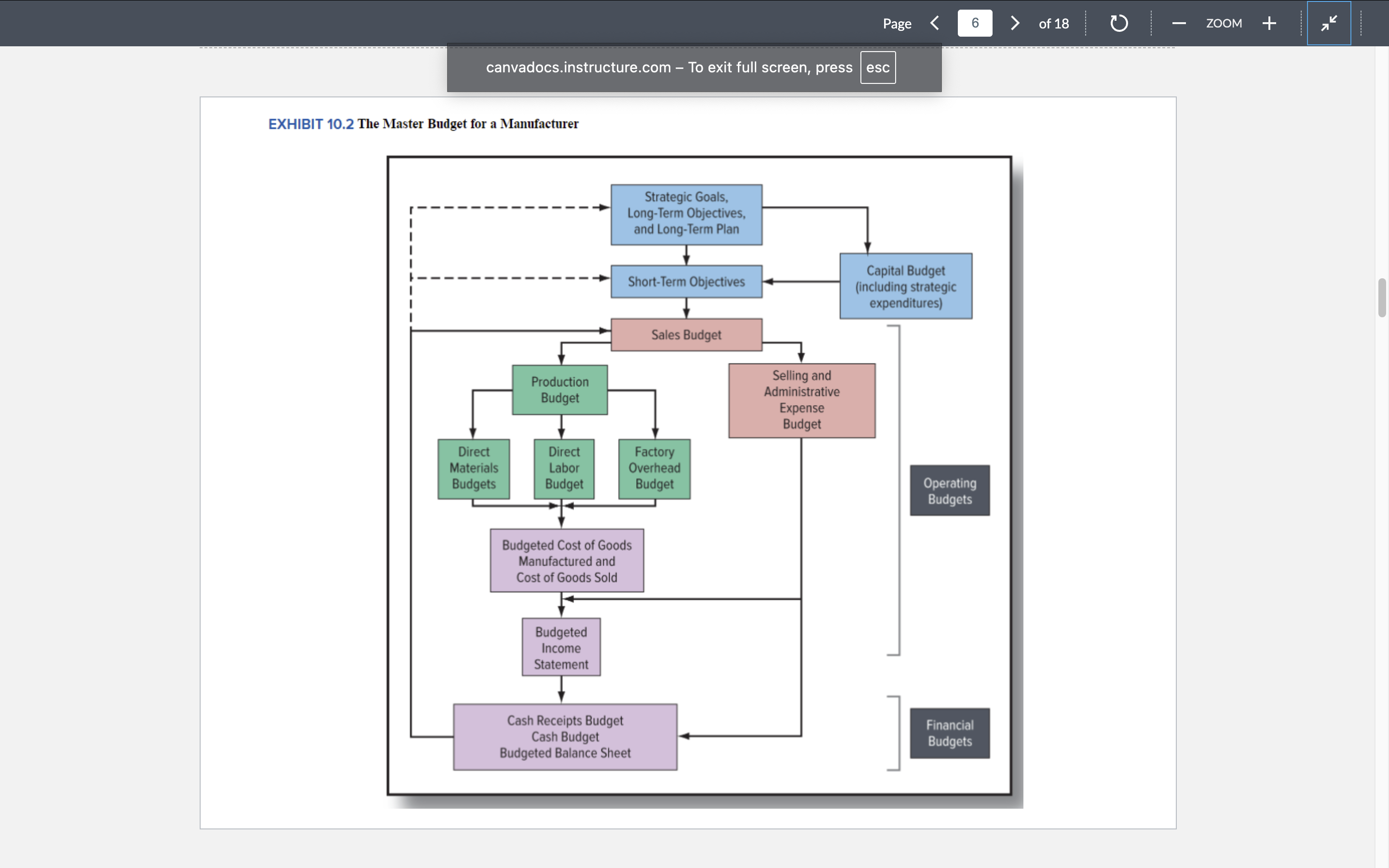
Sales Budget =
SALES
+ Ending Inventory
=total needed
-beginning inventory
=to produce
Factory Overhead Budget
includes all production costs other than direct materials and direct labor. Some firms separate factory overhead into variable and fixed costs.
Cost of Goods Manufactured Budget and COGS Budget
prepared after FOH budget and the IS and BS use this information
Budgeted Income Statement (IS)
describes the upcoming net income for the upcoming period
Budgeted Balance Sheet (BS)
the last budget in the budget preparation process, incorporates the effects of all operations and cash flows during the budget period and shows projected ending balances in asset, liability, and equity accounts
Zero Based Budgeting (ZBB)
is a budgeting process that requires managers to prepare budgets from a zero base
– This type of budgeting allows no activities or functions to be included in the budget unless managers can justify their needs
– In-depth reviews and analyses of all budget items make managers aware of activities and functions that have outlived their usefulness
– Can be a difficult and time-consuming process
Kaizen (continuous improvement budgeting)
A budgeting approach that incorporates continuous-improvement expectations in the budgets
– Can be used as a complement to both traditional and activity-based (ABB and TDABB) systems
Behavioral Issues in Budgeting
-budgetary slack
spending the budget
goal congruence
Authoritative or participative budgeting
Top-down budgeting is referred to as authoritative budgeting
– Bottom-up budgeting is referred to as participative budgeting
Difficulty level of the budget target
An easy budget may fail to encourage employees to give their best efforts, while a very difficult target can discourage managers from even trying
– A “highly achievable target” is suggested with incentives for exceeding the budgeted figures
Linkage of compensation and budgeted performance
Problems with “fixed performance contracts”
– Gaming the performance measure
– Suggested improvements to basing incentive compensation on the basis of a fixed performance contract:
• Use of linear compensation plan, “rolling forecasts”, and relative performance
control
A set of procedures, tools, and systems that organizations use to monitor activities and to reach their goals
management accounting and control system
an organization’s core performance measurement system
operational control
Part of the control system that focuses on short-term operational performance
– Relates to the control of basic business processes (or activities)
short-term financial control
Comparison between actual and budgeted financial results
– Create Flexible Budget Schedule
Variances
Differences between budgeted amounts and actual financial results
Actual Results
Prepared at the end of the period (after actual activity is known)
– Actual sales volume is used, along with actual selling price per
unit, actual variable cost per unit, and actual total fixed costs
Flexible Budget
Prepared at the end of the period (actual activity is known)
– Actual sales volume is used, but with
• budgeted selling price per unit
• budgeted variable cost per unit
• budgeted total fixed costs
– Key to performing variance analysis at the end of the period
DM Price/Rate=
Actual Quantity (Actual Price - Standard Price) or AQ(AP-SP)
DM Qty/Efficiency =
SP(AQ-SQ)
DL Rate=
AH(AR-SR)
DL Efficiency =
SR(AH-SH)
DM Price Variance
= Actual Quantity Purchased (AP-SP) if different use AQP for price variance
DM Quantity Varience=
SP(AQU-SQ) if different use AQU
DM Variance common causes
Price Variances:
– Purchase of materials of different grades
– Quantity discounts
– Freight/delivery expediting cost (“rush orders”)
• Usage Variances:
– Purchase of non-standard quality materials
–Poorly trained or poorly supervised workers
–Poorly maintained machinery (not calibrated properly)
DL Variance common causes
Rate Variances:
– Labor substitution
– Out-of-date standards (e.g., new labor contract)
• Efficiency Variances:
– Poorly trained workers
– Poor quality raw materials used in production
– Poorly maintained equipment
– Poor supervision of workers
– Out-of-date standards
Standard Costs
costs that should be incurred under efficient operating conditions
Standard Cost System
an accounting system in which standard, not actual, cost flow through the formal accounting records
Type of Standards
– Ideal (Perfection) Standards
– Continuous-Improvement Standards
– Currently Attainable Standards
Standard Setting Procedures
Authoritative Standards and Participative Standards
Standard Cost Sheet
Contains both price and quantity components of each cost
Production Budget =
sales + end inv = total needed - beg inv = to produce
DM Purchases Budget=
Unit to produce x dm/unit = qty needed + end inv - beg inv of dm = qty to purch x cost/unit