Pre-Christian Ireland (4000BCE - 500BCE)
 Call Kai
 Learn
Learn Practice Test
 Spaced Repetition
 Match
Match Flashcards
 Knowt Play
1/11

Earn XP
Description and Tags
Discuss the development of motifs on stone carving and metalwork through this period. Refer in your answer to specific artefact. Include discussion of context, materials and techniques, art elements and design principles
Name | Mastery | Learn | Test | Matching | Spaced | Call with Kai |
|---|
No analytics yet
Send a link to your students to track their progress
12 Terms
Discuss the development of motifs on stone carving and metalwork throughout this period
Refer in your answer to specific artefacts
Include discussion of context, materials and techniques, art elements and design principles.
Stone Age Lifestyle & Lack of Decorative Art
During the pre-Christian period in Ireland, decorative motifs greatly changed between the Stone Age and the Iron Age. he different lifestyles, beliefs, and surroundings of people during these periods influenced the artwork they created, leading to the development of a wide range of motifs (designs) over the centuries.
The Stone Age is divided into three time periods:
the Palaeolithic Period (pre-7000 BC),
the Mesolithic Period (7000 - 3700 BC) and
the Neolithic Period (3700 - 2000 BC).
Up to the Neolithic period, no decorative objects have been found. This is likely due to the nomadic style of living, where possessions and homes were often temporary, and comfort was not common. This meant that there was no time to decorate, innovate and invent.
Neolithic farming: hobbies and pagan religion
However, as farming practices reached Ireland from England, People began to live more settled lifestyles as farming communities were established.
These new settled conditions produced a need for hobbies and permanent ownership, resulting in the decoration of valuable personal times. The settled communities also developed the Pagan religion, and decoration was often used as a form of worship.
PASSAGE TOMB
Context:
The first significant decorative structure of the Stone Age was the passage tomb.The people's prior megalithic structures, such as the Portal Dolmen in Poulnabrone, were cleverly constructed but not decorated at all.
Passage tombs are the most complex and impressive tombs of the late Neolithic period.
Newgrange, located near the River Boyne in Co. Meath appears as a large earth mound with a wall of white quartz around the circumference of the tomb.
Materials and Techniques:
Along Newgrange's 19-metre-long cruciform passageway, two monoliths lining the hall are decorated with various geometric designs such as concentric circles, serpenti forms, lozenges, parallel lines, chevrons and radials. (stone people lived simple prehistoric cave rituals)
Techniques developed to create these decorations, such as chip carving, creating lines or patterns in rocks by incising with a sharp flint/obsidian edge or picking and pecking with a point driven by a hammer stone.
Similarly, plain picking involved using a stone chisel to cut out broad or narrow-sized grooves in stones and sanding down the sharp sides with a rougher rock.
Pick dressing was also used to smooth rocks and involved removing the glacial patina, a thin layer of ice from the Ice Age.
Art elements and Design Principles:
Each of these techniques resulted in symbolic and geometric motifs that valued a sense of balance, rhythm, unity and movement.
ENTERANCE STONE
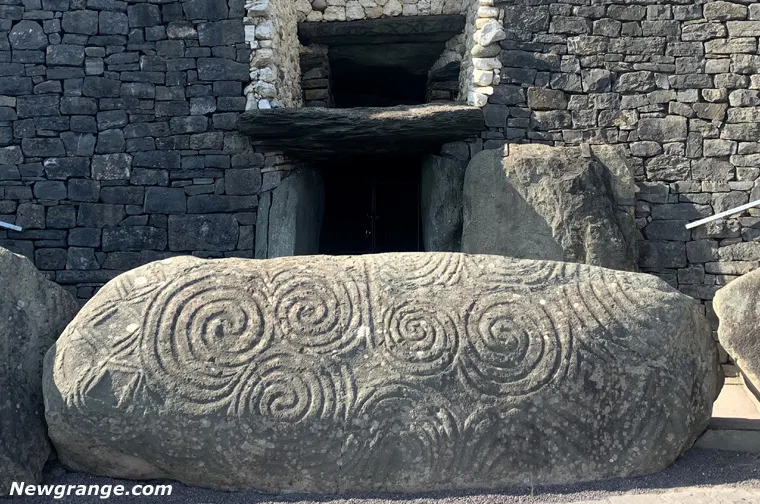
An excellent example of Stone Age motifs can be seen on Newgrange's 'Entrance Stone';
The entrance stone has a vertical line which runs vertically from the top to the centre of the stone and separates parts of the left and right decorating, this line lines up with the centre of the roof box, emphasising its significance.
The rest of the stone is decorated with regular spirals, triple spirals, zigzags and lozenges.
initially been dressed and smoothed to remove any imperfections and roughness.
The designs would have been carved into the rock using incision which involves scratching a design into the rock with a sharp tool or chip carving which involves using a hammer and chisel to chip away areas of low relief.
three spirals on its left side, accompanied by curvilinear grooves at the bottom, appear to symbolise the three geographically aligned passage tombs of Newgrange, Knowth and Dowth, as well as the nearby River Boyne.
BRONZE AGE INTRO
CONTEXT
The Bronze Age in Ireland, lasting from around 2500 to 500 BC, was a time when people began using metal tools and weapons made from a mix of copper and tin, known as bronze. which came from England and shows evidence of trade.
This period followed the Stone Age, where tools were primarily made from stones, and marked a significant advancement in technology, daily life, structures and jewellery brought by the Beaker people.
During the Bronze Age, people built impressive structures like wedge-shaped tombs and crannogs, showing their growing skills and organization. They also created beautiful gold jewellery, indicating a rich and complex culture.
Gold was found in Wicklow, silver came from Silvermines in Co. Tipperary, and copper was harvested from Cork.
LUNULA MANGERTON CO. KERRY
Context:
The lunala is an artefact made in the early Bronze Age, the word lunalea comes from the Latin word Luna which stand for moon, this name is given to the lunalae due to its form, the lunala is a crescent moon shape with two circular paddles at either end that function to form a locking device.
Materials and Techniques:
The decoration on the body of the lunalae is minimal compared to Bronze Age artefacts made during the later stages of the era
The lunalae would have been made using a variety of simplistic techniques.
First a piece of gold would be hammered flat into a thin piece of sheet metal.
The crescent moon with paddles would have been cut from the gold and then the paddles would be twisted to create the locking device around the neck.
The decorative patterns would then have been incised on the surface of the gold; incision is the process of scratching the design into the metal using a small pointed tool.
repoussé, which consisted of crafting a design on the back of a metal object so it appears in relief on the front.
Soldering techniques were also developed, allowing pieces of metal to be joined together using heat.
Art elements and Design Principles:
The lunala shows a strong emphasis on simplicity, balance, and symmetry, with its crescent shape creating a clear sense of rhythm and unity.
the incised patterns introduce subtle texture and movement, while the overall design prioritises harmony and proportion rather than complexity.
THE GLENINSHEEN GORGET
Context:
The Gleninsheen Gorget is a large, heavy crescent-shaped gold collar with two circular discs at each end. It was likely worn during ceremonial or ritual occasions by a high-status individual found in the late Bronze Age. (800-700BCE) - The Dowris Phase
Materials and Techniques:
The decoration of the gorget is intricate and groundbreaking.
Gold was beaten into sheet metal, decorated, and the discs were sewn on using fine gold wire, showing advanced craftsmanship.
Along the collar there are alternating series of rope-like patterns and smooth ridges running from one end to the other; these patterns would have been made using repousse.
Repousse is the process of using a tool to press in a pattern to the back of an object and then when it's flipped the pattern is raised on the surface of the object.
The pattern on the large discs at either end consists of a raised conical boss surrounded by a ring of incised concentric circles, these were surrounded by a ring of raised bumps and then another ring of concentric circles. Both discs have a ring of small bosses surrounding the circumference. The bosses would have been added using repousse.
Art elements and Design Principles:
The Gleninsheen Gorget shows strong use of balance, symmetry, rhythm, and emphasis in its design. The repeated circular forms and evenly spaced patterns create a clear sense of rhythm and visual harmony across the collar. Its mirrored structure on both sides produces strong symmetry and balance, reinforcing its formal, ceremonial purpose
INTRODUCTION TO IRON AGE
The Iron Age began with the arrival of the Celts, who introduced iron tools and the La Tène style, leading to a revival of stone carving unseen since the Neolithic period.
The Iron Age was divided into two periods design-wise: the Insular La Tene period and the Ultimate La Tene period. Both periods were deeply influenced by the Celtic European La Tene style of art and trade with wider Europe.
As new discoveries in iron were made, tools became more durable and techniques more intricate and careful. Iron melts at a higher temperature and is also far more durable than bronze. Bronze, gold and iron were all used during the Iron Age to display the distinct La Tene motifs that developed.
Contrasting with the Bronze Age's geometry, the Insular La Tene period saw a far more naturalistic and organic type of design.
TUROE STONE
On stones such as the Turoe Stone (granite), Co. Galway, designs of deep 3mm grooves reflected Stone Age work, but utilising a method that was far more organised and driven.
It features La Tène motifs such as spirals, trumpet ends, vines and palmate designs, as well as a Greek key–influenced step pattern.
BROIGHTER COLLAR
Context:
Contrasting with the Bronze Age's geometry, the Insular La Tene period saw a far more naturalistic and organic type of design.
Method and Technique:
A similar freeform curvilinear design is seen on the Broighter Collar (c. 50 BC), a gold ornament made from curved sheets of metal (gold) and decorated with spiralling vine forms all along the collar band.
The collar is accompanied by spiral bosses that appear to be in the shape of roses, adding to the proof that the La Tene style as a whole valued nature above geometry.
New techniques, such as chasing, It allowed the decoration to stand out clearly. Chasing was a method of hammering back the surrounding metal to bring objects into relief, creating an effect similar to repoussé.
Design and art elements:
context:
However, as the Iron Age developed, people began to combine geometry and natural, loose structures to create intricate patterns of animalistic and natural motifs. This showed huge development, as artistic elements were taken from all the ages in order to create a style rich with variety and excellent craftwork.
Method and Technique:
This Ultimate La Tene style can be seen very clearly in the Petrie Crown (bronze), where the structure of the semicircular band, the conical horn and the attached concave discs features geometric lines lining the rims of the semicircular band edges.
The conical-shaped horn has a pattern of swirling bird heads.
The eyes of these birds once contained enamel, a new material of the Iron Age.
The concave discs show a repeating pattern of trumpet ends, circles, vine forms and cruciforms, displaying a clear combination of many different motifs across the ages.
Art elements and designs:
From simple circles like in the Stone Age to repeating geometrical lines around the Petrie Crown's edges to the natural motifs of organic forms such as bird heads and vines, the Petrie Crown is an excellent example of just how smoothly artistic motifs developed in pre-Christian Ireland.
CONCLUSION
To conclude, it is clear that across the Stone Age, the Bronze Age and the Iron Age, the motifs created by the people developed as a result of the context of the time, the new techniques that were developed and the buildup of knowledge the people were acquiring.