Consumer Perception
 Call Kai
 Learn
Learn Practice Test
 Spaced Repetition
 Match
Match Flashcards
 Knowt Play
1/36

There's no tags or description
Looks like no tags are added yet.
Name | Mastery | Learn | Test | Matching | Spaced | Call with Kai |
|---|
No analytics yet
Send a link to your students to track their progress
37 Terms
Learning definition
Change in behaviour resulting from some interaction between a person and a stimulus
Perception definition
Consumer’s awareness and interpretation of reality
Exposure definition
Process of bringing some stimulus within proximity of a consumer so that the consumer can sense it with one of the human senses
Sensation definition
Consumer’s immediate response to a stimulus
A consumer senses stimuli to which they are exposed.
Sensing is an immediate response to stimuli that have come into contact with one of the consumer’s senses (sight, smell, touch, taste, or hearing).
Example: when a consumer touches their phone, enters a store, browses on Amazon, watches a TikTok, tastes food, looks at an advertisement, or tries on clothes, the perceptual process goes into action
What is attention in a marketing context?
Attention - purposeful allocation of information processing capacity toward developing an understanding of some stimulus
Example: Roadside (Tim Hortons in “xyz” Km) get attention of drivers and remind of hunger
Cognitive Organization
Process by which the human brain assembles sensory evidence into something recognizable
How can Stimulus be categorized? (3)
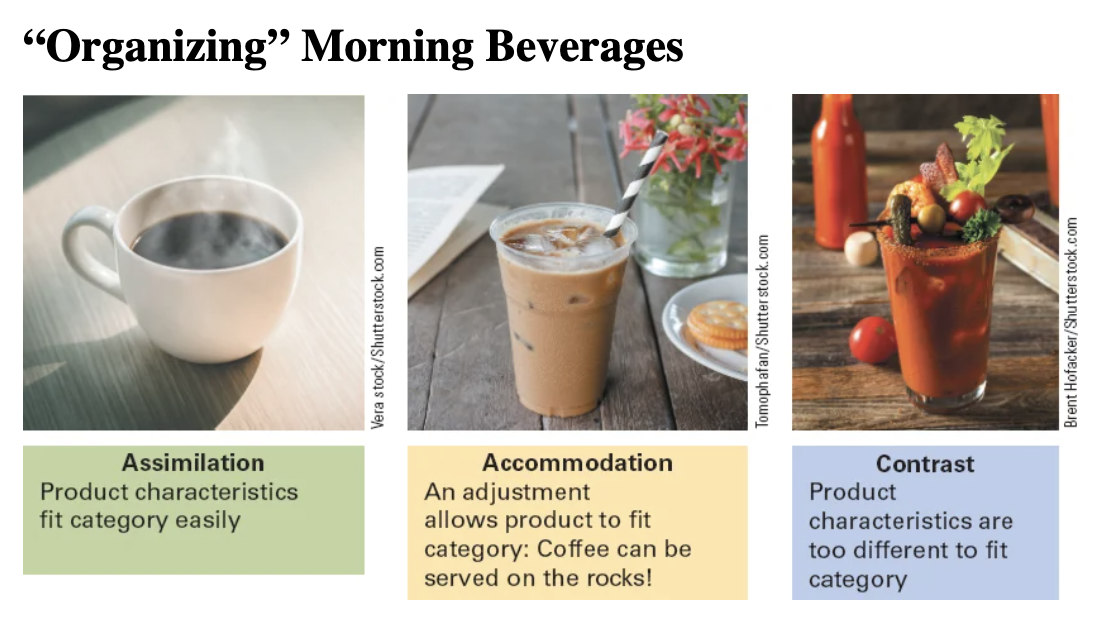
Assimilation
Accommodation
Contrast
Describe Assimilation
Occurs when a stimulus has characteristics such that individuals readily recognize it as an example of a specific category.
Example: Hot, brown coffee served in a ceramic mug fits the “morning beverage” category easily
Describe Accommodation
When a stimulus shares some, but not all, of the characteristics that allow it to fit neatly into an existing category
At this point, the consumer will begin processing, which allows exceptions to rules about the category
Example: An iced coffee may require some adjustment for a consumer used to hot coffee as a morning beverage.
Describe Contrast
Occurs when a stimulus does not share enough in common with existing categories to allow categorization. (VERY DIFFERENT FROM REST)
Example:
A cold, bright red, alcoholic, spicy beverage served in a salt-rimmed glass shares very little in common with the “morning beverage” category.
The differences are so great that the consumer cannot even force a fit through accommodation.
The perceptual process ends with
a reaction.
Example: If an object is successfully recognized, chances are that some nearly automatic reaction takes place.
Difference between Selective exposure & Selective attention
Process of screening out certain stimuli and purposely exposing oneself to other stimuli
Selective Distortion definition
process by which consumers interpret information in ways that are biased by their previously held beliefs
What is subliminal processing?
subliminal processing is way that the human brain deals with very low-strength stimuli, so low that the person has no conscious awareness of it
What is a absolute threshold
Minimum strength of a stimulus that can be perceived
Subliminal Persuasion is
Behaviour change induced by subliminal processing
What is the difference between Just noticeable difference & Just meaningful difference
Just noticeable difference (JND) - condition in which one stimulus is sufficiently stronger than another so that someone can actually notice that the two are not the same
Just meaningful difference (JMD) - smallest amount of change in a stimulus that would influence consumer consumption and choice
What is Weber’s Law?
Law stating that a consumer’s ability to detect differences between two levels of a stimulus decreases as the intensity of the initial stimulus increases
Types of Memory (2)
Explicit Memory
Implicit Memory
Explicit Memory
Memory that develops when a person is exposed to, attends to, and tries to remember information
Implicit Memory
memory for things that a person did not try to remember
Pre-attentive effects
learning that occurs without attention
What is the mere exposure effect
that which leads consumers to prefer a stimulus to which they’ve previously been exposure
Explain involuntary attention & orientation reflex
involuntary attention - attention that is beyond the conscious control of a consumer
orientation reflex - natural reflex that occurs as a response to something threatening
What factors get attention? (6)
Intensity of Stimuli
Contrast
Movement
Surprising
Size of Stimuli
Involvement
Explain Unintentional & Intentional learning
unintentional learning - learning that occurs when behaviour is modified through a consumer–stimulus interaction without any effortful allocation of cognitive processing capacity toward that stimulus
intentional learning - process by which consumers set out specifically to learn information devoted to a certain subject
behaviourist approach
to learning theory of learning that focuses on changes in behaviour due to association, without great concern for the cognitive mechanics of the learning process
Information processing (or cognitive) perspective
approach to learning that focuses on changes in thought and knowledge and how these precipitate behavioural changes
Classical conditioning is a
change in behaviour that occurs simply through associating some stimulus with another stimulus that naturally causes some reaction; a type of unintentional learning
Difference from Unconditional Stimulus & conditioned Stimulus
unconditioned stimulus - stimulus with which a behavioural response is already associated
conditioned stimulus - object or event that does not cause the desired response naturally but that can be conditioned to do so by pairing with an unconditioned stimulus
What is instrumental conditioning
type of learning in which a behavioural response can be conditioned through reinforcement—either punishment or rewards associated with undesirable or desirable behaviour
positive reinforcers are
reinforcers that take the form of a reward
What is discriminative stimuli
stimuli that occur solely in the presence of a reinforcer
What is shaping
process through which a desired behaviour is altered over time, in small increments
What are “punishers“
Stimuli that decrease the likelihood that a behaviour will persist
Negative reinforcement
removal of harmful stimuli as a way of encouraging behaviour
Extinction is
process through which behaviours cease because of lack of reinforcement