Unit 2 Renaissance
 Call Kai
 Learn
Learn Practice Test
 Spaced Repetition
 Match
Match Flashcards
 Knowt Play
1/59

There's no tags or description
Looks like no tags are added yet.
Name | Mastery | Learn | Test | Matching | Spaced | Call with Kai |
|---|
No analytics yet
Send a link to your students to track their progress
60 Terms
Renaissance
The rebirth of European society after the 14 century in learning, art, literature and culture. It begins in urban Italy where specialization of labor and communication made ideas flow easily.
Wealth promoted sponsorship.
Italian Urbanization
Creation of Italian City States such as Florence and Venice.
Note That Italy was not a state until much later.
Rebirth of Italian Nobility
Kings begin selling noble titles to high class merchants. There is also a major shift from a militaristic education to more of a humanist one as shown in The Book of the Courtier by Castiglione.
The Book of the Courtier, Baldassare Castiglione
Published in 1528 this work serves as the handbook for nobility at the time. Castiglione valued military prowess and athleticism as well as a foundation in the humanist arts.
This is where the “Renaissance Man” concept came about.
States that chivalry should be inherent.
Renaissance Family
Families were large, extended families with a lot of power. These families often owned entire city blocks. These families often had rivalries because family loyalty was above all; there was no nationalism at this time.
Careful attention was paid to marriages which were often planned years in advance to be strategic with power shifts and dowries.
The marriage situation caused a massive rape problem in urban Italy. Prostitution was supported.
Patriarch made all decisions. Many younger sons would leave due to lack of inheritance; however the patriarch had to legally excommunicate them for them to leave.
Humanism
An educational system based on Greco-Roman classical culture. Focused on rhetoric, history, poetry, literature civics and ethics.
Was not Religious based
Had a profound effect on education. Renaissance humanists believed that human beings could be dramatically changed by education.
Liberal Arts
The focuses of Humanism.
Rhetoric, history, poetry, literature civics and ethics.
Petrarch
The Father of Italian Humanism. He became a poet against his fathers will.
He began gathering classical sources and copying them from libraries in Constantinople, Alexandria as well as private collections.
“Christ is my God; Cicero is the prince of the language.”
Civic Humanism and Cicero
Cicero was the model for civic humanism. He was a great orator who made speeches regarding human liberties. Many Place him on the same level as Plato and Aristotle
He was killed when opposing move of Rome from Republic to Dictatorship.
Leonardo Bruni
Perfect example of civic humanism
The chancellor of Florence who had the viewpoint that those who didn’t use their humanist education were worthless.
Believed that it was the duty of an intellectual to live an active life for one’s state.
Lorenzo Valla
A papal secretary to Nicholas V who proved the donation of Constantine fake.
He was removed for this action.
Florentine Platonic Academy
A group of humanist scholars who tried to meld Platonic and Christian concepts together.
This is Known as Neoplatonism
Marsilio Ficino
His Neoplatonism was based upon two primary ideas, the Neoplatonic hierarchy of substances and theory of spiritual love (platonic love).
Had a hierarchy of life that had man below God with man trying to attain a union with God at Death. This is the origin of Neoplatonism.
Humans were the link between the material world and the spiritual world, and it was humanity’s duty to ascend toward that union with God—the purpose of existence.
Platonic love maintained that people and the universe are bound together in sympathetic love.
Pico della Mirandola
Writes the Oration on the Dignity of Man which states that only man had the privilege to gain a union with God.
Was Ficino’s student.
Held that human potential was limitless through the grace of God.
Vernacular
The Common Tongue
Writing in the vernacular comes about with the Tuscan Triumvirate
Petrarch, Dante Alighieri and Boccaccio
1381 Canterbury Tales are written in vernacular
Early 1400s Rabelais (a major French Renaissance writer, physician, and humanist) brings vernacular to France.
Dante Alighieri
Major work was the Divine Comedy in which he travels with Virgil. Highly symbolic and shows that humanist education and knowledge only take you so far.
Giovanni Boccaccio
Florentine Nobleman who wrote The Decameron, a group of short stories set in Florence and the surrounding area during the plague. Follows a group of nobles who escaped the plague and party in a country estate.
Johannes Gutenberg
Invents the printing press in 1456 which speeds up literacy in Europe by decreasing book price.
Italian Renaissance Art
First modern era of art this showed massive transition from the gothic art of the previous century.
Classic values of symmetry and perfection and depth are shown
Used depth and perception mostly on Fresco
Brunelleschi 1434-1461
Begins Shift in architecture with his dome of the Santa Maria del Flore
Donatello’s David
Beginnings of sculpture which Michelangelo built off of.
School of Athens, Raphael 1510
Embodies humanism ideas by depicting the gathering of many Roman and Greek
Brunelleschi 1434-1461
Begins Shift in architecture with his dome of the Santa Maria del Flore
Donatello’s David
Beginnings of sculpture which Michelangelo built off of.
School of Athens, Raphael 1510
Embodies humanism ideas by depicting the gathering of many Roman and Greek
Northern Humanism / Christian Humanism
All Humanism Outside of Italy mainly Flanders, Germany, Spain, Netherlands, France and England
Heavier focus on classical Christian sources, they found the Church added rituals to Christianity that were not supposed to be there. Northern Humanists wanted people to focus on Christianity and not the rituals. Really was a reform movement.
Machiavelli
Major figure in civic humanism that began a trend of power politics, Get Power and keeps it at all cost and by any means.
He also promoted diplomacy which also brought along espionage.
Began concepts of Embassy
Wrote “The Prince” based on Cesare Borgia
His major concerns in the work were the acquisition and expansion of power as man’s to restore order in his time. From Machiavelli’s point of view, a prince’s attitude toward power must be based on an understanding of human nature, which he saw as selfish and cruel—political activity, therefore, could not be restricted by moral considerations.
Major City State
Naples
Papal States
Republic of Florence
Milan
Venice
Cosimo de Medici
Successful Medici leader who opens the first bank of Europe. He basically becomes a loan shark and many nobles owe him money. Giving him great power and influence.
Had many political favors from people who owed him money, including the Church who made his son a cardinal at age 13.
Lorenzo De Medici
Under Lorenzo Florence reaches the height of its power. Economically it prospers and draws artists to the area for funding. As soon as Lorenzo Dies it all falls apart.
Girolamo Savonarola
Preached against the Medici’s calling them devil spawn. He gains the backing of the people and successfully seizes power in Florence. He then burns artwork and books in Florence to get rid of things the Medici’s had invested money into. Alexander VI sends Cesare to remove him when he preaches against the Papacy.
Visconti Family
The primary rulers of Milan. They were the Dukes of Milan until Lombardy rebels. Needing help they call in Sforza who stays in Milan and takes power.
Naples
Ruled by a hereditary monarchy, which constantly changes hands into the Trastamaras who came from Spain. This caused a volatile political climate in Naples
By far the worst off economically of the major states. It only had power because of the population and size of it. Also was the least urbanized area of Italy.
Papal States
Ruled by the pope. It was actually several independent city states conquered by Cesare Borgia.
Overall very wealthy due to the wealth of the church.
Republic of Florence
Very volatile government with power constantly changing hands until in 1431 the Medici’s bring stability.
Very well off economically due to wool and silk industries. Also wealthy due to the banking of the Medici’s who become loan sharks in this time.
Milan
Had Enemies on all sides, Florence, Venice, Swiss, French and Germans. Thus they had a militaristic government with a strong military. It was primarily led by the Visconti Family until Francesco Sforza takes over after putting down the rebellion in Lombardy.
Made money primarily off the armor and weaponry industries
Venice
Oligarchy ruled by the best merchants of Venice. Very stable government. Every year a Doge (Duke) was elected as a figurehead.
Very stable state economically and by far the wealthiest of all. Made money through taxation on trade and trade itself.
They could not take over Italy due to the impending Ottoman threat.
Francesco Sforza
A powerful condottiere who is called in by the Visconti’s to put down the rebellion in Lombardy. Sforza stays in Milan and takes power at which point he marries a Visconti to ensure his position.
Renaissance Papacy
The papacy of this era had a lot of power and even made wars on other states. The popes of this time led scandalous lives and took advantage of any opportunity to make money.
Pope Alexander VI
Originally Rodrigo Borgia takes power. He immediately makes his son a cardinal and sends his son Cesare to take over surrounding states. Also led a scandalous adult life.
Pope Julius II
Known as the “Warrior Pope” due to his constant military campaigns. The popes’ concern with politics stemmed from their desire to restore temporal papal authority
He was a major patron to the arts during his time. Providing a lot of funding for artists through the wealth of the Church.
Cesare Borgia
Son to Alexander XI who conquers Bologna and Romagna for the Papal States. He becomes the picture of Jesus in this era thanks to his father the pope.
Cesare was also a cardinal thanks to his father.
Italianization of Europe
Europe’s culture had become completely Italianized. Humanism spread throughout Europe as well as the concepts found in Italian art and literature. Italy also kick starts the age of exploration.
The Italian Currencies of the Ducat and Florin were accepted all across Europe.
Peace of Lodi
A peace between the 5 major city states in Italy that gave them forty years to conquer all the smaller city states before they resumed fighting.
Mehmed II and the Ottoman Threat
The ottomans conquered the Balkans and the Middle East they also sacked Constantinople in 1453.
By 1450, they were moving on the Aegean and Adriatic.
Venice was most directly affected by the Ottoman advance. Not only was their overseas empire overrun by the Ottomans, but their dominance over European trade and commerce was upset greatly. By 1480, Venetian naval supremacy was a thing of the past.
The city-states might have met this challenge from the Ottomans had they been able to unite in opposing it. Successive popes pleaded for this union to start a holy war against the Turks; the fall of Constantinople in 1453 was such a shock to the world that many that it was the signal of the end of days.
Sack of Constantinople
This was seen as the end of all ties to Ancient Rome (because it was the end of the Eastern Roman Empire).
Wars of Italy (1494-1529)
Italy’s war amongst themselves that ended them. After the Peace of Lodi the Papal States ally with Florence and Naples to take down Milan. Milan calls in the King Charles VIII of France to Italy fight. Florence and Naples fall to the France but the papal states are spared due to Catholicism. Venice fearing its own demise calls in the Spanish (Ferdinand of Aragon) and Germans (Holy Roman Empire).
Italy becomes a playground for the next fifty years.
Ludovico (il Moro) Sforza
The leader of Milan who asked Charles VIII to invade during the Wars of Italy
King Charles VIII
The French king invited into Italy by Milan during the Wars of Italy
Sack of Rome
Rome is sacked by the Germans in 1527 as they pillage in Italy
“The final blow to Italian hegemony was the sack of Rome in 1527 by German mercenaries sanctioned by Holy Roman Emperor and King of Spain Charles V.” - Tyler
Desiderius Erasmus
First Professional Scholar who wrote The Handbook of the Christian Knight which focuses on living a Jesus led life without all the Churches rituals.
Promoted Humanist Literacy for reading of the Bible
Also wrote the Praise of Folly which is a satire about power abusive and corrupt clergy.
Sir Thomas More
A close friend of Erasmus who becomes the advisor of Henry VII. Henry promotes him to Lord Chancellor until More opposes him on divorce. More retires and writes Utopia until Henry returns with the act of Supremacy in 1534 which More refuses to sign and is thus killed.
Utopia is about a fictional place of perfect society in the new world
Utopia means nowhere in greek.
Reflects More’s own concerns with the economic, social, and political problems of his day. He presented a new social system in which cooperation and reason replaced power and fame as the proper motivating agents for human society. Utopian society, therefore, is based on communal ownership and cooperative living, not private property.
Northern Renaissance Art
Northern Renaissance art was done primarily by Flemish, Dutch and German artists. They maintained the same classical Ideals as Italy and most of their art was Christian as well. However the themes of this art were darker than in Italy.
First to master Oil Based paints. Also use lots of Triptychs in their art.
Jan Van Eyck
Albrecht Durer 1500
Hans Holbein the younger
Pieta Brueghel
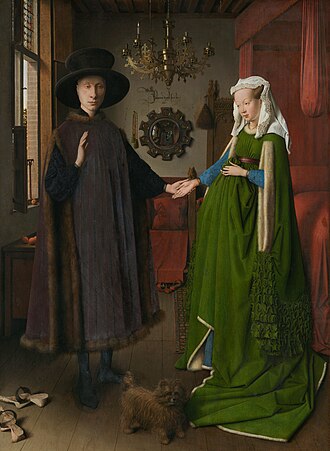
Jan Van Eyck
Was the first to master oil based paints which allowed for more detail than frescos. He was 80 years before Michelangelo. He did Marriage of the Arnolfini which is amazing in its symbolism and detail.
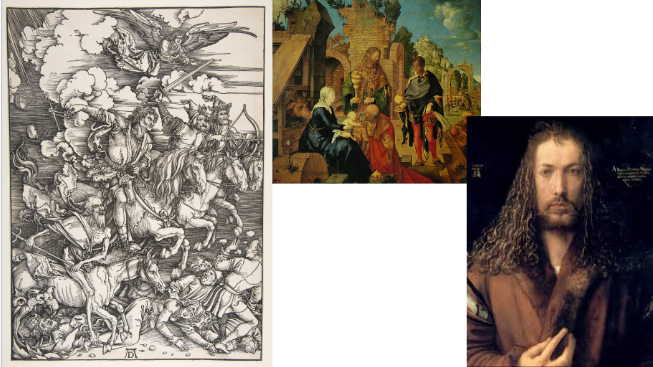
Albrecht Durer
Self Portrait 1500. Worked in paintings and woodcuts. Painted The Four
Horseman of the Apocolypse in 1498, and the Adoration of the Magi
Hans Holbein the younger
painted the Portrait of Erasmus and Sir Thomas More.
King Henry VIII's favorite painter, so painted people like the king, Anne Boleyn and public officials
highly detailed, realistic portraits
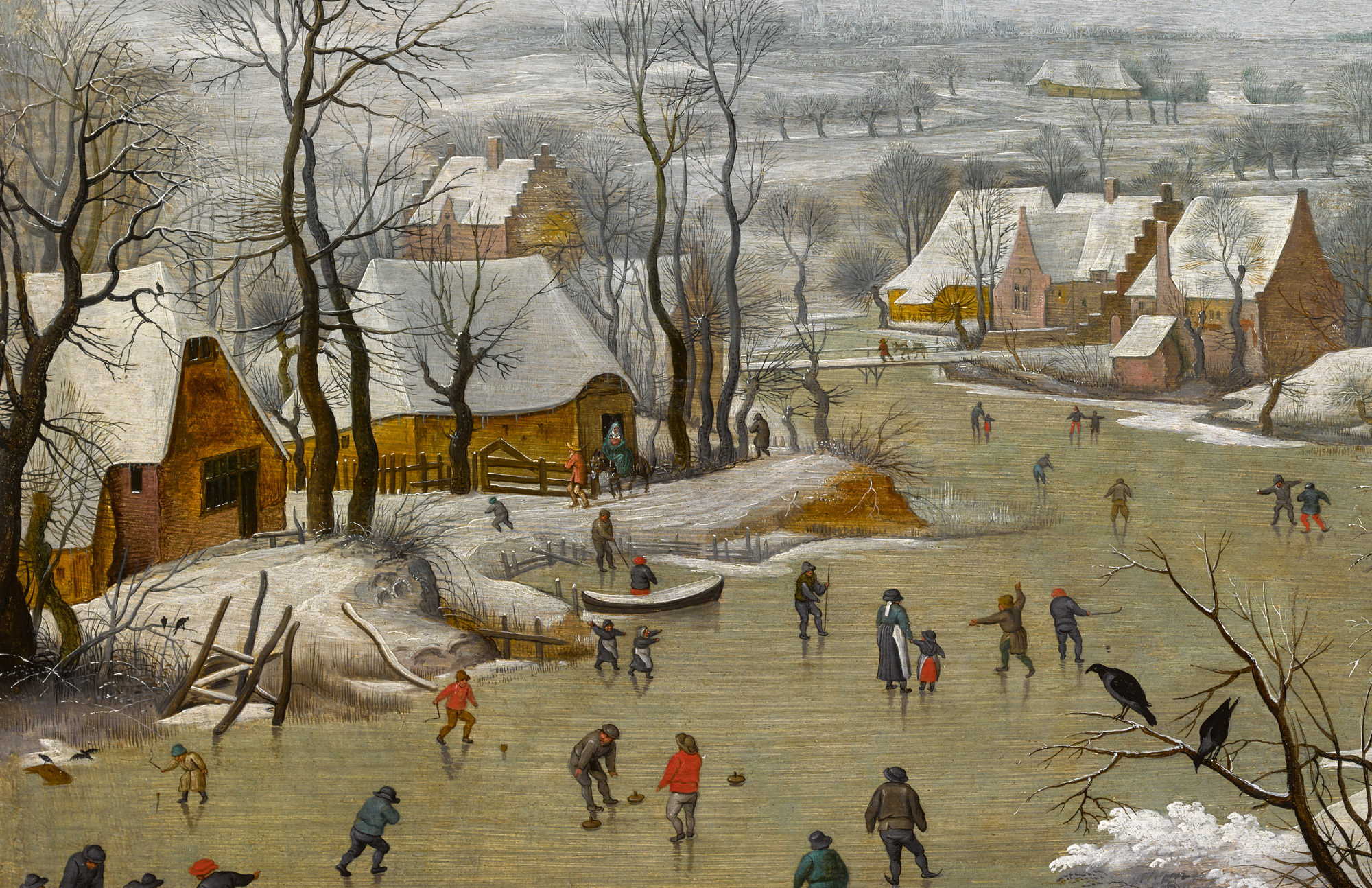
Pieter Brueghel
did many works of landscapes such as Winter Landscape and depicted peasant life as in Peasant Wedding. Something uncommon in the art of that time.
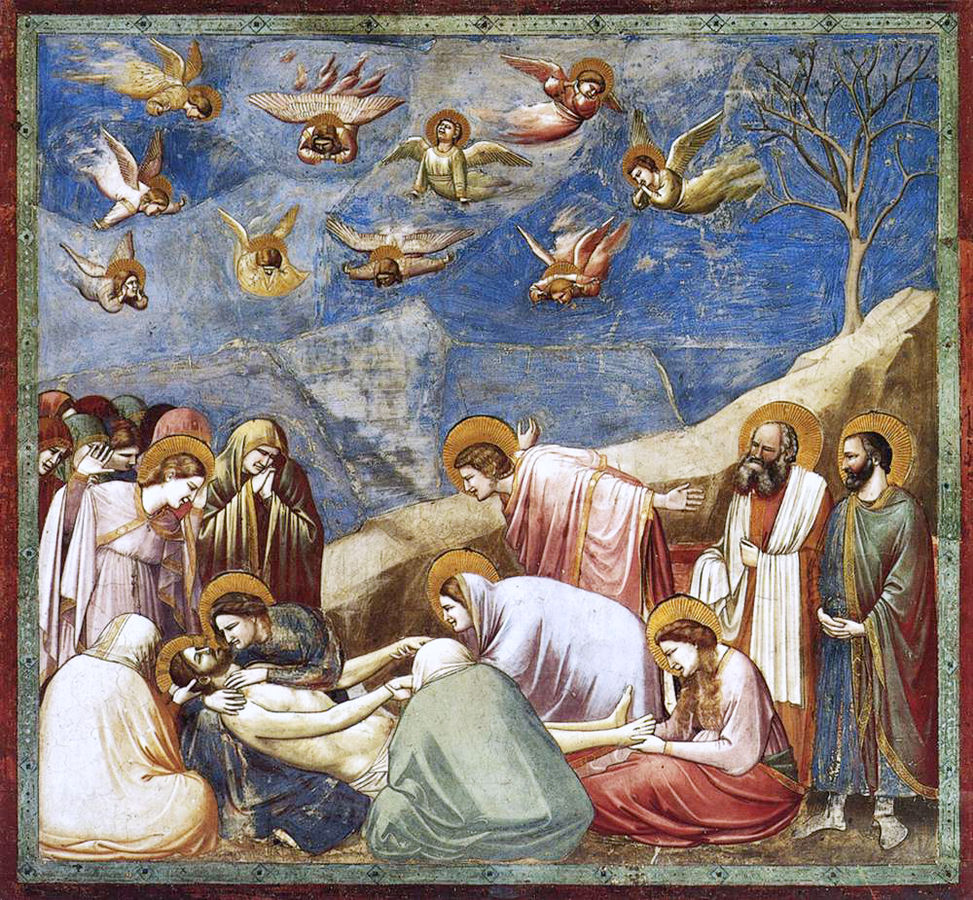
Giotto
Bridge between Gothic art and Renaissance art, began experimenting with perspective
Lamentation, Kiss of Judas
Ghiberti
Did the “Gates of Paradise” in Florence, won the commission over Donatello and Brunelleschi.
Bronze, gilded over in gold
Panels of the stories of the Old Testament
Featured important figures from Ancient Greece and Rome
Piero della Francesca
First to master perspective and depth
Donatello
Sculptures
Penitent Magdalene, David in bronze
Botticelli
The Adoration of the Magi, Primavera, Birth of Venus
Raphael
School of Athens
Embodies humanism ideas by depicting the gathering of many Roman and Greek Thinkers such as Plato Aristotle and Pythagoras.