Topic 5 - Separate Chemistry I
 Call Kai
 Learn
Learn Practice Test
 Spaced Repetition
 Match
Match Flashcards
 Knowt Play
1/140

There's no tags or description
Looks like no tags are added yet.
Name | Mastery | Learn | Test | Matching | Spaced | Call with Kai |
|---|
No analytics yet
Send a link to your students to track their progress
141 Terms
properties of transition metals(7)
very lustrous
hard
strong
good heat conductors
good electrical conductors
highly dense
very high mps
oxidation state
a number given to show if the element has been oxidised or reduced. The oxidation state of an ion is simply the charge on the ion
Do transition metals have just one oxidation state?
No they can have more than one
Why can transition metals have more than one oxidation state?
They can lose a different number of electrons depending on the chemical environment they are in
Are transition metals colourful?
No but the compounds they form are
How does the differing oxidation state of a transition metal have on its compounds in aqueous solutions?
They will have differing properties and colours
Uses of transition metals(3)
catalysis
medicine
other industrial applications
Why are transition metals used in catalysis?
They can be used as catalysts as their catalytic characteristics stem from their ability to interchange between a range of oxidation states.
This allows them t form complexes with reagents that can easily donate and accept electrons from other chemical species within a reaction system
What is iron used in?
The Haber Process
What is nickel used in?
the hydrogenation of alkenes
What is vanadium pentoxide used in?
The Contact Process to produce sulfuric acid
Why are transition metals used in medicine
Due to their hardness and strength, they can be used in surgical applications such as limb and joint replacement.
Titanium is useful in particular as it is the only element that can bond with bones due to its high biocompatibility
How are transition metals used in industrial applications?
They can form coloured compounds for dyes and paints
They are used in creating stained glass, jewellery and in anti-corrosive materials
corrosion
the destruction of materials by chemical substances in their environment which act on them over a period of time
Most metals corrode in which gas presence to form what compound?
oxygen to form a metal oxide
What type of reaction is corrosion caused by and how?
Redox
Tis is because the metal loses electrons and is oxidised whilst the oxygen gains electrons and is reduced
rusting
the corrosion of specifically iron in the presence of water and oxygen in the air
rusting equation
iron + water + oxygen ⟶ hydrated iron(III)oxide
How do barrier methods prevent rusting?
They prevent the iron from coming into contact with water and oxygen
Problems with barrier methods?
If the coating is washed away are scratched the iron is again exposed to water and oxygen and will rust
Common barrier methods(4)
grease
oil
paint
plastic
What metal is used in galvanising?
Zinc
Why does galvanising work?
Because zinc is more reactive than iron
How does galvanising work?
Iron is coated in a layer of zinc.
A barrier method is formed when zinc reacts with oxygen and carbon dioxide in the air to form zinc carbonate
If the coating is damaged/scratched then zinc anyways preferentially corrodes due to its higher reactivity position and loses its 2 electrons and the iron stays protected as it accepts the electrons released by zinc, remaining in the reduced state and thus it doesn’t undergo oxidation
The electrons donated by zinc also reacts with hydrogen ions in the water producing hydrogen gas
Therefore zinc reacts with oxygen and water and corrodes instead of the ion
sacrificial corrosion
when a more reactive metal is intentionally allowed to corrode
Where is sacrificial corrosion used?
In ships’ hulls which sometimes have large blocks of magnesium or magnesium alloys attached which corrode de and provide protect to the hull the same way zinc does by pushing electrons onto the iron which prevents it from being oxidised
electroplating
a process where the surface of one metal is coated with a layer of a different, less reactive metal
What is the anode in electroplating?
The pure substance used to coat
What is the cathode in electroplating?
The object to be electroplated
What is the electrolyte in electroplating?
An aqueous solution of a soluble salt of the pure metal at the anode
Uses of electroplating(3)
Makes metals more resistant to corrosion or damage
For a tin can(actually a steel can with 1% tin on the interior surface) it can resist corrosion from the liquids inside
Improving the appearance of metals e.g. silver plating cutlery and jewellery
alloys
mixtures metals where the metals are mixed together physically but not chemically combined
What properties do alloys have to can be different to the metals the contain?
Greater strength
greater hardness
greater resistance to corrosion
extreme temperatures
Why are alloys much harder than pure metals?
They contain atoms of different sizes which distorts the regular lattice arrangements of atoms
This makes it more difficult for the layers to slide over each other so they are usually much harder than the pure metal
What is cast iron?
Iron from a blast furnace.
It is an alloy of 96% iron with carbon phosphorus, silicon, and sulfur impurities
Why is cast iron converted into steel?
It is too brittle for many used
What is iron alloyed with in mild steel?
0.25% carbon
What is iron alloyed with in high carbon steel?
0.5-1.4% carbon
What is iron alloyed with in low alloy steel?
1-5% of other metals(chromium, nickel, titanium)
What is iron alloyed with in stainless steel?
20% chromium
10% nickel
Uses of mild steel
car body panels
wires
uses of high carbon steel
tools and chisels
Uses of low alloy steel
construction bridges
high speed tools
Uses of stainless steel
cutlery and sinks
chemical plants
properties of mild steel
relatively soft
tough
malleable
magnetic
cheap
can be recycled
properties of high carbon steel
hard but brittle
properties of low alloy steel
hard and strong
low ductility
low malleability
properties of stainless steel
strong
resistant to corrosion
Are alloys a compound?
no
What is magnalium
an aluminium alloy
What are the properties of magnalium(5% Mg)?
Lighter
stronger
more corrosion resistant than aluminium
What is magnalium(5% Mg) used in?
Automobile and aircraft construction
What is magnalium (50% Mg) used in and why?
The production of fireworks as it is more stable than pure magnesium but still burns brightly
Uses of aluminium(5)
aeroplane bodies
overhead power cables
saucepans
food cans
window frames
Why is aluminium used in aeroplane bodies?
High strength to weight ratio(low density)
Why is aluminium used in overhead power cables?
good conductor of electricity
Why is aluminium used in saucepans?
good heat conductor
Why is aluminium used in food cans?
non toxic
corrosion resistant
acidic food stuffs
Why is aluminium used in window frames?
Corrosion resistant
bronze
an alloy made of copper and tin
Is bronze harder than copper or the other way around?
bronze > copper
uses of bronze
making ornaments and medals
brass
an alloy containing 70% copper and 30% zinc
properties of brass
decorative
corrosion resistant
uses of brass
low friction ornamental purposes such as plumbing and carpentry fittings
uses of copper
electrical wires
water pipes
Why is copper used in electrical wires?
It’s a good electrical conductor and malleable
Why is copper used in water pipes?
Easy to work with and bend
non-toxic
unreactive(doesn’t react with water)
properties of gold
soft
malleable
What do carats represent?
The purity of gold jewellery
What is the maximum carat?
24 carat
(100% gold)
What does a 12 carat piece of jewellery at 50g contain?
50% gold
therefore 25g of the jewellery is pure gold
concentration formula in mol/dm3
number of moles of solute(mol) / volume of solution(dm3)
How do go from g/dm3 to mol/dm3 and vice versa
g/dm3 to mol/dm3 - divide by molar mass in grams
mol/dm3 to g/dm3 - multiply by molar mass in grams
How to go from cm3 to dm3 and vice versa
cm3 to dm3 - divide by 1000
dm3 to cm3 - multiply by 1000
Equipment for preparing the solution to add for a titration
The solution plus indicator is added into the burette
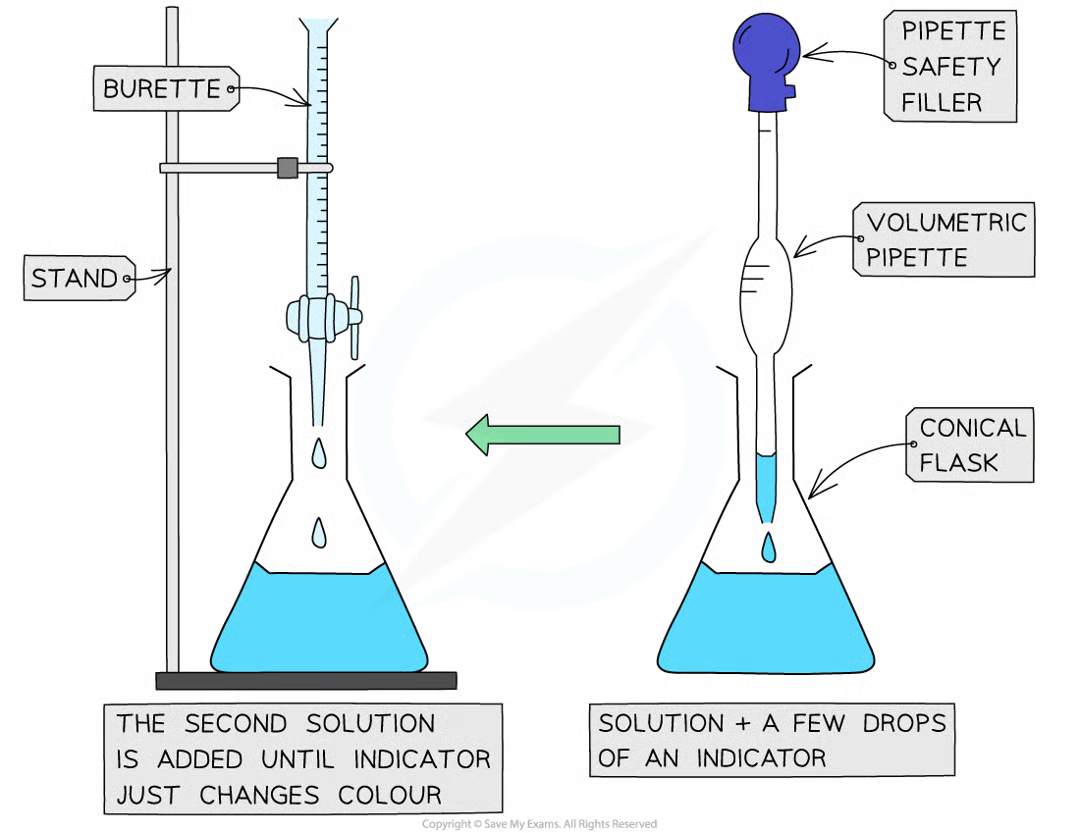
CP: Titration Steps
Use the pipette and pipette filler and place exactly 25 cm3 sodium hydroxide solution into the conical flask
Place the conical flask on a white tile so the tip of the burette is inside the flask
Add a few drops of a suitable indicator to the solution in the conical flask
Perform a rough titration by taking the burette reading and running in the solution in 1 – 3 cm3 portions, while swirling the flask vigorously
Quickly close the tap when the end-point is reached (sharp colour change) and record the volume, placing your eye level with the meniscus
Now repeat the titration with a fresh batch of sodium hydroxide
As the rough end-point volume is approached, add the solution from the burette one drop at a time until the indicator just changes colour
Record the volume to the nearest 0.05 cm3
Repeat until you achieve two concordant results (two results that are within 0.1 cm3 of each other) to increase accuracy
How to complete titration calculations?
Step 1: Write out the balanced equation for the reaction
Step 2: Calculate the moles of the known solution given the volume and concentration
Step 3: Use the equation to deduce the moles of the unknown solution
Step 4: Use the moles and volume of the unknown solution to calculate the concentration
yield
the amount of product you get from a reactant
Is 100% yield possible in reality?
No, never
Why is yield never 100% in reality?
Some reactants may be left behind in the equipment
Reversible reactions will never get high yield as products are turning back into reactants
Products may be lost during separation and purification stages such as filtration or distillation
There may be side reactions where a substance reacts with a gas in the air or an impurity in 1 of the reactants
Products can also be lost from transfer of one container to the other
actual yield
the recorded amount of product obtained
theoretical yield
the amount of product that would be obtained under perfect practical and chemical conditions
How is theoretical yield calculated?
From the balanced equation and the reacting masses
percentage yield equation
actual yield/theoretical yield x 100
reaction pathways
a sequence of reactions which must occur to produce the required product.
Does a compound have only 1 reaction pathway?
No, multiple reaction pathways can lead to the creation of the same compound
Why is percentage yield useful in industry?
It allows companies to test out different reaction pathways and these are then compared and evaluated so that a manufacturing process can be chosen
atom economy
a way of measuring the efficiency of a reaction by comparing the amount of useful products measured to the total amount of products made
Why is atom economy important for industry?
Used in an effort to obtain sustainable development
The higher the atom economy the more sustainable that process is
It is also economically better to use processes with higher atom economies
atom economy formula
total relative formula mass of desired product/total relative formula mass of all products x 100
What must you remember about the RFM when doing atom economy?
Include the superscript(the coefficient)
What is the problem with low atom economy reactions?
They use up a lot of resources and produce a lot of waste material that need to be exposed of.
It’s pretty expensive as raw materials and the waste disposal(which requires chemicals equipment, space and transport)
How can atom economy be improved?
Finding a way to make the waste products useful
Selling or reusing the waste products could help
Considering alternative methods of production that may produce a more useful by product is also not a bad idea
molar volume equation
amount of gas moles x 24(dm3/mol)
Avogadro’s Law
Equal volumes of all gases at the same temperature and pressure, contain the same number of molecules and moles
What are the conditions for room temperature?
20 degrees Celsius
1 atm
1 mole of any gas at room temperature occupies what volume?
24 dm3/mol
What does the stoichiometry of a reaction and Avogadro’s Law enable us to do?
deduce the exact volumes of gaseous reactants and products
If gas volumes are not in the same ratio as the coefficients then what determines the amount of product?
The amount of product is determined by the limiting reactant so it is essential to identify it first