Infections of the nervous system – III
 Call Kai
 Learn
Learn Practice Test
 Spaced Repetition
 Match
Match Flashcards
 Knowt Play
1/33

There's no tags or description
Looks like no tags are added yet.
Name | Mastery | Learn | Test | Matching | Spaced | Call with Kai |
|---|
No analytics yet
Send a link to your students to track their progress
34 Terms
What is the pathogen of cattle and sheep that causes septicemia, Thrombotic meningoencephalitis (TME)?
Histophilus somni
What causes Glasser’s disease in pigs?
Glaesserella (Haemophilus) parasuis
Glaesserella (Haemophilus) parasuis and Histophilus somni are gram- ___
negative
Haemophilus spp. does NOT grow on
MacConkey agar
Fastidious in growth
H. parasuis and Avibacterium paragallinarum require growth factor V (NAD)
TME and Glasser’s disease occur ____ due to predisposing factors.
opportunistically
Virulence factors of H. somni
Endotoxin
Phase variation of its lipo-oligosaccharide (LOS)
Production of transferrin-binding proteins (Tbps)
Immunoglobulin-binding proteins
Diagnostic Procedures for H. somni
Either chocolate agar or blood agar inoculated with a streak of S. aureus, incubated in 5-10% CO2 at 37oC for 2 to 3 days in moist atmosphere, is used for isolation
PCR
Disease associated with H. somni in cattle
Septicemia and thrombotic meningoencephalitis
Disease associated with Glaesserella (Haemophilus) parasuis in pigs?
Glasser’s disease
Clinical signs of infections caused by H. somni in cattle
Septicemia
Thrombotic meningoencephalitis (TME)
dead, high fever, depression, blindness, lameness, & ataxia
Sudden death due to myocarditis
Arthritis
What is Thrombotic meningoencephalitis (TME) ?
Common consequence of septicemia, is encountered sporadically in young cattle recently introduced to feedlots due to infection in cattle caused by H. somni
What pathogen is commonly isolated from the enzootic calf pnemonia complex?
Histophilus somni
Diagnosis of Infection caused by H. somni in cattle
Severe neurological signs
Multiple foci of hemorrhagic necrosis,
Cattle affected by H. somni should be
isolated
Treatment of infection by H. somni in cattle?
Oxytetracycline is used for therapy
Healthy sheep may carry __ __ of H. somni in prepuce or vagina
ovine strains
What does H. somni cause in young rams?
epididymitis
What does H. somni cause in ewes?
Vulvitis, mastitis and reduced reproductive performance
What does H. somni cause in (lambs)
Meningitis
Septicemia
Glasser’s Disease manifests as
polyserositis and leptomeningitis
Who does Glasser’s Disease affect?
s pigs from weaning up to 12 weeks of age
How do piglets acquire infection of Glasser’s Disease?
by direct contact or aerosols from sows shortly after birth
Diagnosis of Glasser’s Disease
Isolation and identification of G. parasuis from joint fluid, heart blood, CSF, post-mortem tissues of a recently dead pig are confirmatory
Post-mortem findings of pigs with Glasser’s Disease includes:
polyserositis, polyarthritis and meningitis
Treatment of Glasser’s disease includes
Antimicrobial drugs as tetracycline, penicillin and potentiated sulfonamides administered early in the course of disease are effective
What is the causative agent of Cryptococcosis?
Cryptococcus neoformans, a capsulated yeast. NOT a dimorphic fungus
Cryptococcosis is most common in
cats
Reservoir for Cryptococcosis is
Soil especially associated with pigeon excreta
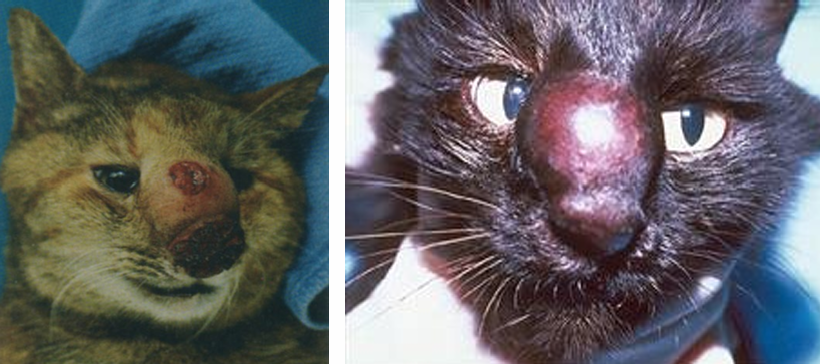
Clinical signs of Cryptococcosis in Cats
Hard, nodular skin swellings, most often over the bridge of the nose
Distortion of the nasal cavity as a result of bone invasion
Neurologic abnormalities
Eye disorders
Cryptococcus neoformans remain in what forms in the environment and host?
yeast form in both
What is the most primary site of infection from Cryptococcosis?
Nasal mucosa
Treatment of Cryptococcosis
Surgical intervention; cryotherapy.
Antifungals – azoles derivatives.
Diagnosis of Cryptococcosis
Clinical signs
Impression smears of exudate or granulomatous tissue
Culture