Unit 2 Flashcards
 View linked note
 Call Kai
 Learn
Learn Practice Test
 Spaced Repetition
 Match
Match Flashcards
 Knowt Play
1/24

There's no tags or description
Looks like no tags are added yet.
Name | Mastery | Learn | Test | Matching | Spaced | Call with Kai | Chat |
|---|
No analytics yet
Send a link to your students to track their progress
25 Terms
What is the Taylor (Maclaurin) series for e^x?
e^x = Σ_{n=0} (x^n/n!)
What is the interval of convergence for e^x?
(-∞, ∞)
What is the Taylor (Maclaurin) series for sin x?
sin x = Σ_{n=0} (-1)^n (x^{2n+1}/(2n+1)!)
What is the interval of convergence for sin x?
(-∞, ∞)
What is the Taylor (Maclaurin) series for cos x?
cos x = Σ_{n=0} (-1)^n (x^{2n}/(2n)!)
What is the interval of convergence for cos x?
(-∞, ∞)
What is the Taylor (Maclaurin) series for 1/(1 - x)?
1/(1 - x) = Σ_{n=0} (x^n)
What is the interval of convergence for 1/(1 - x)?
|x| < 1
What is the Taylor (Maclaurin) series for ln(1 + x)?
ln(1 + x) = Σ_{n=1}^{∞} (-1)^{n+1} (x^n/n)
What is the interval of convergence for ln(1 + x)?
-1 < x ≤ 1
Operations that DO NOT change the interval of convergence for a power series
1. Adding or removing finite terms
→ Behavior at infinity is unaffected
2. Differentiating term-by-term
→ Same radius; must recheck endpoints only
3. Integrating term-by-term
→ Same radius; must recheck endpoints only
4. Multiplying by a constant
→ Scalar multiplication doesn’t affect convergence
5. Reindexing the series (e.g. start at n = 1 instead of n = 0)
→ Just shifts the labeling, not the convergence
6. Adding or subtracting another power series with the same center and radius
→ Intersection of intervals is still the same
What is 6! 5!, 4!, 3!, 2!, 1! ?
6! = 720 // 5! = 120 // 4! = 24 // 3! = 6 // 2! = 2 // 1! = 1
What are the 5 types of series covered?
Power Series
Taylor Series
Alternating Series
Geometric Series
P-series
Power Series
a_k(x-c)^k
Common Test: Ratio Test
Common Questions: Interval of Convergence, Power Series Representations
Taylor Series
a_k(x-c)^k
a_k = f^k (c) / k!
Alternating Series
(-1)^n * b_k
Converges when: b_k is decreasing and lim = 0
If it doesn’t increase: inconclusive
Alternating Series Error Bound:
| s_n - S | < a_(n+1)
Geometric Series
ar^n
Defined by its common ratio
Common Test: Ratio
Common Problems: interval of convergence
p-Series
1/n^p
Converges when: p > 1
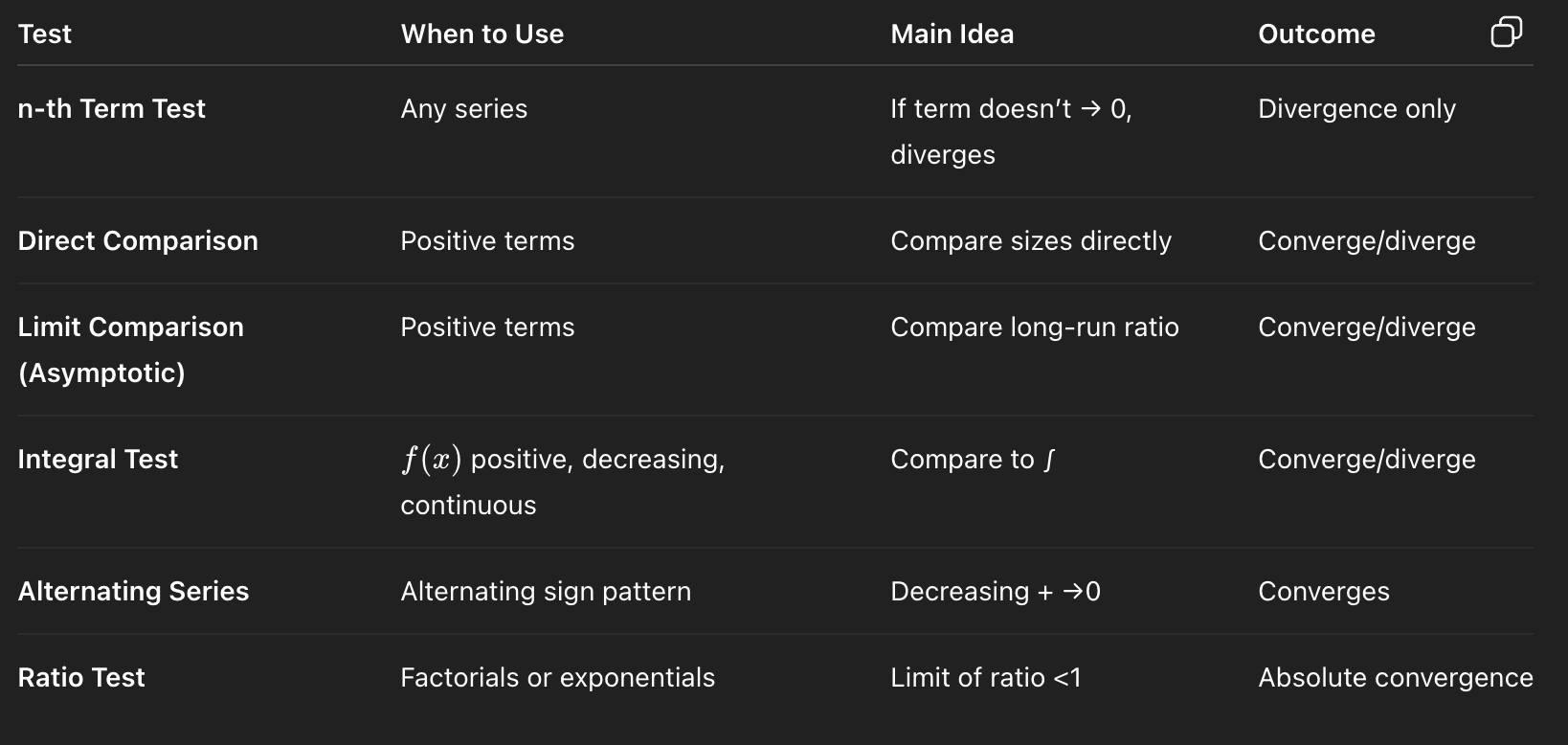
What are the 6 common tests covered
N-th term test
Direct comparison test
Alternating series test
Asymptotic comparison test
Integral comparison test
Ratio test
N-th term test
Purpose:
Quickly check if a series diverges.
Applies to:
→ Any series
Rule:
If lim n→∞ = 0, inconclusive. Otherwise, it diverges
Direct Comparison Test
Purpose:
Compare your series to a known convergent or divergent one.
Applies to:
→ Series with positive terms.
Rule:
Make sure 0 ≤ an ≤ bn
If ... (you know how it works)
Alternating Series Test
Purpose:
Check convergence for alternating series.
Applies to:
→ Series of the form
∑(−1)^n * b_n OR ∑(−1)^(n+1) * b_n
Rule:
bn+1≤bn eventually (terms decrease).
limn→∞bn=0
If BOTH are true, the series converges
Asymptotic Comparison Test
Purpose:
Compare two positive-term series when direct comparison is messy.
Applies to:
→ Series with positive terms.
C ≪lnk ≪ k^a (for 0<a<1) ≪ k^1 ≪ k^m ≪ a^k ≪ k! ≪ k^k
Rule:
If a_n ~ b_n, and b_n converges, the a_n also converges
if a_n ~ b_n, and b_n diverges, the a_n also diverges
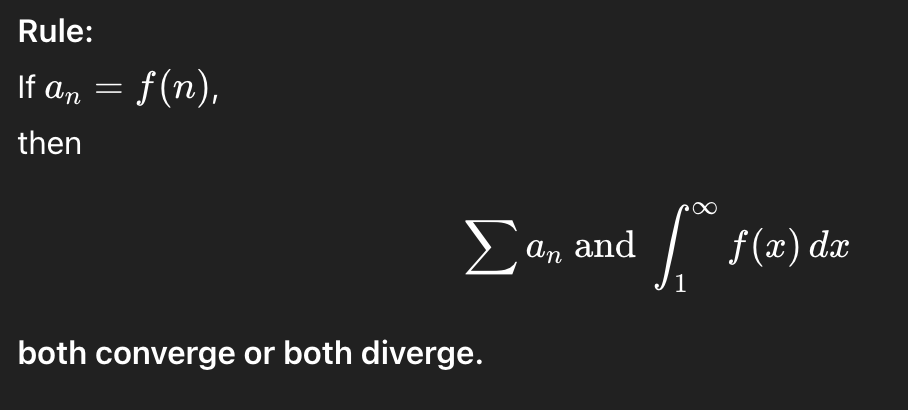
Integral Comparison Test
Purpose:
Compare a series to an improper integral.
Applies to:
→ Series with positive, continuous, and decreasing terms f(x)f(x)f(x).
Rule:
Check image
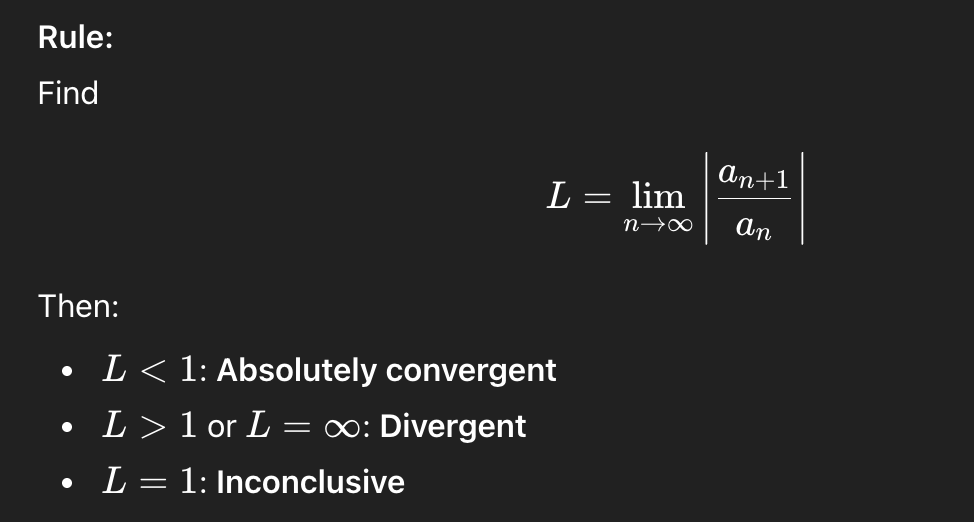
Ratio Test
Purpose:
Used when factorials or exponentials appear.
Applies to:
→ ∑an\sum a_n∑an (terms can be positive or alternating).
Rule:
Check image
Typical Use:
Factorials, powers of constants, exponentials, or any time growth rates compete.