Physics Definitions (Leaving Cert)
 Call Kai
 Learn
Learn Practice Test
 Spaced Repetition
 Match
Match Flashcards
 Knowt Play
1/204

There's no tags or description
Looks like no tags are added yet.
Name | Mastery | Learn | Test | Matching | Spaced | Call with Kai |
|---|
No analytics yet
Send a link to your students to track their progress
205 Terms
Self luminous object
An object that gives out it's own light
Non luminous object
An object that does not give out it's own light.
First law of Reflection
The incident ray, the normal, and the reflected ray are all in the same plane.
Second Law of Reflection
The angle of incidence is equal to the angle of reflection. I.e i = r
First Law of Refraction
The incident ray, the normal and the refracted ray are all on the same plane.
The Second Law of Refraction
The sine of the angle of incidence is proportional to the sine of the angle of refraction. This can be represented mathematically by sin i / sin r = n , where n is a constant.
Principle of Reversibility of Light
Light travels along exactly the same path, if it's direction is reversed; it just goes in the opposite direction.
Light
Is a form of energy that travels away from the source producing it at the speed of about 3x10^8 m s^-1.
Diffuse Reflection
If the surface on which the light shines is rough, the reflected light is scattered in all directions.
Regular Reflection
Is the bouncing of light off an object that is silvered and polished, called a mirror, or a shiny flat surface.
Angle of Incidence
The angle between the incident Ray and the normal.
Angle of Reflection
The angle between the reflected ray and the normal.
Angle of Refraction
The angle between the refracted Ray and the normal.
Refractive Index
The ratio of the sine of the angle of incidence to the sine of the angle of refraction.
Centre of Curvature
The centre of the sphere or circle which a mirror would be part of.
Pole
The centre point of a mirror or lens.
Radius of Curvature
The radius of the sphere or circle which a mirror would be part of.
Principle Axis
The line which passes through the centre of curvature and the pole.
Principle Focus
The point on the principle axis through which all rays traveling parallel to the principle axis are reflected or refracted.
Focal Length
The distance between the principle focus and the pole.
Real Image
An image formed by rays which actually pass through the image. Such an image would form on a screen.
Virtual Image
An image formed by rays which do not actually pass through the image; they only appear to do so.
Parallax
Is the apparent movement of one object relative to the another due to the motion of the observer. the object that is farthest away appears to move with the observer.
Magnification
The ratio of the image height to to the object height. I.e the height of the image divided by the height of the object.
Refraction
The bending of a light ray (or a wave) which occurs when it passes from one medium to another of different density or refractive index.
Critical Angle
When light travels from a denser to a rarer medium, the angle of incidence whose corresponding angle of refraction is 90° is called the critical angle for those two media.
Total Internal Reflection
The reflection of all light, incident at a surface, back into the denser medium due to the critical angle being exceeded.
Optical Fibre
A fibre consisting of a very fine solid strand of high quality glass coated with a film of another glass of lower refractive index. Light is transmitted along it with no loss through the walls, due to total internal reflection occurring at the walls.
Power of Accommodation
The ability of the eye to change the focal length of its lens and so form a sharp image on the retina for objects at different distances. This can be represented mathematically as p = 1 / f , where p is power and f is the focal length.
Short Sightedness
A defect of vision in which the sufferer can successfully accommodate objects a short distance from the eye but not ones far off. (Can be thought as due to the eyeball being too long).
Long Sightedness
A defect of vision in which the sufferer can successfully accommodate objects a long way from the eye but not ones close by. (Can be thought of the eyeball being too short).
Speed
Is the rate of change of distance with respect to time.
Displacement
Is distance in a given direction.
Velocity
Is the rate of change of displacement with respect to time.
Constant Velocity
Is when an object moves in a straight line and does not speed up or slow down.
Acceleration
Is the rate of change of velocity with respect to time.
Scalar Quantity
A quantity that has magnitude only and has no direction in space.
Vector Quantity
A quantity that has both magnitude and direction in space.
Force
Is anything that causes or tends to cause the velocity of an object to change.
Mass
Of a body is a measure of how difficult it is to accelerate that body.
Weight
The weight of an object is the force of the Earth's gravity acting on it. i.e. W =mg
Momentum
Mass x Velocity
Newton's First Law of Motion
States that every body will remain in a state of rest or traveling with constant velocity unless an unbalanced external force acts on it.
Newton's Second Law of Motion
States that when an unbalanced force acts on a body the rate of change of the body's momentum is directly proportional to the force and takes place in the direction of the force.
Newton's Third Law of Motion
States that if body A exerts a force on body B, the body B exerts an equal but opposite force on body A.
The principle/Law of conservation of momentum
In any reaction between bodies in a closed system, the total momentum before the interaction is equal to the total momentum after the interaction.
Density
of an substance is its mass per unit volume. This can be represented mathematically by:
Density=mass/volume (kg m-3)
Pressure
Force per unit area.
Force / Area
Unit of pressure
The pressure is one pascal if a force of 1 N acts over an area of 1 m^2
Archimedes' Principle
When a body is partially of completely immersed in fluid, the upthrust is equal in magnitude to the weight of fluid displaced.
The law of Flotation
States that the weight of a floating body is equal to the weight of the fluid it displaces.
Boyle's Law
States that at a constant temperature the volume of a fixed mass of gas is inversely proportional to its pressure.
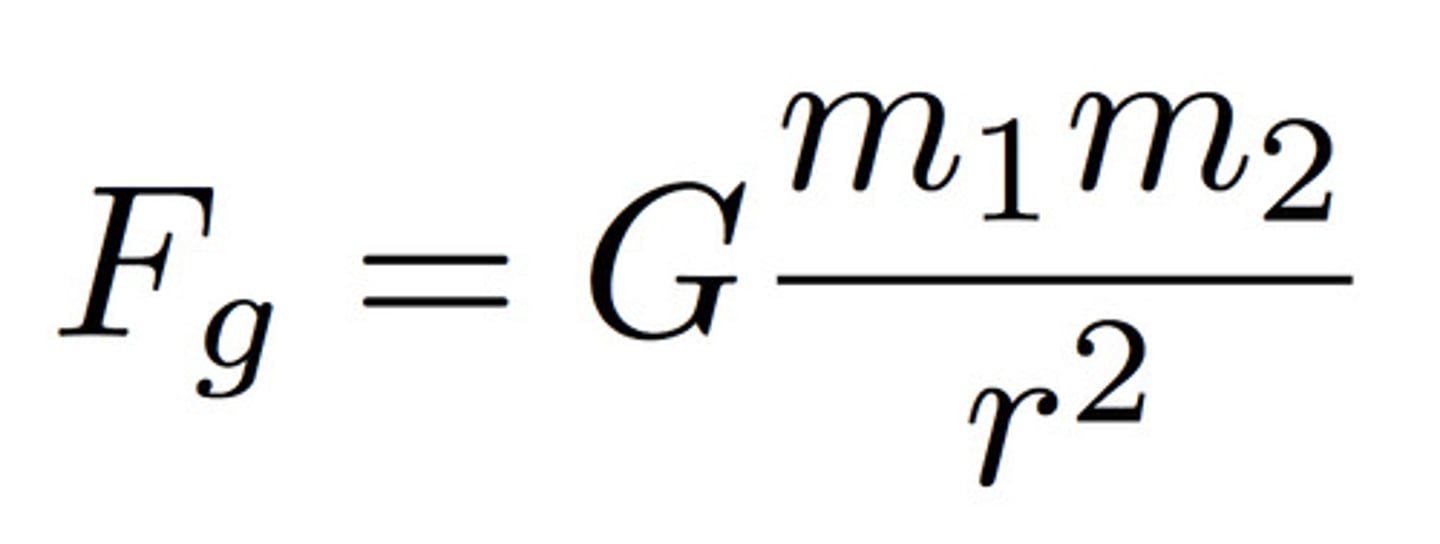
Newton's Law of Universal Gravitation
States that any two point masses in the universe attract each other with a force that is directly proportional to the product of their masses and inversely proportional to the square of the distance between them.
The moment of a Force
the moment of a force, about an axis, is the product of the force times the perpendicular distance between the axis and the line of action of the force.
Conditions for equalibrium
-When a body is in equilibrium, the sum of all forces acting on it is zero.
-The sum of the clockwise moments about any axis is equal to the sum of the anticlockwise moments.
Couple / Torque
Two parallel forces with the same magnitude acting in opposite direction.
Work
Work is done when a force moves a body. The amount of work done is equal to the product of the force times the distance moved in the direction of a force.
The joule
One joule is the work done when a force of 1 Newton acts for a distance of 1 metre in the direction of the force.
Energy
Is the ability to do work. The amount of energy something has is the amount of work it can do.
Principle of Conservation of energy
States that energy cannot be created or destroyed but can only be converted from one form to another.
Kinetic Energy
Of a body is the energy that body has due to motion.
Potential Energy
Of a body is the energy it has due to its position or condition in a force field.
Renewable source of energy
A source of energy that does not get used up.
Power
Is the rate at which work is done.
Unit of power
The power is one watt if work is being done or energy is being converted at a rate of one joule per second.
Angular velocity
Is the rate of change of angle with respect to time
Unit of angular velocity
radian per second
Centripetal Force
Any force that causes a body to move in a circular path. The force constantly acts at right angles to the direction of the body's velocity.
Centripetal acceleration
Its the acceleration a body has towards the center of the circle if that body is moving in a circle.
Period of an orbit
The time taken for a satellite to go once around the central body is called the periodic time or simply the period (T) of the orbit.
Hooke's Law
States that when an object is bent, stretched or compressed by a displacement s, the restoring force F is directly proportional to the displacement - provide the elastic limit is not exceeded.
A body is moving in simple harmonic motion if
1. its acceleration is directly proportional to its distance from a fixed point on its path.
2. and its acceleration is always directed towards that point.
Periodic time (T)
of a particle executing simple harmonic motion is the time for one complete oscillation. T is measured in seconds.
Frequency (f)
Is the number of cycles per second. It is measure in cycles per second - Hertz (Hz).
Temperature
is the measure of the hotness or coldness of a body.
Thermometric Property
is any physical property that changes measurably and uniformly with temperature.
Heat capacity
Of an object is the heat energy needed to change the temperature of that object by 1kelvin
Specific Heat capacity
Of an object is the heat energy need to change the temperature of 1kg of that substance by 1kelvin
Latent heat
Of an object is the heat energy needed to change its state without a change in temperature.
Specific latent heat
Of a substance is the amount of heat energy needed to change the state of 1 kg of that substance without a change in temperature
Specific latent heat of fusion
Is the amount of heat energy needed to change 1kg of a substance from a solid to liquid without a change in temperature
Specific latent heat of vaporisation
Of a substance is the amount of heat energy needed to change 1kg of that substance from a liquid to a gas without a change in temperature
Conduction
Is the movement of heat energy through a substance by the passing of vibrating molecules. There is no overall motion of the substance.
Radiation
Is the transfer of heat energy from one place to another in the form of electromagnetic waves.
Convection
Is the transfer of heat through a fluid by means of circulating currents of fluid cause by heat
U-value
Of a structure is the amount of heat energy conducted per second through 1 metre squared of that structure when a temperature difference of 1 degrees Celsius is maintained between its ends.
Solar constant
The average amount of the sun's energy falling per second perpendicularly on 1 metre squared of the the Earth's atmosphere is the solar constant.
Traveling Mechanical wave
Is a disturbance carrying energy through a medium without any overall motion of that medium
Traveling wave
Either mechanical or electromagnetic, is a disturbance that travels out from the source producing it , transferring the energy from the source to other places through which it passes
Transverse wave
Is a wave where the direction of the vibration is perpendicular to the direction in which the wave travels
Longitudinal wave
Is a wave where the direction of vibration is parallel to the direction in which the wave travels
Amplitude
The maximum distance of any particle from its undisturbed position
Oscillation or cycle
The distance produced by one complete vibration of the source
Wavelength
The distance from any point on one cycle to the corresponding point on the next cycle
Frequency
The number of cycles per second. The unit of frequency is the hertz
Velocity (c)
Is the distance traveled by one cycle in one second.
Reflection of waves
Is the bouncing of waves off of an obstacle in their path
Refraction of waves
Is the changing of direction of a wave when it enters a region where it's speed changes
Diffraction
The sideways spreading of waves into the region beyond a gap or around an obstacle
Interference
Is when waves from two sources meet, a new wave is produced. The displacement produced at any point by this wave is the algebraic sum of the displacements that each wave would produce on its own.