11 Bio - Mod 2 (2)
 Call Kai
 Learn
Learn Practice Test
 Spaced Repetition
 Match
Match Flashcards
 Knowt Play
1/25

Earn XP
Description and Tags
Nutrient & Gas Requirements
Name | Mastery | Learn | Test | Matching | Spaced | Call with Kai |
|---|
No analytics yet
Send a link to your students to track their progress
26 Terms
Autotrophs
Produce their own organic substances and need to obtain water, minerals, gases and oxygen from external sources.
E.g plants, algae and photoplankton.
Water movement (P)
Water moves into the roots of plants by osmosis.
Mineral ions move into the roots by diffusion.
If the movement of diffusion is too slow or the concentration gradient is not high or steep enough, facilitated diffusion and active transport get involved.
Heterotrophs
Organism that cannot produce its own food.
Gains energy from consuming other organisms.
e.g humans, dogs, cows
Absorbing sunlight (P)
Leaves absorb sunlight and carbon dioxide, producing glucose (organic compound) through photosynthesis.
Transpiration occurs when water evaporates from the leaves, aiding the movement of water from the roots to the leaves in the xylem.
Leaves absorb the maximum amount of sunlight to provide energy to break the bonds of water molecules to generate chemical energy.
The large surface area allows for the absorption of light energy by the chlorophyll inside the chloroplast in the leaves.
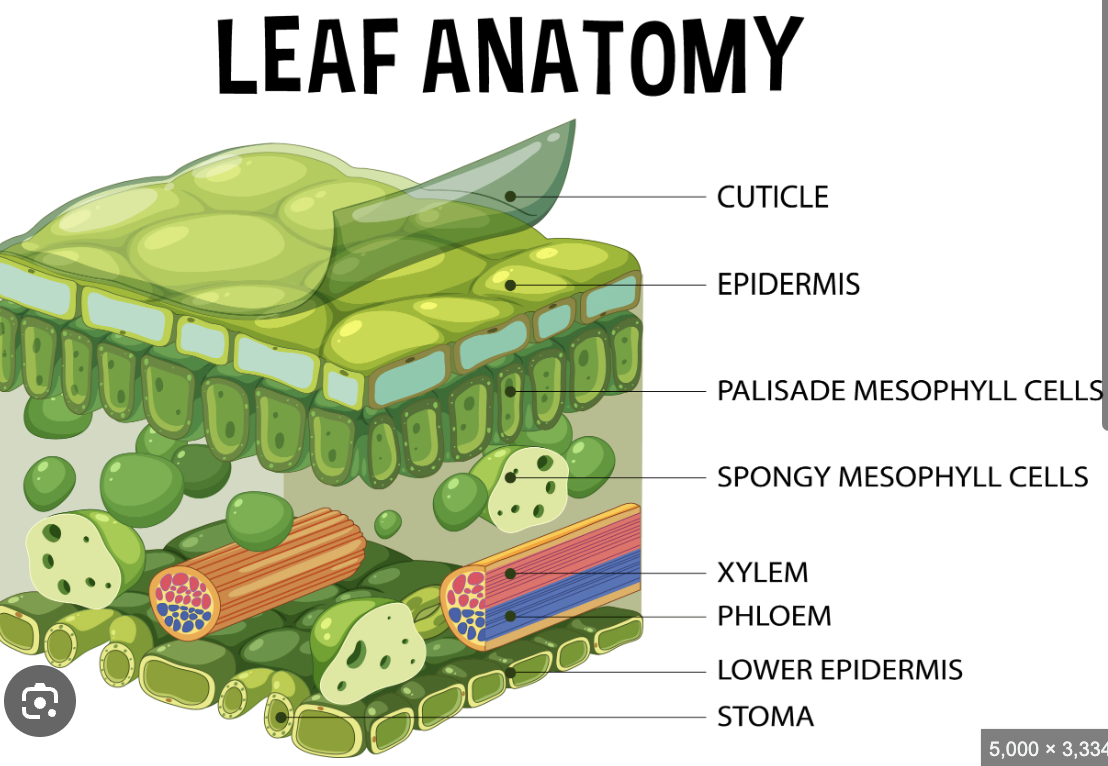
The outermost layer is the epidermis, which is transparent allows the sun to penetrate.
The mesophyll is the middle layers of the leaf which consists of two cell types.
Palisade layer - elongated, dense with chloroplasts, main photosynthetic cell, situated immediately under the epidermis so it is exposed to the maximum amount of sunlight.
Spongy mesophyll layer - situated between the palisade cells and lower epidermis, irregular in distribution to allow efficient gas exchange.
Cells within the roots cannot photosynthesis as they do not contain chloroplast and are not exposed to the sunlight.
They take part in aerobic cellular respiration which is when they use the glucose produced through photosynthesis and oxygen to create ATP, with carbon dioxide and water produced as waste products (opposite of photosynthesis).
Gas exchange (P)
The epidermis is a flattened layer of cells on the top and bottom surface of leaves that protect the inner tissue and secrete a waterproof cuticle (on top) to ensure the evaporation of water from the surface of leaves.
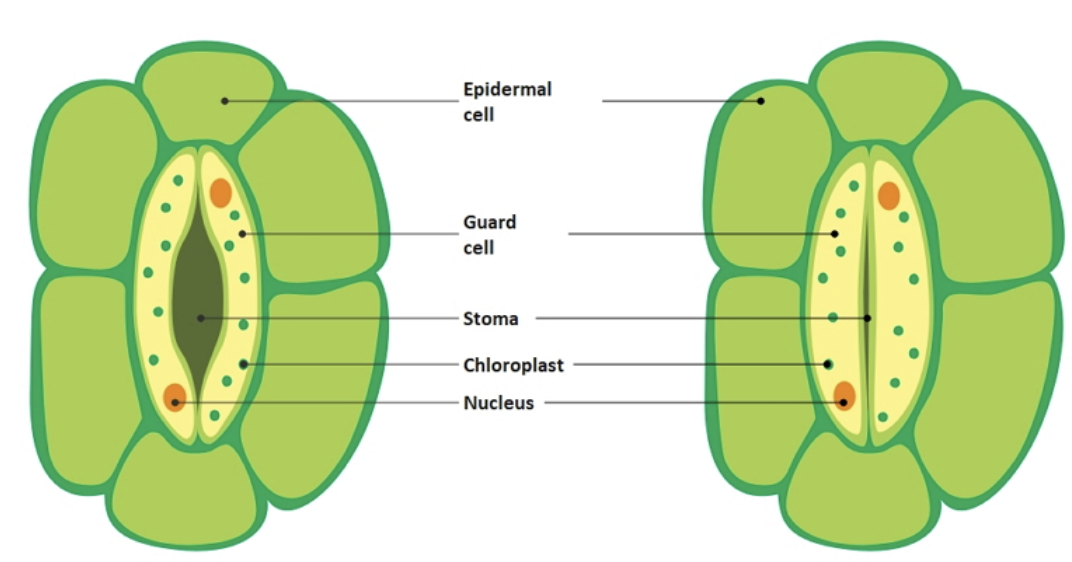
The guard cells in the epidermis control the exchange of gases and the loss of water through leaves. They are bean-shaped and occur in pairs surrounding a stoma (pore).
The stomata are pores found on the undersurface of leaves.
Stomata can open and close to allow gas to exchange without losing too much water.
When stomata are open the gases are able to diffuse. When the guard cells fill with water and become turgid, the outer wall stretches, but the inner walls do not bulge so they are pulled apart and the pore widens.
The main factor of stomata opening and closing is light.
When the temperature increases, more water is lost. Additionally, when water availability is decreased, photosynthesis is limited and the concentration of carbon dioxide inside the plant decreases, causing the stomata to close to restrict the access of carbon dioxide and vice versa.
The arrangement of stomata depends on the environment of the plant. e.g Australian plants have leaves that hang vertically to maximise surface area so that the stomata are exposed on both sides.
Transport (P)
The vascular tissue in the centre of the root is continuous, it passes up the stem and into the leaves like ‘veins’ and is the main transport tissue.
The main vein is called the midrib and the smaller veins branch out from it.
These veins contain xylem and phloem tissue.
Cellular respiration (P)
The oxygen required for cellular respiration (during the night + day) comes from the oxygen produced by photosynthesis during the day, which occurs at a greater than respiration during the day.
Any oxygen not used during cellular respiration is released into the outer environment.
The carbon dioxide released as a result of cellular respiration is used as a reactant in photosynthesis.
When the photosynthesis rate is high, the supply of carbon dioxide is insufficient so it is absorbed from the air.
Imaging technology (P)
A 3D image of a plant can be produced by a digital camera. These photos are combined to produce a 3D image of the plant. Measurements are made and the external structure can be studied using this. MRI (magnetic resonance imaging) uses radio waves and a magnetic field to produce a series of images of the plant structure. These images can be combined with images produced by other technologies like PET (positron emission tomography) or (NT) neutron tomography to provide greater detail and functional information. X-ray computed microtomography is another emerging technology which is used for information on the internal structure of plants.
Lenticels (P)
These are pores through which gaseous exchange occurs in the woody part of plants such as trunks and branches.
They appear as small dots but are a cluster of loose cells.
The diffusion of gases through lenticels is relatively slow when compared to stomata.
Gas exchange (A)
Gaseous exchange in animals occurs by the movement of gases by diffusion across cell membranes. Oxygen is essential for cellular respiration to release energy from nutrients consumed, as a result carbon dioxide is produced and removed. A high concentration of carbon dioxide is toxic, changing the pH of cells and interfering with enzyme function. All respiratory organs have a large surface area enhanced by folding, branching or flattening depending on the organism, allowing for a faster rate of diffusion. They have moist surface to allow gases to dissolve easier and a thin distance they have to travel, they are also in close proximity to a transport system which takes the gases to and from all the cells in the body. They also have a greater concentration of the required gas on one side of the membrane to maintain a concentration gradient. The respiratory system enable gas exchange, however different animals have varying respiratory organs. e.g fish - gils, mammals - lungs and insects - tracheal system.
Gas exchange (A) - mammals
The gaseous exchange in mammals occurs in the lungs, alveoli are thin-walled air sacs which are connected to the external environment via airways, each surrounded by tiny, thin-walled blood vessels known as capillaries.
Alveoli (A)
An increased surface area for efficient gas exchange is achieved as thin interior lining of the alveoli is made of a single layer of flattened cells, providing a small distance for diffusion. The surface of the respiratory system is moist and the air inside the alveoli is saturated with water vapour. A mucus-lined epithelium (tissue lining the inner surface) reduces the evaporation of water and ensures that the carbon dioxide and oxygen diffusing across are in dissolved form (physically in the mixture of fluid lining the alveoli), increasing the diffusion rate. The capillaries surrounding the alveolus ensure that they are in close contact with the blood stream. Oxygen in the incoming alveolus air (the air breathed in) is higher in concentration that the bloodstream. Carbon dioxide is higher in concentration in the bloodstream so it diffuses along the concentration gradient from the capillaries into the alveolus air and is, from there, exhaled.
Respiratory systems in other animals (A)
Some animals have other structures which assist with gas exchange. Fish - Gases have a low solubility in water so the concentration is lower, gills can extract the maximum possible amount of oxygen from the water, require water flowing over them, water flows in one direction, when the fish opens its mouth the water enters and leaves through the gills, as water flows over gas exchange occurs. Insects - take in and expel air through spiracles (breathing pores), to ensure these are not continually exposed to the dry effects of the atmosphere they have valves to regulate opening and closing, they do not have lungs or capillaries as they are small organisms, they have branching air tubes known as tracheal tubes which carry air directly to cells, they are kept open by spiral rings, they branch into smaller tubules called tracheoles creating a large surface area, the ends are filled with a fluid in which the gases dissolve, the number of open or closed spiracles determines the rate of respiration.
Digestion (A)
Heterotrophs are living things that are required to eat their nutrients to supply energy and organic compounds. Complex foods are ingested and are broken down by the digestive system into simpler molecules which can be absorbed into the bloodstream. When large/complex food particles are broken down into smaller particles. There are two types of digestion: mechanical and chemical.
Mechanical digestion (A)
Physical breakdown of food. This begins in the mouth when the teeth break down food by cutting and grinding the food. The churning motion of the stomach (muscular layers twist and contract) continues this process, breaking the food into smaller particles which can be acted on by enzymes in chemical digestion as the surface area is increased.
Chemical digestion (A)
The process of digestive enzymes chemically breaking down larger substances into simpler forms. The simple substances obtained by breaking down foods are: glucose from complex carbohydrates, amino acids from proteins, glycerol and fatty acids from lipids and nucleotides from nucleic acids.
Pathway of digestion - (mouth) (A)
Mechanical digestion begins the process. Teeth break down the food into smaller pieces with greater surface area so the enzymes are more efficient. Salivary amylase is released into the mouth and mixed with food by the tongue. The enzyme begins the chemical breakdown of the complex carbohydrate starch into a simpler sugar maltose. Once the food is chewed and mixed with saliva the tongue forms it into a small ball shape called the bolus and sends it down the oesophagus.
Pathway of digestion - (oesophagus) (A)
Once the bolus enters the oesophagus, it travels along the soft walls, passes the entrance to the trachea which is covered by a flap of skin, epiglottis, which closes the entrance to prevent the entry of food to the respiratory system. The bolus moves down the oesophagus due to the muscular contractions, the chemical digestion of starch continues during this movement.
Pathway of digestion - (stomach) (A)
The entry and exit of the stomach are narrow openings controlled by circular sphincter muscles, which control the movement of substances in and out of the stomach. Once inside, relaxation and contraction of the stomach muscles continue mechanical digestion. The bolus breaks down and combines with the gastric juices inside the stomach, creating a mixture called chyme. Gastric juices are secreted from the walls of the stomach, containing water, hydrochloric acid, pepsinogen and pepsin. The acid makes the pH 2-3, mucus lining the stomach prevents the acids from ‘eating away’ at the stomach walls. The enzyme pepsinogen converts into the active form called pepsin in the acidic environment and begins the chemical breakdown of the long-chained proteins into polypeptides, also breaking down nucleic acids into their nucleotides. The chyme stays in the stomach for around 6 hours.
Pathway of digestion - (small intestine) (A)
The chyme from the stomach enters the small intestine through a small muscular opening the pyloric sphincter. The small intestine is around 7m long in an adult and is in three main regions: duodenum (at the start), jejunum (middle), and ileum (end). As the chyme enters the duodenum a hormone is released which stimulates the release of pancreatic juices. These are secreted by the pancreas and contain a mixture of amylase, trypsin (both continue the chemical breakdown of carbohydrates and proteins), lipase and bicarbonate ions (neutralises the acidic chyme). Bile is released where there a lipids, produced by the gall bladder, breaking down the fats into small pieces or fat droplets. This increase the surface area for the enzyme lipase to chemically break down the fats into fatty acid and glycerol molecules.
Pathway of digestion - (digestive tract) (A)
The absorption of substances occurs in the jejunum section of the small intestine. The products of digestion (amino acids, glycerol, fatty acids and glucose) move into the transport systems in the small intestine. They move by diffusion or active transport through tiny projections called villi, lining the intestinal wall. These increase the surface area, are moist and are one cell thick. They have a high blood supply as they contain capillaries which are wrapped around a lacteal (lymphatic capillaries which specialise in absorbing fats from digested food) which are connected to another transporting system, the lymph system.
Pathway of digestion - (pancreas) A
The pancreas produces pancreatic juices which is a fluid that contains water, electrolytes and enzymes and delivers this to the small intestine. This fluid neutralises the stomach acid and breaks down carbohydrates, fats and proteins into absorbable nutrients. Protease (breaks down proteins into amino acids), lipase (breaks down fats into fatty acids) and amylase (breaks down complicated carbohydrates into simple sugars) are enzymes produced by the pancreas. The enzymes and bicarbonate travel via the common bile duct in the gall bladder and empty into the duodenum in the small intestine.
Pathway of digestion - (gall bladder) A
Stores bile from the liver, releasing it into the small intestine to break down fatty foods into small pieces or fat droplets, known as emulsification. Emulsification increases the surface area of the fat droplets, allowing the digestive enzyme from the pancreas (lipase) to easily break down these molecules into fatty acids or energy. The liver continuously produces bile which moves into the gall bladder, the muscular contractions of the gall bladder release the bile through the common bile duct, into the duodenum.
Pathway of digestion - (liver) (A)
Once the digestive food is absorbed into the bloodstream it travels towards the liver. It ensures that sugar, glucose, glycogen and proteins levels are all balanced. This is where the blood is detoxified and the centre of food metabolism.
Pathway of digestion - (large intestine) (A)
When all digestive products have been absorbed in the small intestine the remaining undigested material moves towards the large intestine. These consist of water, salt and dietary fibre. It has two main sections: Colon - the water and some salts are absorbed into the bloodstream, vitamin A + K are produced by the bacteria in the colon, they act on the undigested matter and are then also absorbed into the blood. Rectum - the remaining waste (faeces) moves into the rectum by peristalsis, is then eliminated from the body through the anus.
Pathway of digestion - (digestive products) (A)
The end products of digestion can be used as either new biological material or an energy source. The products are transported to areas in the body that require them. e.g Lipids can be used to form cell membranes, proteins fibres can be used for muscle tissue. Fat can be used as an energy storage in the liver and the muscles.