Psychology
 Call Kai
 Learn
Learn Practice Test
 Spaced Repetition
 Match
Match Flashcards
 Knowt Play
1/28

There's no tags or description
Looks like no tags are added yet.
Name | Mastery | Learn | Test | Matching | Spaced | Call with Kai |
|---|
No analytics yet
Send a link to your students to track their progress
29 Terms
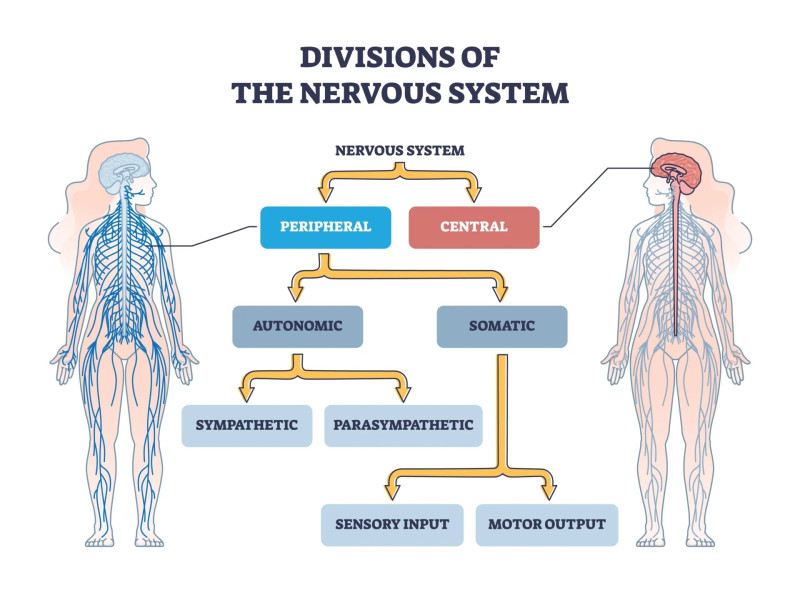
Divisions of the Nervous System
What is heredity
The genetic traits you inherit from your parents. (eg. temperament, physical traits, intelligence potential,
What is heritability
The proportion of variation in a trait within a population that is due to genetic differences. (Think of 4 boys in the 4 barrels).
What is the central nervous system comprised of?
The brain and spinal cord
What are the basic functions of the brain?
Interprets sensory input, initiates voluntary movement, handles thinking, memory, emotions and consciousness.
What are the basic functions of the spinal cord?
Carries sensory information up to the brain, carries motor commands down to the body, controls simple reflexes.
What is the peripheral nervous system comprised of?
All the nerves outside outside the brain and spinal chord.
What are the two divisions of the peripheral nervous system?
Somatic nervous system and autonomic nervous system.
What is the peripheral nervous system’s job?
Its job is to bring information up to the central nervous system and carry motor instructions from the central nervous system down to the body.
What does the somatic nervous system responsible for?
The somatic nervous system controls voluntary actions. It carries sensory information from skin, muscles, and joints to CNS, and sends motor commands from CNS to skeletal muscles.
What does the autonomic nervous system control?
The autonomic nervous system controls involuntary processes like heart rate, digestion, breathing rate, glands, and pupils.
What are the two opposing divisions of the autonomic nervous system?
The sympathetic nervous system and the parasympathetic nervous sysem
What is the purpose of the sympathetic nervous system?
The sympathetic division, also known as the fight or flight system, prepares the body for action. Effects activated during stress, fear, or excitement include increased heart rate, dilated pupils, slowed digestion, triggered adrenal glands, and released glucose for energy.
What is the purpose of the parasympathetic nervous system?
The parasympathetic division, also known as the “rest or digest” system calms the body and restores the balance. Effects include slowed heart rate, constrict pupils, restored digestion, and conserved energy.
What is the goal of both the sympathetic and parasympathetic nervous system?
To work together to restore and maintain homeostasis, your body’s internal balance.
What are the two major cell types in the nervous system?
Neurons and glial cells
What is the purpose of neurons?
To transmit information by using electrical impulses and chemical messengers.
What is the purpose of glial cells?
They support neuron by providing structure, forming myelin (insulation on axons), maintaining homeostasis, and removing waste. Although glial cells do not send action potentials, without them neural communication would break down.
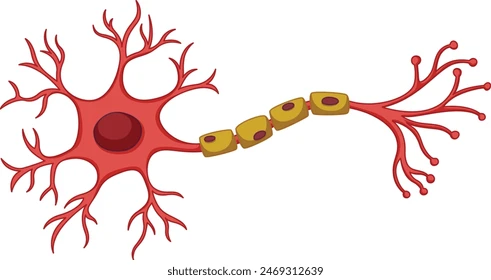
Label the diagram
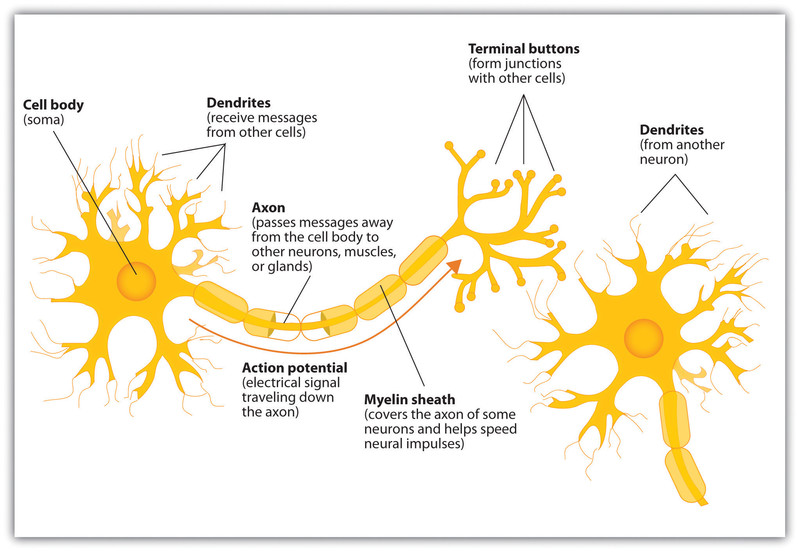
Explain the roles of each part of a neuron duing
The dendrites receive incoming signals
Cell body (soma) integrates information
Axon carries the electrical impulse away from the soma
Myelin sheath speeds transmission
Axon terminals release neurotransmitters into the synapse
What is the electrical process within one neuron during neural firing?
Resting potential: The neuron is polarized. Inside is negatively charged compared to the outside, it is ready to fire.
Threshold: The minimum level of stimulation required to trigger an impulse.
Action potential: Once threshold is reached, an electrical impulse travels down the axon.
Depolarization: Positive charge rushes in and briefly flips the charge.
Refractory period: The neuron resets and cannot fire again immediately.
What is the all-or-none principle?
The concept that if the threshold is reached, the neuron fires fully. If not, it does not fire at all. There is no partial action potential
What is the process of chemical communications between neurons?
The action potential reaches axon terminals.
Neurotransmitters are released into the synapse.
They bind to receptors on the next neuron.
Reuptake reabsorbs leftover neurotransmitter.
What diseases occur when the process of neural chemical communications break down?
Multiple sclerosis, where damage to the myelin slows signals and myasthenia gravis, where the immune system blocks acetycholine receptors, causing muscle weakness.
What are the three types of neurons and their responsibilities?
Sensory neurons: Carry information from senses to CNS
Interneurons: Process information in brain/spinal chord
Motor neurons: Sends commands to muscles or glands
What is the reflex arc in the example of touching a hot stove?
Sensory neuron detects heat
Signal travels to spinal chord
Interneuron processes
Motor neuron activates muscles
What are the two types of neurotransmitters and their role?
Neurotransmitters can be either excitatory (increase likelihood of firing) or inhibitory (decrease likelihood).
Explain the purpose of dopamine and related issues